

Flood damage does not automatically qualify for payment under a store’s commercial property policy. For a Belleville, NJ, retail store flood claim, coverage generally depends on whether the business has separate flood insurance and what that policy covers. Many standard commercial property policies exclude flood damage.
That distinction matters when water damages inventory, fixtures, equipment, or the building itself, especially near the Passaic River. Learn how commercial and flood coverage may apply, which exclusions can affect a claim, and what to document before removing damaged property. This article also explains how public adjuster support can help organize a retail property claim, from recording damage to preparing a comprehensive claim for the insurer.
Key Takeaways
- Review the policy’s flood exclusions and covered-property terms to understand which building components, inventory, and equipment may qualify.
- Photograph damaged stock and fixtures, keep inventory and sales records, and save receipts for necessary temporary repairs.
- Separate river overflow or heavy-rain flooding from internal water damage, since the cause can affect which coverage applies.
- Retail claims can involve leased-space improvements, shared building areas, and business income provisions, so document how the loss affects each.
- Public adjuster support can help organize damage evidence and prepare a comprehensive claim for the insurer.
When Will a Commercial Insurance Policy Cover Flood Damage?
A commercial policy may cover flood damage if the business has flood coverage that applies to the damaged property. Many standard commercial property policies exclude flood damage, so identify the water source and review the relevant policy terms.
Identifying the Flooding Cause
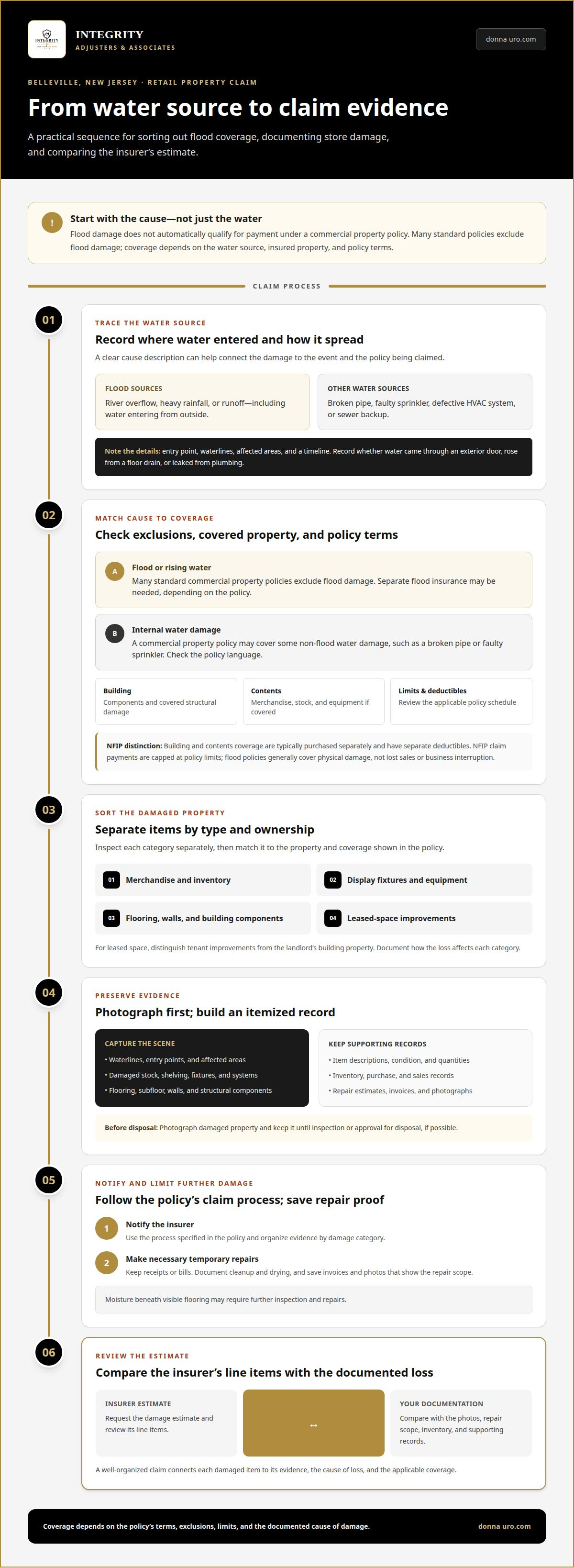
Start by recording where water entered the Belleville store and how it spread. River overflow, heavy rainfall, and runoff can cause flooding. A broken pipe, faulty sprinkler, defective HVAC system, or sewer backup has a different source. The distinction matters because commercial property policies may cover some internal water damage, while flood losses may require separate coverage.
Photograph waterlines, entry points, and affected areas before cleanup changes the scene. Note whether water came through an exterior door, rose from a floor drain, or leaked from plumbing. A clear timeline and description of the cause can help connect each damaged item to the event and the policy being claimed.
Assessing Merchandise and Property Damage
Inspect merchandise, inventory, display fixtures, and building components separately. For example, record wet cartons by product type and quantity, then photograph damaged shelving, flooring, and electrical or plumbing systems. Commercial flood coverage may apply to a store’s building and covered contents, subject to the policy’s terms and limits.
Coverage depends on what the policy insures. Create an inventory with item descriptions, condition, and supporting purchase or sales records. Photograph damaged property before discarding it, and keep it until inspection or approval for disposal if possible.
Check the insurance policy for separate building and contents coverage, limits, and deductibles. NFIP building and contents coverage are typically purchased separately and have separate deductibles. Most NFIP policies have a 30-day waiting period before coverage takes effect, according to the Federal Emergency Management Agency. That timing can matter when a store’s policy was recently purchased.
For water damage, document the repair scope from cleanup through drying. Save invoices and photographs showing affected flooring, subfloor, walls, and structural components. Moisture beneath visible flooring may require further inspection and repairs. A commercial property policy may cover internal water events such as broken pipes, while flood exclusions can limit recovery for rising or overflowing water.
Keep premium information in context: annual NFIP premium increases for primary residences are capped at 18%, according to the Federal Emergency Management Agency. That cap concerns primary residences, not retail-store claim coverage. For a Belleville store, the central questions remain the water source, covered property, applicable limits, and evidence supporting each claimed loss.
Other possible sources include faulty sprinkler systems, defective HVAC systems, and city water-main or sewer backups. A standard commercial policy may cover cleanup, subfloor replacement, mold prevention, and inventory losses from non-flood water damage.
Filing homeowners and commercial property insurance claims
Coverage depends on the water source, insured property, and policy terms. In New Jersey, businesses often need separate flood insurance because standard commercial property policies commonly exclude flood damage.
Flood Exclusions in Property Policies
Read the exclusions and definitions in the commercial property insurance policy. Look for how it treats river overflow, surface water, heavy rainfall, sewer backup, and accidental plumbing leaks. A policy may exclude flood damage while covering some losses from a burst pipe or faulty sprinkler system.
Homeowners’ and renters’ policies also exclude flood damage. For a Belleville shop, identify the source before grouping all water damage under one claim. A roof leak, plumbing failure, and river flooding can involve different coverage terms and evidence.
NFIP Coverage for Businesses
The federal National Flood Insurance Program offers commercial flood coverage for direct physical damage to a business building and covered belongings. Depending on the policy, eligible property can include merchandise held for sale, stock, equipment, and building components.
NFIP claim payments are capped at the policy limits. Flood policies generally cover physical damage, not lost sales or business interruption. Separate building and contents coverage may apply, so match each damaged item to the coverage shown in the policy schedule.
Factors That Affect Flood Insurance Pricing
Commercial flood insurance pricing can depend on the property’s location, flood exposure, elevation, building details, occupancy, and claims history. Selected limits and deductibles also matter. Available terms depend on the insurer and whether coverage comes through the NFIP or a private insurer.
For example, a retail property with ground-floor stock has a different exposure from one that stores inventory elsewhere. Compare the policy’s covered property and exclusions alongside its premium. A lower price alone does not show whether the limits fit the store’s building, stock, and equipment.
Filing a Commercial Property Claim
Notify the insurer using the process in the policy, then organize evidence by damage category. Photograph affected inventory, fixtures, equipment, and building areas. Keep purchase records, inventory lists, repair estimates, and sales documents that support the claimed loss.
Make necessary temporary repairs to prevent further damage, and save receipts or bills. Request the insurer’s damage estimate and compare its line items with the documented repair scope. If the loss affects leased space, identify tenant improvements and distinguish them from the landlord’s building property.
For a storefront with shared walls or systems, record which areas and equipment were affected. Keep claim forms, photographs, estimates, and insurer communications together. An organized file helps connect each requested repair or replacement to the cause of loss and applicable coverage.
Flood insurance claims near the Passaic River
A retail flood insurance claim near the Passaic River starts by connecting the water source, damaged property, and policy. River overflow, intense rainfall, and drainage problems can affect different parts of a Belleville storefront. Record where water entered, which rooms it reached, and whether neighboring or shared areas show similar damage. These details can help distinguish a localized building issue from water affecting several properties.
New Jersey businesses can obtain flood insurance through the National Flood Insurance Program or an insurer offering private flood coverage. NFIP insurance covers direct physical flood damage to a business building and covered belongings, subject to policy limits. Private commercial flood insurance may offer higher limits and more flexibility, depending on the insurer. Compare covered buildings, inventory, equipment, deductibles, and exclusions, not just the policy label.
Prepare a claim file that lets an insurance adjuster trace each loss to the flood event. Photograph waterlines, damaged stock, fixtures, and affected building systems. Make an inventory of damaged merchandise, noting descriptions, condition, and available purchase records. Keep repair estimates, sales or inventory records, and invoices together. For a Belleville NJ retail store flood claim, label evidence by location, such as “front entrance” or “rear stockroom.”
During an inspection, walk through the store with the insurance adjuster and identify damage by location. Point out visible water marks, damaged flooring, and equipment that stopped working after the flood. Share the timeline, photographs, and itemized inventory. Compare the adjuster’s estimate with the documented damage and repair scope. If an item or area appears to be missing, identify it clearly and provide related evidence in writing.
Some claims involve multiple tenants, shared systems, or a landlord’s building coverage. A store tenant should distinguish its inventory, business equipment, and improvements from common areas or building components. Keep copies of communications with the insurer and property owner. This record helps clarify which policy is being considered for each part of the loss and prevents unrelated damage from being grouped together.
If the insurer’s estimate or coverage decision leaves a dispute, first try to resolve the issue directly with the insurance company. Compare the written decision with the policy language, estimate, photographs, and repair documentation. New Jersey residents can contact the New Jersey Department of Banking and Insurance Consumer Hotline at 1-800-446-7467 from 8:30 am to 5:00 pm EST, Monday through Friday, about insurance claim disputes.
A public adjuster is optional, not a requirement for filing or resolving an insurance claim. Policyholders may use one to appraise property damage and negotiate a claim. For a Belleville NJ retail store flood claim, organized evidence remains central: preserve the estimate, note disputed line items, and connect each follow-up to a specific documented loss.
Public adjuster representation for retail property claims
A public adjuster represents the policyholder’s interests in documenting and presenting a property insurance claim. In New Jersey, public adjusters are licensed by the Department of Banking and Insurance and may appraise property damage and negotiate claims. For a retail loss, public adjuster support can help organize evidence across the storefront, sales floor, stockroom, and shared building areas.
An inspection should connect observed damage to the event and affected property. A public adjuster can inspect storefronts, interiors, roofs, and common areas. For example, the review may document water-damaged flooring, wet inventory, damaged furniture, and affected electrical or plumbing components. A photo log and room-by-room damage schedule make it easier to see what the estimate includes.
Retail losses often involve more than visible flood damage. Merchandise may be unsellable, fixtures may need repair, and water beneath flooring may affect the subfloor. The adjuster can organize these losses into distinct categories, then support them with photographs, inventory records, repair estimates, and other claim documentation. Seasonal stock or perishable goods need clear item descriptions and valuation records to explain the claimed loss.
That documentation matters when the insurer’s estimate leaves out a damaged area or assigns a different repair scope. Compare the estimate line by line with the inspection record. If it includes flooring but not the affected subfloor, identify the location and provide supporting photographs or repair findings. If it counts only part of the inventory, reconcile the estimate with stock records and item descriptions.
A retail claim can also involve tenant improvements, shared systems, and common areas. A public adjuster’s review should distinguish the store’s business personal property from building components or damage affecting other tenants. This helps clarify which items belong in the policyholder’s claim and which may relate to another property interest. Preserve those distinctions in the claim file rather than combining every loss into one unsupported total.
Representation has defined limits. A public adjuster appraises damage and negotiates an insurance claim. That role is separate from physical repairs and legal representation. New Jersey public adjuster contracts must list the services to be provided and the maximum fee, which must be reasonably related to services rendered and not excessive. Read the written scope so you understand what claim work is covered.
For a Belleville retail property loss, consider representation when damage spans inventory, fixtures, building areas, or multiple tenants, or when the insurer’s estimate needs a detailed comparison. A public adjuster is not required to file or resolve a claim. The practical takeaway is to keep control of the evidence: organize each damaged item, location, and estimate entry so the claim can be reviewed on its documented facts.
What caused the flooding at the Belleville, NJ retail store?
Flooding at a Belleville retail property can start with heavy rainfall, river overflow, runoff, or drainage failure. The Passaic River is one potential source, but a store’s location alone doesn’t establish how water entered. Severe storms brought almost 6 inches of rainfall to some areas of the region, showing how intense rain can contribute to flooding beyond riverbanks.
Trace the water’s route through the property. Water entering through a storefront door or parking area may point to surface runoff, while water rising through a floor drain suggests a drainage or sewer issue. A roof leak follows a different path. Record affected entrances, drains, walls, and floor levels to distinguish these possibilities.
River and creek overflow can push water onto nearby commercial land, while heavy rain can overwhelm local drainage. Parking lot runoff may collect near a low entrance and enter a ground-floor shop. New Jersey businesses outside traditionally high-risk flood zones may still face flooding from severe rainfall, runoff, and drainage problems.
To assess the cause, compare observations inside the store with conditions around the building. Note whether neighboring storefronts, shared corridors, or common areas also show water marks. If several units have damage at the same height, that pattern may help explain how water moved through the property. A single wet stockroom may point to a more localized entry route.
Build a time-ordered record while details remain clear. Write down when water was first noticed, where it appeared, and which areas became wet next. Photograph exterior water, drains, roof openings, and interior waterlines. Label images by location, such as “front entrance” or “rear stockroom,” so the sequence is easy to review.
Cause matters to a Belleville store’s insurance claim because policies may treat floodwater differently from internal plumbing damage. A broken pipe, faulty sprinkler, or defective HVAC system can raise a different coverage question than river overflow or surface water. Describe observed facts rather than guessing: identify the water source if visible, its path, and the property it reached.
Preserve records that help connect the event to the damage. Keep maintenance notes about drains or plumbing, photographs taken before cleanup, and repair findings that identify affected building areas. For example, a documented roof opening and water staining below it provide a different account from water entering through a ground-level door. A clear record of cause and location gives the claim a useful factual foundation.
New Jersey commercial properties may face flooding from inland rain, drainage failures, creek and river overflow, parking lot runoff, and storm surge. Weigh those possibilities against the water’s observed route and the property areas affected. Separating exterior entry from water appearing inside can help clarify which pathway fits the damage. If the source remains uncertain, preserve observations without assigning a cause; later repair findings can be compared with that record.
Integrity Adjusters & Associates: Residential Water Damage Claim Support
Integrity Adjusters & Associates helps policyholders document property damage and prepare a comprehensive claim for the insurer. For a retail store loss caused by storm damage, its Commercial Storm Damage Claim Support can help organize evidence of affected building areas, inventory, and fixtures. This support focuses on documenting losses and presenting the claim, not performing repairs.
Turn to this support when storm-related damage raises questions about what was affected or how to document it. For water damage at a residence, Integrity Adjusters & Associates also offers Residential Water Damage Claim Support. Contact Integrity Adjusters & Associates for a free claim review that costs you nothing and to discuss support for your property loss.
Move Your Claim Forward With a Clear Record
The next useful step is to turn the store’s damage record into a clear account of what happened and which property was affected. A Belleville NJ retail store flood claim may involve separate questions about building damage, business contents, and the water source. Keep those details organized so the insurer can consider each part under the applicable policy.
Integrity Adjusters & Associates helps policyholders document property losses and prepare claims for insurers. Its support includes Residential Water Damage Claim Support, Residential Storm Damage Claim Support, and Residential Fire Loss Claim Support. For a commercial property loss, the firm can help organize claim documentation and present a comprehensive account of the damage.
Coverage and claim outcomes depend on the policy terms and documented loss. For help organizing a property claim, contact Integrity Adjusters & Associates. A careful, well-supported next step can help you move forward with greater clarity.
Frequently Asked Questions
What insurance coverage applies to retail store flood damage in New Jersey?
Separate commercial flood insurance is generally needed because standard commercial property policies often exclude flood damage. Coverage depends on the policy and whether the claimant owns the building, leases the space, or insures business property. A store tenant may have coverage for its inventory, equipment, and certain improvements, while the building owner’s policy may address building components. Match each claimed item to the policy that insures it.
Did the flood cause the Belleville retail store to close or limit operations?
Flood damage alone does not establish whether a particular store closed or reduced operations. The practical impact depends on which areas and systems were affected. For example, water in a sales area may prevent customer access, while damage to stock or electrical systems can limit trading even if part of the store remains usable. Business owners can document closure periods, reduced sales, and affected operations for review under any applicable policy provisions.
What steps must a New Jersey business take to file a flood insurance claim?
First, identify the flood policy and the insured business or property owner. Notify the insurer through the policy’s claim process and record the claim reference and adjuster’s contact details. Keep a dated file of communications, invoices, inventory records, and repair estimates. If a landlord and tenant have separate policies, list which party owns each damaged item. Compare the insurer’s written estimate with the submitted documentation and flag any specific omissions.


