

The fire may be out long before the claim is settled. A Bloomfield NJ church fire insurance claim may resolve in weeks when the damage and paperwork are straightforward, while a large or disputed loss can take months. Incomplete documents can add delays, so the timeline depends in part on how thoroughly the damage and losses are documented.
That uncertainty is difficult when a congregation is also dealing with smoke, soot, and structural damage. Learn what can extend a claim, which delays deserve attention, and how to keep the claim record organized as the review progresses.
This article explains how fire damage can extend beyond visibly burned areas, what to document before cleanup, and how a public adjuster can review the loss and negotiate with the insurance carrier. The goal is to clarify the process and outline practical steps for protecting the church’s claim.
Key Takeaways
- Report the fire promptly and keep a clear record of the incident, insurer communications, and claim documents.
- Organize the loss by building repairs, damaged property, and any interruption-related expenses, then compare each category with the policy terms.
- Keep receipts and estimates together so repair needs and property losses are easier to review.
- Understand how policy limits, deductibles, and exclusions may affect the amount available for covered damage.
- When the carrier’s assessment leaves questions about the scope of damage, a public adjuster can review the claim documentation and negotiate on the policyholder’s behalf.
How long does a church insurance claim take - and when is a delay a red flag?
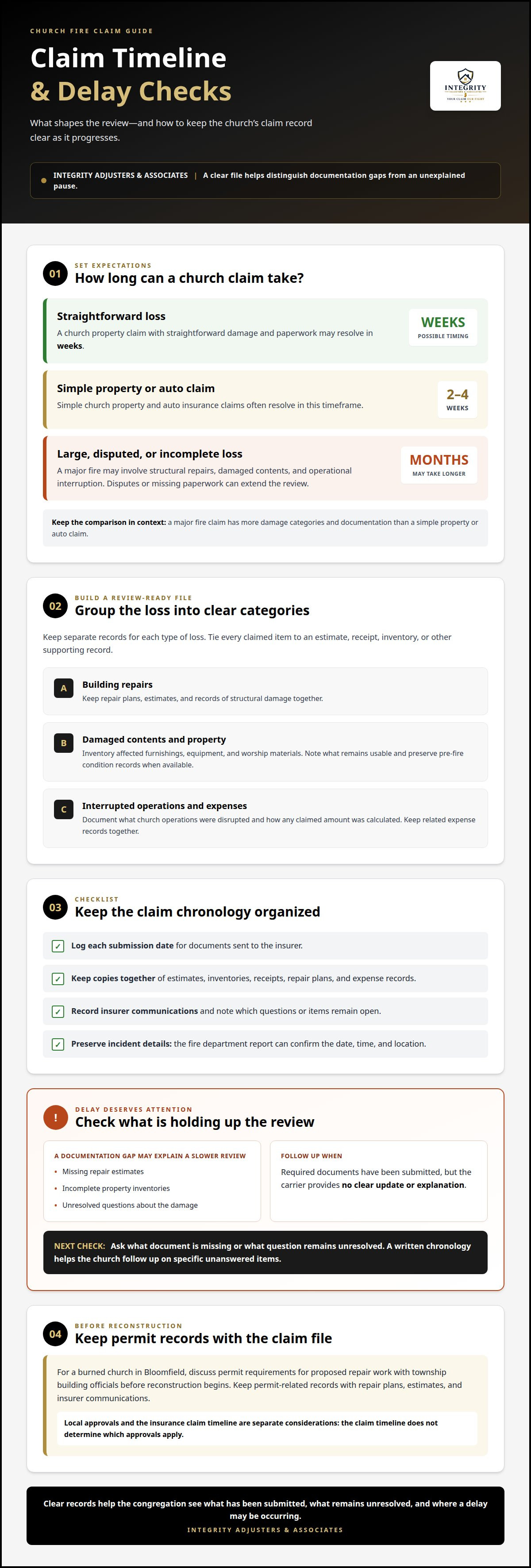
A straightforward church property claim can resolve in weeks. Large losses, disputes, or incomplete documents can extend the process to months. Simple church property and auto insurance claims often resolve in two to four weeks, but a major fire claim involves more damage categories and documentation. For a Bloomfield NJ church fire insurance claim, track every submission and response so you can understand the context of any delay.
For a burned church in Bloomfield, discuss permit requirements for the proposed repair work with township building officials before reconstruction begins. The claim timeline does not determine which local approvals apply. Keep permit-related records with repair plans, estimates, and insurer communications.
Compensation depends on the policy’s covered property and loss categories. Keep separate records for building repairs, damaged contents, and expenses tied to interrupted church operations. Connect each item to an estimate, receipt, inventory, or other supporting record. Lost income or operating losses require documentation showing what was disrupted and how the amount was calculated. This gives the carrier distinct items to review instead of one unsupported total.
Religious organizations should also document how the damage affects the property’s use. Note which rooms, equipment, or worship materials were affected, and preserve records showing their pre-fire condition when available. A detailed inventory helps distinguish damaged property from items that remain usable. The fire department report can confirm the incident’s date, time, and location.
- Record the date each claim document goes to the insurer.
- Keep copies of repair estimates, property inventories, and expense records.
- Ask for a clear explanation when a review stalls or a requested document is missing.
A delay deserves attention when required documents have been submitted but the carrier provides no clear update or explanation. Missing estimates, incomplete inventories, or unresolved questions about damage can explain a slower review. Distinguish those documentation gaps from periods without a response. A written chronology helps the church identify outstanding items and follow up on specific unanswered questions.
Property and auto claims follow different paths. Simple church property and auto claims can take two to four weeks, while a fire loss involving structural repairs, contents, and operational interruption can require a longer review. Compare the carrier’s assessment with the documented damage categories, not just the proposed total payment. Keep the claim file organized as the review proceeds. Clear records help the congregation understand whether the next step is supplying evidence, clarifying a disputed item, or following up on a delay.
Public adjuster claim review and carrier negotiation
A church’s claim file needs more than a damage estimate. A public adjuster can review documented losses, build a comprehensive claim, and negotiate with the carrier using evidence tied to the property damage.
Public Adjuster Claim Review
The review compares the church’s damage records with the carrier’s assessment. A public adjuster can organize evidence for affected structures, furnishings, and other property, then identify gaps requiring further documentation. For example, records for a damaged sanctuary and fellowship hall should distinguish building repairs from damaged contents. Church leaders should look for a clear, itemized connection between observed damage, supporting documents, and each claimed loss.
Carrier Negotiation
Negotiation focuses on documented differences between the church’s claim and the carrier’s position. The public adjuster can present evidence, explain disputed damage items, and respond to the insurer’s questions. Church leaders can follow progress by keeping written communications and noting which issues remain open. Many church property policies include an appraisal clause that can help resolve disputes about the amount of a loss. Its terms matter.
For religious institutions, a review should account for the property’s full use, not only visible damage in worship areas. A church may need to document damage to meeting spaces, furnishings, and other insured property. Policy documents, renewal notices, and insurer communications help establish coverage and claim history. The adjuster’s role is to assemble and present the loss; the policy remains the basis for evaluating coverage.
The carrier’s adjuster and a public adjuster serve different roles. Most church insurance carriers assign an adjuster within one to two business days. That assignment begins the carrier’s review, but it does not establish that every loss has been captured. A separate claim review can help the congregation assess whether the evaluation reflects documented property damage and whether any questions remain unanswered.
Useful records include:
- The policy and renewal notices relevant to the loss.
- Photos, inventories, estimates, and receipts tied to damaged property.
- Insurer letters and messages, arranged by date and issue.
- A list of disputed items with the evidence supporting each position.
Consider involving a public adjuster early when the church faces a substantial fire loss, complex damage records, or disagreement over the amount of damage. An early review can organize evidence before unresolved questions accumulate. A complete file also gives the congregation a practical way to track carrier requests, responses, and outstanding claim issues.
Church fire, smoke, soot, and structural damage claims
A church fire can damage more than the rooms touched by flames. Separate records for fire, smoke, soot, and structural impacts help show the full loss.
Fire Damage Claims
Document each visibly burned area before cleanup, once the property is safe to approach. Photograph rooms, fixtures, furnishings, and equipment, then connect each image to an inventory or repair estimate. A documented church fire case listed an initial offer of $214,872 and a final settlement of $418,317. That example shows why itemized evidence matters, not what another church should expect.
Smoke and Soot Damage Claims
Smoke and soot may affect areas beyond the room where flames began. Record affected surfaces, furnishings, equipment, and contents throughout the church. Photograph residue and visible discoloration before cleaning changes the evidence. Keep receipts and estimates for damaged belongings and proposed work. A detailed record helps distinguish fire damage from smoke or soot impacts when the carrier reviews each claimed item.
Structural Damage Claims
Fire can affect structural components as well as visible finishes. Preserve photographs and repair estimates identifying affected areas and proposed work. Keep proof of property ownership and policy details with the claim file. Compare the carrier’s damage assessment with the church’s documented repair needs, including areas where damage may not be obvious from the surface.
Keep the first response organized. Once the property is safe, take these steps:
- Photograph fire, smoke, soot, and structural damage before cleanup.
- Make the property safe and prevent further damage.
- Report the loss promptly and retain the insurer’s claim communications.
- Save receipts for emergency work needed to prevent additional damage.
Churches should avoid authorizing major repairs before the adjuster inspects the damage. Emergency work to prevent further damage is the exception, so keep its receipts. This preserves a record of the original condition while addressing immediate protection needs. Repair estimates should describe the affected area and proposed work, tying each amount to a specific part of the loss.
Build the file around distinct damage categories. A contents inventory identifies damaged belongings, while photographs show their condition and location. Repair estimates support building work; receipts document emergency measures and damaged items. Keep each record with the relevant part of the claim. This structure makes it easier to spot missing documentation or differences between the church’s evidence and the carrier’s assessment.
The outcome depends on how clearly the claim presents the documented loss. A fire department report can establish the incident’s date, time, and location. Pair it with property records, damage photographs, and repair estimates. If cleanup or emergency work has begun, preserve available before-and-after photographs and related receipts. These records help explain what changed and why the church is claiming each affected item.
Church insurance claim timelines and delays
A church fire claim moves through notice, inspection, documentation, evaluation, and payment. Churches should report claims on the day of the incident. Some church policies require prompt notice as a condition of coverage. Record the notice date, claim number, and contact person. That timeline helps church leaders distinguish active review from unexplained silence.
Each stage depends on the information needed to evaluate the loss. Missing estimates or incomplete damage records can slow the review because the carrier may need clarification. Keep a dated log of documents sent, questions received, and responses provided. If the carrier requests a specific record, note the request and submission dates. This creates a precise chronology rather than relying on memory.
Separate routine review steps from warning signs. A request for a repair estimate or further documentation identifies an outstanding task. A delay becomes harder to assess when the church has answered requests but receives no status update or explanation. Follow up in writing, identify the open issue, and ask what information is still needed to advance that stage of the claim.
- Record the incident and claim-notice dates.
- Track each carrier request and the church’s response.
- List unresolved damage questions and the evidence addressing them.
- Save status updates with the related claim correspondence.
Some claims resolve quickly, while large or disputed losses can take months. The difference often comes down to the damage scope, supporting records, and disagreement over the amount claimed. A church can help keep the file moving by submitting complete documents together and labeling each record by damage area. That makes questions easier to answer without rebuilding the file each time.
Not every church claim concerns building damage alone. Injury and liability claims can take months because medical treatment may need to conclude before the claim can be evaluated. Keep those matters separate from property-damage records. For a property claim, focus follow-ups on repair scope, contents, and outstanding valuation issues. Track treatment-related requests separately for an injury claim.
A specific church fire claim reached a policy-limit recovery within 10 days. Treat that as an example, not a standard timeline for every loss. The scale of damage, policy terms, and evidence required can change the review. Church leaders should compare progress against actual outstanding tasks, not a single case’s outcome. If the file has no pending request and no clear update, document the follow-up and the carrier’s response.
What insurance coverage limits, deductibles, and exclusions applied to the church fire claim?
The reported church fire claim had a documented recovery of more than $2 million, reaching the policy limits. That figure describes the recovery and limit reached in that claim. It doesn’t establish the available limit, deductible, or exclusions for another church. For a Bloomfield church, those terms must be read from its own policy documents.
Start with the declarations page. It identifies the listed property and coverage limits, while endorsements may change how specific losses are treated. Match each claimed category to the relevant policy language: building, contents, and other documented property. For example, compare the church’s repair estimate with the building coverage, then review damaged furnishings against the applicable contents terms.
A deductible is the amount the policyholder bears under the applicable coverage before the insurer calculates payment. Find the deductible wording for the fire loss and note whether different terms apply to different property categories. Then compare the deductible with the carrier’s covered-loss calculation. Don’t subtract it from every estimate automatically; first identify which covered amount and policy provision govern its application.
Exclusions and conditions also matter. Review the wording related to the cause of loss, affected property, and claimed expenses. An exclusion may address a particular circumstance or item, while an endorsement can modify the base policy. Keep the relevant pages beside the carrier’s explanation. If the insurer declines an item, identify the cited provision and compare it with that item’s facts and records.
- Locate declarations, endorsements, and applicable policy wording.
- Separate building, contents, and other claimed property.
- Record each limit, deductible, and cited exclusion beside its claim category.
- Compare the carrier’s calculation with the policy language and supporting estimate.
A simple comparison can pinpoint a coverage dispute. If the carrier recognizes building damage but omits documented contents, keep those calculations separate. If the proposed payment approaches a stated limit, identify which covered costs contribute to the amount. This makes it easier to ask focused questions about valuation, deductible application, or excluded items.
Policy language controls the review, not a headline recovery from another fire. A public adjuster can examine policy terms, organize the loss by coverage category, and present documented differences to the carrier. For a church facing a limit or exclusion dispute, request a structured review of the policy and claim calculation before accepting the carrier’s breakdown.
Damage from the Bloomfield house fire remained limited to the residence’s upper levels, while the lower floor did not appear to sustain the same level of impact. That difference illustrates why damage should be documented by area and matched to the applicable property category and policy wording. The pattern of impact alone does not establish a separate limit, deductible, or exclusion. Compare the insurer’s itemized assessment with the records for each affected area, and determine coverage from the policy terms.
Integrity Adjusters & Associates: Residential Water Damage Claim Support
Integrity Adjusters & Associates helps policyholders document property damage and prepare a comprehensive claim for the insurer. For a church fire loss, its Commercial Fire Loss Claim Support can help organize evidence, record affected property, and present the documented loss to the carrier. This support can be useful when the church’s damage records need review or the carrier’s assessment leaves items in dispute.
The process focuses on the claim: documenting losses and presenting them for review and negotiation. It does not include physical restoration or legal representation. Clear records of damaged areas, property, and related estimates give the claim a stronger factual foundation.
Contact Integrity Adjusters & Associates to discuss support for a commercial fire loss claim.
Put the Next Claim Step on Solid Ground
A Bloomfield NJ church fire insurance claim is also a decision about how the congregation will organize its next steps. Designate a church representative to preserve the claim file and track unanswered carrier questions. A clear point of coordination can help keep records and correspondence from becoming scattered.
Integrity Adjusters & Associates also offers Residential Water Damage Claim Support, Residential Storm Damage Claim Support, and Residential Fire Loss Claim Support. For a church fire loss, its commercial fire claim support can help document property losses and present a comprehensive claim to the insurance carrier. Seek a claim review when the damage record needs structure or the carrier’s assessment leaves specific items unresolved.
Bring the policy documents, available damage records, and carrier correspondence together before taking that next step. Contact Integrity Adjusters & Associates to discuss claim support. A focused, well-documented process can help your congregation move forward with greater clarity.
Frequently Asked Questions
Who signs the claim paperwork, the pastor, the board, or the session?
The person authorized under the church’s governing documents should sign claim paperwork. A pastor may sign if granted that authority, while a board or session may need to authorize another representative. Before submitting forms, review the church’s bylaws, governing resolutions, and the policy’s named-insured details. Keep a copy of the authorization with the claim file, especially if leadership changes or multiple officers communicate with the insurer.
How much damage did the fire cause to the church and its contents?
The damage amount depends on documented building repairs and affected contents, not on a policy limit alone. For example, an organ, sound equipment, pews, and interior finishes each need their own damage record and valuation support. A church can build an itemized schedule using purchase records, photographs, and repair or replacement estimates. A settlement figure from another church does not establish the physical damage or claim value for a Bloomfield property.
How can a church in Bloomfield, NJ, document and appeal a denied or underpaid fire insurance claim?
Start by requesting the insurer’s written explanation and identifying each denied or undervalued item. Compare the explanation with the policy wording and evidence for the specific loss, such as an estimate addressing omitted repairs or records supporting damaged contents. Submit a written response naming each disputed item and attaching relevant evidence. For a Bloomfield, NJ church fire insurance claim, review any appraisal clause if the disagreement concerns the amount of loss.
Did the church file an insurance claim, and what was the claim status or payout?
The church’s fire claim reached a policy-limit recovery within 10 days, with a documented recovery of more than $2 million.


