

Most standard homeowners’ and renters’ insurance policies cover theft and vandalism, but policy limits, endorsements, and deductibles affect what may be paid. A vandalism claim in Lawrenceville is typically filed within 30 to 60 days, subject to the policy’s terms; report the incident to local law enforcement, notify your insurer, and document damage and missing items. A Lawrenceville NJ public adjuster for vandalism can review claim records and compare an insurer’s offer with the losses documented.
After discovering damage or missing belongings, it can be hard to know what to document first or how to value each item. This guide explains what coverage may apply, what to include in a personal property inventory, and how a public adjuster reviews claim documentation and settlement offers. You’ll also learn how to organize evidence so the reported loss is clear.
Key Takeaways
- Review your policy’s limits, endorsements, and deductible to understand how they shape a theft or vandalism claim.
- Compare an insurer’s offer with the documented scope of damage and the terms of your coverage.
- Build a clear personal property inventory with item details and support for how each loss is priced.
- Understand how a public adjuster can organize claim evidence and present a policyholder’s loss to the insurer.
- Keep claim records organized so missing information or disputed valuations are easier to identify.
Does my homeowner’s or renter’s insurance cover theft and vandalism?
Many standard homeowners’ and renters’ policies cover theft and vandalism, subject to the policy’s limits, endorsements, deductible, and terms.
Documenting Vandalism and Theft Damage
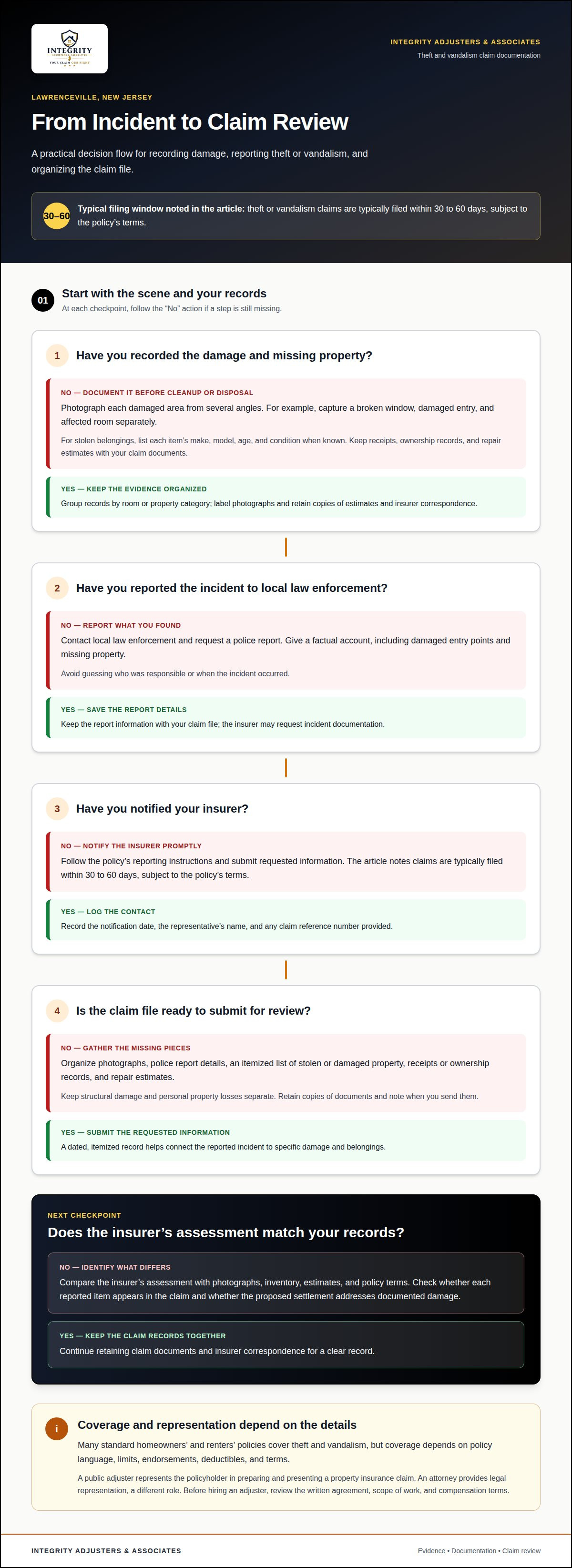
Record each damaged area and missing item before cleanup or disposal. Take clear photographs from several angles, then write an inventory describing what happened. For example, photograph a broken window, damaged entry, and affected room separately. Keep receipts, ownership records, and repair estimates with your claim documents. For stolen belongings, note each item’s make, model, age, and condition when known.
Organize evidence by room or property category. Label photographs and retain copies of estimates and insurer correspondence. A dated, itemized record helps connect the reported incident to specific damage and belongings.
Reporting the Incident and Notifying Insurers
After discovering theft or vandalism, contact local law enforcement and request a police report. Give a factual account of what you found, including damaged entry points and missing property. Avoid guessing who was responsible or when the incident occurred. Keep the report details with your claim file, since the insurer may request incident documentation.
Notify your insurer promptly and follow the policy’s reporting instructions. Theft or vandalism claims are typically filed within 30 to 60 days, subject to the policy’s terms. Record the date of notification, the representative’s name, and any claim reference number provided.
Filing a Vandalism Claim in Lawrenceville
For a Lawrenceville claim, report the incident to local law enforcement, document the scene, and notify your insurer. Submit the requested information, including police report details, photographs, and an itemized list of stolen or damaged property. Keep copies of each document and note when you sent it. This creates a clear record for claim review.
Coverage depends on the policy’s language, limits, endorsements, and deductible. Homeowners’ and renters’ policies may cover damaged property or stolen belongings, but the applicable coverage and settlement calculation depend on the terms. Keep structural damage and personal property losses separate in your records to make estimates and inventory entries easier to review.
Reviewing and Negotiating the Claim
Compare the insurer’s assessment with your photographs, inventory, estimates, and policy terms. Check whether each reported item appears in the claim and whether the proposed settlement addresses documented damage. A public adjuster represents the policyholder in preparing and presenting a property insurance claim. An attorney provides legal representation, which is a different role from claim documentation and adjustment.
Before hiring a public adjuster, review the written agreement, the scope of work, and the compensation terms. Understand what claim tasks the adjuster will handle and how the agreement applies if the claim changes. These steps help you weigh representation without assuming a particular settlement. During a phone consultation or claim review, organize your policy, incident notes, and insurer offer so the discussion can focus on specific gaps and evidence.
Smoke detectors sounded in 54% of fires reported to United States fire departments from 2011 to 2018. Keep detector information with household safety records.
Public adjuster representation in New Jersey
A public adjuster represents a policyholder with an insured property loss. For a New Jersey property, review the adjuster’s state license, written terms, and experience with the type of damage involved.
Service Areas and Coverage
Representation should match the state where the damaged property is located. For a Lawrenceville home, discuss New Jersey claim handling; for property across the border, ask how Pennsylvania matters are handled. Don’t assume that work in one state means an adjuster can represent owners in another. Confirm the relevant state authorization before signing an agreement.
A New Jersey public adjuster can help organize claim materials, assess documented losses, and present the policyholder’s position to the insurer. The role is focused on the insurance claim, not legal representation or physical repairs. Keep the agreement and claim communications together, especially if a property owner has losses in both New Jersey and Pennsylvania.
To verify a New Jersey adjuster, use the state’s insurance licensing lookup. Search by the adjuster’s name or license details, then compare the result with the person named in the proposed agreement. Confirm that the record corresponds to the individual who will represent you, not only a business name. Keep a copy of the lookup result with your claim records.
Fees and Vandalism Claim Specialization
Before representation begins, read the written agreement carefully. Check how the fee is calculated, what it applies to, and how the terms work if the claim changes. Integrity Adjusters & Associates charges a contingency fee, a percentage of the final settlement, with no upfront fees and no payment unless recovery is achieved. The initial claim review is free and costs you nothing.
For a vandalism claim, look for relevant experience handling damaged structures and stolen or damaged belongings. A Lawrenceville adjuster should be able to explain how they organize incident records, property documentation, and insurer communications. Ask what claim tasks the agreement covers and how updates will be shared. Specific answers make it easier to assess whether the proposed representation fits your claim.
Before signing, read the complete agreement and retain a copy. Check the named adjuster, the property and claim covered, the fee calculation, and any cancellation terms. If a clause is unclear, request a plain-language explanation before proceeding. This helps you understand the financial arrangement and scope of representation before authorizing claim work.
Vandalism claims can involve separate records, including incident documentation, damage assessments, and personal property details. The proposed approach should address the records relevant to your loss. For example, a broken entry and missing electronics require different supporting details. Compare the scope of work with the damage reported to the insurer.
Initial insurance offers and adjuster settlements
An insurer’s first offer is a starting point for reviewing the claim, not a substitute for checking its details. Compare the proposed settlement with the policy, documented losses, and each estimate.
Reviewing Initial Insurance Offers
Read the insurer’s offer alongside its damage assessment and the coverage terms. Check which property items appear, which repairs are included, and how the deductible affects the proposed payment. For example, if an estimate covers a damaged door but omits related interior damage, compare it with your photographs and repair documentation.
A cited comparison reports estimated claim amounts of $1,391 per claim for policyholders who did not use public adjusters, and an average of $9,379 per claim for those who did. It also reports a 574% difference between estimated claim amounts. These figures describe the comparison, not a valuation of a specific vandalism loss.
Use the offer as a checklist. Match each line to a documented loss, then flag entries that seem incomplete, unclear, or missing. Separate disagreements about whether damage occurred from disagreements about its estimated scope or value. This helps identify the evidence or explanation needed for each issue.
Negotiating Adjuster Settlements
A public adjuster works for the policyholder on a property insurance claim. When reviewing an offer, the adjuster can compare the insurer’s assessment with the policyholder’s documentation and identify differences that need support. The aim is to present a clear, organized claim, not to assume every disputed item will be accepted.
Build a response around specific discrepancies. For a vandalized room, connect damaged surfaces to photographs, repair estimates, and the relevant claim entry. For a stolen item, refer to the inventory and available ownership records. Submit explanations with supporting documents, and keep copies of the response and insurer communications.
Track unresolved issues in a simple table or claim log. Record the insurer’s position, your supporting evidence, and the date of each exchange. If a revised offer arrives, compare it with the previous version and note what changed. A clear record helps keep each disputed loss visible during settlement discussions.
Before accepting a settlement, read its terms and check the payment calculation against the claim details. Identify unresolved damage, omitted property, or unclear conditions. Keep the final offer, supporting estimates, and related correspondence together. Comparing these records helps you understand what the insurer included and what remains disputed.
If vandalism or theft is discovered, contact local law enforcement, file a police report, notify your insurer, and document the damage or stolen property. Keep these steps in view when reviewing an offer or discussing disputed items. The report and documentation can help ensure that the loss presented for review reflects what was discovered and reported. Include the available information about the damage or property in the claim materials you use to explain why an item or repair belongs in the settlement discussion.
Personal property inventory and pricing
A detailed inventory turns missing or damaged belongings into a claim record the insurer can assess. For each item, connect its description and claimed value to available evidence, and organize entries so the loss is easy to follow.
Create a separate entry for each belonging rather than grouping unrelated items. Record the item’s name, brand, model, age, condition before the incident, and whether it was stolen or damaged. For example, list a stolen television separately from a vandalized speaker, even if both were in the same room. Clear descriptions help explain each loss.
Support each entry with evidence you already have. Useful records may include receipts, order confirmations, photographs, manuals, warranty documents, and bank or card statements. A photograph showing the item in your home can help document prior possession. If an item is damaged, photograph the damage and keep repair or replacement estimates when available.
Value each item according to its details and the policy’s valuation terms. Check the policy language and the insurer’s explanation to understand how the claim value is calculated. For a damaged laptop, compare the assessment with the documented model, condition, and repair estimate. For a stolen coat, identify its brand, material, age, and purchase evidence. Avoid using a broad category price that does not describe the actual property.
Build the inventory in a consistent format. A spreadsheet or written table can include:
- Item description, including brand, model, and identifying details.
- Loss status, such as stolen, broken, or otherwise damaged.
- Purchase or ownership evidence, when available.
- Condition before the incident and supporting photographs.
- Estimated value and the record supporting that estimate.
Keep the original records and a copy of the inventory together. Mark which entries have supporting documents and which need more detail. If the insurer questions a value, you can locate the related receipt, image, or estimate without rebuilding the list. Update entries when new documents clarify a model or repair scope.
Business owners can use the same item-by-item approach for business property. Separate equipment, furnishings, and other affected belongings, then connect each entry to ownership records and evidence of damage or loss. For example, document a damaged office monitor separately from missing tools. Keep business and personal property records distinct so each item’s owner and use are clear.
Before submitting the inventory, compare each entry with the incident report and claim records. Remove duplicates, clarify uncertain descriptions, and make sure the totals follow the policy’s valuation approach. A public adjuster can use the inventory and supporting evidence to document personal property losses and present an organized claim for insurer review.
Public adjuster representation
A public adjuster is a professional employed exclusively by a policyholder who has sustained an insured loss. The adjuster works on the policyholder’s claim, rather than the insurer’s assessment. For vandalism, representation can include organizing claim records, documenting property damage, and presenting reported losses to the insurance company. The claim work should stay connected to the policy terms and evidence from the incident.
Start by identifying each loss in the claim. A damaged entry, broken interior fixture, and stolen belongings each need clear descriptions. A public adjuster can organize these items into a claim presentation, linking reported losses with photographs, estimates, or inventory records. This makes it easier to see what evidence supports each part of the claim.
Representation can help identify differences between the insurer’s assessment and the documented loss. For example, if an estimate includes a damaged door but overlooks related damage, that difference needs a specific explanation. A Lawrenceville NJ public adjuster for vandalism can help organize the evidence and present the policyholder’s position. Keep copies of each submission and insurer response.
Before engaging an adjuster, review the written agreement. Confirm the property and claim covered, the services included, and the fee terms. Ask how the adjuster will handle practical claim tasks, such as:
- Organizing claim records and identifying missing information.
- Documenting damaged property and connecting it to evidence.
- Comparing the insurer’s estimate with the documented losses.
- Preparing and presenting claim materials for the policyholder.
- Tracking communications and outstanding differences.
The work should fit the loss. A vandalized home may involve structural damage, personal belongings, or both. A Lawrenceville NJ public adjuster for vandalism should explain how the proposed work addresses the specific records and disputed items in your claim. Review the scope against your documents, and retain the signed agreement for reference.
Understand what you authorize and keep a copy of the agreement and claim materials shared with the adjuster. If the insurer issues a revised assessment, compare it with the earlier version and note which entries changed. This helps you track the claim’s progress and identify documented losses that remain unresolved.
Public adjuster representation focuses on preparing and presenting a property insurance claim for the policyholder. It does not replace the policy or promise a particular settlement. For a Lawrenceville property owner, organizing the policy, incident records, estimates, and insurer communications provides a practical basis for reviewing the claim and deciding what support is needed.
Integrity Adjusters & Associates: Residential Water Damage Claim Support
Integrity Adjusters & Associates helps policyholders document property damage and build a comprehensive insurance claim. If vandalism also caused water damage, the firm’s Residential Water Damage Claim Support can help organize the water-loss documentation for presentation to the insurer.
For example, keep photographs of water-damaged rooms, records of affected belongings, and repair estimates together. Clear documentation helps distinguish water damage from other losses in the claim. The policy’s terms determine which damage may be covered. Integrity Adjusters & Associates also supports residential storm and fire loss claims.
To discuss a residential water damage claim, contact Integrity Adjusters & Associates.
Move Forward With a Clear Claim Plan
Turn your claim file into a working record. Keep insurer correspondence, estimates, and supporting documents together, and note unresolved questions or decisions. An organized file makes it easier to discuss the claim’s status and the documentation relevant to it.
A Lawrenceville NJ public adjuster for vandalism can help organize and present a property insurance claim. Integrity Adjusters & Associates supports residential water damage, storm damage, and fire loss claims for New Jersey policyholders. The firm offers a free claim review that costs you nothing. Contact Integrity Adjusters & Associates to discuss your claim and the next steps.
Contact Integrity Adjusters & Associates to discuss your property claim. A clear next step can help you approach the process with greater focus.
Frequently Asked Questions
How long do I have to file a claim after a theft or vandalism incident?
Typically, file within 30 to 60 days, subject to your policy’s terms. Use the earliest deadline stated in your policy or claim instructions, and notify your insurer promptly rather than waiting until your inventory is complete. Record the date and time of your notice, the claim reference number, and the representative’s name. Keep copies of messages and submitted forms together.
What should I do immediately after discovering vandalism or theft?
Contact local law enforcement, then notify your insurer and document what you found. Photograph affected areas before moving damaged items, if practical. Make separate notes about stolen belongings and property damage, and avoid guessing when or how the incident occurred. For example, record a broken lock as you found it rather than assuming when it was forced. Keep relevant receipts and messages.
New Jersey public adjuster fee limits and typical fees
Review the written agreement for the fee calculation, any expenses, and how the terms apply if the claim changes. Ask for each item to be explained in writing; no typical fee amount is provided here.
Risks of hiring a public adjuster for a vandalism insurance claim
A public adjuster cannot promise that disputed items will be accepted or that you will receive a particular settlement. Before signing, review the agreement’s scope, compensation, cancellation terms, and named adjuster. A public adjuster handles the insurance claim, not legal representation or physical repairs.
New Jersey homeowners insurance coverage for vandalism and exclusions
Many standard New Jersey homeowners’ policies cover vandalism, but coverage depends on the policy’s limits, endorsements, deductible, and terms. Review your policy to understand which losses may be covered.


