

For a New Jersey business, an NJ commercial storm damage claim expert can help document the loss and organize the claim around the policy’s terms. Wind damage, water intrusion, and flooding may fall under different coverage provisions, and the policy sets the applicable proof-of-loss deadline. If you can’t prepare a complete proof of loss by that deadline, request an extension in writing and keep written confirmation.
Storm damage may seem like one claim, but the cause of each loss and the policy wording can affect how it is assessed. Strong documentation connects observed damage to the storm and clearly records repairs, damaged contents, and business impacts.
This guide explains what to record after a storm, how wind, water, and flood coverage can differ, and what to know about proof-of-loss deadlines. You’ll also learn how commercial claim support can help organize damage information for the insurer, giving you a clearer record and practical next steps.
Key Takeaways
- Report storm damage promptly and keep a written record of claim conversations, inspections, and supporting documents.
- Separate wind damage, water intrusion, and flooding in your documentation because policy terms may treat these losses differently.
- Preserve photos and records of damaged property, temporary repairs, and related expenses to build a clearer claim file.
- Proof-of-loss deadlines depend on the policy; if you need more time, request an extension in writing and keep the insurer’s written response.
- If a storm claim dispute remains unresolved, New Jersey policyholders can contact the New Jersey Department of Banking and Insurance Consumer Hotline at 1-800-446-7467.
Commercial storm and wind damage claims
Report storm losses promptly to your agent or insurer, with your commercial policy number ready. The insurer’s adjuster assesses damage and coverage. A public adjuster represents the policyholder in the claim, while an attorney provides legal representation.
Wind Damage Coverage Disputes
Wind claims can turn on whether the storm caused the damage or whether the insurer attributes it to wear and tear. A loosened roof, cracked foundation, or broken windows may need close inspection, since visible damage can conceal related problems. Compare the insurer’s estimate with the observed damage and the policy terms on covered causes and exclusions.
Hurricane and Wind Deductibles
New Jersey insurers and the FAIR Plan must provide a hurricane deductible notice at new business and every renewal under N.J. Admin. Code § 11:2-42.8. Look at the notice and applicable policy endorsement to understand which deductible applies to the claimed loss. New Jersey standardized hurricane deductible endorsement language through Endorsement HD 04 05, effective March 1, 2004 for new business and May 1, 2004 for renewals.
Wind, Rain, and Debris Damage
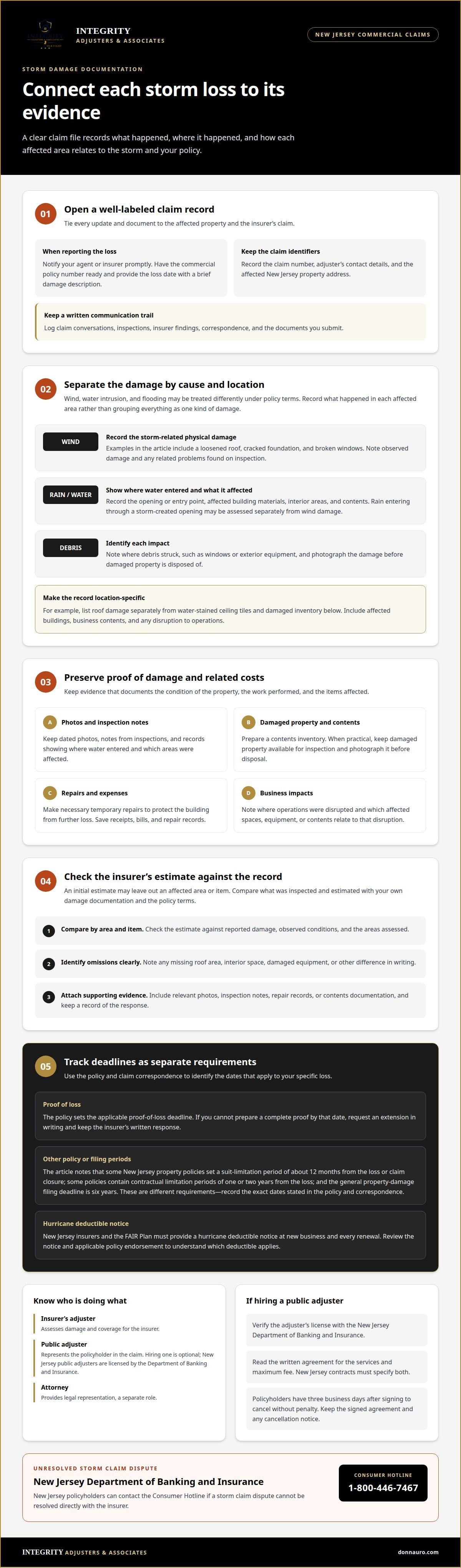
Document each storm impact separately: wind may damage a roof, rain may enter through an opening, and debris may strike windows or exterior equipment. The sequence matters because an insurer may assess the cause of each affected area when deciding coverage. Photograph damage before disposal, and keep records showing where water entered and which building materials or contents were affected.
For a commercial property claim, organize evidence by location and damage type. For example, record roof damage separately from water-stained ceiling tiles and damaged inventory below. Dated photos, inspection notes, repair records, and a contents inventory can connect each loss to the storm. Keep written notes of claim conversations and the insurer’s inspection findings.
Don’t assume an initial estimate is complete if it overlooks a roof area, interior space, or damaged equipment. Compare it with your documentation and note specific omissions or differences. An NJ commercial storm damage claim expert can help assess damage, prepare claim documents, and present the loss to the insurer.
Make necessary temporary repairs to protect the building from further loss, and save related receipts or bills. Keep damaged property available for inspection when practical, and photograph it before disposal. If a storm claim dispute cannot be resolved directly with the insurer, New Jersey policyholders can contact the New Jersey Department of Banking and Insurance Consumer Hotline at 1-800-446-7467.
Service areas in Pennsylvania, New Jersey, Delaware, and Maryland
While regional coverage discussions often span neighboring states, our primary focus as your trusted NJ commercial storm damage claim expert remains firmly rooted in New Jersey, including properties throughout West Central New Jersey. The property’s location, policy language, and documented loss shape how the claim proceeds. Keep the insurer’s correspondence and claim records tied to the affected New Jersey address.
To file a commercial storm claim in New Jersey, notify your agent or insurer and provide the policy number, loss date, and a brief description of the damage. Identify affected buildings and business contents, and note where operations were disrupted. Keep a copy of the notice, the claim number, and the adjuster’s contact details. Organized records make follow-up questions easier to answer and help keep communications tied to the right property.
After the insurer inspects the property, compare its estimate with the damage reported and the areas assessed. If the estimate leaves out an affected space or item, describe the gap in writing and attach relevant evidence. Keep a record of each response. If direct discussions do not resolve a dispute, New Jersey policyholders can contact the New Jersey Department of Banking and Insurance Consumer Hotline at 1-800-446-7467.
New Jersey public adjusters are licensed by the Department of Banking and Insurance. Policyholders may hire an expert like Integrity Adjusters & Associates to appraise property damage and negotiate an insurance claim, but aren’t required to do so. A public adjuster represents the policyholder’s interests; the insurer’s adjuster assesses damage for the insurance company. An attorney provides legal representation, a separate role.
Verify a public adjuster’s license with the New Jersey Department of Banking and Insurance. Read the written agreement for the services and maximum fee. New Jersey public adjuster contracts must specify both, and fees must be reasonably related to the services and not excessive. Policyholders have three business days after signing to cancel without penalty. Keep a copy of the signed agreement and any cancellation notice.
Track policy deadlines separately. Some New Jersey property policies set a suit-limitation period of about 12 months from the loss or claim closure, while the general property damage filing deadline is six years. Some policies contain contractual limitation periods of one or two years from the loss. These periods concern different legal or policy requirements, so record the exact dates stated in the policy and claim correspondence, and address any proof-of-loss deadline separately.
For owners in West Central New Jersey, include the property address and affected areas in every submission. This makes the documentation specific to the insured location and distinguishes the business’s losses from general reports of storm damage elsewhere in the state.
Quantitative and qualitative damage documentation
After storm damage in New Jersey, collect dated photos, videos, inspection notes, and repair records. Document affected locations, damaged materials and contents, and temporary work so the evidence connects each loss to the event.
Immediate Safety and Documentation
Before documenting a severe storm’s effects, keep staff away from visibly unstable areas, fallen wires, and standing water near electrical equipment. Record damage from a safe position, such as a collapsed ceiling, broken window, or water entering a storage area. Note the location and time of each observation. These details help organize evidence without putting employees at risk.
Damage Evidence and Temporary Repairs
Photograph damaged property before disposal, and retain it until the insurer inspects it or says it can be discarded. Take wide views of each affected area, followed by close-ups of specific damage, such as a torn roof membrane or soaked inventory. Make necessary temporary repairs to protect the property from further loss, and save receipts and bills for the claim.
Build a detailed record with photos, videos, written reports, and an inventory. Identify each affected space, building component, piece of equipment, and stock item. For example, note the number and location of damaged ceiling tiles, then link them to photos showing water staining above. Separate commercial contents from building damage so the insurer can see what was affected and where.
Written findings can add details that images alone cannot show. A storm investigation may involve visual inspection, testing, or destructive analysis using accepted methods. For example, water-infiltration testing at a window or door can help assess a reported leak. Record the area tested, the method, the observed results, and how they relate to the claimed damage. Testing should clarify the evidence, not obscure it.
Keep evidence in a consistent file structure. Label each photo or video with its date, building area, and a short description. Store inspection reports, repair proposals, invoices, and insurer communications with the related images. If a temporary repair covers the original damage, photograph it first and preserve removed materials when practical. This sequence shows both the initial condition and the work done to limit further loss.
Prepare before storm season by keeping property and contents records up to date. A pre-storm photo of a window system, for example, can help show its condition before the damage. For a business, maintain an inventory of equipment and stock and update it when items change. Comparing those records with post-storm evidence can clarify what was damaged, what needs repair, and what was present before the event.
Wind, water, and flood coverage distinctions
For a New Jersey business, the cause of damage matters because wind, water intrusion, and flooding may involve different policy terms. Identify how water entered, what the storm damaged, and which coverage the insurer is assessing.
Commercial property insurance generally doesn’t include flood insurance, and flood insurance generally covers business property against flood damage. Check the policy wording for covered causes, exclusions, and any separate flood coverage. If the insurer excludes part of a loss, it must explain how the policy excludes that portion. A written explanation can clarify whether the disagreement concerns the source of damage or the policy wording.
Rain entering through a storm-damaged roof or window may raise different questions from floodwater inundating the property. Record the water’s path and affected areas, then compare those observations with the insurer’s inspection and estimate. After a hurricane, flood and property insurers may dispute the cause of damage and which insurer should respond. Keep communications and estimates showing how each company addresses the loss.
New Jersey businesses can obtain flood insurance through the National Flood Insurance Program or a private insurer offering flood coverage. Flood insurance isn’t effective until 30 days after it’s sold. That timing matters for preparedness, not as a way to insure damage after a storm has begun. Commercial vehicle flood damage also depends on coverage: an auto policy needs optional comprehensive coverage, while liability coverage alone doesn’t cover flood damage to a vehicle.
In an emergency, protect people first, then take reasonable steps to prevent further property loss. Photograph damage before disposal, preserve damaged materials for inspection when practical, and save bills for temporary work. Keep observations about wind, rain, and flooding distinct in the record. If the insurer disputes coverage, compare its explanation with the relevant policy terms before considering a settlement. An attorney’s role differs from insurance claim adjustment, particularly when a dispute raises legal questions.
Does New Jersey offer disaster assistance for businesses after severe storms? A severe storm alone doesn’t establish eligibility for disaster assistance, so distinguish any relief-program eligibility from insurance coverage. For an insurance claim, report the damage to the insurer and document the property losses and any response.
Business income may also matter. Some commercial property policies include business interruption coverage for a defined period, such as 12 or 18 months. Coverage may address lost income during the period of restoration, meaning the time reasonably needed to repair or replace damaged property. Review the policy’s terms and connect claimed income loss to the storm-related interruption and restoration period.
Sworn proof of loss requirements and deadlines
A sworn proof of loss is a formal account of the damage and amount claimed, submitted under the policy’s requirements. The deadline and required details depend on the specific policy, so identify both before preparing the submission.
Start by finding the policy’s proof-of-loss clause and any instructions from the insurer. Note the due date, required form, requested information, and whether the statement must be sworn. Don’t assume the insurer’s initial estimate replaces a required proof of loss. The claim file can include inspection records, repair estimates, an inventory, photographs, and documents supporting the reported amount.
Build the statement from evidence organized by building area and type of loss. For example, distinguish roof damage from water-damaged equipment, and separate repairs from replacing items that cannot be restored. Include the observed condition, the source of each figure, and supporting construction or repair records. Clear itemization helps the adjuster understand how the claimed amount relates to the damage.
Deadlines vary by policy. Some property policies contain contractual limitation periods of one or two years from the date of loss. New Jersey property policies often set a suit-limitation period of about 12 months from the date of loss or claim closure. These periods may concern different steps, so don’t treat a proof-of-loss due date as interchangeable with a deadline to file suit. Track each date separately, including dates stated in insurer correspondence.
If you can’t prepare a complete proof of loss by the deadline, request an extension from the insurer in writing. Keep your request and written confirmation that the extension was granted. A phone conversation alone doesn’t provide the same written record. If the insurer requests more information, record the request date, identify the documents needed, and keep copies of what you submit.
A hurricane claim may involve several damage categories and coverage questions. Specify which building areas suffered wind damage, where water entered, and which items relate to flooding. Include structural findings or construction assessments when they support the claimed scope. Public adjusters can help policyholders appraise damage and prepare claim materials, but the policyholder remains responsible for meeting applicable policy requirements.
Before submitting, compare the proof of loss with the insurer’s estimate and inspection record. Address mismatched room descriptions, omitted items, or unsupported amounts with relevant documentation. Keep a complete copy of the signed submission and proof of delivery. If you need help organizing a commercial storm claim, gather the policy, insurer correspondence, damage inventory, and supporting estimates for a focused review.
Integrity Adjusters & Associates
Integrity Adjusters & Associates helps policyholders document property damage and build a comprehensive claim to present to the insurer. For a commercial storm loss, organized evidence can show the affected areas, damaged contents, and related property losses in one clear record.
Consider public-adjusting support when the damage assessment feels incomplete, records are difficult to organize, or the claim involves several affected parts of a commercial property. Integrity Adjusters & Associates documents losses and prepares claim materials, helping bring structure to a demanding process.
If you need support organizing a commercial property claim after storm damage, contact Integrity Adjusters & Associates to discuss your claim.
Move Your Claim Forward With a Clear Plan
A storm claim can affect decisions about reopening, repairs, and business operations. Keep claim preparation tied to those practical priorities: organize the records your team needs, identify unresolved damage questions, and make sure the next submission addresses them clearly. An NJ commercial storm damage claim expert can help structure this work and present documented losses to the insurer.
Integrity Adjusters & Associates also supports residential water damage, storm damage, and fire loss claims. For commercial property owners dealing with a complicated storm loss, focused claim support can make the next steps more manageable.
Contact Integrity Adjusters & Associates to discuss support for your property claim. A clear, organized claim file is a practical place to begin moving forward.
Frequently Asked Questions
What does a commercial storm damage claim expert do in New Jersey?
An NJ commercial storm damage claim expert evaluates the reported loss and organizes evidence to support the policyholder’s claim. The work can include documenting affected building areas and contents, assessing storm-related damage, and preparing a clear account for the insurer. For example, the claim file can distinguish wind damage to a roof from water damage to equipment. This clarifies which losses are being claimed and how they relate to the storm.
How do I find a licensed public adjuster for a commercial storm damage claim in NJ?
Confirm the adjuster’s New Jersey license with the New Jersey Department of Banking and Insurance, and ask about experience with commercial storm losses. Review the written contract for the services, fee terms, and cancellation provisions. Make sure the agreement identifies the adjuster handling your claim. These steps clarify who represents your interests and what the engagement covers before you sign.
What deadlines apply to commercial storm damage claims under New Jersey insurance policies?
There isn’t one deadline for every step. The policy may set a proof-of-loss submission date and a separate time limit for filing suit. New Jersey property policies often set suit-limitation periods of about 12 months from the loss or claim closure, while some policies contain one- or two-year contractual limits. Record each deadline stated in the policy or insurer’s letters, and distinguish claim-document deadlines from legal filing limits.
How are commercial storm damage claims assessed and estimated?
The insurer’s adjuster inspects the property and prepares an estimate based on the assessed damage and policy terms. Check whether the estimate accounts for every affected area, damaged contents, and relevant repair work. New Jersey policyholders should receive a copy of the damage estimate. You can ask the insurer about contractors who may be willing to do the work at the estimated price, then decide whether to use one after reviewing the estimate.
What should I do if my New Jersey commercial storm damage claim is denied or underpaid?
Ask the insurer for its written explanation and identify the specific policy wording or damage items behind the decision. Compare the explanation with the inspection record, estimate, and evidence supporting the disputed loss. Submit a focused written response addressing each disagreement and including relevant documents. If direct discussions don’t resolve the dispute, New Jersey policyholders can raise the matter through the New Jersey Department of Banking and Insurance’s consumer assistance channels.


