

New Jersey property owners handling a damage claim can hire a public adjuster to document losses and represent them in dealings with the insurer. The best public adjuster in New Jersey is a licensed professional who represents policyholders exclusively. A public adjuster can help prepare a detailed claim and present it to the insurance company.
A property loss can leave you managing repairs, records, and claim decisions all at once. Clear guidance and an accurate account of the damage can help you understand what comes next. This article explains how public adjusters support residential and commercial claims, what representation involves, and how New Jersey licensing fits into the process. Coverage details matter too: flood coverage is often separate from other property coverage, as the Federal Emergency Management Agency explains. Understanding these distinctions can help you decide when professional claim support may be useful.
Key Takeaways
- Understand why water and flood losses can involve different coverage questions, and what details shape a claim.
- See how claim support can apply to residential and commercial property damage, including storm and fire losses.
- Learn what New Jersey public adjuster licensing means for policyholder representation.
- Identify how detailed documentation and claim preparation can help make property losses clearer to an insurer.
- Use practical criteria to assess representation and decide when professional claim support may fit your situation.
Why should New Jersey property owners hire a public adjuster for property damage claims?
A public adjuster helps New Jersey property owners document damage, prepare a claim, and present it to the insurance company. This support can be especially useful when water damage, a disputed scope, or complex property records make a claim harder to assess.
Claim Assessment and Documentation
A claim assessment brings together visible damage, supporting records, and the reported cause of loss. During an inspection, a public adjuster documents affected areas and prepares a detailed account for the insurance company. For example, water damage records can identify affected rooms, building materials, and contents. Clear documentation links the observed damage to the claim and gives the policyholder an organized basis for reviewing a proposed settlement.
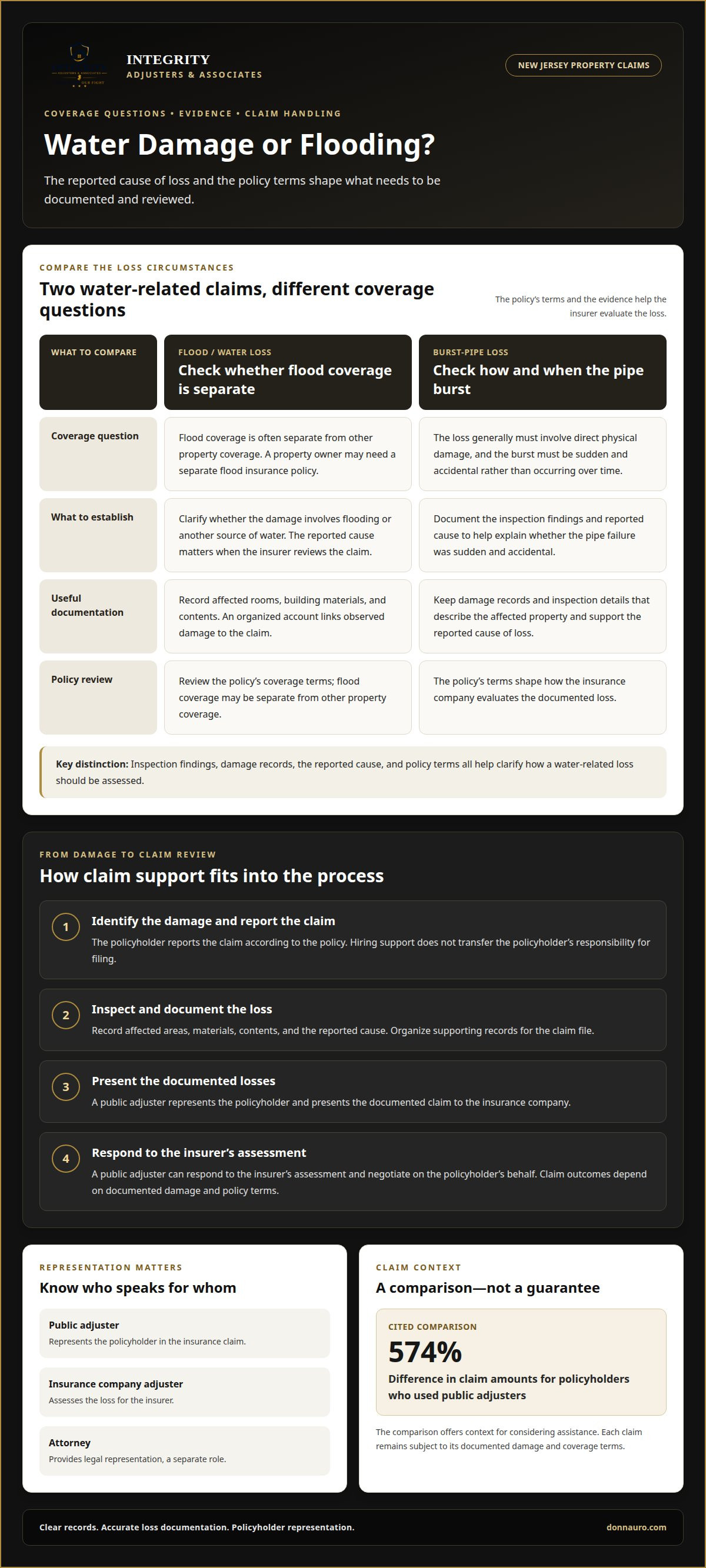
Water and flood losses require careful attention to coverage. According to the Federal Emergency Management Agency, flood coverage is often separate from other property coverage, so New Jersey property owners may need a separate flood insurance policy. A burst-pipe claim raises a different coverage question: the loss generally must involve direct physical damage, and the burst must be sudden and accidental rather than occurring over time.
That distinction affects the evidence needed. Inspection findings, damage records, and the reported cause help explain whether a claim involves a sudden pipe failure or flooding. The policy’s terms also shape how the insurance company evaluates the loss.
Filing and Negotiating Claims
The process starts by identifying the damage and reporting the claim according to the policy. The property is then inspected, and the loss is documented and organized for submission. A public adjuster presents the documented losses to the insurance company, responds to its assessment, and negotiates on the policyholder’s behalf. The policyholder remains responsible for reporting the claim, while organized records help keep the file clear and focused.
A public adjuster represents the policyholder in an insurance claim; an insurance company adjuster assesses the loss for the insurer. An attorney provides legal representation, which is a separate role. Knowing the difference helps property owners understand who speaks for whom during an inspection, claim review, or settlement discussion.
Support may apply to a new claim, an existing claim, or a claim being reopened. A supplemental claim addresses additional documented losses connected to an existing claim. If a claim is rejected, the insurer’s reasoning and the evidence submitted may need closer review. The appropriate path depends on the damage records, policy terms, and claim history.
Residential, commercial, and industrial claims can involve different records and affected property. A home may require documentation of rooms and contents, while a business property claim may also involve building areas and business records. For any property type, a public adjuster’s central task is to accurately document losses and present the claim for the policyholder.
Policyholders, rather than the insurance company, are responsible for every step of filing a property insurance claim, so hiring support does not transfer that responsibility. The cited comparison found a 574% difference in claim amounts for policyholders who used public adjusters. This comparison offers context for considering assistance, while each claim remains subject to its documented damage and coverage terms.
Public adjuster services for New Jersey homeowners and businesses
Public adjusters help property owners organize damage claims and present documented losses to an insurance company. The work differs depending on whether the property is a home, storefront, or commercial building.
Home and Business Claim Services
For homeowners, claim support can cover residential water, storm, or fire damage. An assessment records affected areas, building materials, and damaged contents. Business owners may need documentation for a commercial building, equipment, or other insured property. Vandalism claims also call for a clear record of the damage and affected property. The policy terms and loss details determine what belongs in each claim.
An adjuster working for an insurer assesses the reported loss from the company’s perspective. A public adjuster represents the policyholder when preparing and presenting the claim. For example, if a storm damages a home and a nearby business, each property needs its own damage record and policy review. Keeping the records separate clarifies which losses belong to each claim.
Property owners may also ask about emergency relocation, temporary housing, or furnishings after a loss. These needs are separate from documenting and presenting an insurance claim. Policy terms and the circumstances determine whether related expenses may be considered. Appraisal, mediation, umpire involvement, and estimating are also distinct processes or services, not automatic parts of every public adjusting engagement.
Regional Service Areas
Public adjusting support is available to property owners throughout New Jersey, including North, Central, and South Jersey. The property’s location identifies where the damaged building sits, while the loss details and policy define the claim. Owners with properties in New Jersey and Pennsylvania should treat each location and its insurance claim separately.
State boundaries matter to a claim. New Jersey public adjusters are licensed by the state to represent policyholders exclusively. For a Pennsylvania property, the applicable state requirements and the adjuster’s authority are separate considerations. The relevant service area is determined by the property’s location, not by proximity to another state.
For a New Jersey property, the claim file should identify the affected building, type of loss, and supporting records. This approach helps organize claims throughout South Jersey as well as North and Central Jersey. If a loss affects several properties, separate documentation makes each location’s damage easier to assess and present.
When considering a public adjuster, distinguish claim documentation and policyholder representation from relocation arrangements or dispute procedures. This helps homeowners and business owners understand what a public adjuster handles during a property claim and which processes are separate.
This example adds a financial dimension to claim preparation alongside the documentation of property damage. The business income claim should remain identifiable as its own part of the file, with the relevant policy and loss details considered when it is presented. Keeping the offer associated with the correct claim helps distinguish it from separate building, equipment, or contents losses.
New Jersey public adjuster licensing and representation
In New Jersey, public adjusters are licensed by the state to represent policyholders exclusively. That role matters: a public adjuster advocates for the property owner, while an insurance company adjuster assesses the claim for the insurer. Homeowners and business owners can use this distinction to understand who represents their interests during claim preparation and discussions.
Licensing identifies a professional’s role, but it does not explain how a particular engagement will work. Before signing, review the agreement’s scope, fee method, services, and cancellation terms. For example, a water damage claim may require detailed records of affected areas and the reported cause. The written agreement should make clear which claim tasks the adjuster will handle and how the relationship can end.
Review the written agreement and applicable New Jersey requirements for contract and cancellation terms. Read the cancellation language, deadlines, and any stated consequences before signing, rather than relying on a verbal summary. Because legal terms can depend on the specific agreement, a general description is not a substitute for reading the contract.
The proposed agreement should explain the public adjuster’s fee, including how it is calculated and which claim proceeds it may apply to. New Jersey requirements may affect the fee, so don’t assume a particular cap or percentage without a reliable basis. Review the written terms and whether a cap applies to the specific engagement before agreeing.
Useful questions focus on representation and the work product. Ask who will handle communications with the insurance company, which records will support the claim, and how you will receive updates. For a commercial property loss, clarify whether the scope includes the affected building and business property. Specific answers make the proposed service easier to understand.
Warning signs include pressure to sign quickly, unclear fees, or requests to exaggerate or misrepresent damage. A legitimate claim should rely on accurate records, not inflated descriptions. Review the agreement carefully, confirm the adjuster’s New Jersey license, and keep copies of claim documents and communications. These steps create a clear record of the engagement.
For a detailed water damage claim, the adjuster should explain how inspection findings connect to documented losses and the claim submission. For a business property claim, ask how the work will distinguish building damage from other affected property. Clear explanations help homeowners and business owners assess whether the representation fits their claim.
The best public adjuster in New Jersey is not defined by a slogan. Assess the professional’s New Jersey license, written scope, fee terms, and approach to accurate documentation. Reviewing these details before signing helps you understand who represents you and what the engagement covers.
Reasons to hire a public adjuster
A public adjuster can help when a property damage claim requires detailed records, ongoing communication, and negotiation with an insurance company. For a homeowner facing water damage, the work may include documenting affected rooms, organizing evidence, and presenting losses in a structured claim. A business owner’s property and records may differ. In either case, the purpose is to represent the policyholder through the claim process.
Documentation is a practical reason to seek help. An inspection can record damaged areas, materials, and contents, while supporting records connect those findings to the reported loss. A clear claim file gives the insurance company specific information to assess. For example, records of damage in several rooms identify the affected areas more clearly than a general description of the home.
Negotiation is another part of the role. A public adjuster presents the documented claim, responds to the insurer’s assessment, and discusses disputed items on the policyholder’s behalf. If a proposed settlement leaves out a documented area of damage, the adjuster can identify the omission and support the claim with relevant records. This keeps discussions focused on the reported loss and available evidence.
A comparison reports estimated claim amounts of $9,379 for policyholders who used public adjusters, compared with $1,391 for those who did not. Those figures describe the comparison, not a promised outcome for an individual claim. The amount supported by a specific claim depends on its documented losses and applicable policy terms. The comparison offers context, not a substitute for reviewing the facts of a property loss.
Public adjusting may also help when a claim has several moving parts. A storm loss at a home, for instance, may involve damage to the roof and interior. A commercial property claim may need to distinguish building damage from other affected property. In each case, the adjuster organizes and presents documented losses without making assumptions about what the policy covers.
Representation can reduce the policyholder’s burden of coordinating claim details. A public adjuster can prepare the claim and negotiate with the insurance company, representing the property owner’s interests. Before hiring, review the written scope and fee terms, then consider whether the proposed work addresses the damage claims and records involved.
Hiring a public adjuster does not replace accurate reporting or policy review. The adjuster should present evidence honestly and explain how each documented item relates to the claimed damage. Property owners deserve a clear account of the work, the representation, and the claim materials being prepared. This clarity helps them decide whether professional assistance fits their situation.
Which New Jersey public adjusters are highly rated and experienced?
A high rating alone does not establish whether an adjuster fits a particular property claim. Compare the professional’s New Jersey license, written scope, and experience with the type of damage involved. A residential water loss and a commercial storm claim, for example, require different property records. Look for a clear explanation of how the adjuster will document and present your specific losses.
Start with the individual who would handle the claim, not just the firm’s general profile. Ask about their role in inspections, claim preparation, and communication with the insurance company. A useful answer explains how they organize damage records and address disputed items. If your property is a business, ask how the proposed work accounts for the building and affected business property.
Ratings can reveal patterns in customer experiences, but read the details behind them. A review describing clear updates during a fire claim offers different information from a general comment about service. Consider whether feedback discusses communication, documentation, and claim handling. Treat broad praise as one signal, then compare it with the adjuster’s explanation of your claim’s scope.
Experience should match the type of loss. For water damage at home, ask how the adjuster identifies affected materials and records the cause. For storm damage at a business, ask how the file will identify each affected area and property category. The answer should relate the proposed assessment to the building and loss, rather than relying on a generic claim description.
Review the engagement documents before deciding. Confirm that the written scope identifies the claim work, fee method, and communication process. Ask who will prepare the claim materials and speak with the insurer. Clear answers help you understand the representation and compare it with your needs. Keep the agreement and related claim records together.
The best public adjuster in New Jersey for your situation should explain the work without promising a settlement. Look for a sound process: inspect the reported damage, document relevant losses, and support the claim with records. The professional should distinguish documented facts from estimates or unresolved questions. That care matters for both new and disputed claims.
Use focused criteria to compare your options. Match the adjuster’s experience to your property type and damage, read detailed reviews, and assess whether the written scope answers your questions. Then consider whether the communication gives you a clear picture of the next claim steps. This approach helps you look beyond ratings that offer little detail.
Integrity Adjusters & Associates
Integrity Adjusters & Associates helps New Jersey property owners document damage and prepare comprehensive claims for presentation to the insurance company. The firm supports residential water, storm, and fire damage claims, as well as commercial fire losses. Its public adjusters represent policyholders only, helping organize the documented property losses and supporting details.
Consider Integrity Adjusters & Associates when you need an organized claim file, help documenting property damage, or support presenting a residential or commercial loss to the insurer. The firm provides claim advocacy for policyholders, bringing structure to the documentation and presentation of your losses.
Contact Integrity Adjusters & Associates to discuss support for your property damage claim.
Take the Next Step With a Clear Claim Plan
Choosing the best public adjuster in New Jersey means finding representation that fits the damage and the work ahead. Before moving forward, gather your policy, claim correspondence, and records showing the affected property. A focused review of those materials can clarify the next step and what support may help.
Integrity Adjusters & Associates supports residential water damage, storm damage, and fire loss claims. If your property loss calls for organized documentation and claim presentation, contact Integrity Adjusters & Associates to discuss your situation. A clear starting point can help you approach the claim with greater structure and confidence.
Frequently Asked Questions
How do I find the best public adjuster in New Jersey?
Choose a public adjuster whose experience and written scope fit your property loss. The best public adjuster in New Jersey for your situation should explain who will manage the file, what documentation they will prepare, and how they will communicate with you. For example, ask how they would organize records for a home with water damage across several rooms. Compare the clarity of the explanation and review the engagement terms before deciding.
How can I verify a New Jersey public adjuster's license and disciplinary history?
Ask for the adjuster’s full name and license details, then contact the New Jersey Department of Banking and Insurance to ask what status and disciplinary information it can confirm. Match the name carefully, especially if a firm has several representatives. Keep a dated note of your inquiry and any response. A careful review helps you evaluate whether the best public adjuster in New Jersey for your claim has the credentials and professional record you expect.


