

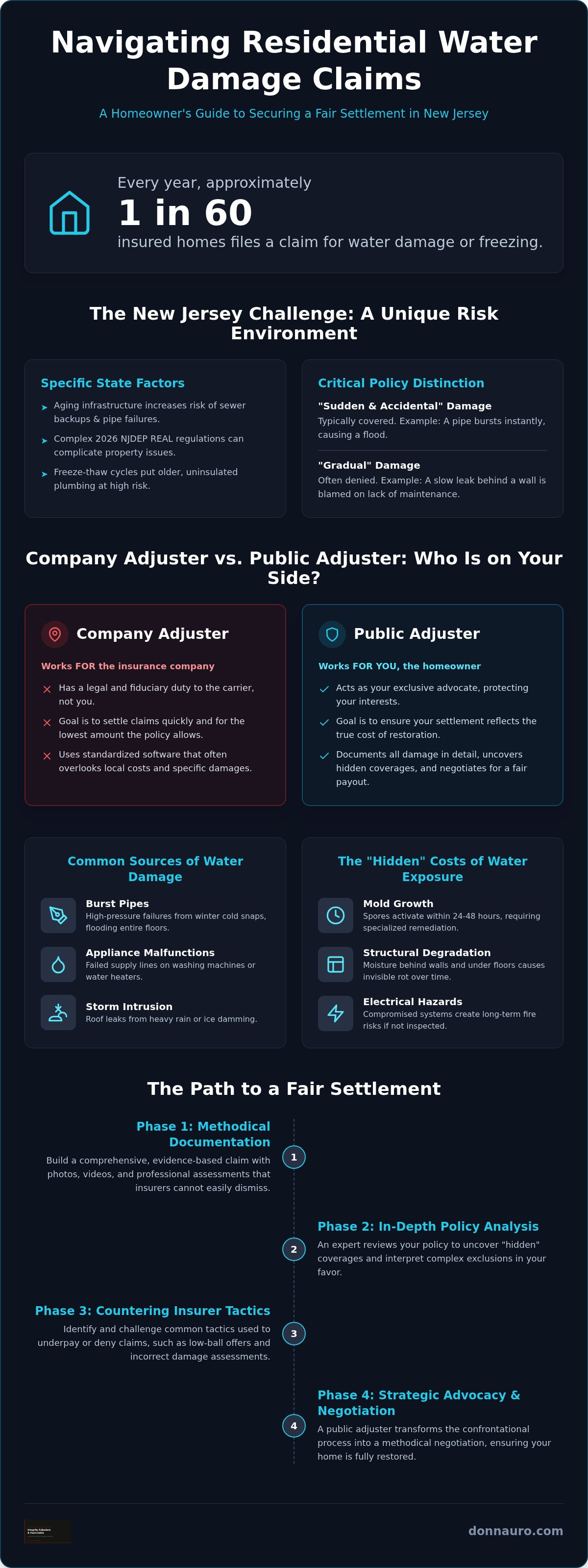
Approximately 1 in 60 insured homes across the country files a claim for water damage or freezing every single year. In New Jersey, where aging infrastructure and the 2026 NJDEP REAL regulations complicate property ownership, the risk is even more pronounced. When a pipe bursts or a storm hits, most homeowners expect their insurance company to act as a partner in recovery. However, the reality often involves low-ball offers and overlooked structural rot. This is why professional residential water damage claim support is no longer a luxury. It's a necessary shield for your home's financial and physical integrity.
It's exhausting to battle an insurance company while you're already worrying about hidden mold or long-term structural decay. You deserve a settlement that reflects the actual cost of professional restoration, not just a surface-level fix. This guide will show you how to secure a fair settlement through expert documentation and strategic advocacy. We'll break down how to identify hidden damage, interpret complex policy exclusions, and leverage professional representation to ensure your home is fully restored without the typical stress of the claims process.
Key Takeaways
- Understand why professional residential water damage claim support is essential for navigating New Jersey's specific regulatory and environmental challenges.
- Distinguish between company adjusters and public adjusters to ensure your interests are protected by an advocate who works exclusively for you.
- Learn the methodical phases of documenting damage to build a comprehensive, evidence-based claim that insurers cannot easily dismiss.
- Identify common tactics used by insurers to underpay or deny claims and how to counter them with factual integrity.
- Discover the structured, sequential process used to transform a chaotic property loss into a successful and fair settlement.
The Reality of Residential Water Damage Claims in New Jersey
In New Jersey, water damage isn't a rare occurrence; it's a persistent threat to property value. Residential water damage claim support is the professional advocacy required to bridge the gap between a policyholder’s loss and an insurer’s valuation. Most homeowners assume their homeowners insurance policy provides a straightforward safety net. However, the technical language within these contracts often creates substantial hurdles during the recovery process.
New Jersey's unique environment contributes to the complexity of these claims. Aging infrastructure in densely populated areas like Essex County, where sewer backups account for 57% of water restoration calls, creates a high-risk environment. A critical distinction exists between "sudden and accidental" damage and "gradual" damage. If a pipe bursts instantly, coverage is typically clear. If a slow leak persists behind a vanity for weeks, the insurer may argue the damage resulted from a lack of maintenance. This leads to underpayments or outright denials that leave homeowners stranded.
Common Sources of Residential Water Damage
NJ homeowners face specific threats dictated by the state's climate and housing stock. The freeze-thaw cycle is a primary culprit, particularly in older homes with uninsulated plumbing.
- Burst pipes: High-pressure failures during winter cold snaps that flood entire levels of a home.
- Appliance malfunctions: Failed supply lines on washing machines or water heaters that release hundreds of gallons of water in minutes.
- Storm intrusion: Roof leaks caused by heavy rainfall or ice damming that forces water under shingles.
The 'Hidden' Costs of Water Exposure
The visible puddle on your floor is rarely the full extent of the loss. Secondary damage acts as a silent threat to your property's structural integrity. Mold spores can activate within 24 to 48 hours of exposure, requiring expensive, specialized remediation. Water also compromises electrical systems, creating fire hazards that aren't always immediate but require professional inspection to ensure safety.
Sub-surface damage refers to moisture that migrates behind wall cavities or beneath sub-flooring, causing long-term structural degradation that remains invisible until rot or mold sets in. These complexities are why methodical residential water damage claim support is vital. Without a disciplined navigator, homeowners often accept settlements that fail to cover the true cost of professional restoration.
Company Adjuster vs. Public Adjuster: Who is on Your Side?
When you file a claim, your insurer sends an adjuster to evaluate the loss. Many homeowners assume this individual is a neutral party. They aren't. A company adjuster has a legal and fiduciary obligation to the insurance carrier, not to you. Their goal is to settle the claim quickly and for as little as the policy allows. In contrast, a public adjuster provides residential water damage claim support by acting as your exclusive advocate. They work for you; they ensure every detail of the damage is documented and priced according to current market rates.
The Conflict of Interest in Default Claims
Insurers often hire "independent" adjusters. This title is misleading. These adjusters are independent contractors hired by the insurance company. Their continued employment depends on satisfying the carrier's cost-saving metrics. They utilize standardized estimating software to generate payouts. While efficient for the insurer, these programs often fail to account for the specific labor costs or material grades found in New Jersey homes. A strategic ally identifies these discrepancies during the initial inspection. They act as a buffer, preventing the insurer from overlooking critical damage like the sub-surface rot mentioned previously.
Benefits of Licensed Public Adjusting Advocacy
Expert advocacy transforms the claims process from a confrontation into a methodical negotiation. Licensed public adjusters conduct an in-depth policy analysis to uncover "hidden" coverages homeowners often miss. This process requires factual integrity and evidence-backed documentation. By referencing industry standards, such as those outlined in the California Residential Property Claims Guide, an advocate ensures your claim follows established best practices for property loss. This level of detail reduces the time-sensitive burden on you. It allows you to focus on your family while an expert handles the institutional bureaucracy.
The most common objection is cost. Public adjusters typically work on a contingency basis. While this is a percentage of the settlement, the increased value they secure often far outweighs the fee. Without professional residential water damage claim support, you risk accepting a settlement that covers only the surface damage. Methodical confidence is required to challenge an insurer's initial estimate. If you aren't sure if your current offer is fair, consulting with a strategic ally can provide the clarity you need to move forward.
Methodical Documentation: Building a Comprehensive Claim
Success in property recovery depends on the quality of your evidence. Residential water damage claim support involves transforming a chaotic scene into a structured set of facts. You must maintain factual integrity throughout the process. In New Jersey, insurance carriers require a formal "proof of loss" statement. This document is a sworn statement detailing the extent of the damage and the cost of repairs. Errors or omissions in this document can lead to significant delays or total claim denials. It's the foundation of your recovery, and it must be bulletproof.
Step 1: Immediate Evidence Preservation
Documentation begins the moment you discover the loss. Don't wait for the insurer's adjuster to arrive.
- Capture high-resolution video and photos of every affected room before any mitigation or cleanup begins.
- Mark water lines on walls with a pencil to show the peak depth reached by the water.
- Preserve the failed part, such as a burst pipe section or a failed appliance hose. This is your primary physical evidence and proves the cause of loss.
- Record serial numbers and model numbers of damaged electronics and appliances immediately.
- Save every receipt for emergency supplies, such as fans or shop vacuums, purchased in the immediate aftermath.
Step 2: Professional Damage Assessment
Visual photos are only the baseline. You need a comprehensive estimate that uses the same line-item software as the insurer. This ensures you're speaking the same technical language during negotiations. Document everything from structural materials like drywall and subflooring to personal property like clothing and furniture. In Plainsboro, New Jersey, average water restoration costs ranged from $2,392 to $2,456 in August 2026. However, severe cases can exceed $16,000. Your documentation must justify every dollar of that potential settlement.
Loss of use coverage provides reimbursement for additional living expenses (ALE) when your home is uninhabitable, covering costs like temporary housing and increased meal expenses. Keep a meticulous log of these costs. Professional residential water damage claim support ensures that no hidden structural rot or secondary mold growth is left out of the final assessment. Mold can activate within 24 to 48 hours. If your documentation doesn't reflect the urgency of drying the structure, the insurer may push back on the cost of professional remediation.
Why Your Water Damage Claim Might Be Underpaid or Denied
Receiving a settlement check doesn't always mean your recovery is complete. Many homeowners find that the initial offer from their insurer fails to cover even half of the actual restoration costs. This is the difference between a total denial and an underpayment. A denial occurs when the insurer claims the loss isn't covered by the policy at all. Underpayment is more subtle. It happens when the insurer acknowledges the loss but utilizes restrictive estimating methods to minimize the payout. Professional residential water damage claim support is designed to identify these discrepancies before you sign away your rights to further compensation.
New Jersey law requires insurance companies to handle claims with "good faith." This means they must conduct a thorough investigation and pay what is fairly owed. However, insurers often present their first offer as a final take-it-or-leave-it figure. This is a misconception. In many cases, a claim can be reopened or negotiated if new evidence of damage is found. You have a six-year statute of limitations in New Jersey for property damage lawsuits under NJ Revised Statutes section 2A:14-1, though your specific policy likely has much tighter deadlines for internal appeals.
Tactics that Lead to Low Settlements
Insurers employ several methodical strategies to reduce their financial exposure.
- Aggressive Depreciation: Adjusters may apply heavy "wear and tear" deductions to your materials. They often base this on the age of the item rather than its actual condition before the water damage.
- Excluding Matching Requirements: If your hardwood floors are damaged in one room, the insurer may only offer to replace the affected planks. This leaves you with a mismatched home. Advocacy ensures they respect the need for a uniform appearance.
- Challenging the Scope: Insurers often dispute the necessity of professional dehumidification or antimicrobial treatments, labeling them as "luxury" services rather than requirements for structural safety.
How to Dispute a Low Insurance Offer
You don't have to accept a settlement that leaves your home in disrepair. The formal process for disputing an offer begins with a comprehensive counter-estimate. A public adjuster provides residential water damage claim support by generating a line-item report based on current New Jersey market rates for labor and materials. If a stalemate occurs, your policy likely contains an "Appraisal" clause. This is a form of alternative dispute resolution where independent appraisers determine the true value of the loss, bypassing the insurer's internal adjusters entirely.
Don't let a low-ball offer stall your home's restoration. If you believe your claim has been unfairly minimized, contact Integrity Adjusters & Associates for a professional claim review. We act as your strategic ally to ensure your settlement reflects the true cost of a full recovery.
Advocacy in Action: How Integrity Adjusters Secures Your Recovery
Integrity Adjusters & Associates serves as a disciplined navigator for homeowners facing property loss. We act as a strategic ally. Our firm provides the professional residential water damage claim support required to level the playing field against large insurance entities. While the insurer focuses on their bottom line, we remain focused on the facts of your loss. We identify the damage that company adjusters often overlook, such as the sub-surface rot or electrical vulnerabilities discussed in previous sections. Our approach is methodical. We bring order to the chaos of a water damage crisis by acting as a dedicated shield for the policyholder.
Negotiating with insurance carriers requires an assertive but professional tone. We do not rely on emotional pleas; we rely on evidence. Our team utilizes a grounded, transparent approach that prioritizes factual integrity over marketing fluff. This steady confidence suggests we are fully in control of the process. By acting as a buffer between you and the complex institutional system, we ensure that your claim is handled with the gravity it deserves. We speak the technical language of the insurance industry to ensure your recovery is both complete and legally sound.
Our Process: From Initial Review to Final Settlement
We follow a structured, sequential format to ensure no detail is missed during the recovery phase.
- Initial Policy Review: We perform a comprehensive analysis of your coverage and a physical damage walkthrough to identify all potential areas of loss.
- Claim Package Development: Our team builds a bulletproof claim package featuring detailed line-item estimates that mirror the software used by insurers.
- Communication Management: We handle all correspondence, phone calls, and on-site meetings with the insurance company's representatives.
- Strategic Negotiation: We present the evidence and negotiate assertively to reach a settlement that covers the full cost of professional restoration.
Why Experience in the New Jersey Market Matters
New Jersey is a unique regulatory environment. We understand the specific building codes and high labor costs associated with the Garden State. Our team stays current on New Jersey Department of Banking and Insurance (DOBI) standards to ensure your claim remains compliant. We have an established reputation with local insurance company adjusters, which allows for more efficient resolutions. We don't just guess at repair costs; we use local market data to justify every dollar. This expertise is what transforms a low-ball offer into a fair settlement. Secure your fair settlement with Integrity Adjusters & Associates and ensure your home is protected by a professional advocate.
Secure Your Property’s Recovery with Strategic Advocacy
Recovering from a major water loss requires more than just surface repairs. It demands a disciplined approach to the insurance process. You've seen that the insurer’s initial estimate is rarely the final word and that methodical documentation is your most powerful tool for ensuring factual integrity. By choosing professional residential water damage claim support, you transform from a passive policyholder into an active participant in your home's restoration. This ensures that hidden structural rot and secondary mold are addressed before they become permanent financial liabilities.
Integrity Adjusters & Associates provides the expert shield you need against complex institutional systems. As licensed NJ Public Adjusters, we bring expertise in complex residential claims and provide methodical advocacy for policyholders. We act as your strategic ally, navigating every detail of the process to ensure you receive the full settlement you deserve. Don't leave your recovery to chance or settle for an insufficient payout that ignores the true cost of restoration.
Take the first step toward a fair resolution today. Request a Professional Claim Review from Integrity Adjusters to confirm that all damage has been found and properly valued. You have the right to a full recovery, and with a disciplined navigator by your side, you can achieve it.
Frequently Asked Questions
What exactly does a public adjuster do for a water damage claim?
A public adjuster acts as your exclusive advocate by documenting every aspect of the property loss and building a comprehensive claim package. They handle all communication with the insurance provider and negotiate to ensure the settlement covers the full cost of restoration. Unlike company adjusters, their fiduciary duty is to you. They identify hidden damage like structural rot or mold that might be missed during a cursory inspection by the insurer’s representative.
Is it worth hiring a public adjuster for a smaller residential claim?
Minor incidents often hide significant secondary issues like mold growth or sub-surface structural decay. Professional residential water damage claim support ensures these hidden liabilities are accounted for early. If the cost of repair exceeds your deductible, an advocate can often secure a higher settlement that covers true professional restoration rates. This prevents you from paying out of pocket for damage that should have been covered by your homeowners insurance policy.
Can I hire a public adjuster if I have already started the claim process?
You can hire a public adjuster at any stage of the claim process, even if you’ve already received an initial offer. Many homeowners seek professional advocacy after realizing the insurer’s settlement is insufficient to cover their actual repair costs. An expert can reopen the claim, conduct a more thorough damage assessment, and present new evidence to the carrier. It’s never too late to bring a strategic ally into the negotiation to protect your interests.
How much do public adjuster services cost in New Jersey?
Public adjusters in New Jersey typically work on a contingency fee basis. This means they receive a percentage of the final settlement amount rather than an upfront payment. This arrangement aligns the advocate’s interests with yours, as they only get paid when you secure a recovery. While industry averages vary depending on claim complexity, this fee is often offset by the significantly higher settlement values secured through professional documentation and assertive negotiation.
What happens if my insurance company has already denied my water damage claim?
A denial isn't necessarily the final word on your recovery. Many denials result from a lack of documentation or a misinterpretation of policy language regarding gradual versus sudden damage. An advocate can review the denial letter and your policy to identify grounds for an appeal. By presenting new, evidence-based documentation and technical arguments, they can often convince the insurer to reverse their decision and provide the coverage you're entitled to receive under your contract.
Will hiring an advocate delay my insurance settlement check?
Hiring an advocate often accelerates the process by ensuring the claim package is complete and professionally formatted from the start. Insurers frequently delay payouts when documentation is missing or disorganized. A public adjuster provides the methodical residential water damage claim support needed to keep the process moving forward. While the negotiation phase requires time to ensure factual integrity, the result is typically a faster path to a fair and final resolution than self-representation.
What is the difference between a restoration company and a public adjuster?
A restoration company performs the physical cleanup and repair work. A public adjuster handles the financial and administrative side of the insurance claim. These are two distinct roles. In New Jersey, it's critical to understand that restoration contractors cannot legally negotiate your insurance claim for you. You need a licensed public adjuster to act as your strategic ally in financial negotiations while the restoration team focuses on the physical recovery of your property.
How long do I have to file a water damage claim in NJ?
New Jersey Revised Statutes section 2A:14-1 provides a six-year statute of limitations for property damage claims. However, most insurance policies contain much stricter internal deadlines, often requiring you to report a loss immediately or within one to two years. It's vital to act quickly to preserve evidence and comply with your specific policy requirements. Delaying a claim can lead to a denial based on a failure to mitigate damage or report the loss promptly.


