

The most expensive damage to your New Jersey home is often the water you cannot see. While a burst pipe is obvious, the slow seepage behind your kitchen cabinets or under your hardwood flooring is a silent threat to your property's structural integrity. You likely already suspect that a musty smell or a slight discoloration on the ceiling signals a deeper problem. It's frustrating to deal with insurance adjusters who overlook non-visible damage, leaving you to worry about future mold growth and rot.
You deserve a settlement that covers the full scope of your loss, not just the visible surface. This guide provides a methodical checklist to help you identify undetected moisture and build a hidden water damage insurance claim that your carrier cannot ignore. We will break down the precise signs of moisture intrusion, the technical evidence required for validation, and the steps necessary to secure a comprehensive restoration of your home. By following this structured process, you can replace anxiety with a clear path toward property recovery and professional validation of your loss.
Key Takeaways
- Identify the subtle signs of moisture trapped in structural cavities before small leaks lead to catastrophic structural failure.
- Pinpoint high-risk zones in New Jersey homes, including areas vulnerable to ice damming and seepage behind kitchen islands.
- Learn how to document a hidden water damage insurance claim using technical evidence that prevents carrier adjusters from ignoring non-visible damage.
- Understand why a visual-only inspection by a company adjuster often fails to reflect the true scope of your property loss.
- Discover the methodical process for re-opening underpaid claims to ensure your property receives a comprehensive restoration.
Understanding the Risks of Hidden Water Damage
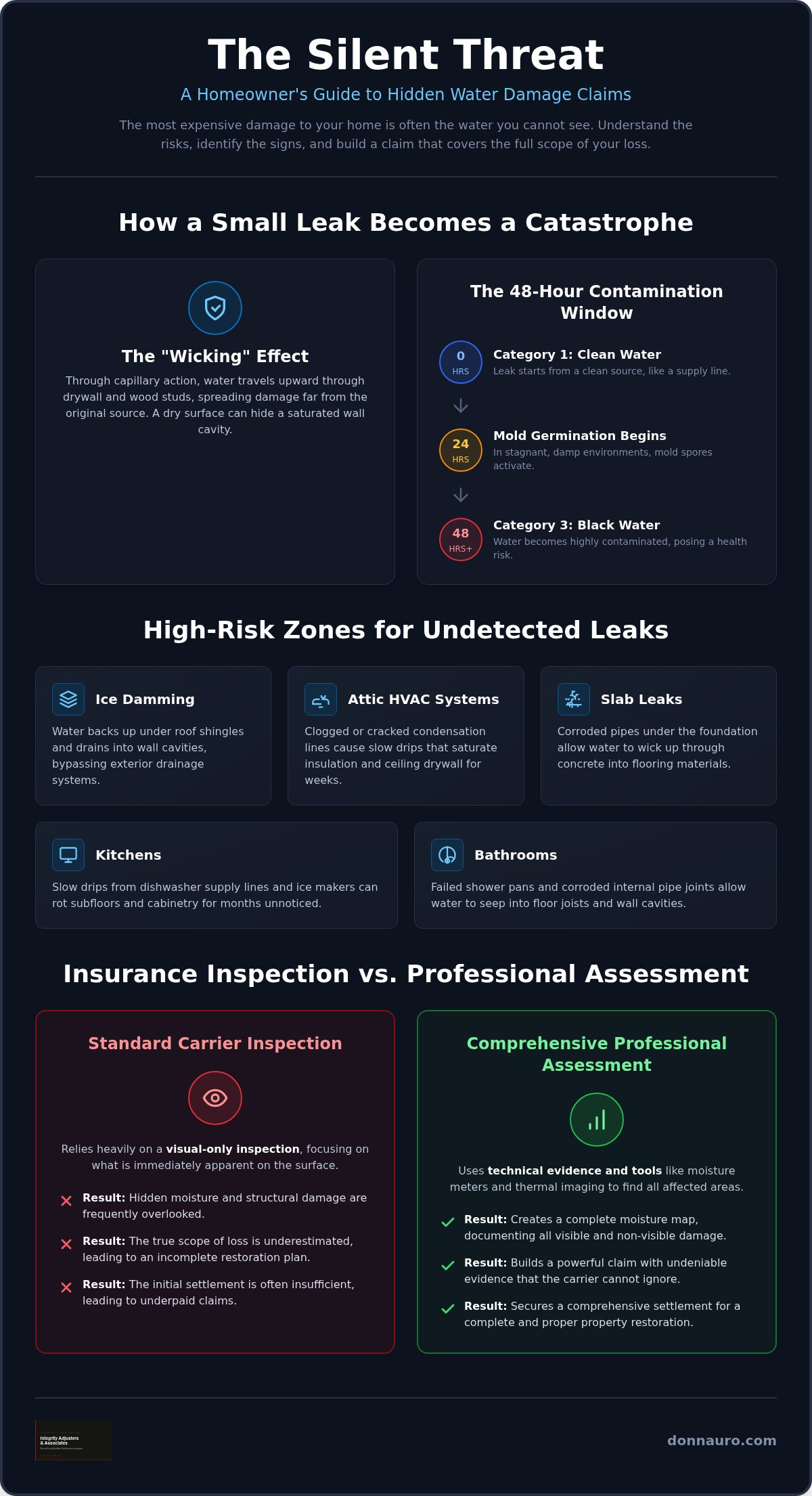
Hidden water damage isn't just a nuisance; it's a structural threat. It occurs when moisture remains trapped in structural cavities, subflooring, or insulation, far from the reach of standard airflow. Understanding what constitutes water damage is essential for any homeowner facing a potential loss. While a flood is obvious, the slow, silent seepage behind your walls is often more destructive over time. We refer to this as the "Silent Killer" of property value. A small pinhole leak in a copper pipe can go undetected for months. By the time you notice a soft spot on the floor or a stain on the ceiling, the wood studs may already be rotting. This delay complicates a hidden water damage insurance claim, as carriers often argue the damage was preventable or pre-existing.
New Jersey’s humid climate creates a perfect environment for microbial growth. Mold spores germinate quickly in dark, damp spaces, leading to serious health implications. Respiratory issues and allergic reactions often stem from moisture hidden behind the drywall that you can't see but certainly breathe. Beyond health, the financial impact of delayed claims is severe. Secondary damage, such as warped subfloors or compromised foundations, can double or triple the cost of restoration if not addressed immediately.
The Science of Secondary Damage
Water doesn't stay where it lands. Through capillary action, moisture travels upward through drywall and wood. This wicking effect can damage areas feet away from the original leak. You have a narrow 24 to 48 hour window before mold begins to germinate in stagnant environments. Industry standards distinguish between Category 1 water, which is clean, and Category 3 water, which is highly contaminated. If a clean leak isn't dried immediately, it quickly degrades into a Category 3 black water risk as it interacts with building materials and dust. This transition drastically changes the scope of your claim and the safety of your home.
Why Homeowners Overlook Hidden Leaks
Many homeowners dismiss musty odors as a typical "old house" smell. This is a mistake. Odors are often the first sign of a hidden water damage insurance claim in the making. Another common error is patching a visible water spot with paint without investigating the source. Covering the stain doesn't stop the rot inside the wall. A surface that feels dry to the touch can still hide a saturated wall cavity. Without professional moisture mapping, you are essentially leaving a ticking time bomb inside your home's structure.
Common Locations for Undetected Moisture in NJ Homes
New Jersey homes face a unique set of environmental stressors. From coastal humidity to intense freeze-thaw cycles, moisture finds its way into the most inaccessible parts of a structure. Identifying these high-risk zones is the first step in building a successful hidden water damage insurance claim. Many homeowners focus on visible puddles, but the real threat often lies behind window flashing or under kitchen islands where air circulation is non-existent. Water doesn't stay where it lands. It migrates through the path of least resistance, often settling in structural voids that never dry on their own.
In the Northeast, ice damming is a frequent contributor to internal losses. When snow melts and refreezes at the gutters, water backs up under the shingles. It then drains directly into wall cavities, bypassing the exterior drainage system. This often triggers a complex hidden water damage insurance claim because the damage is internal and invisible to the naked eye. Similarly, HVAC systems located in attics often have condensation lines that clog or crack. These slow drips saturate insulation and ceiling drywall over several weeks before any visible staining appears. In older New Jersey residential properties, slab leaks are a persistent issue. Copper pipes buried beneath the concrete foundation eventually corrode. This allows water to wick upward through the slab and into your hardwood or carpeted flooring.
Kitchen and Bathroom Cavities
- Dishwasher Supply Lines: A slow drip at the supply line rots the subfloor and cabinetry for months without being noticed.
- Shower Pan Failures: When the waterproof membrane beneath the tile cracks, water seeps into the floor joists. The evidence usually appears as a ceiling stain in the room below.
- Internal Wall Partitions: Corroded pipe joints inside walls are too small to trigger a sudden pressure drop but large enough to cause structural decay.
These areas are particularly dangerous because the moisture is trapped between non-porous materials like tile and cabinetry. This prevents evaporation and accelerates the growth of microbial colonies. By the time the smell becomes noticeable, the structural materials are often beyond simple cleaning and require full replacement.
Attics, Basements, and Crawlspaces
Ground saturation in New Jersey often leads to hydrostatic pressure against basement walls. This pressure forces water through porous concrete or foundation cracks. In the attic, roof leaks rarely drip straight down. Water often tracks along rafters, traveling several feet from the entry point before hitting the ceiling. This makes the source of the moisture difficult to document without professional assistance. High humidity in crawlspaces is another silent threat. It rots floor joists from the bottom up, compromising the stability of your home's main level. If you suspect your property has sustained such losses, it's vital to have a professional assessment of the damage to ensure your insurer accounts for every affected area.
Insurance Carrier Tactics vs. Professional Assessment
Carrier adjusters often prioritize the company's bottom line. Their "visual-only" inspection is a common tactic used to limit the scope of a hidden water damage insurance claim. If they can't see the water with the naked eye, they often assume it doesn't exist. This approach ignores the reality of moisture migration behind drywall and under flooring. A company adjuster works for the insurer; their primary goal is to settle the claim quickly and economically. In contrast, a public adjuster acts as your advocate. We prioritize the full restoration of your property by uncovering the damage the carrier chooses to ignore. We act as a professional buffer, ensuring the insurer’s assessment matches the actual physical reality of your home.
In New Jersey, carriers frequently use the "wear and tear" or "gradual seepage" exclusion to deny hidden leak claims. They argue that a leak was a long-term maintenance issue rather than a sudden, covered event. Without professional representation, it's difficult for a homeowner to counter this narrative. We use methodical documentation to prove the timeline of the loss. This ensures your claim isn't dismissed on a technicality. Professional claim advocacy is essential within the context of New Jersey property insurance to ensure policyholders receive the full benefits they've paid for. We provide the stability and expertise needed to challenge these institutional tactics effectively.
The Problem with the Carrier’s Estimate
Insurers rely on software like Xactimate to calculate payouts. While the tool is standard, it's often used to under-scope a hidden water damage insurance claim by omitting labor for structural drying or necessary material removal. Carriers also use the "pre-existing condition" trap. They claim old pipes or roof wear caused the damage to avoid paying for the actual loss. Often, they recommend "drying in place." This is usually an insufficient fix for moisture trapped inside insulation, which eventually leads to mold and structural decay. These estimates rarely account for the full technical requirements of a comprehensive restoration.
The Public Adjuster Advantage
We build claims on forensic evidence. We don't rely on visual cues alone. Instead, we use moisture mapping and thermal technology to prove where water has traveled. This creates a factual record that the carrier cannot easily dismiss. We understand the specific nuances of New Jersey property policies and act as a shield against institutional delays. Our goal is to bring order to the chaos of the claims process, focusing on a comprehensive restoration rather than a quick patch. As your disciplined navigator, we ensure the insurer follows the terms of the policy you've consistently funded.
The Hidden Water Damage Claims Checklist
Proving a hidden water damage insurance claim requires a methodical approach that goes beyond visual inspection. You must act quickly to satisfy policy requirements while preserving the technical evidence needed for a full settlement. Carriers often look for reasons to minimize payouts, so your documentation must be indisputable from the start. This process brings order to the chaos of property loss and ensures you maintain control over the outcome.
- Step 1: Immediate Mitigation. Stop the source of the water immediately. While you must prevent further damage, don't discard failed plumbing parts or saturated materials until they are documented. These items are the physical evidence of your loss.
- Step 2: Comprehensive Visual Record. Capture high-resolution photos and video of the leak site. Document the entire room and any suspect areas where moisture might have migrated, such as baseboards and subflooring.
- Step 3: Technical Verification. Use specialized tools to find what the eye misses. This is where you bridge the gap between a denied claim and a successful settlement.
- Step 4: Professional Advocacy. Secure a professional assessment from a New Jersey public adjuster to validate your hidden water damage insurance claim. This provides a shield between you and the carrier’s interests.
- Step 5: Policy Compliance. Carefully review your "Duties After Loss" section. Missing a deadline or failing to provide a proof of loss can jeopardize your entire claim.
Forensic Documentation Techniques
Thermal imaging provides a non-destructive way to see temperature variances caused by moisture hidden behind surfaces. This technology allows us to "see" inside walls without tearing them down prematurely. Moisture meters then provide the hard data needed to prove a material is "wet" compared to a dry baseline. We also recommend logging the exact timeline of discovery. Document when you first noticed a smell or a soft spot. This helps combat the carrier's attempt to deny the claim based on "gradual damage" or "wear and tear" theories.
Essential Evidence for Your File
Your claim file must be bulletproof to withstand the carrier’s scrutiny. Include plumbing invoices that detail the specific repair made to the source of the leak. These receipts prove the loss was sudden and accidental. Expert reports on structural integrity or mold presence provide the professional validation carriers often try to bypass with their own internal adjusters. Finally, create a detailed inventory of personal property within the hidden zones. Even if an item looks fine on the surface, exposure to high humidity inside a wall cavity can cause long-term damage. If you are unsure how to document these technical details, request a professional claim review to protect your interests and ensure no damage is overlooked.
Navigating Your Claim with Integrity Adjusters & Associates
Managing a hidden water damage insurance claim in New Jersey requires more than just a checklist; it requires a strategic ally who understands the local regulatory environment. Integrity Adjusters & Associates provides that specialized expertise. We act as a dedicated shield for homeowners facing complex institutional systems. Our team brings order to the chaos of property loss by focusing on factual integrity and methodical documentation. Whether you're filing a new claim or need to re-open an underpaid one, we provide the stability and expertise needed to secure a fair resolution. We move you from a state of confusion to a state of clarity by acting as your disciplined navigator through the carrier’s system.
Our Methodical Advocacy Process
We build every case to exceed New Jersey standards for property loss documentation. This isn't just about taking photos. It involves a deep dive into the structural elements of your home to ensure every impacted area is recorded and valued correctly. We handle all direct negotiations with your insurance carrier on your behalf. This removes the burden from you and ensures the insurer cannot leverage your confusion to minimize your payout. By recording every affected joist, wall cavity, and subfloor, we create a narrative of loss that is impossible for the carrier to ignore. We specialize in the technical process of re-opening underpaid claims, ensuring that previously overlooked hidden damage is finally addressed and funded by your provider.
Take Control of Your Property Recovery
You should never feel pressured to accept the first settlement offer from your insurance company. These initial estimates often fail to account for the long-term structural implications of moisture trapped in structural cavities. We provide the peace of mind that comes from knowing a professional is auditing every line item of your claim. Our role is to ensure that your property restoration is comprehensive and that your settlement reflects the true cost of recovery. We act as a strategic buffer, protecting your interests while you focus on your family. If you suspect your insurance company has overlooked the full scope of your loss, it's time to secure professional advocacy. Speak with an Integrity Adjusters & Associates Today to begin the process of professional validation and recovery.
Secure Your Home’s Future with Professional Advocacy
Hidden moisture is a silent threat to your property's value and structural safety. By the time damage becomes visible, the decay is often advanced. You now have the tools to identify high-risk zones in New Jersey homes and understand the technical documentation required for a successful hidden water damage insurance claim. Success depends on moving quickly and using forensic evidence to challenge the insurer’s visual-only inspections. We work for you, not the insurance company, providing the independent representation needed to navigate complex institutional systems.
Integrity Adjusters & Associates acts as your strategic shield. Our methodical documentation process ensures every impacted area is accurately valued, protecting you from under-scoping tactics. Don't settle for a partial recovery when professional advocacy can secure the full settlement you deserve. We bring order to the chaos of property loss and provide the stability required to move forward with confidence.
Get a Professional Claim Assessment from Integrity Adjusters to ensure your property restoration is comprehensive. You've worked hard to maintain your home; we'll work hard to ensure it's fully restored.
Frequently Asked Questions
Does homeowners insurance cover water damage that is not visible?
Standard New Jersey homeowners policies typically cover water damage that is not visible, provided the cause was sudden and accidental. If a pipe bursts inside a wall, the resulting damage to structural cavities and insulation is generally covered. However, insurance carriers often use the "gradual seepage" exclusion to deny a hidden water damage insurance claim. Professional documentation is required to prove that the moisture intrusion occurred within the policy's covered timeframe and wasn't a maintenance failure.
How do I prove hidden water damage was sudden and accidental?
Proving a loss was sudden requires a combination of physical evidence and professional validation. You should keep the failed plumbing part and secure a detailed invoice from your plumber describing the specific break. In New Jersey, we use moisture meters and thermal imaging to establish a clear timeline of the intrusion. This technical data demonstrates that the damage is a direct result of a specific incident rather than years of neglect or wear and tear.
What happens if my NJ insurance claim for water damage is denied?
If your claim is denied, you have the right to challenge the insurer's decision through an appeal or by re-opening the file. Carriers often deny claims based on a "visual-only" inspection that fails to account for moisture trapped in subflooring or wall cavities. A public adjuster can conduct a forensic review of the denial letter and provide the methodical evidence needed to overturn the decision. This ensures your property rights are protected under New Jersey insurance standards.
Can I hire a public adjuster after the insurance company already inspected my home?
You can hire a public adjuster at any stage of the process, even after a company adjuster has inspected your property. Many New Jersey homeowners seek independent advocacy after receiving an underpaid settlement or a formal denial. We can step in to re-evaluate the scope of work and negotiate directly with the carrier. It's often necessary to re-open the claim once the true extent of the hidden moisture is professionally documented.
How much does a public adjuster cost for a hidden water damage claim?
Public adjusters typically operate on a contingency basis, meaning their fee is a percentage of the total settlement amount recovered from the insurance company. This fee structure aligns our interests with yours; we only succeed when you receive a fair payout. You don't have to pay out-of-pocket upfront for these services. This allows you to secure professional advocacy for your hidden water damage insurance claim without increasing your immediate financial burden during a crisis.
Is mold covered under a hidden water damage insurance claim in NJ?
Mold coverage in New Jersey depends heavily on your specific policy language and endorsements. Many standard policies include a limited "mold sub-limit," which provides a specific dollar amount for remediation if the growth resulted from a covered water peril. However, if the carrier determines the water damage was gradual, they may deny the mold claim entirely. Methodical documentation of the initial leak is essential to trigger whatever mold coverage is available in your policy.
What is the difference between a company adjuster and a public adjuster?
A company adjuster is an employee of the insurance carrier and is tasked with protecting the insurer's financial interests. Their goal is to settle the claim according to company guidelines. A public adjuster is an independent professional licensed by the State of New Jersey to represent the policyholder exclusively. We act as your strategic shield, ensuring every structural loss is accurately recorded and that the final settlement reflects the actual cost of a comprehensive restoration.
How long do I have to file a hidden water damage claim in New Jersey?
New Jersey policies usually require you to report a loss "promptly" or "as soon as practicable." For hidden damage, the clock typically starts when you first discover the signs of moisture, such as a musty odor or a soft spot on the floor. Delaying the report can give the carrier grounds to deny the claim for "failure to mitigate." It's vital to review your policy's "Duties After Loss" section to ensure you meet all mandatory filing deadlines.


