

The insurance company's initial response to your property damage is rarely a roadmap to a full recovery. When you're staring at a soaked ceiling or warped flooring, the pressure to act quickly often leads to costly mistakes in the filing process. Seeking professional water leak insurance claim help is the only way to counter the "denial-first" strategy often employed by carriers. You likely feel overwhelmed by complex policy language and the aggressive tactics of adjusters who aim to minimize your payout.
It's frustrating to realize that the coverage you've paid for years might not protect you from hidden mold or structural issues unless you prove they exist. We understand that you want a settlement that covers every cent of your repair costs without the stress of managing endless paperwork. This guide provides the exact steps to document your loss, meet New Jersey's strict reporting timelines, and navigate the claims process with confidence. You'll learn how to identify overlooked damage and hold your insurer accountable to the terms of your policy. By following a methodical approach to evidence and documentation, you can secure the resources needed to restore your property entirely.
Key Takeaways
- Identify your "Mitigation Mandate" to stop insurers from denying claims based on avoidable secondary damage.
- Implement the "360-Degree Rule" for photography to capture the source, visible destruction, and hidden moisture that adjusters often overlook.
- Master New Jersey's strict claim processing timelines to ensure your carrier acknowledges and investigates your loss within the legal 10-day window.
- Discover how professional water leak insurance claim help acts as a strategic buffer against adjusters who prioritize their company's bottom line.
- Learn how to invoke the Appraisal Clause if you disagree with a settlement offer, providing a clear path to resolution without litigation.
Immediate Actions: What to Do When a Water Leak Occurs
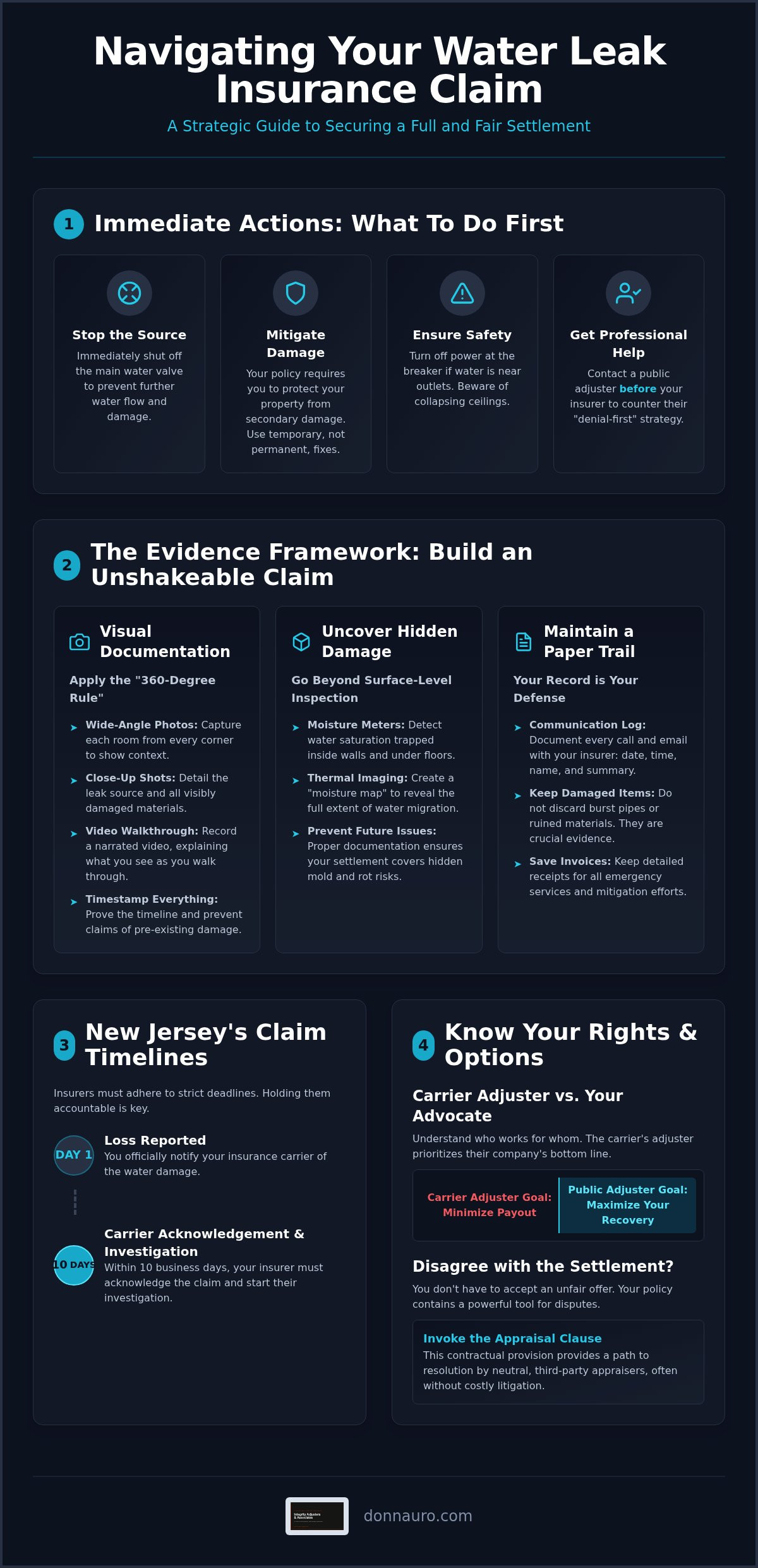
The moment you discover water where it shouldn't be, the clock starts on your insurance claim. Your first priority is stopping the flow. This means shutting off the main water valve immediately. Once the source is controlled, your focus must shift to protecting your property from secondary damage. This isn't just a suggestion; it's a contractual obligation known as the "Mitigation Mandate."
Securing professional water leak insurance claim help before contacting your carrier can fundamentally change the trajectory of your recovery. While your instinct might be to call your agent first, a public adjuster acts as your immediate advocate. They ensure that every step you take aligns with policy requirements. This early intervention prevents you from making statements or taking actions that an insurance company might later use to justify a claim denial. You need a buffer between your crisis and the insurer's bottom line.
The Difference Between Mitigation and Permanent Repair
Mitigation is the policyholder’s primary duty to prevent loss expansion. It involves temporary actions like extracting standing water, setting up dehumidifiers, or boarding up an opening. These steps are distinct from permanent repairs, such as replacing drywall or installing new flooring. You must never rush into permanent fixes before the insurance company’s adjuster has inspected the site. To understand the full scope of risks, including structural decay and mold growth, it helps to review the technical definition of What is Water Damage? as it relates to property insurance.
Keep all damaged materials on-site. If you throw away a burst pipe or a section of ruined cabinetry, you destroy the evidence required to prove the cause of loss. Use temporary fixes to stabilize the environment, and keep detailed invoices for any emergency services you hire. These costs are typically reimbursable as part of the mitigation phase of your claim.
Safety First: Managing Immediate Risks
Water intrusion creates hidden hazards that require immediate assessment. If water has reached electrical outlets or is dripping through light fixtures, turn off the power at the breaker box. Don't enter flooded basements or kitchens if the electricity is still active. Structural integrity is also a concern; saturated ceilings can collapse without warning under the weight of trapped water.
Health risks are equally critical. Professionals categorize water based on its contamination level. "Category 3" water, often called black water, contains unsanitary agents and bacteria from sewage or ground surface water. This requires specialized handling. If you're dealing with anything beyond a clean pipe burst, seek expert water leak insurance claim help to ensure the carrier pays for the high cost of professional biohazard extraction and sanitization.
The Evidence Framework: Documenting Your Water Leak Claim
Evidence is the only objective truth in an insurance dispute. Without it, your claim relies entirely on the carrier adjuster's interpretation of the scene. Professional water leak insurance claim help focuses on building a file that makes denial difficult for the insurer. You must start the documentation process before any cleanup crews move or remove saturated items. This creates a baseline for the total scope of the loss.
Visual Documentation Strategies
Follow the "360-degree rule" for every affected room. Take wide-angle photos from each corner to establish the context of the damage. Once the room is captured, move in for close-up shots of the leak source and the specific materials affected, such as warped baseboards or stained drywall. Record a video walkthrough and narrate exactly what you see. Timestamping every piece of digital evidence is non-negotiable because it proves the timeline of the loss and prevents the insurer from claiming the damage was pre-existing or caused by long-term neglect.
Professional Assessments and Moisture Logs
Water often migrates into areas the human eye cannot reach. This is why you need a professional moisture map of your floors and walls. Using moisture meters and thermal imaging cameras reveals pockets of saturation trapped inside wall cavities or under subflooring. If these areas aren't identified and properly dried, you risk the rapid onset of mold and wood rot. Documenting these "invisible" issues ensures your settlement covers the full cost of remediation, not just the visible surface repairs.
Maintain a rigorous paper trail for every interaction. Log the date, time, and name of every insurance representative you speak with. Create a detailed inventory of damaged personal and business property, noting the age and original cost of each item. Keep every receipt for mitigation supplies or emergency services. Following the specific New Jersey Insurance Claim Regulations is essential for protecting your rights during this process. These rules dictate how and when an insurer must respond to your evidence.
Managing this level of detail while dealing with property loss is exhausting for any policyholder. Our team at Integrity Adjusters & Associates can take over the documentation process to ensure no technical detail is missed. We track humidity levels during the drying process and cross-reference them with industry standards to prove when a structure is truly dry. This methodical approach forces the carrier to acknowledge the actual scope of your loss rather than relying on a surface-level inspection.
Why Carrier Adjusters Often Underestimate Water Damage
Carrier adjusters aren't your allies. They're employees or contractors for the insurance company. Their primary metric for success is often how effectively they can limit the carrier’s financial exposure. This inherent conflict of interest means their initial estimate is frequently the lowest possible number they can justify. Professional water leak insurance claim help provides a necessary counter-balance to this "company man" approach. It ensures your interests are represented by someone whose goal is your full recovery, not the insurer's profit margin.
Low-ball tactics are common in the industry. Adjusters might apply heavy depreciation to materials that were in excellent condition. They often miss critical line items like the labor required for content manipulation or the specific costs of professional-grade drying equipment. Perhaps most dangerous are "surface-only" settlements. If an adjuster only pays for a coat of paint and a new piece of carpet, they're ignoring the structural dampness trapped in your wall studs or subfloor. This leads to mold and rot that won't be covered in a future claim.
The "Wear and Tear" Trap
Insurers frequently use pre-existing conditions to deny valid claims. They'll argue that a pipe burst was actually a result of years of corrosion or "wear and tear," which are standard exclusions. Standard New Jersey homeowners policies typically define covered events through a "sudden and accidental" clause, meaning the damage must occur abruptly rather than through gradual seepage over time. Differentiating between a sudden failure and long-term neglect requires technical expertise and methodical evidence. Without a professional advocate, you're left to argue technical plumbing failures against a seasoned corporate adjuster who is trained to find reasons for denial.
Hidden Costs and Omitted Line Items
The cost of matching is a major point of contention. If a leak ruins twenty square feet of a continuous hardwood floor, you can't simply patch it with new wood that doesn't match the original grain or finish. Most policies require the insurer to restore the property to a "uniform and consistent" appearance. This often means replacing the entire floor, not just the damaged section, to maintain the home's value. Adjusters frequently "forget" this requirement in their initial estimates.
Adjusters also frequently overlook the high labor costs associated with monitoring specialized drying equipment. They might offer a flat fee that doesn't account for the daily site visits required to check moisture levels. Public adjusters use Xactimate, the same software carriers use, to ensure every line item reflects current, industry-standard pricing for your specific New Jersey zip code. This levels the playing field. It ensures your estimate reflects the actual market cost of restoration, not a discounted corporate figure.
Navigating New Jersey Insurance Claim Regulations
New Jersey law provides a specific framework of protections for property owners. Understanding these regulations is essential for holding carriers accountable to their contractual duties. If you're struggling with a delayed response or a silent adjuster, professional water leak insurance claim help ensures your carrier adheres to the timelines established by the state. These rules exist to prevent insurers from using stall tactics to pressure you into a lower settlement.
NJ Department of Banking and Insurance (DOBI) Standards
The New Jersey Administrative Code dictates exactly how insurers must operate. Under N.J. Admin Code 11:2-17.6 and 11:2-17.7, carriers must acknowledge your claim and reply to your communications within 10 days of receipt. They're also required to begin an investigation within that same 10-day window. Once you provide a properly completed proof of loss, the insurer has 30 days to complete their investigation. If the claim is not paid upon completion, the insurer must explain why in writing within 45 days. Once a settlement is reached, payment must be issued within 10 days.
Policyholders also benefit from a generous statute of limitations. In New Jersey, you have 6 years from the date of the loss to commence a lawsuit for property damage. However, waiting this long is never advisable. Evidence disappears and mold spreads. Prompt action is always the best strategy for a full recovery. If you feel your rights are being ignored, you have the right to file a formal complaint with the DOBI to trigger a regulatory review of your file.
The Appraisal Clause and Dispute Resolution
If you and your insurer disagree on the value of the loss, you don't necessarily have to go to court. Most New Jersey policies include an Appraisal Clause. This is your right to a second opinion. It allows both parties to hire independent appraisers to determine the value of the damage. If the appraisers can't agree, an impartial umpire makes the final decision. It's a faster, often more cost-effective way to secure a fair settlement when the carrier's estimate is too low.
Commercial Property Considerations in NJ
Business owners face additional layers of complexity. A leak in a retail space or warehouse doesn't just damage the structure; it halts revenue. Business Interruption coverage is critical for NJ business property claims. You must prove the exact amount of lost income resulting from the water damage through detailed financial logs. In multi-family buildings in urban centers like Camden, determining responsibility between landlords and tenants requires a precise review of lease agreements and master policies. Industrial water damage also carries the risk of ruined inventory and specialized machinery that requires expert valuation.
Local climate factors also play a role in your claim. New Jersey's freezing winters lead to burst pipes, while coastal areas like Manasquan face high humidity that accelerates mold growth after a leak. Whether you're managing a residence or a commercial facility, our team at Integrity Adjusters & Associates provides the local expertise needed to navigate these NJ-specific challenges. We act as your strategic navigator through the DOBI standards to ensure no deadline is missed and every right is protected.
Professional Advocacy: Securing a Fair Water Leak Settlement
The transition from documenting damage to negotiating a settlement is where many policyholders lose momentum. Facts and photos are essential, but they don't speak for themselves in a corporate environment. Professional water leak insurance claim help bridges the gap between a pile of evidence and a check that covers the actual cost of restoration. Integrity Adjusters & Associates acts as your dedicated shield, ensuring that your claim is never reduced to a series of low-ball estimates or overlooked line items. We handle the carrier so you can focus on restoring your life.
Industry data consistently shows that policyholders with professional representation receive significantly higher average settlements. This isn't because of luck; it's because public adjusters identify the "invisible" costs that carrier employees are trained to ignore. We rebuild your claim from the ground up, using industry-standard pricing and technical moisture logs to prove the necessity of every repair. By removing the burden of communication from your shoulders, we eliminate the risk of you saying something that could inadvertently jeopardize your coverage.
Building the Comprehensive Claim Package
Success in a water damage claim requires a synthesis of evidence, local building codes, and precise policy interpretation. We don't just send photos; we build a winning argument. This package includes a detailed scope of work that accounts for matching materials, labor for content manipulation, and the technical requirements of professional drying standards. During the negotiation phase, we meet the carrier adjuster on equal footing. We speak their language and use the same valuation software they do, which forces them to justify any attempt at a reduction. Integrity Adjusters & Associates ensures all property losses are accurately recorded by cross-referencing on-site evidence with specific policy endorsements and current market material costs.
Next Steps: Get Your Claim Reviewed
Before you sign a release or accept a settlement offer, you must understand if you're being underpaid. Many homeowners accept the first check out of a desperate need to start repairs, only to find that the funds run out before the work is finished. A professional review can identify these shortfalls before it's too late. We provide local New Jersey expertise for both residential and commercial property owners who need a strategic ally in their corner.
Don't leave your recovery to the discretion of an insurance company whose interests are diametrically opposed to your own. A methodical, evidence-based approach is the only way to secure the full value of your policy. We are ready to review your claim and provide the disciplined navigation required to bring order to the chaos of property loss. Protect your investment—contact Integrity Adjusters & Associates for a claim consultation today.
Secure Your Full Property Recovery
Restoring your property requires more than just cleaning up water. It demands a rigorous adherence to the mitigation mandate and a methodical approach to evidence that leaves no room for carrier disputes. You've learned how to identify hidden moisture and why New Jersey's specific claim timelines are your most powerful tool for accountability. Professional water leak insurance claim help transforms a stressful, lopsided process into a strategic path toward a fair settlement. Our team handles the fine print so you can focus on your home or business.
Integrity Adjusters & Associates specializes in residential and commercial property advocacy throughout New Jersey. We act as your dedicated buffer, navigating the complex insurer system so you don't have to. Our "no recovery, no fee" model ensures that our interests are perfectly aligned with your successful outcome. You deserve a settlement that covers every necessary repair without the burden of corporate negotiation. We bring order to the chaos of property loss by focusing on the facts and the technical details of your policy.
Get Expert Help with Your Water Leak Claim. Your recovery starts with a disciplined plan and an expert ally in your corner.
Frequently Asked Questions
What is the first thing I should do if I find a water leak?
Stop the water source immediately by shutting off the main water valve. Once the flow is controlled, you must perform emergency mitigation to prevent further damage, as required by your policy terms. Take clear photos and videos of the standing water and the source before any cleanup begins. Seeking professional water leak insurance claim help early ensures you don't accidentally compromise your coverage through poor initial documentation or avoidable secondary damage.
Will my insurance rates go up if I file a water damage claim?
Filing a water damage claim can lead to a premium increase of 20% to 40% in many cases. Additionally, the claim will remain on your Comprehensive Loss Underwriting Exchange (CLUE) report for five to seven years. In New Jersey, having two or more water damage claims within a short window significantly increases the risk of a policy non-renewal. You should weigh the repair cost against the long term impact on your insurance costs.
How long do I have to file a water leak claim in New Jersey?
New Jersey law provides a six year statute of limitations for property damage claims. While this provides a long window for legal action, your specific insurance policy likely requires "prompt notice" of the loss. Delaying your claim can lead to a denial if the carrier argues that the delay caused additional, avoidable damage like mold or rot. It's best to act while evidence is fresh and the damage is clearly visible.
Can I hire my own contractor before the insurance adjuster arrives?
You can hire a contractor for emergency mitigation services, such as water extraction or drying, before the adjuster arrives. Your policy requires you to take these steps to prevent further loss. However, you should avoid starting permanent repairs, like replacing flooring or cabinets, until the insurance company’s adjuster has inspected the damage. Always keep detailed receipts and invoices for any emergency work performed to ensure you receive proper reimbursement during the settlement.
What happens if my insurance company denies my water damage claim?
If your claim is denied, request a formal letter explaining the specific policy language used for the decision. You have the right to dispute the denial through several channels, including the Appraisal Clause or a formal complaint with the New Jersey Department of Banking and Insurance. Professional water leak insurance claim help is often necessary at this stage to review the carrier's findings and provide technical evidence that counters their reasons for denial.
How is a public adjuster different from the insurance company’s adjuster?
A public adjuster works exclusively for you, the policyholder, while the insurance company’s adjuster works for the carrier. The carrier's adjuster is tasked with protecting the insurance company's interests and limiting their financial exposure. A public adjuster from Integrity Adjusters & Associates acts as your advocate. We document the full scope of your loss and negotiate directly with the carrier to ensure you receive the maximum settlement allowed under your specific policy.
What does "sudden and accidental" water damage mean?
This refers to damage that happens abruptly and without warning, such as a burst pipe or a washing machine hose failure. Standard New Jersey policies generally cover these events. Conversely, gradual damage caused by a slow leak over months, seepage through a foundation, or lack of maintenance is typically excluded. Differentiating between a sudden burst and long term wear is a common point of contention that requires methodical documentation and expert evidence.
How much does it cost to hire a public adjuster for a water leak?
Public adjusters typically work on a contingency fee basis, meaning they earn a percentage of the final settlement amount paid by the insurance company. This "no recovery, no fee" model ensures that you don't pay out of pocket for advocacy services. If the adjuster doesn't secure a settlement for you, they don't get paid. This arrangement aligns the adjuster's goals with yours: securing the highest possible recovery for your property damage through accurate documentation.


