

Public adjuster fees can vary, so review the agreement carefully before hiring one. Before signing, understand how the fee is calculated and which claim amount it applies to.
Property damage can leave you managing repairs, records, and an insurance claim all at once. It’s reasonable to want a clear picture of the cost and the support a public adjuster can provide before deciding what to do next.
This article explains how public adjuster fees work in Bayonne, what to consider when reviewing an agreement, and where to find agency contact details. It also outlines the personal property claim types covered, including residential water, storm, and fire losses, so you can see how claim support may fit your situation.
Key Takeaways
- New Jersey does not set a legal percentage cap on public adjuster fees, so review the proposed fee terms carefully before signing.
- Read the contract to understand how the fee is calculated, what claim work it covers, and the conditions for ending the agreement.
- Compare the adjuster’s role with handling the claim yourself or seeking legal representation; each serves a different purpose.
- Before hiring, assess how the adjuster will document damage and build the claim, and confirm the support matches your property loss.
- Residential water, storm, and fire losses are among the personal property claims covered by the support described in this article.
Are public adjuster fees in New Jersey capped by law?
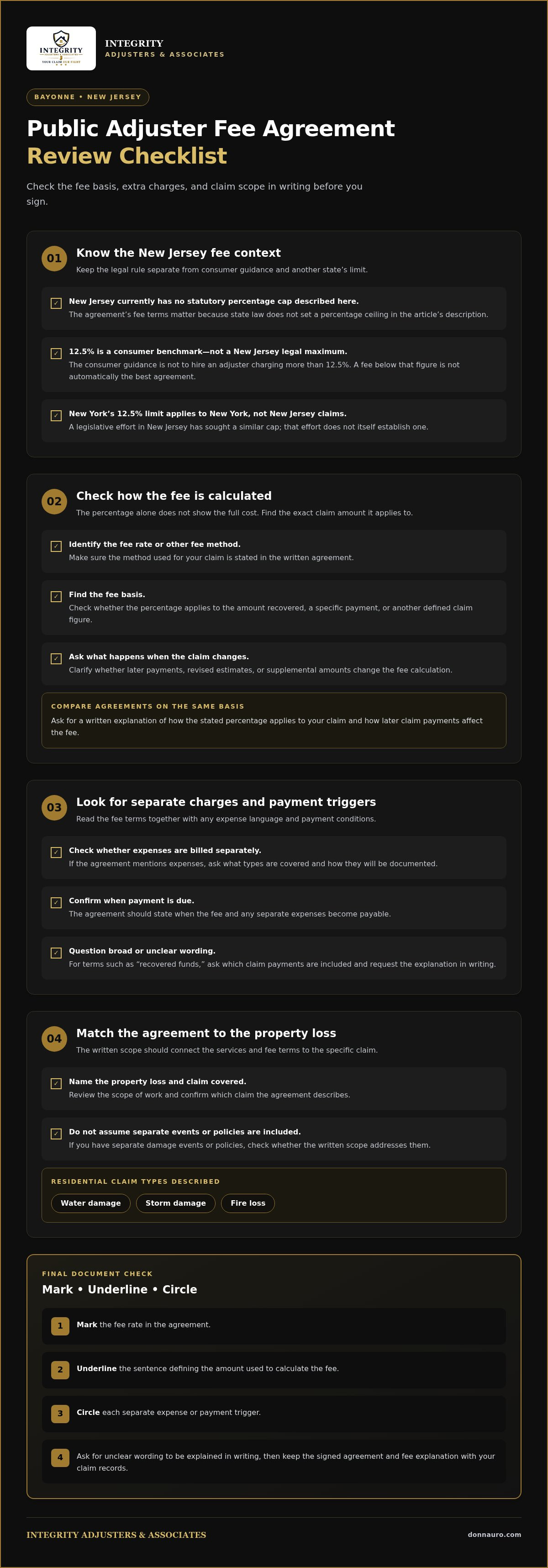
Bayonne NJ public adjuster fees are not subject to a state percentage cap under current laws. New Jersey places no legal limit on the percentage a public adjuster may charge a homeowner or business owner. That makes the written agreement especially important. The percentage alone does not explain the full cost; the fee calculation and its claim basis also matter.
A legislative effort in New Jersey has sought to establish a 12.5% cap, similar to New York’s limit. The effort does not itself create a cap. New York limits public adjuster fees to no more than 12.5%, but that rule does not apply to New Jersey claims. Bayonne property owners should distinguish another state’s law from New Jersey’s current rules.
Until consumer protections establish a New Jersey cap, the guidance for consumers is not to hire a public adjuster charging more than 12.5%. Treat that percentage as a consumer recommendation, not a legal maximum. A fee below 12.5% is not automatically the best agreement, either. The calculation method, covered work, and claim amount used to calculate the fee all affect what you pay.
Before signing, check how the agreed percentage applies to your claim. Does the contract calculate it on the amount recovered, another claim figure, or a defined part of the settlement? Ask how additional payments or revisions affect the calculation. These details help you compare agreements on the same basis, even though New Jersey sets no percentage ceiling.
- Identify the exact percentage stated in the agreement.
- Find the sentence defining the amount to which that percentage applies.
- Ask for a written explanation of how later claim payments affect the fee.
These steps do not change New Jersey law. They help expose the financial effect before you commit. A 12.5% recommendation is a practical benchmark, while New York’s 12.5% limit is a legal rule for that state. Neither should be confused with a New Jersey cap. If an agreement proposes a higher percentage, consider the consumer guidance carefully before proceeding.
For Bayonne homeowners and business owners, the core distinction is straightforward: New Jersey currently has no statutory percentage limit described here, while a legislative effort has sought one. Read the agreement line by line, calculate the fee using its stated basis, and compare the result with the 12.5% consumer recommendation. That gives you a concrete basis for evaluating the proposed terms.
What does a public adjuster contract in New Jersey need to disclose about fees?
Because New Jersey sets no percentage cap on public adjuster fees, pay close attention to the contract’s calculation terms. The agreement should state the fee rate, the amount used to calculate it, and when payment is due. Don’t rely on a verbal explanation that differs from the written terms. Compare the explanation with the document before signing.
Start with the fee basis. The contract should say whether the percentage applies to the amount recovered, a specific payment, or another defined claim figure. These terms can produce different results. For example, a fee based on a claim payment may differ from one based on a narrower portion. The distinction should be clear in the agreement.
Then look for details that affect the calculation:
- The percentage or other fee method used for the claim.
- The exact claim amount or payment to which the fee applies.
- Whether later payments, revised estimates, or supplemental amounts change the fee.
- Any expenses billed separately from the adjuster’s fee.
- When the fee and any separate expenses become payable.
Ask about any term that could change the final calculation. If the contract refers to “recovered funds,” for example, ask which claim payments that phrase includes. If it mentions expenses, check what types it covers and how they are documented. A broad label alone may not explain how the clause applies to your claim.
Review the agreement’s scope alongside its fee terms. Identify the property loss and claim covered, as well as the work the adjuster will perform. If you have separate damage events or policies, don’t assume one agreement covers them all. The written scope should connect each service and fee term to the specific claim.
Use a simple review sequence before signing: mark the fee rate, underline its calculation basis, and circle each separate expense or payment trigger. Ask for unclear wording to be explained in writing. Keep a copy of the signed agreement and written fee explanation with your claim records. You can refer to them when reviewing later payments and invoices.
This checklist helps you assess whether the financial terms are clear. It does not set a universal statutory disclosure formula for New Jersey. Focus on what the agreement says, how each term affects the calculation, and whether the written explanation matches the proposed fee arrangement.
These fee terms are separate from other New Jersey insurance and benefits questions. New Jersey requires drivers to have auto insurance, and Bayonne SHIP counselors assist New Jersey Medicare beneficiaries with Medicare Part D prescription drug coverage. Neither fact explains a public adjuster’s fee calculation. Refer to your signed agreement and written fee explanation when reviewing your claim.
Can homeowners cancel a public adjuster contract in New Jersey, and within what time period?
Don’t assume every New Jersey public adjuster agreement has the same cancellation window. The applicable deadline and process depend on the terms and circumstances of your agreement. Read the signed contract for its cancellation clause, notice instructions, and any deadline. Don’t rely on a verbal assurance or a deadline remembered from another agreement.
Look for a section titled “Cancellation,” “Termination,” or similar wording. Check when the cancellation period begins, how notice must be delivered, and whether the contract describes any consequences. If the clause refers to a triggering event, such as signing or receiving a copy, note the relevant date from your records and keep it with the agreement.
Before sending notice, follow these steps:
- Read the complete cancellation and termination language in the signed agreement.
- Note the stated deadline, required delivery method, and recipient.
- Prepare a written notice identifying yourself, the property, and the agreement.
- Send it using the method specified in the contract, and retain proof of delivery.
- Save the notice, delivery record, and any response with your claim documents.
For example, if the contract requires written notice to a named recipient, a phone call alone may not meet its instructions. Use the specified method and keep a copy of what you sent. If the agreement gives an address or email for notice, copy it accurately from the signed document rather than relying on an old message or business card.
Cancellation can also raise practical questions about claim materials and ongoing communications. List the documents already shared, such as photographs, estimates, and insurer correspondence, and keep copies. Check the agreement for terms about outstanding fees, expenses, or work completed before cancellation. Don’t assume those terms automatically end when you send notice.
If the contract’s deadline or procedure is unclear, keep the document and the dates connected to signing and delivery. Get unclear wording explained before relying on an interpretation. Make your cancellation notice clear and dated, and identify the agreement you intend to end. If you have multiple claims or agreements, name each separately to avoid confusion.
Use the deadline and notice process that apply to your specific agreement, not an assumed statewide number. Act promptly once you decide to cancel. Review the signed terms, send written notice as instructed, and retain proof of delivery. This creates a clear record of your decision and its timing.
How do public adjuster fees compare with attorney fees or doing an insurance claim yourself
These options involve different work, so compare the role and payment terms, not just the fee label. A public adjuster documents property damage and prepares a comprehensive claim for presentation to the insurer. An attorney provides legal representation, a distinct service. If you handle the claim yourself, you organize the evidence and communicate directly with the insurer.
Public adjuster fees are often structured as a percentage of an amount recovered, but the written agreement determines the specific calculation. Review the fee basis alongside the work covered. For example, a contract may define which claim payments count. That definition matters more than a headline percentage alone.
An attorney’s engagement agreement sets the terms for legal work. The scope may differ from claim documentation and adjustment, so the roles are not interchangeable. If a dispute involves legal questions, the issue is not simply which professional costs less. Consider whether the task calls for claim preparation, legal representation, or both distinct functions.
Handling a claim yourself avoids a public adjuster fee, but the claim work falls to you. You’ll need to photograph damage, organize receipts and estimates, track insurer communications, and explain how the evidence supports the claimed loss. For a water-damaged room, for instance, document affected materials and keep related repair estimates with the claim file.
Compare the three paths using these practical questions:
- Scope: Who will document damage, assemble records, and present the claim?
- Fee basis: What claim amount triggers a public adjuster’s fee, and when is it due?
- Legal work: Does the issue require legal representation rather than claim preparation?
- Your capacity: Can you maintain records and manage insurer communication alongside other responsibilities?
Consider a storm claim involving roof damage and interior staining. If you manage it yourself, you gather photographs, estimates, and correspondence. A public adjuster’s role is to document the property loss and build the claim for presentation. An attorney provides legal representation, not a substitute for either option.
For a sound comparison, put each option’s scope beside its payment terms. Check the public adjuster agreement’s calculation method, then assess the work you would do yourself. Keep legal representation separate in your comparison. The right fit depends on the claim tasks and whether you can complete them accurately and consistently.
Your time and the value of work transferred to a professional also matter. This is why it helps to calculate what would remain under the agreement rather than compare a fee percentage in isolation. The result depends on the hypothetical claim and fee; it does not establish what an adjuster or attorney will charge in another case. Consider both the cash outcome and whether you can manage the documentation and follow-up the claim requires.
What should Bayonne property owners check before hiring a public adjuster
Start with the loss and the work you need handled. A Bayonne homeowner with water damage may need help organizing photographs, estimates, and claim records. A business owner facing storm damage may need the affected building areas and business property clearly documented. Match the proposed work to the actual property claim before reviewing the agreement.
Next, review the written scope. It should identify the claim and describe the adjuster’s role in documenting and presenting the loss. If your property has separate damage events, such as an earlier leak and later storm damage, clarify which event the agreement covers. Don’t assume one claim file includes every loss.
Review the fee language alongside the scope. Identify the percentage or other calculation method, the amount it applies to, and any separate expenses. Ask for an example using the agreement’s terms. A written illustration can show how a supplemental payment or revised claim amount affects the calculation.
Check the proposed claim process, too. Ask how damage documentation will be organized, how estimates and insurer correspondence will be incorporated, and how you’ll receive updates. For a fire-damaged property, for example, the file should distinguish visible damage from other reported affected areas. Clear records make it easier to follow what has been presented and what remains under review.
Before signing, use this practical checklist:
- Confirm the agreement names the property loss and claim involved.
- Identify the work included and any tasks outside its stated scope.
- Mark the fee calculation basis, payment triggers, and separate expenses.
- Review how documents, estimates, and claim communications will be managed.
- Read cancellation terms and notice instructions before accepting the agreement.
Keep contact details organized once the claim is underway. Record the adjuster’s name, business contact information, and preferred method for sending claim documents. Store the signed agreement, photographs, estimates, and messages together in one claim folder. You’ll have a clear reference if questions arise about what was submitted or discussed.
For a commercial property claim, map the affected areas and business property before presenting the claim. Separate photographs and estimates by location or damage type. This practical organization links each item to the reported loss and makes missing records easier to spot.
Use these checks to decide whether the proposed scope and fee terms fit your claim. Discuss your property claim documentation as a next step if you need help organizing the loss details.
Integrity Adjusters & Associates: Residential Water Damage Claim Support
Integrity Adjusters & Associates helps New Jersey policyholders document property damage and build a comprehensive claim for presentation to the insurer. For homeowners with water damage, this support can help organize records of affected areas and property losses. The firm also supports residential storm and fire loss claims, as well as commercial fire loss claims.
Consider claim support when damage needs careful documentation and you want help assembling information for your insurer. Keep photographs, estimates, and claim correspondence together so property losses can be accurately recorded and presented.
Contact Integrity Adjusters & Associates to discuss support for your property insurance claim.
Take the Next Step With a Clear Claim Plan
Before moving forward, organize your damage records and identify the questions that matter most to your claim. A clear picture of the loss can make a discussion about Bayonne, NJ, public adjuster fees more useful and focused. Bring your photographs, estimates, insurer correspondence, and agreement together to discuss the claim using the same records.
Integrity Adjusters & Associates supports residential water, storm, and fire loss claims. The firm documents property losses and builds comprehensive claims for presentation to the insurance provider. This support can help when damage records need structure and the claim needs a clear, detailed presentation.
Decide what you need help organizing before taking the next step. Write down the affected areas, the documents you already have, and any unresolved claim questions. Then contact Integrity Adjusters & Associates to discuss your property claim and the support available for presenting it. A methodical start can help you move forward with greater clarity.
Frequently Asked Questions
How are public adjuster fees calculated in New Jersey?
In New Jersey, public adjusters traditionally charge a percentage of the amount recovered, with typical fees ranging from 10% to 12.5%. The contract defines the calculation basis, so review whether the percentage applies to total claim payments or another specified amount. For instance, if an insurer issues an additional payment after reviewing new damage records, the agreement’s wording determines whether that payment is included in the fee calculation.
Do Bayonne public adjusters charge a flat fee, hourly rate, or percentage of the claim?
Public adjusters traditionally charge a percentage of the amount recovered, though the contract states the specific fee method. Don’t assume a flat fee or hourly rate applies. Some public adjusters operating in New Jersey charge 35% to 50% for property claims, so compare the proposed percentage and its calculation basis carefully. Read the agreement to understand what claim payments count and whether separate expenses are described.
Can a public adjuster charge fees on the entire settlement or only the increase they negotiate?
The agreement’s fee language determines whether the calculation uses the entire settlement or only an increase attributed to the adjuster’s work. Check the clause defining the fee basis, especially if the insurer made an initial payment before you hired an adjuster. The contract should clarify whether that earlier payment is included when later claim funds are calculated. Compare the written terms with any explanation you received.


