

A denial letter is the insurer’s position, not a complete account of what happened to your property. A Union City NJ denied insurance claim appeal should start with the reason the insurer gives, then compare that explanation with the damage, policy language, and claim records. This helps you identify whether the dispute concerns coverage, the cause of damage, the extent of the loss, or missing information.
Keep the denial letter and policy together, note any dates or response instructions, and preserve photos, estimates, receipts, and insurer communications. If you’re unsure what the insurer relied on, make a list of the points that are unclear. A clear record gives you a practical basis for deciding what to do next.
This guide explains how to assess a property claim denial, organize evidence, and prepare a focused response. It also explains how public-adjusting advocacy can help document a loss and present a comprehensive claim, and how that role differs from legal representation. The next step should address the reason for the denial and the facts of your claim, rather than rely on a generic complaint.
Key Takeaways
- In a Union City NJ denied insurance claim appeal, first identify whether the insurer rejected the entire claim, only part of it, or specific damage.
- Keep the denial letter, policy, claim correspondence, and submission records together so you can track what the insurer reviewed.
- Match the stated denial reason to relevant policy language, damage evidence, and any unanswered questions before preparing a response.
- Choose your next step based on the issue: a documented reconsideration or public-adjusting advocacy may address claim evidence and damage scope, while legal questions call for an attorney.
- Use a document checklist to prepare for the next stage and understand the distinct roles of you, the insurer, a public adjuster, and an attorney.
Union City, NJ property insurance claim denied: what the decision means
A property claim denial is the insurer’s stated decision that some or all of the loss you submitted isn’t covered or supported as presented. It is a decision to examine, not a complete account of the damage itself. For a Union City homeowner or business owner, the first step is to identify exactly what the insurer decided and which policy language and claim information it relied on. The same careful review applies to water, storm, and fire damage.
What a property claim denial does, and does not, tell you
The insurer’s conclusion and the evidence behind it are separate things. A letter may say a cause of damage is excluded, that the loss falls outside the policy, or that the submitted information doesn’t establish the damage claimed. Those statements don’t, by themselves, show whether the evidence was complete or whether the cited wording applies to each damaged area. Understanding your insurance policy can help explain the role policy terms play, but your own policy and claim documents are the relevant materials for assessing your situation.
Distinguish a full denial from a partial denial or a disagreement about the damage’s scope. A full denial rejects the submitted claim as a whole. A partial denial accepts some items or damage while rejecting others. A scope dispute may arise when the insurer acknowledges damage but disagrees about its cause, extent, or the work needed. For a partial denial, list which items are accepted, disputed, or unexplained. A denial isn’t automatically improper or reversible; the facts, policy terms, and supporting records matter.
Read the denial letter before choosing your next step
Start with the exact wording, not an assumption about what the insurer meant. Mark the stated reason for the decision, any policy section or exclusion cited, and any information the insurer says is missing. Then compare those points with the claim you submitted. For example, if the letter disputes the cause of interior damage, note whether it explains the basis for that conclusion and addresses the areas or items in your documentation.
Record the letter’s date and claim number, along with any response instructions or dates mentioned. Check your policy for applicable response requirements and time limits. Don’t rely on a general deadline from another claim or source. If the explanation is unclear or appears inconsistent, send a concise written request asking the insurer to identify the specific policy language, damage, or records behind its position. Keep a copy of your request and proof of submission with the letter and policy documents.
A focused Union City NJ denied insurance claim appeal begins with this review. It helps you separate accepted damage from disputed issues and identify what needs clarification before you prepare a response. Keep the process factual: connect each question to the relevant policy wording and claim record. That foundation makes your next action more deliberate without assuming every denial has the same cause or solution.
How to appeal a denied insurance claim in Union City, NJ
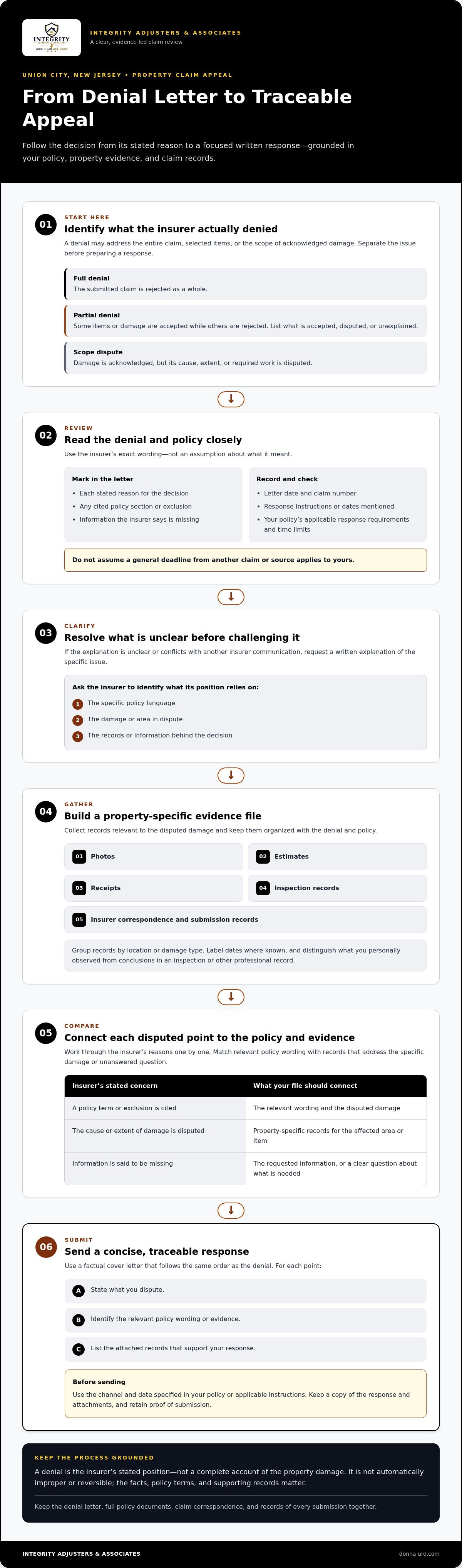
A focused response addresses the insurer’s stated concerns with relevant policy language and property-specific evidence. The process is not simply sending the same claim again. Review what was decided, clarify what remains uncertain, gather supporting records, compare them with the policy and denial, then submit a traceable written response. Follow your policy’s instructions and applicable current requirements rather than assuming a deadline or procedure from another type of claim.
- Review: Read the denial and mark each reason, cited policy term, and requested item of information.
- Clarify: If the letter doesn’t explain the decision or conflicts with another insurer communication, request a written explanation of the specific issue.
- Gather: Collect relevant photos, estimates, receipts, inspection records, and correspondence.
- Compare: Connect each disputed item to the policy wording and evidence that addresses it.
- Submit: Send a concise response through the channel and by the date specified in your policy or applicable instructions, and retain a copy.
Build the response around the insurer’s stated reason
Organize records so the reviewer can follow the connection between each disputed point and the evidence. Group photos, estimates, receipts, and inspection records by location or damage type, and label dates where known. For example, if the decision disputes the extent of water damage in a room, identify the affected area and attach records that document it. Separate what you personally observed from conclusions in an inspection or other professional record. If the denial doesn’t identify a clear policy basis, ask the insurer to explain it before deciding what to challenge.
Submit a clear, traceable appeal package
Use a factual cover letter that responds to the insurer’s reasons in the same order they appear in the denial. For each point, state what you dispute, identify the relevant policy wording or evidence, and list the attached records. Avoid broad claims that the decision is unfair without showing what information supports reconsideration. Keep the denial letter, full policy documents, claim correspondence, and records of every submission together. Save copies of all attachments and note when and how you sent the package.
Response channels and time limits can vary with policy terms and applicable requirements. Check your policy and the denial instructions for the right method and deadline. Don’t rely on guidance meant for a different type of insurance. HealthCare.gov’s How to appeal a denied insurance claim explains health coverage appeals, so use it as background only, not as a substitute for property-policy instructions.
In short: review the denial, clarify gaps, gather and compare property evidence, then submit a reasoned response with a record of what you sent. If organizing the loss documentation is the main challenge, property claim documentation support can help you prepare a more complete presentation of the damage.
Compare the denial reason with your property damage evidence
Once you have the insurer’s stated reason, test it against the exact policy language cited and the records that describe the damage. A disagreement may concern whether an exclusion applies, what caused the loss, how much damage occurred, or whether the insurer has enough information. These are different questions. A structured comparison helps you identify what the evidence supports, what remains unclear, and what needs qualified legal review.
| Denial reason | Policy language to review | Potentially relevant evidence | Question to resolve |
|---|---|---|---|
| Exclusion cited | The specific exclusion and any related definitions or exceptions in the policy | Photos, inspection records, incident details, and documents describing the damaged property | Does the cited wording address the particular damage and circumstances described? |
| Cause or timing disputed | Terms addressing covered causes of loss, exclusions, or timing requirements | Dated photos, maintenance records, prior condition information, and incident records | What evidence supports the insurer’s view of when or how the damage occurred? |
| Damage scope disputed | Coverage provisions and any relevant limits or conditions | The insurer’s estimate compared with photos, inspection records, and documentation of affected areas | Which rooms, materials, or items are included in one assessment but not the other? |
| Records considered incomplete | Policy provisions or claim instructions identifying the information at issue | Available receipts, estimates, photographs, reports, and prior submissions | Which specific records are missing, and can you provide them or explain why they’re unavailable? |
Match common denial explanations to useful records
For a cause or timing dispute, arrange dated photos and maintenance or incident records in chronological order. For a scope disagreement, compare the insurer’s estimate line by line with documented affected areas, noting items that appear omitted or differ in extent. If the insurer says records are missing, identify each requested item and whether you can supply it. For water-loss context, the residential water damage claim guide discusses documenting this type of property loss.
Separate covered damage questions from legal disputes
A factual disagreement about cause, documentation, or scope is not automatically a legal violation. The policy wording and claim facts determine whether a coverage position needs closer review. Don’t label a decision bad faith simply because you disagree with it or received an unfavorable outcome. Legal rights and remedies involve separate questions that require qualified legal analysis. Public-adjusting advocacy focuses on documenting property damage and presenting the claim; it isn’t legal representation.
For a Union City NJ denied insurance claim appeal, use the comparison to turn general frustration into specific questions: which policy term applies, which damage is disputed, and what evidence addresses that point? Keep the answers tied to the record. This creates a clearer basis for deciding whether the issue is primarily claim documentation, damage scope, or a legal question.
Choose the right next step for a Union City property claim
The right kind of support depends on what is actually disputed. If the main issue is missing documentation or an incomplete damage scope, strengthen the claim record. If the question involves how policy language applies, legal rights, or possible litigation, that is a separate legal matter. These paths can address different parts of the same dispute, but no representative can guarantee the insurer will change its decision.
| Next step | Best fit for the issue | What it focuses on |
|---|---|---|
| Prepare a reconsideration yourself | The denial is specific, and you can gather the relevant records | Responding to each reason with policy references and supporting evidence |
| Seek public-adjusting advocacy | Damage documentation, claim presentation, or scope is the central concern | Documenting the property loss, organizing a comprehensive claim, and navigating insurer communications |
| Seek legal advice | You need guidance about policy interpretation, legal rights, or litigation | Analyzing legal questions and potential legal options |
When public-adjusting advocacy may help with property claims
Public-adjusting advocacy is a fit when the challenge is building a clear, well-supported account of the property loss. An advocate can help document damage, organize claim information, present a comprehensive claim, and navigate communications with the insurer on the policyholder’s behalf. This role concerns claim advocacy, not legal representation or repair work. For a storm-related loss, the residential storm damage claim guide offers additional context on documenting that type of property claim.
When a coverage question calls for legal guidance
Questions about what a policy means in a particular dispute, what legal rights may apply, or whether to pursue litigation require qualified legal analysis. A disagreement about damage scope may call for better documentation; a dispute about legal obligations is different. Don’t treat an unfavorable decision alone as proof of misconduct or assume a particular remedy applies. A public adjuster can advocate on the property claim, but does not replace an attorney’s legal advice.
Before choosing, write down the unresolved issue in one sentence: “The estimate omits documented damage,” “The insurer disputes the cause,” or “I need advice about my legal rights.” That distinction can clarify whether your next move is a focused reconsideration, claim advocacy, or legal guidance. For help documenting and presenting a property claim, public-adjusting claim support is available.
Prepare your denied insurance claim for a stronger next step
A well-organized claim file makes it easier to explain what happened, track what the insurer has reviewed, and identify what remains unresolved. Before pursuing the next step in a Union City NJ denied insurance claim appeal, assemble one clear record instead of searching through scattered emails, photos, and paperwork. Keep originals safely stored and make a working copy you can share.
Assemble a usable claim file
Use this checklist to prepare the core records:
- Policy and denial: Include the relevant policy documents, denial letter, and claim number.
- Insurer communications: Gather emails, letters, notes of calls, and any written clarification or response.
- Claim submissions: Add estimates, receipts, invoices, and copies of materials already sent to the insurer.
- Damage documentation: Collect dated photographs and relevant inspection or mitigation records that show the property’s condition.
- Loss timeline: Note when the damage occurred or was discovered, when inspections took place, what you submitted, and when the insurer responded.
Label files by date and location where possible. A photo identified as “kitchen ceiling, date taken” is easier to connect to a claim issue than an unlabeled image in a large camera folder. Keep a separate list of records you know exist but haven’t located, along with documents you can’t obtain. This helps distinguish an actual gap from information that may already be in the insurer’s file.
Know who does what
Each party has a distinct role. The policyholder reports the loss, provides available information, and makes decisions about the claim. The insurer evaluates the submitted claim under the policy and communicates its position. A public adjuster advocates on the property claim by helping document the loss, organize claim information, and present a comprehensive submission. An attorney provides legal advice and representation on legal questions. Public adjusting is not legal representation, and neither role guarantees a particular claim outcome.
Get help organizing a Union City property claim
If the main challenge is documenting the damage or presenting a complete residential or commercial property claim, Integrity Adjusters & Associates provides public-adjusting advocacy to help policyholders build the claim record and navigate insurer communications. The firm supports residential water, storm, and fire loss claims, along with commercial fire, storm, and business property claims. Its role is claim advocacy, not legal representation or repair work.
Bring your organized file and identify the questions still unresolved. Discuss your property claim with Integrity Adjusters & Associates to explore support with documenting the loss and presenting your property claim.
Move forward with a clear claim strategy
The next step doesn’t need to solve every issue at once. Identify the key question standing between your property loss and a clear response: Is the damage fully documented? Does the claim presentation address the insurer’s concerns? Or do you need a legal professional to assess your rights? Keeping that distinction clear can help direct your effort where it belongs.
A Union City NJ denied insurance claim appeal is strongest when the next action follows the evidence and the specific issue in dispute. Integrity Adjusters & Associates provides residential and commercial property claim advocacy, helping policyholders document losses, present comprehensive claims, and navigate insurer communications. Public adjusting is claim advocacy, not legal representation, and no change in the insurer’s decision can be guaranteed.
You don’t have to make sense of a complicated property claim alone. Discuss your property claim with Integrity Adjusters & Associates to take a practical next step with a clearer plan.
Frequently Asked Questions
Can an insurance company deny only part of a property claim?
Yes. An insurer may accept some reported damage while disputing other items, causes, or amounts. For example, it might recognize damage in one room but question whether damage elsewhere came from the same event. Identify each accepted and disputed item separately, then match the disputed items to relevant policy wording and evidence. A partial payment or acceptance doesn’t necessarily resolve every part of the claim, so review the decision and its instructions carefully.
How long do I have to appeal a denied property insurance claim in New Jersey?
There isn’t one deadline that applies to every New Jersey property claim. Check the denial letter and policy for appeal instructions, response dates, and any other time limits that may affect your rights. Record when you received the letter and when you send any response. If a deadline is unclear, seek qualified guidance promptly rather than relying on a general estimate online. A written request for clarification may not change or pause a deadline.
Should I accept an insurer’s explanation of a denied claim without asking questions?
No. If the explanation doesn’t identify the policy wording, facts, or damage at issue, you can ask the insurer to clarify its position in writing. Keep your request focused, such as asking which policy provision applies to a specific damaged area. Save the request and the insurer’s reply with your claim file. A clarification request doesn’t prove the decision is wrong or guarantee reconsideration, but the answer may show what evidence or issue remains unresolved.
What documents should I include when appealing a denied property insurance claim?
Include records that directly address the insurer’s stated reason. Along with your policy and denial letter, you might submit dated photos, an inspection report, invoices, receipts, or an estimate identifying a disputed area. Label each attachment and explain briefly what it shows. For example, connect a photograph to the room and damage it depicts rather than sending a folder of uncaptioned images. Keep the originals where practical, plus a complete copy of what you submit.
Can a public adjuster help after a property insurance claim is denied?
A public adjuster can help with property-loss documentation and claim presentation. For instance, if the disagreement centers on whether all damaged areas are documented, an adjuster’s claim advocacy can help organize the loss information and insurer communications. Public adjusting is distinct from legal representation. It doesn’t guarantee that the insurer will revise its position or pay a particular amount. Legal questions should be addressed by qualified legal counsel.
Does a denied insurance claim automatically mean the insurer acted in bad faith?
No. A denial, a disagreement about damage, or an unsatisfactory outcome doesn’t by itself establish bad faith. The reasons for the decision, the policy terms, the evidence, and the insurer’s conduct may all matter to a legal analysis. Keep communications and claim records factual and complete. Avoid making legal accusations based only on the result. If you’re concerned about legal rights or remedies, consult qualified legal counsel for advice based on the specific circumstances.
What should a Union City homeowner do if the insurer says damage was pre-existing?
Respond with records that help show the property’s condition and the timing of the reported loss. Depending on what’s available, that could include earlier dated photos, inspection documents, maintenance records, or information about when the damage was first observed. Put the materials in date order and explain what each one shows without claiming more than it proves. If records are incomplete, state that plainly and ask the insurer what specific information supports its pre-existing-damage position.
Can I appeal a denial if I already received payment for part of the damage?
Possibly. A payment for some damage doesn’t necessarily resolve every disputed item, so review the insurer’s written decision and how it describes the payment. Compare the items addressed with those still in question. Before signing a release or settlement document, read its terms carefully and determine what claims or damage it covers. If the wording is unclear or may affect your rights, get qualified guidance before signing. Keep a copy of the payment documents and any related correspondence.


