

New Jersey ranks first in the United States for the costliest flood damage per square mile. For a local business owner, this data represents a significant threat to your livelihood. When water breaches your property, the physical cleanup is often the simplest part of the ordeal. The real challenge lies in the financial aftermath. You still face fixed costs, rent, and payroll while your revenue has stopped. You need professional commercial flood damage claim help to ensure these mounting expenses don't lead to permanent closure.
It's exhausting to fight an insurer that disputes your projected revenue or hides behind complex policy language regarding the period of restoration. We understand that every day your business remains inactive is a day of lost opportunity. This guide provides the strategic roadmap you need to navigate these complexities and secure the full financial recovery your New Jersey business deserves. You'll learn how to document lost net income accurately, claim reimbursement for extra expenses, and hold your carrier accountable to the specific terms of your policy.
Key Takeaways
- Business interruption claims are often the most contested part of a property loss. Learn why insurers challenge these figures and how to defend your revenue.
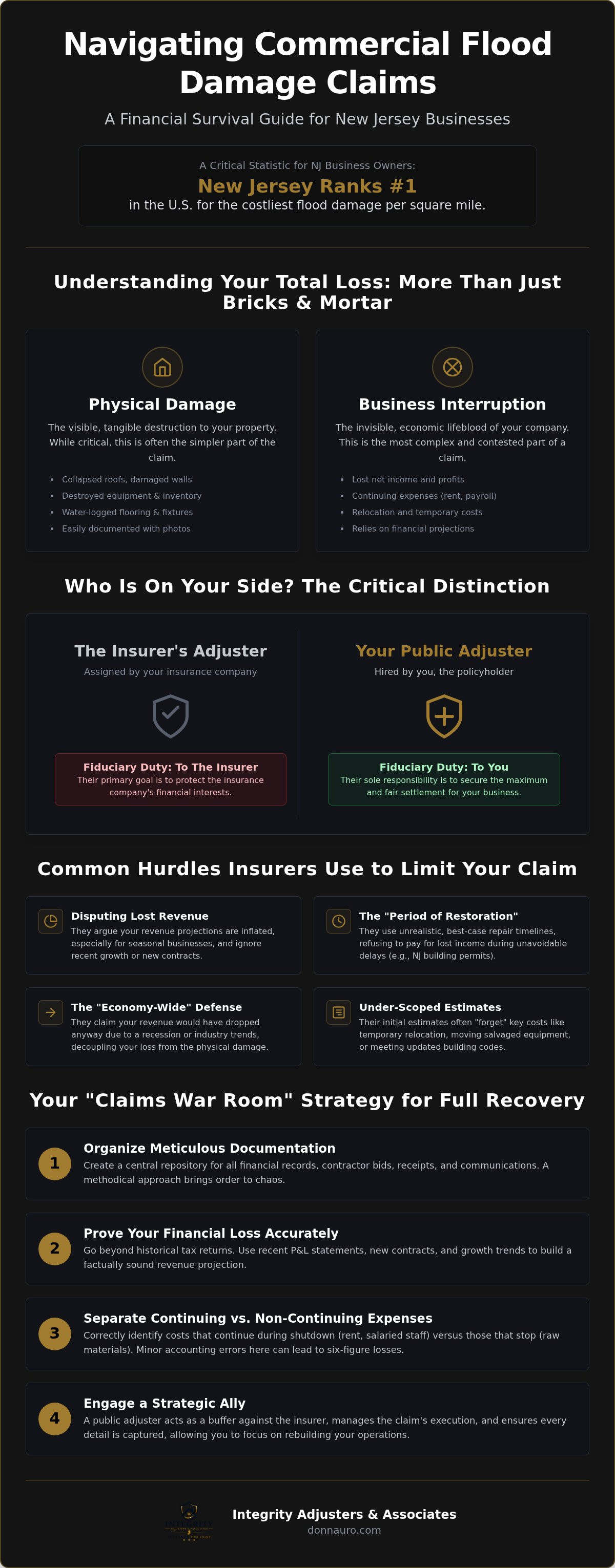
- A company adjuster works for the insurer. A public adjuster works for you. This distinction is critical for your business's financial survival.
- Professional commercial flood damage claim help prevents the minor accounting errors that lead to six-figure losses. Ensure your revenue projections are factually sound.
- Successful recovery requires a "claims war room" strategy. Learn how to organize your data and separate continuing expenses from non-continuing ones.
- A methodical, detail-oriented approach brings order to the chaos of a claim. Use a strategic ally to act as a buffer against the insurance carrier.
Understanding Business Interruption Insurance Claims in New Jersey
Business interruption insurance serves as a vital safeguard for your company's cash flow. It replaces lost income when a covered peril forces you to suspend operations. While property insurance pays for the bricks and mortar, this coverage addresses the economic lifeblood of your business. The fundamental objective is to place your business in the same financial position it would have occupied if the loss had never happened. In New Jersey, common triggers for these claims include fire, windstorm damage, or significant water events. If your facility is shuttered due to rising waters, securing professional commercial flood damage claim help is a critical step. These claims are frequently the most disputed portion of any commercial loss because they rely on accounting projections rather than physical evidence.
The Difference Between Physical Damage and Economic Loss
Physical damage is visible and easily documented through photographs or site inspections. You can see a collapsed roof or a charred warehouse floor. Economic loss is invisible. It represents the "what if" scenario of your business's performance. Insurers often attempt to decouple the physical repair timeline from your financial recovery. This is why the "period of restoration" is a frequent point of contention. The period of restoration is the time required to repair the property with reasonable speed. If your insurer claims the repairs should have taken three months but they actually took six, they may refuse to pay for those final three months of lost income. You must prove that every day of closure was necessary and directly linked to the physical damage.
Common Challenges in Proving Lost Revenue
Proving what you would have earned is a complex forensic exercise. New Jersey businesses face unique hurdles, particularly regarding seasonal fluctuations. A boardwalk shop or a Shore-based restaurant cannot be evaluated using a simple 12-month average. Insurers also employ the "economy-wide" defense. They may argue that your revenue would have dropped anyway due to a local recession or industry trends, regardless of the physical damage. This is particularly common during widespread disasters, where commercial flood damage claim help becomes necessary to distinguish your specific site-related losses from general economic conditions. Relying on standard tax returns is rarely sufficient for high-value claims. These documents are historical. They don't reflect recent growth, new contracts, or operational improvements that would have boosted your bottom line. You need a detailed, evidence-based approach to overcome these institutional barriers.
Evaluating Your Need for Professional Claim Advocacy
The moment you file a claim, the insurance company assigns a "company adjuster" to your case. It's vital to understand that this individual is an employee of the carrier. Their primary fiduciary duty is to the insurance company, not your business. In contrast, a public adjuster acts as your strategic ally. They provide the professional advocacy needed to balance the scales. In the high-stakes environment of commercial property loss, even a minor 10% error in calculation can lead to six-figure losses. You can't afford to leave that capital on the table while trying to rebuild.
Managing a complex claim is an immense administrative burden. Between documenting inventory, coordinating with contractors, and managing staff, your time is already stretched thin. An advocate serves as a protective shield against the institutional pressure of a large insurer. They handle the methodical execution of the claim process, allowing you to focus on operational recovery. If you're struggling with the aftermath of a major storm, seeking commercial business property claim support ensures that every detail is captured accurately.
Identifying Gaps in the Insurance Company’s Estimate
Insurance company estimates frequently overlook the specific realities of doing business in New Jersey. They might "forget" to include temporary relocation costs or the expense of moving salvaged equipment. A major oversight often involves the timeline for New Jersey building permits. Local bureaucracy can delay reconstruction for months, yet insurers often base their "period of restoration" on unrealistic, best-case scenarios. Accepting an initial "advance" check without a comprehensive strategy is risky. These payments often come before the full scope of the loss is understood, potentially capping your total recovery prematurely.
The Role of Forensic Accounting in Revenue Recovery
Proving lost income requires more than just showing last year's tax returns. It requires forensic accounting. This process involves verifying historical data to project what your earnings would have been if the disaster hadn't occurred. As Forbes explains business interruption coverage, these projections must account for market trends and seasonal fluctuations. When you need commercial flood damage claim help, an expert advocate uses this data to build a bulletproof case. They also document "extra expenses." These are the costs you incur specifically to mitigate further loss, such as renting temporary generators or expedited shipping for replacement machinery. Every dollar spent to stay operational should be part of your financial recovery.
Key Criteria for Choosing a Business Interruption Claim Expert
Selecting the right advocate is a critical business decision that dictates the trajectory of your recovery. You must prioritize experts who demonstrate specific experience in commercial property and business income loss. A generalist who primarily handles residential roof claims won't have the forensic depth required to parse a complex profit and loss statement. Look for a methodical, detail-oriented approach. Aggressive marketing tactics and "ambulance chasing" behavior often mask a lack of technical expertise. Your advocate should function as a strategic extension of your company, providing the commercial flood damage claim help necessary to build a unified, evidence-based case.
Experience with Complex Commercial Policies
Commercial policies are dense. They contain specific endorsements that can either make or break your claim. Generalist adjusters often overlook "Civil Authority" coverage, which triggers when a government order prevents access to your premises. Understanding industry-specific revenue cycles is equally vital. A manufacturer's loss looks different than a retailer's loss due to supply chain complexities and production lead times. If you're managing a large-scale facility, you may need specialized public adjusters for office building damage who understand tenant lease structures and shared utility costs. These nuances require an advocate who speaks the language of commercial enterprise.
Local Advocacy and New Jersey Regulatory Knowledge
Proximity to the loss site matters. A local advocate understands the unique economic pressures facing New Jersey business owners. This is especially true when seeking commercial flood damage claim help in a state that ranks first in the nation for the costliest flood damage per square mile, according to a June 2026 report. A local expert recognizes how regional economic factors, such as seasonal tourism or local supply chain disruptions, impact your revenue projections. They're also well-versed in the New Jersey Department of Banking and Insurance (DOBI) standards. These regulations dictate how carriers must communicate and settle claims. Having an advocate who knows these rules ensures your insurer remains compliant throughout the process. They monitor timelines for responses and challenge low-ball settlement offers that ignore state-specific valuation requirements. They act as a dedicated shield, ensuring that your claim is handled with factual integrity and professional urgency.
The Documentation Strategy: Proving Your Financial Losses
Successful recovery begins with organization. You must establish a "claims war room" to centralize every financial record, receipt, and communication. This dedicated space, whether digital or physical, ensures that no piece of evidence is lost in the chaos of recovery. A primary task in this space is the separation of "continuing expenses" from "non-continuing expenses." Continuing expenses, such as your mortgage, debt service, and key management payroll, must be paid despite the closure. Non-continuing expenses, like raw materials or hourly labor you've suspended, naturally stop. Insurers will deduct non-continuing expenses from your gross lost revenue to calculate your net payout. Accurate categorization prevents the carrier from over-deducting and shrinking your settlement.
Methodical record-keeping is your strongest defense. Maintain a detailed log of every phone call, email, and site visit with the insurance company. Record the date, the name of the representative, and the specific topics discussed. Every operational decision you make should be documented as a "mitigation effort." If you spend money to protect remaining inventory or secure a temporary facility, frame these as actions taken to minimize the total loss. When you seek professional commercial flood damage claim help, this organized log becomes the backbone of your advocate's strategy.
Defining the Period of Restoration with Precision
The period of restoration is rarely a fixed date. In New Jersey, labor shortages and specialized equipment shipping delays can significantly extend your timeline. These external factors are beyond your control but directly impact your revenue. You must document these bottlenecks to justify a longer claim period. You should also review your policy for an "Extended Business Income" (EBI) endorsement. This critical coverage pays for the "ramp-up" period after you physically reopen but before your revenue returns to pre-loss levels. To support this, keep the following documents ready:
- Profit and Loss statements from the last three fiscal years.
- Detailed payroll records and tax filings.
- Current purchase orders and cancelled contracts.
- Utility bills and lease agreements.
Calculating Extra Expenses and Mitigation Costs
Extra expenses are the costs you incur specifically to avoid a total shutdown. This includes renting a temporary office, leasing mobile equipment, or paying for expedited shipping of replacement parts. Insurers are generally required to reimburse these costs if they successfully reduce the total business interruption loss. Track employee overtime specifically dedicated to disaster-related tasks, such as inventorying damaged stock or coordinating repairs. Insurers often scrutinize these costs, so they must be presented as strategic mitigation rather than elective spending. Proactive commercial flood damage claim help ensures these expenses are categorized correctly from the start. If you're overwhelmed by the volume of data required, our team provides expert commercial storm damage claim support to manage the documentation process for you.
How Integrity Adjusters & Associates Secures Your Business Future
Integrity Adjusters & Associates operates as a disciplined navigator through the insurance landscape. We prioritize factual integrity over marketing fluff. For NJ policyholders, property loss is not just a line item; it is a threat to a legacy. Our firm builds a comprehensive, fact-based claim that leaves no room for insurer speculation. We act as a dedicated shield. We stand between your business and the complex institutional systems that often prioritize their bottom line over your recovery. By bringing order to chaos, we provide the steady, methodical confidence you need to make informed decisions under pressure.
Our Methodical Approach to Commercial Advocacy
Our process begins with exhaustive forensic documentation. We don't just list losses. We prove them. We present your case to the insurer with the methodical confidence that comes from years of expertise. This advocacy is essential for navigating the complex insurer process where every word in a policy can be interpreted differently. If your facility has suffered water intrusion, seeking professional commercial flood damage claim help ensures that the carrier's interpretation doesn't result in an underpayment. We advocate for fair settlements by speaking the language of policy law and forensic accounting. We invite you to explore our broader resources on commercial property insurance claim help to understand the full scope of our advocacy in New Jersey.
Next Steps for Your NJ Business Recovery
Early intervention is the most effective way to protect your settlement. Decisions made in the first 48 hours after a loss often dictate the final outcome of the claim. Waiting for the insurer to act first puts you in a defensive position. A professional claim review allows us to identify potential coverage issues before they become permanent roadblocks. We transition you from a state of confusion to a state of absolute clarity. You focus on your employees and your customers. We focus on the documentation, the evidence, and the resolution. Having a strategic ally manage this burden isn't just a convenience. It's a necessity for economic survival. Secure the professional commercial flood damage claim help your business requires to ensure a full financial recovery. Contact our team today to begin the methodical process of reclaiming your business's future.
Reclaim Your Business’s Financial Stability
Recovering from a commercial loss is a test of endurance. You've learned that proving lost income requires forensic precision rather than simple bookkeeping. Your settlement depends on how effectively you document continuing expenses and defend your specific period of restoration against insurer delays. Without professional intervention, minor accounting oversights can quickly escalate into six-figure losses.
Integrity Adjusters & Associates specializes in commercial property claim advocacy. We provide the local New Jersey expertise needed to challenge institutional pushback and secure the full value of your policy. Our methodical, forensic approach to revenue recovery ensures that no detail is overlooked. If you're struggling to manage the complexities of your recovery, we offer the commercial flood damage claim help necessary to stabilize your operations. Contact Integrity Adjusters & Associates for a Professional Claim Review today. You don't have to face the insurance giant alone. Stability is within reach.
Frequently Asked Questions
What is business interruption insurance and how does it work?
Business interruption insurance acts as a financial bridge during a period of forced closure. It's designed to replace the net income your business would've earned and cover fixed costs like rent and payroll. This coverage is typically triggered by a physical loss from a covered peril, such as fire or wind. If your facility is shuttered, professional commercial flood damage claim help ensures your carrier doesn't underestimate your daily operating requirements while repairs are underway.
How much does a public adjuster charge for a business interruption claim?
Public adjusters typically operate on a contingency basis, meaning their compensation is a percentage of the final settlement they secure for you. This structure aligns the adjuster's interests with yours, as they're motivated to maximize your financial recovery. You should verify the specific terms in your representation agreement. While we don't quote specific rates here, professional advocacy often identifies enough overlooked expenses to more than offset the cost of the service itself.
Can I file a business interruption claim if there was no physical damage to my property?
Most standard policies require direct physical loss or damage to the insured property to trigger business income coverage. However, a Civil Authority endorsement may provide a narrow exception. This coverage applies when a government entity prohibits access to your business due to physical damage at a nearby location. If a neighboring building collapses and the city cordons off your block, you might have a valid claim even if your specific structure remains untouched.
How long does it take to settle a commercial business interruption claim in NJ?
Settlement timelines vary significantly based on the complexity of your financial records and the extent of the damage. In New Jersey, the Department of Banking and Insurance (DOBI) sets standards for how quickly carriers must acknowledge and investigate claims. A straightforward loss might resolve in a few months. However, disputes over projected revenue or the period of restoration can extend the process. Having a strategic ally manage the documentation often prevents unnecessary administrative delays.
What documents do I need to prove lost income for an insurance claim?
Proving lost income requires a comprehensive forensic trail. You'll need profit and loss statements from the last three years to establish your historical baseline. Additionally, provide current payroll records, tax returns, and any cancelled contracts or purchase orders that demonstrate lost opportunities. If you're seeking commercial flood damage claim help, you must also document extra expenses like temporary equipment rentals. These records allow your advocate to build a bulletproof case for your full financial recovery.
What happens if my insurance company denies my business interruption claim?
If your claim is denied, you'll receive a formal letter outlining the specific policy exclusions the carrier is citing. Don't accept a denial as the final word. Many denials stem from a misunderstanding of the facts or a narrow interpretation of policy language. You have the right to dispute the decision with new evidence. A public adjuster acts as a buffer between you and the insurer, reviewing the denial for factual errors and presenting a corrected claim.
Is business interruption insurance the same as business income insurance?
Yes, these terms are frequently used interchangeably within the industry. Business income insurance is the technical term used in many modern ISO policy forms. Business interruption insurance is the more common name used by business owners and the general public. Both coverages serve the same primary function. They replace lost net income and pay for continuing normal operating expenses, including payroll, during a period of suspended operations caused by a covered property loss.
How is the "period of restoration" determined in a commercial claim?
The period of restoration is defined as the length of time required to repair, rebuild, or replace the damaged property with reasonable speed and similar quality. This period begins on the date of the physical loss and ends when the property should be repaired. This is a common point of disagreement. Insurers often push for a shorter period based on best-case scenarios. Advocates must document NJ-specific labor shortages or permitting delays to justify an extended recovery timeline.


