

What if the insurer’s first damage assessment leaves important losses out of the picture? After water, storm, or fire damage, it can be difficult to judge whether the claim reflects the full scope of the damage, gather the right evidence, and respond to every request. A Hackensack NJ public insurance adjuster may help present a policyholder’s claim, but the right fit depends on more than a confident pitch.
It’s reasonable to want clear answers before handing someone a role in your claim. A public adjuster represents the policyholder in the insurance claim process, but doesn’t replace an attorney, insurer, or restoration contractor. Before hiring, understand what the adjuster will handle, what remains your responsibility, and how compensation and cancellation terms are described in the agreement.
This guide explains a public adjuster’s role and limits, offers practical questions for comparing candidates in Hackensack, and outlines documents that can help support a claim. You’ll also learn what to verify about licensing and contract terms before signing, so you can make a careful decision based on your property damage and claim circumstances.
Key Takeaways
- Assess a Hackensack NJ public insurance adjuster by how clearly they connect documented damage to your policy and claim strategy.
- Learn how a public adjuster’s role differs from the insurer’s adjuster, an attorney, and a repair or mitigation provider.
- Check current New Jersey licensing through the appropriate state source, then ask about relevant claim experience and communication.
- Compare representation scope, documentation responsibilities, fee basis, and contract terms before you sign.
- Organize photos, receipts, and insurer correspondence, and review your policy’s notice requirements and deadlines.
What a Hackensack, NJ Public Insurance Adjuster Does for Your Claim
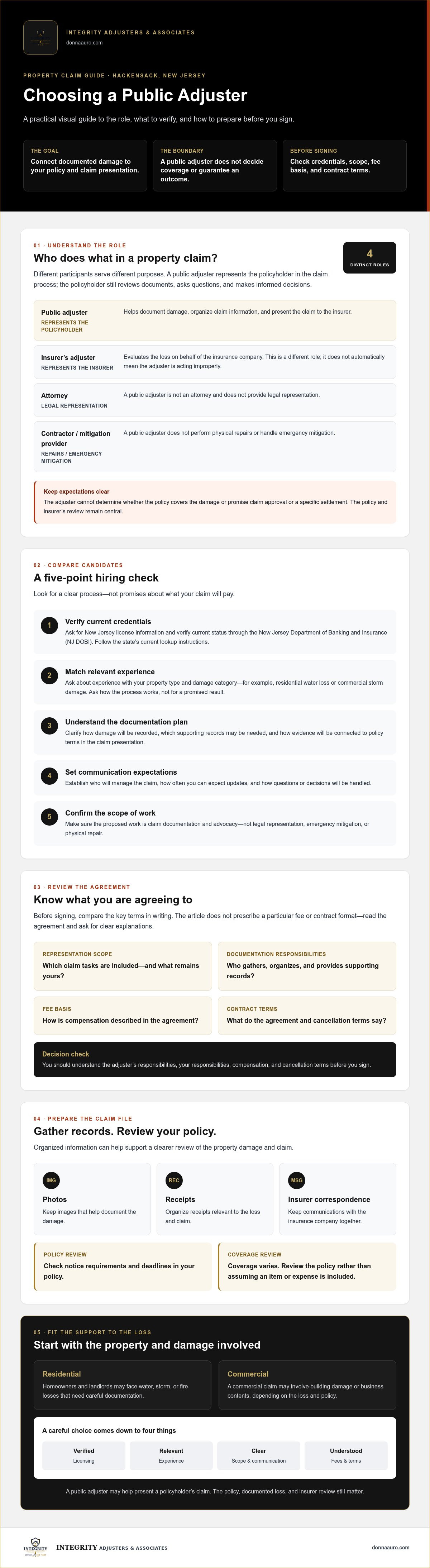
After property damage, the challenge isn’t only identifying what was affected. It’s documenting the loss and presenting it clearly in an insurance claim. A Hackensack NJ public insurance adjuster works on the policyholder’s side, helping document property damage, organize claim information, and present it to the insurer. For background on terms such as policy, claim, and claims adjuster, see What is Insurance.
This support may be relevant to Hackensack homeowners, landlords, and businesses facing a property loss. It doesn’t mean the adjuster can decide whether the policy covers the damage or guarantee claim approval or a specific settlement. The policy and the insurer’s review remain central.
For a general overview of claim support, watch this video:
How public adjusters differ from insurer representatives
An insurer’s adjuster evaluates the loss on behalf of the insurance company. A public adjuster represents the policyholder by documenting damage and preparing the claim presentation. These are different roles, but the insurer’s adjuster isn’t automatically acting improperly; each works for a different party in the claim process.
A public adjuster also isn’t an attorney, contractor, or mitigation company. They don’t provide legal representation, perform repairs, or handle emergency mitigation. The policyholder still needs to review claim documents, ask questions, and make informed decisions about any agreement or proposed resolution.
Which Hackensack property claims may need advocacy
Residential water, storm, and fire losses can involve damage that needs careful documentation. Water damage, for example, may affect more than the visibly wet area. Learn what records can help support that type of claim in this residential water damage claim guide.
Commercial property claims may involve building damage or business contents, depending on the loss and policy. Coverage varies, so review the policy rather than assume a particular item or expense is included. Integrity Adjusters & Associates describes its work as supporting residential and commercial policyholders with damage documentation, claim preparation, and insurer-process support for water, storm, and fire losses. Confirm that its current service availability and representation scope fit your circumstances.
How to Evaluate a Hackensack Public Adjuster Before You Hire
Choose a Hackensack NJ public insurance adjuster by the clarity of their process, not by promises about what your claim will pay. A useful starting point is to understand the role and ask how the adjuster will apply it to your loss. The National Association of Public Insurance Adjusters explains what a public adjuster does for policyholders.
Use this checklist to compare candidates:
- Confirm credentials: Ask for the adjuster’s New Jersey license information and verify current status through the New Jersey Department of Banking and Insurance (NJ DOBI). Check NJ DOBI’s current instructions for its license lookup process.
- Match relevant experience: Ask about work involving your property type and damage category, such as residential water loss or commercial storm damage. Request examples of the process, not promises of a particular outcome.
- Understand the documentation plan: Find out how damage will be recorded, which supporting records may be needed, and how the claim presentation will connect evidence to policy terms.
- Assess communication: Establish who will manage the claim, how often you can expect updates, and how questions or decisions will be handled.
- Clarify scope: Confirm that the proposed work is claim documentation and advocacy. It should not be presented as legal representation, emergency mitigation, or physical repair.
Questions to ask during an initial claim discussion
Ask who your main contact will be and how the firm will share updates, requests, and documents. Find out whether the process may involve a property inspection, photographs, inventories, estimates, receipts, or other records. Ask how the adjuster will respond if the insurer disputes an estimate, requests more information, or if documentation reveals additional damage. Clear answers help you understand what the firm will handle and what you’ll need to review or provide.
Verify qualifications and service fit in New Jersey
Check license status with NJ DOBI using its current verification process before signing. Then assess whether the adjuster’s experience fits both your property and loss. A homeowner with water damage and a business owner with fire-related building or contents damage may need different documentation. Ask how similar claim types are approached, while treating past examples as context, not a guarantee of your result.
Before making a decision, confirm that the agreement explains the representation scope and how communication will work. If you’d like to discuss your circumstances and clarify what support may involve, discuss your claim with Integrity Adjusters & Associates.
Compare Claim Representation, Fees, and Scope Before Committing
Representation has a cost and a defined scope. Before hiring a Hackensack NJ public insurance adjuster, compare what each candidate will do with what the agreement requires of you. The goal isn’t to predict a settlement or estimate savings. It’s to decide whether the proposed support and commitment fit your claim.
| Area | What to compare | What to clarify |
|---|---|---|
| Responsibilities | Damage documentation, claim preparation, and communication with the insurer | Which tasks are included, and what remains your responsibility? |
| Communication | Who manages the claim and how updates are delivered | How will questions, decisions, and insurer requests be handled? |
| Documentation | Inspections, photographs, inventories, estimates, and supporting records | Who gathers each item, and how are additional findings addressed? |
| Fee basis | The firm describes its revenue as typically tied to a percentage of the final settlement | What calculation applies, when is payment due, and are expenses separate? |
| Contract terms | Services, representation scope, term, and conditions for ending the agreement | Are the terms clear and consistent with what was discussed? |
What the agreement should make clear
Read the written agreement before signing. Check the services included, the scope and duration of representation, and the conditions for ending the arrangement. If compensation is percentage-based, ask exactly how the percentage is calculated and which settlement components it applies to. Confirm timing and any expenses in writing. If language is unclear, request an explanation in writing before you commit. This is a practical review step, not legal advice.
Compare the expected work, communication, and financial commitment across candidates. Don’t rely on a predicted claim value or promised savings to justify a fee. The insurer determines coverage under the policy, and no adjuster can guarantee a particular result.
Know when another professional may be needed
A public adjuster supports claim documentation and presentation, but doesn’t provide legal representation or perform cleanup and repairs. If the matter involves a legal dispute, consider seeking advice from a qualified attorney. For physical cleanup or repairs, contact an appropriate mitigation or restoration provider. Businesses reviewing property-related claim support can also consult this commercial property insurance claim guide.
Prepare Your Hackensack Property Claim for a Productive Review
A clear record can help the insurer and any claim representative understand what happened and what property was affected. It doesn’t establish coverage by itself or guarantee payment. Follow a steady sequence: protect people, limit further damage where it’s safe, document the loss, organize records, then review the claim information and policy instructions.
- Protect people first. Keep away from unsafe areas and follow appropriate emergency guidance. Don’t enter a space or handle damaged equipment if doing so could put anyone at risk.
- Prevent further damage where safe. Take reasonable steps to protect the property, but don’t attempt hazardous cleanup or repairs. Keep receipts for any temporary measures and note what was done and when.
- Document before conditions change. Take dated photos or videos of visible damage and affected rooms, equipment, contents, or business areas. When safe and practical, don’t discard damaged items before recording them.
- Organize the file. Save inventories, estimates, invoices, temporary-measure receipts, insurer communications, and claim reference information together. Keep copies of anything you submit.
- Notify and review. Give the insurer prompt notice, follow its instructions, and check your policy for applicable notice, proof, and other deadlines. Don’t assume that a general timeline applies to your policy.
Organize damage evidence and claim records
Use a dated log to record where damage occurred, what you observed, and when you first noticed it. For a home, that might mean listing affected rooms and contents; for a business, note impacted equipment, inventory, or work areas. Keep related photographs, correspondence, and receipts in clearly labeled folders. A consistent record makes it easier to answer follow-up questions and identify missing information.
Clarify the assessment and next steps
Before an inspection or claim review, ask what findings or documents are still outstanding. Compare the insurer’s communications and assessment with the records you’ve gathered and the relevant policy language. If something appears missing or unclear, ask for an explanation and keep the response with your claim file. Documentation can support evaluation, but it doesn’t decide whether a loss is covered.
If you’re considering a Hackensack NJ public insurance adjuster, organized records can help make a discussion about your claim more specific. Review your claim circumstances with Integrity Adjusters & Associates and clarify what support may fit your situation.
Choose Claim Support That Fits Your Hackensack Property and Loss
The right claim support depends on what was damaged, the type of property, and how much documentation is available. A homeowner reviewing damage to a roof, rooms, or personal belongings may need a different claim presentation than a business assessing building damage or affected business property. In either case, compare the proposed work with the policy and the records you can provide. No representation can guarantee coverage or a particular claim result.
Residential and commercial claim needs are not identical
For a residential claim, organize evidence by affected area and property type. Then check how the policy describes the relevant coverage before assuming an item is included. Storm-related damage? This residential storm damage claim guide can help you consider what to document.
For a business, identify affected building areas, contents, or equipment and gather records that help describe the loss. Policy terms determine what may be covered; don’t assume that business interruption losses are included or handled by a particular service. A claim’s complexity and the completeness of available records can also shape the support you need.
Integrity Adjusters & Associates describes its advocacy and claim support for residential water, storm, and fire losses, as well as commercial fire, storm, and business property claims. Its work includes documenting property damage, preparing claims, and helping policyholders navigate the insurer process. The firm does not sell insurance policies, provide legal representation, restore properties, or offer emergency mitigation. Confirm that the firm’s current service availability and proposed scope fit your property and loss.
Clarify the scope before requesting representation
Before speaking with a prospective adjuster, note the loss date, property type, damage category, insurer communications, and key records you have gathered. You don’t need a perfect file to ask questions. A concise summary helps focus the discussion on your actual claim.
Ask what the process may involve, who would manage communication, how damage documentation will be handled, and what records may still be needed. Clarify the fee basis, how it’s calculated, when it’s due, and what the written agreement says about services, term, and ending representation. Ask about any limits on the proposed service, too. Review the terms before signing and request written clarification if something is unclear.
If you’re considering a Hackensack NJ public insurance adjuster, a discussion can help establish whether the proposed support fits your circumstances. Contact Integrity Adjusters & Associates to discuss your property claim, including the potential scope, documentation, and agreement terms.
Move Forward With a Clear Claim Plan
Choosing a Hackensack NJ public insurance adjuster starts with understanding the role, checking relevant qualifications, and comparing the proposed support with the agreement. Keep your claim records organized, review policy instructions and deadlines, and ask direct questions about communication, documentation, fees, and representation scope before signing.
Integrity Adjusters & Associates describes its work as advocating for residential and commercial policyholders, documenting property losses, and building comprehensive claims. That support can help organize and present claim information, but it can’t guarantee coverage or a particular outcome. Make sure the services offered match your property, damage, and needs.
If you’re ready to discuss your circumstances and clarify what representation may include, contact Integrity Adjusters & Associates to discuss your property claim. A careful, informed next step can help you approach the claim process with greater clarity.
Frequently Asked Questions
What does a public insurance adjuster do in Hackensack, NJ?
A public insurance adjuster represents the policyholder in documenting and presenting a property insurance claim. A Hackensack NJ public insurance adjuster may help organize damage records, build a comprehensive claim, and communicate with the insurer about the claim. The insurer’s adjuster represents the insurance company. A public adjuster doesn’t provide legal representation, perform repairs, or handle emergency mitigation, and can’t guarantee coverage or a particular settlement.
How do I verify a public adjuster’s license in New Jersey?
Verify the adjuster’s current license status through the New Jersey Department of Banking and Insurance (NJ DOBI). Ask the adjuster for their license information, then use NJ DOBI’s current online verification process to check that the record matches the person you’re considering. Confirm the process directly with the department if you’re unsure how to search. Do this before signing an agreement, and ask questions if the details don’t match.
When should I hire a public adjuster for a property insurance claim?
Consider speaking with one if damage is difficult to document, the claim involves many affected areas or contents, or you need help organizing records and presenting information to the insurer. You can ask questions before deciding whether representation fits your situation. Don’t delay notifying the insurer or following policy instructions while you consider your options. Review the policy’s deadlines, and clarify what the adjuster would handle before signing.
How much does a public adjuster cost in New Jersey?
The cost depends on the adjuster’s agreement and fee structure. Integrity Adjusters & Associates describes its revenue as typically tied to a percentage of the final settlement, but confirm the actual terms for your claim. Before signing, ask how the fee is calculated, which settlement components it applies to, when it’s due, and whether expenses are separate. Review the written agreement carefully and request written clarification of anything unclear.
Can a public adjuster guarantee a higher insurance settlement?
No. A public adjuster can’t guarantee a higher settlement, claim approval, or coverage. The adjuster may document damage and present claim information for the insurer’s review, but the outcome depends on the policy, the loss, and the claim evaluation. Treat promises of a specific payment or guaranteed result with caution. Ask instead how the adjuster will document the damage, explain the claim position, and communicate about questions or disputed information.
Can a public adjuster help with both residential and commercial claims?
Yes. Integrity Adjusters & Associates describes advocacy for both residential and commercial property insurance claims. Its stated support includes residential water, storm, and fire losses, plus commercial fire, storm, and business property claims. The records and policy terms to review will depend on the property and damage. For a business, clarify whether the proposed work addresses the building or affected business property, and don’t assume other losses are included.
What should I bring when speaking with a public adjuster about property damage?
Bring the policy if available, the loss date, claim reference information, insurer letters or emails, and any inspection or estimate documents. Photos or videos, receipts for temporary measures, invoices, and an inventory of damaged property can also help explain the loss. For a business, note affected building areas, equipment, or contents. If some records are missing, bring what you have and ask what else may be useful.


