

What if the insurer’s estimate doesn’t account for all the damage your property sustained? Maximizing property insurance settlement isn’t about guessing at a number or pushing back without support. It starts with evidence that connects documented damage to your policy’s coverage and terms.
An estimate can be difficult to assess when policy language is unfamiliar or important details may be missing. An organized record helps you compare the insurer’s findings with the damage, identify questions or gaps, and respond with facts rather than assumptions.
This guide explains what a settlement should be based on, how to document property damage, and how to compare an insurer’s estimate with your policy and supporting evidence. You’ll also learn how to organize claim materials and when a New Jersey policyholder may want to discuss public adjusting support. Integrity Adjusters & Associates helps residential and commercial policyholders document and present property claims. No particular outcome is guaranteed, but a methodical approach can bring more clarity to the process.
Key Takeaways
- A well-supported settlement reflects damage covered by the policy and credible documentation, not assumptions about what every loss should include.
- Build an organized record with dated photos, videos, receipts, inventories, and claim-related communications.
- Compare each line of the insurer’s estimate with the damage you observed and your evidence, then list questions that need answers.
- Address a low or incomplete offer methodically: identify the gap, support your concern with records, and keep written copies of communications.
- Maximizing property insurance settlement may involve public adjusting support when claim complexity, documentation gaps, or limited time make the process difficult to manage.
Maximizing a Property Insurance Settlement Starts With Understanding the Claim
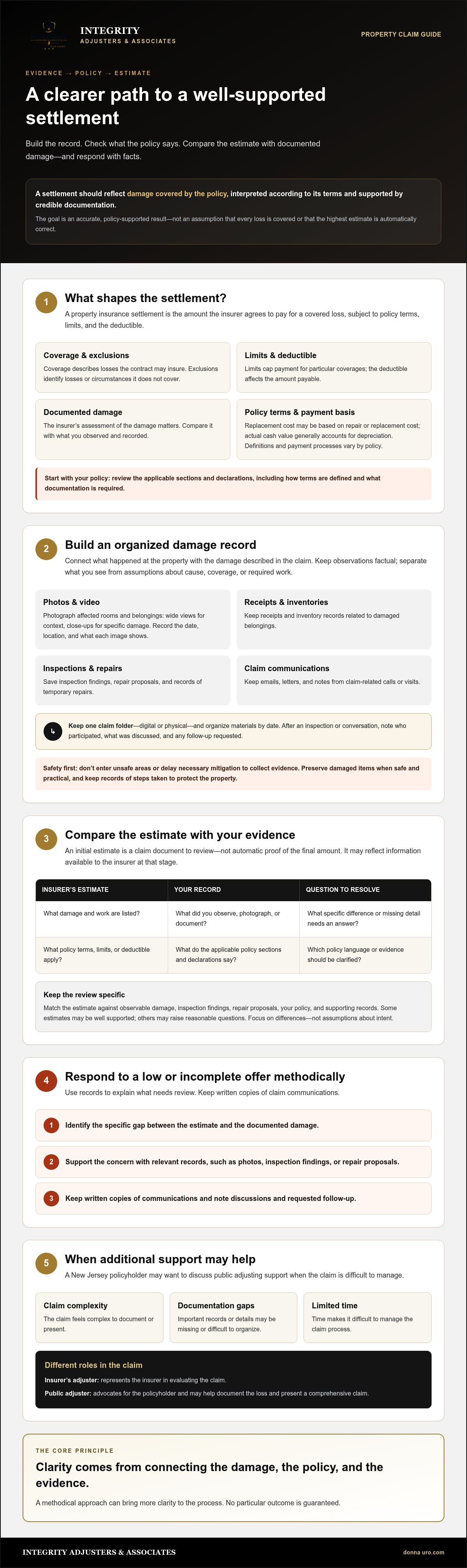
A settlement should reflect damage covered by your policy, interpreted according to its terms and supported by credible documentation. Maximizing property insurance settlement means pursuing an accurate, policy-supported result. It does not mean assuming every loss is covered or that the highest estimate is automatically correct.
A property insurance settlement is the amount an insurer agrees to pay for a covered loss, subject to the policy’s terms, limits, and deductible. Understanding the insurance claim process can help clarify why the policy, documented damage, evidence, and estimate all matter.
For a practical overview of handling a home insurance claim and communicating with adjusters, watch this video:
What determines a property insurance settlement?
Start with your policy. Coverage describes the losses the contract may insure, while exclusions identify losses or circumstances it doesn’t cover. Limits cap payment for particular coverages, and the deductible affects the amount payable. The insurer’s assessment of the documented damage also matters. Read the applicable sections and declarations rather than relying on assumptions about what a standard policy includes.
If your policy provides replacement cost coverage, payment may be based on the cost to repair or replace covered property, subject to the contract’s conditions. Actual cash value generally accounts for depreciation. Definitions and payment processes vary by policy, so check how yours defines each term and what documentation it requires.
Why the first estimate may not answer every question
An initial estimate is a claim document to review, not automatic proof of the final amount. It may reflect the information available to the insurer at that stage. Compare its listed damage and work with what you can observe, your policy, and your supporting records. Some estimates may be well supported; others may raise reasonable questions. Focus on specific differences, not assumptions about intent.
The insurer’s adjuster represents the insurer in evaluating the claim. A public adjuster, by contrast, advocates for the policyholder and may help document the loss and present a comprehensive claim. If the insurer denies coverage, the reason and relevant policy language matter. See a guide to resolving denied property insurance claims in New Jersey for next steps.
Document Property Damage in New Jersey Before Settlement Discussions
A clear record connects what happened at the property with the damage described in the claim. It also gives you a practical way to compare your observations, inspection findings, and repair proposals with the insurer’s estimate. Keep the record factual: document what you can see, and separate those observations from assumptions about the cause, coverage, or work required.
Create a clear record of the loss
Photograph affected rooms and belongings from wide angles, then take close-ups of specific damage. Record the date, location, and what each image shows. Videos can add context, such as the extent of water in a room or damage across several surfaces. Don’t enter unsafe areas or delay necessary mitigation to collect evidence. Preserve damaged items when it’s safe and practical, and keep records of steps taken to protect the property.
Use one claim folder, digital or physical, and organize materials by date. Include:
- Dated photos and videos, labeled by room or area.
- Receipts, inventories, and records related to damaged belongings.
- Inspection findings, repair proposals, and temporary repair records.
- Emails, letters, and notes from claim-related calls or visits.
After an inspection or conversation, note the date, who participated, what was discussed, and any follow-up requested. This creates a useful timeline without relying on memory alone.
Support the repair scope with appropriate records
Compare inspection findings and repair proposals with visible conditions and the estimate. If a qualified professional recommends work that isn’t apparent in the insurer’s document, ask them to explain the observed condition and recommended scope in writing. Don’t present a suspected cause as established fact unless the evidence supports it. Apply the same distinction to coverage: document the damage first, then assess coverage under your policy.
For water damage, records may include dated images of affected areas and contents, relevant inspection findings, and written explanations of proposed work. Learn more about residential water damage claim support as you organize those materials.
Accurate documentation can make settlement discussions more focused, but it doesn’t guarantee that every item will be covered. If you’d like help reviewing how your loss is documented, you can discuss your claim circumstances.
Compare the Insurer’s Estimate With Your Policy and Evidence
Review the insurer’s estimate one line at a time. Compare each listed area, item, and proposed task with the relevant policy language and your claim records. The goal is to identify questions that need clarification, not to assume a difference proves the estimate is wrong. Scope, quantities, and valuation assumptions may reflect information or interpretations that need further explanation.
Support each disputed estimate item with evidence so the concern can be assessed against the documented damage and applicable policy terms.
Identify questions and possible estimate gaps
Check whether the estimate addresses documented rooms or areas, damaged contents, and work described in inspection findings or professional observations. Look for unclear descriptions, quantities that don’t match your records, or assumptions about the work included. Treat these as follow-up questions, not automatic errors. Don’t draw technical or coverage conclusions from a line item alone.
A comparison table can keep the review focused:
| Estimate item | Observed condition | Supporting evidence | Question to resolve |
|---|---|---|---|
| Example: living room wall | Visible staining on the wall | Dated photo and inspection notes | How does the listed scope address the documented area? |
Use one row for each concern. If an item appears consistent with your records, note that too. A balanced review helps distinguish genuine questions from differences that are already explained.
Connect each concern to the policy and claim record
Pair each question with the most relevant material, such as a dated photo, inventory, inspection finding, or written professional observation. Then ask the insurer to explain how it assessed the disputed item and how the applicable policy terms relate to it. Be specific: identify the estimate item, describe the observed condition, and refer to the supporting material.
For example, if a documented area doesn’t appear in the estimate, ask whether it was inspected or considered and what additional information may be needed. If a quantity or scope is unclear, request clarification before treating it as an omission. This disciplined comparison supports maximizing property insurance settlement by grounding follow-up in records rather than assumptions. For more guidance on responding to an offer you believe is low, see disputing a low insurance offer for New Jersey property damage.
Respond to a Low or Incomplete Settlement Offer Methodically
A settlement offer that seems low can be frustrating. Respond with a clear record, not an unsupported accusation. Identify the specific concern, gather related records, ask focused questions, and track what happens next. A measured response keeps the discussion centered on the damage, estimate, and policy.
Prepare a focused written response
List each disputed or unclear item separately. For each one, describe what you observed, identify the relevant estimate line, and cite supporting photos, inspection findings, receipts, or written professional observations. Ask the insurer to clarify its assessment or reconsider the item in light of those records. Keep the language concise and factual. Don’t allege misconduct unless you have evidence to support that claim.
Send the response through a channel that creates a record, and save a copy of your message and every attachment. Keep insurer replies with the claim file. If you discuss the claim by phone, note the date, participants, and key points. Follow up in writing if you need to confirm what was discussed.
Keep the claim moving without missing important requirements
Maintain a simple timeline of submissions, inspections, insurer responses, and requests for documents. Check your policy for applicable notice, proof-of-loss, and response requirements. Verify current New Jersey guidance with the Department of Banking and Insurance instead of relying on generic timelines, since requirements can depend on the policy and circumstances of the claim. Keep copies of everything you submit and record when it was sent.
New Jersey regulations include insurer claim-handling timeframes, and their application depends on the claim step and applicable requirements. For example, an insurer has a 30-calendar-day period to pay or deny a first-party property claim after receiving a properly executed proof of loss. Confirm current requirements with authoritative sources and review your policy before relying on any deadline.
Consider what type of help you need. A public adjuster may assist with documenting and presenting a property claim; that role is different from legal representation. If the issue involves interpreting legal rights, pursuing litigation, or responding to a legal dispute, seek advice from a qualified attorney. Integrity Adjusters & Associates doesn’t provide legal representation.
Organized follow-through can make maximizing property insurance settlement a more evidence-based process, though no approach guarantees a particular outcome. To discuss how your claim is documented and presented, discuss your property claim with Integrity Adjusters & Associates.
When a New Jersey Public Adjuster Can Help Strengthen a Property Claim
Preparing a property claim can take substantial time, especially when damage affects multiple areas, documentation is incomplete, or insurer communications are difficult to manage. A public adjuster may help a policyholder document the loss, organize claim materials, and present a comprehensive claim through the insurer’s process. This support may be worth considering when you want an advocate focused on your claim, but it can’t guarantee coverage, a higher settlement, or a particular timeline.
The decision depends on your circumstances. Consider how complex the loss is, how much time you can devote to the process, whether important records are missing, and how comfortable you feel handling communications and follow-up yourself. Maximizing property insurance settlement means pursuing a result supported by the policy and evidence, not expecting a particular outcome from hiring a professional.
What public adjusting support can and cannot include
Public adjusting support may include documenting property damage, organizing claim information, and advocating for the policyholder as the claim is presented to the insurer. It is distinct from insurance sales, legal representation, physical repairs, and emergency mitigation. Ask directly what work is included in a proposed engagement and what remains your responsibility. For legal questions or a coverage dispute requiring legal advice, consult a qualified attorney.
Questions to ask before choosing claim support
Before proceeding, ask about experience with the type of loss and property involved, including whether it is residential or commercial. Confirm current New Jersey licensing information through authoritative sources, including the New Jersey Department of Banking and Insurance, and read the written engagement terms carefully. Make sure you understand the scope of work, your responsibilities, and how communication will be handled. Don’t rely on verbal assurances about results.
A guide to public adjuster services in New Jersey can help you understand the role and prepare questions before choosing support. Compare that information with your claim’s needs. The right choice is the one that fits your circumstances and expectations.
If you’re weighing whether claim advocacy makes sense for your situation, discuss your claim with Integrity Adjusters & Associates. A conversation can help clarify whether support with documenting and presenting your claim fits your needs, without promising a specific result.
Move Forward With a Clear, Evidence-Based Claim
Maximizing property insurance settlement starts with understanding what your policy covers and what your claim record supports. Document the damage, compare the insurer’s estimate with your evidence, and raise specific questions in writing. A disciplined approach helps you pursue an accurate, policy-supported result without assuming every loss is covered.
If the claim feels complex, documentation is incomplete, or insurer communications are difficult to manage, public adjusting support may be worth considering. Integrity Adjusters & Associates advocates for residential and commercial property policyholders in New Jersey, helping document damage and present comprehensive claims. Public adjusting can’t guarantee coverage, a higher settlement, or a particular timeline. Before engaging support, confirm current New Jersey licensing information and review the written terms carefully.
Discuss your property claim with Integrity Adjusters & Associates to explore whether claim advocacy fits your circumstances. With organized records and a clear next step, you can move through the process with greater confidence.
Frequently Asked Questions
Can I negotiate a property insurance settlement if I disagree with the estimate?
Yes. You can ask the insurer to review specific estimate items, but support your concerns with claim records and policy terms. Identify the line item, explain what you believe is missing or unclear, and attach relevant photos, inspection findings, receipts, or written professional observations. Ask focused questions in writing and keep copies of your correspondence. A difference in estimates alone doesn’t establish that the insurer acted improperly or that the policy covers the disputed amount.
How do I prove that the insurer’s property damage estimate is incomplete?
Compare the estimate with your documented damage and identify specific areas, contents, or work that appear unaddressed or unclear. Support each concern with dated photos, inventories, receipts, inspection findings, or written observations from qualified professionals. Ask the insurer to explain how it assessed the item and whether it needs more information. Evidence can help clarify a gap, but coverage and payment still depend on your policy and the claim circumstances.
What happens if I accept an insurance settlement and later find more damage?
Whether you can seek additional payment depends on your policy, the claim status, and any documents you signed when accepting payment. Some claims may remain open for additional covered damage, while a release or final settlement agreement may affect further recovery. Review the payment documents carefully and contact the insurer promptly if new damage appears. If you’re unsure about legal rights or the effect of a release, consult a qualified attorney.
Is the first property insurance settlement offer final?
Not necessarily. An initial offer or estimate may be subject to review as the insurer evaluates the claim and supporting information. Check the offer documents and policy for conditions, deadlines, or release language before accepting or signing. If you identify a specific concern, submit supporting records and ask the insurer for clarification in writing. Don’t assume the offer is either final or automatically open for negotiation without reviewing the applicable terms.
How much can a public adjuster increase my insurance settlement?
A public adjuster can’t promise to increase your settlement or predict a particular recovery. The outcome depends on the documented loss, policy terms, and insurer’s evaluation. A public adjuster may help a policyholder document damage, organize claim information, and present a comprehensive claim to the insurer. For New Jersey homeowners and property owners, consider whether that support fits your circumstances, and review licensing information and engagement terms before proceeding.
When should I hire a public adjuster for a property insurance claim in New Jersey?
Consider speaking with a public adjuster if the loss is complex, you have limited time to manage claim tasks, documentation gaps are difficult to address, or insurer communications feel challenging. A public adjuster may advocate for you by helping document and present the claim, but can’t guarantee coverage, a higher settlement, or a timeline. Confirm current New Jersey licensing information through the Department of Banking and Insurance, and review written engagement terms carefully.
What documents should I submit to support a property insurance claim?
Submit records relevant to your loss and requested by the insurer or required by your policy. These may include dated photos and videos, an inventory of damaged belongings, receipts, inspection findings, repair proposals, temporary repair records, and claim-related communications. Label files by date and location, and keep copies of everything you send. For a New Jersey claim, check your policy and current insurer instructions so you provide the appropriate records rather than relying on a generic checklist alone.


