

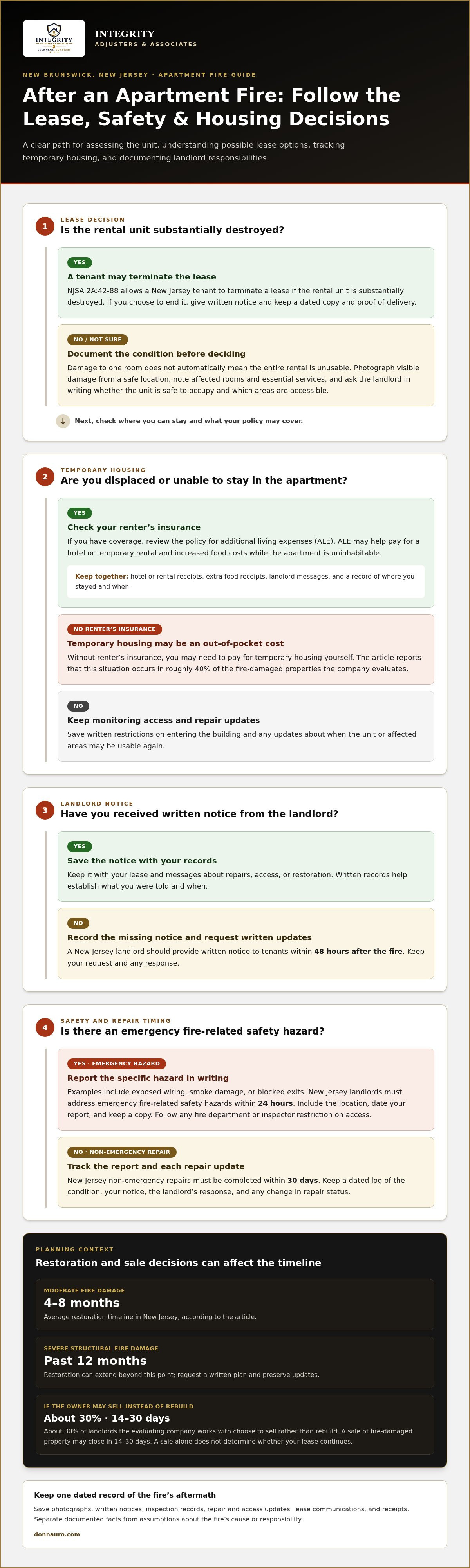
A New Brunswick NJ apartment building fire claim can involve more than replacing belongings. If the rental unit is substantially destroyed, a New Jersey tenant may terminate the lease under NJSA 2A:42-88, and the landlord should provide written notice within 48 hours after the fire. The next challenge is often finding a safe place to stay while you work out what happens to your lease and expenses.
Losing access to your home is stressful, and temporary housing can bring immediate costs. Without renter’s insurance, you may need to pay for temporary housing yourself. If you have coverage, additional living expenses may help pay for a hotel or temporary rental and increased food costs while your apartment is uninhabitable.
This guide explains tenant protections and landlord responsibilities that may apply after an apartment fire in New Brunswick, how to document damage and communicate about your lease, and what to review in your renter’s insurance policy for temporary housing benefits. It also explains how a property insurance claim fits into recovery, so you can take practical next steps without confusing tenant rights with coverage for damaged property.
Key Takeaways
- Assess whether fire damage makes your rental unit uninhabitable and understand how substantial destruction may affect your lease.
- Keep landlord communications and safety concerns documented, including written notices and steps taken to address fire-related hazards.
- Learn how the fire’s cause may factor into responsibility and why evidence of the damage matters.
- Review your renter’s insurance for additional living expenses that may help with temporary housing and increased food costs.
- Organize photos, damaged-item records, and claim documents to support an insurance claim and clarify what losses it covers.
What Are Tenant Rights After a Rental Property Fire in New Jersey?
A fire can leave a New Jersey tenant facing two separate questions: whether the unit is usable and whether the lease continues. If the rental unit is substantially destroyed, a tenant may terminate the lease under NJSA 2A:42-88. The fire’s damage and the landlord’s restoration or sale plans can shape what happens next.
Put key information in writing. A New Jersey landlord should provide written notice to tenants within 48 hours after a rental property fire. Save that notice, your lease, and messages about repairs or access. These records help establish what you were told and when.
For a practical overview of documenting a claim and tracking living expenses, watch this renters insurance walkthrough:
- Document the unit’s condition and ask about habitability.
Photograph visible fire, smoke, and water damage from a safe location. Record which rooms and essential services are affected. Ask the landlord in writing whether the apartment is safe to occupy and which areas remain accessible. Damage to one room does not automatically mean the entire rental is unusable. Keep inspection notices and written restrictions on entering the building.
- Review your lease before deciding whether to end it.
NJSA 2A:42-88 allows a New Jersey tenant to terminate a lease if the rental unit is substantially destroyed. Compare the unit’s actual condition with that standard, then give written notice if you choose to end the lease. Keep a dated copy and proof of delivery. Don’t treat a temporary hotel stay, repair work, or a landlord’s verbal update as a lease termination by itself.
- Request a written restoration plan and preserve each update.
Ask the landlord to describe planned repairs, access limits, and expected milestones. Moderate-fire-damage restoration in New Jersey averages 4 to 8 months; severe structural fire damage can extend restoration timelines past 12 months. These timelines make written updates important. New Jersey non-emergency repairs must be completed within 30 days. Keep each message, especially if the repair scope or schedule changes.
- Prepare for a possible property sale as well as rebuilding.
About 30% of landlords the evaluating company works with choose to sell rather than rebuild. A sale of fire-damaged property may close in 14 to 30 days. Ask whether the owner plans to restore the building or sell it, and request updates in writing. A sale does not itself answer whether your lease continues; document any proposed change to your tenancy and review it against your lease.
- Plan temporary housing around your insurance and records.
Tenants without renter’s insurance must fund temporary housing themselves. This situation occurs in roughly 40% of the fire-damaged properties the company evaluates. Keep hotel or rental receipts, extra food receipts, and landlord communications together. If the fire has displaced you, record where you stay and when. Those details can help you track expenses and explain the disruption while restoration or sale decisions unfold.
What Is a Landlord's Legal Responsibility After a Fire in New Jersey?
- Record immediate hazards and notify the landlord in writing.
List hazards such as exposed wiring, smoke damage, or blocked exits, and send the landlord a dated notice. New Jersey landlords must address emergency fire-related safety hazards within 24 hours. Include the affected location, such as a hallway outlet or damaged stairwell, and keep a copy of your message. If firefighters or inspectors restrict access, save their written instructions and avoid entering restricted areas.
- Track the landlord’s response against New Jersey’s habitability framework.
NJSA 2A:42-85 to 42-96 is the New Jersey legal basis identified for landlord habitability responsibilities after a fire. Record when you reported each condition, the landlord’s response, and whether the hazard remains. For example, note whether a damaged exit is still blocked after the landlord receives notice. A timeline helps distinguish prompt safety action from unresolved conditions.
- Separate the fire’s cause from the landlord’s response.
The fire’s cause matters, but its origin alone does not establish who is responsible for every loss. Preserve notices, maintenance requests, and messages about the area where the fire began. For example, a prior written report about a faulty appliance records what the landlord knew and when. A report about a tenant’s activity may also be relevant. Separate documented facts from assumptions.
- Build a clear record of damage and communications.
Use dated photographs, written notices, inspection records, and a log of calls or visits. Describe specific effects, such as a smoke-damaged bedroom or water intrusion near a ceiling light. Keep original files and avoid editing images. Ask the landlord to put safety instructions and repair updates in writing. This record helps explain the property’s condition and the steps taken after the fire.
- Ask what repairs are planned and document access restrictions.
Request a written account of the repair work, safety measures, and areas tenants may enter. New Jersey non-emergency repairs must be completed within 30 days. Record the date a repair issue was reported and any later change in its status. For example, note whether a damaged window remains unsecured after the landlord says repairs are underway. Keep your own timeline, not only the landlord’s updates.
- Keep property responsibility distinct from tenant insurance claims.
A landlord’s obligations for the building and a tenant’s claim for personal belongings involve different property interests. List your damaged items separately from structural damage, such as burned framing or a damaged roof. Preserve receipts, photographs, and inventory records for your possessions. If the cause is disputed, avoid guessing in written statements. Record dates, observed conditions, and direct communications instead.
After an apartment fire in New Brunswick, organize evidence before drawing conclusions about responsibility. The fire’s cause, recorded conditions, and the landlord’s response are separate facts. A clear timeline can support discussions about safety, repairs, and related insurance matters.
Keep building insurance distinct from a tenant’s claim for personal belongings when documenting recovery. A typical landlord loss-of-rental-income insurance coverage period is 12 to 24 months. Coverage amounts and periods do not establish that a particular policy applies to a specific loss. Request written details about relevant repairs, rental income, and claims, and keep the answers with your records.
A major New Brunswick apartment building fire claim often involves complex multi-unit responses from local municipal services and mutual-aid partners. When navigating a New Brunswick NJ apartment building fire claim, local emergency personnel coordinate containment and safety protocols. These response details can help identify the scale of an incident, but keep them separate from evidence about the condition of your unit, the landlord’s actions, and your own losses. Preserve records for each issue so that building repairs and claims for personal property remain clearly distinguished.
Temporary housing and additional living expenses
- Establish whether the apartment is uninhabitable and record the displacement.
Record when you left and why you could not safely remain. Note specific conditions, such as smoke in the bedroom, a damaged entrance, or unusable utilities. Keep written notices from the landlord or building officials with your records. These details connect your temporary move to the fire and help establish when additional living expenses began.
- Review your renter’s policy for additional living expenses coverage.
Look for the section titled “Additional Living Expenses” or “Loss of Use.” For tenants with renter’s insurance, this coverage may help with hotel stays, temporary rentals, and increased food costs while the unit is uninhabitable. The coverage typically represents 20% to 30% of the renter’s insurance coverage limit. Check the policy limit and how the policy describes eligible expenses.
- Separate ordinary spending from costs caused by the fire.
Create a dated expense log, with a separate entry for each hotel night, temporary rental payment, and increased meal cost. When possible, record what you normally spent before displacement and compare it with the added expense. For example, note the extra cost of prepared meals if your temporary room has no usable kitchen. Keep itemized receipts, not just card statements.
- Keep lodging documents together and explain each charge.
Save booking confirmations, invoices, payment records, and the dates covered by each stay. If you move from a hotel to a rental, record why and note the new address. Label each document with the expense date and category. A hotel bill showing nightly charges is easier to assess alongside a log noting which nights your apartment remained uninhabitable.
- Notify your insurer and submit organized records.
Contact the insurer named on your renter’s policy and report the fire-related displacement. Ask how to submit the claim and organize records in the requested format. Include your policy information, displacement timeline, expense log, receipts, and relevant notices. Keep a copy of every submission and note when you sent it. Add new receipts as expenses continue rather than waiting until your temporary stay ends.
- Keep insurance benefits distinct from emergency assistance.
Insurance coverage and emergency aid are separate forms of support. The American Red Cross provided emergency financial assistance to 18 people affected by a New Brunswick fire. That example does not establish that every displaced tenant receives assistance or the same amount. Record any aid received separately from insurance expenses, and keep its date and purpose clear to avoid mixing records.
- Update the expense record as your housing situation changes.
Save any access or repair updates from the landlord or building officials with your housing timeline. Note whether you return to the apartment, move to another temporary location, or continue paying for lodging. Keep the relevant dates and receipts for each change. A clear timeline shows how the fire affected your housing and which additional costs arose during displacement.
How can affected tenants file an insurance claim after an apartment fire in New Brunswick?
- Locate your renter’s policy and identify the insurer.
Find the declarations page, policy number, insurer name, and claims contact details. Check whether the policy covers personal property and additional living expenses. For your New Brunswick NJ apartment building fire claim, keep both digital and paper copies of the policy. If you share a policy with a roommate, identify whose name appears as the policyholder. That person should lead communications about the claim.
- Report the fire and explain how it affected your belongings.
Contact the insurer through the claims process described in your policy. State the fire date, building address, apartment number, and whether smoke, flames, or firefighting water damaged your property. Give observable facts, not guesses about the fire’s cause. Ask for the claim number and next steps. Record the representative’s name, the call date, and any requested documents.
- Build an inventory of damaged or missing items.
List each damaged item separately, including its room, approximate age, condition, and damage. For example, record a smoke-damaged coat separately from a water-damaged laptop. Add photographs, receipts, order records, or other proof of ownership when available. If you cannot safely enter the building, use existing photos or household records. Keep the original inventory and update it as you identify more damaged belongings.
- Track additional living expenses in a separate file.
Renter’s insurance may cover hotel stays, temporary rentals, and increased food costs while a unit is uninhabitable. Additional living expenses coverage typically covers 20% to 30% of the renter’s insurance coverage limit. Review your policy’s limit and coverage language. Save itemized receipts and note the dates, purpose, and connection to displacement. Keep these costs separate from personal-property losses for clearer claim records.
- Submit requested documents in an organized sequence.
Group records by category: policy information, property inventory, photographs, receipts, and insurer correspondence. Add a brief description to each file, such as “living room chair, smoke damage.” Keep copies of every document you send and note the submission date. If the insurer requests a specific item, record the request and your response. This creates a traceable file as you assemble a New Brunswick NJ apartment building fire claim.
- Review claim summaries before accepting or signing them.
Compare any inventory or payment summary with your own records. Flag missing belongings, inaccurate descriptions, or expenses assigned to the wrong category. Ask the insurer to explain unfamiliar terms in writing, and keep each revised version with its date. Do not discard damaged property before documenting it and following the insurer’s instructions. Photographs and inspection records can help establish its condition.
- Keep assistance records distinct from insurance records.
The American Red Cross provided emergency financial assistance to 18 people affected by a New Brunswick fire. Record any assistance you receive separately, including its date and stated purpose. Don’t combine it with insurer payments in your expense log. A clear record helps distinguish emergency support from your renter’s insurance claim and makes it easier to explain each payment when organizing your file.
Integrity Adjusters & Associates: Residential Water Damage Claim Support
Integrity Adjusters & Associates helps policyholders document residential fire damage and build a comprehensive property insurance claim for presentation to the insurer. After a New Brunswick apartment fire, its Residential Fire Loss Claim Support can help organize evidence of property damage and prepare claim documentation. The service focuses on recording property losses, not determining tenant rights or replacing lease guidance.
Gather photographs, an itemized damage list, receipts, and insurer correspondence before organizing your claim file. A clear record can help present the scope of the property loss. For support documenting a residential fire claim, contact Integrity Adjusters & Associates.
Move Forward With an Organized Claim
A New Brunswick NJ apartment building fire claim is easier to manage when your next steps reflect your immediate priorities. Keep records organized, separate insurance questions from lease concerns, and document the property losses you are claiming. This gives you a clearer foundation for discussions with your insurer.
For property claim documentation, Integrity Adjusters & Associates offers Residential Fire Loss Claim Support, as well as Residential Water Damage Claim Support and Residential Storm Damage Claim Support. The firm documents property damage and prepares a comprehensive claim for presentation to the insurer. This support does not replace advice about tenant rights or lease decisions.
If you want support organizing a residential property claim, contact Integrity Adjusters & Associates. Take the next step at your pace, with your records and priorities in hand.
Frequently Asked Questions
What caused the New Brunswick apartment building fire?
The reported incident details do not establish the fire’s cause. Do not treat speculation about an appliance, electrical issue, or other source as a confirmed finding. The cause of an apartment fire is determined by investigating its origin and the available evidence. As a tenant, keep personal observations separate from conclusions: record what you saw, when you noticed it, and any relevant messages or maintenance reports.
How much damage did the fire cause, and what is the estimated repair cost?
The fire involved an eight-unit residential building on Louis Street in New Brunswick. Repair costs depend on the documented extent of fire, smoke, and firefighting-water damage, as well as the structural work required. An assessment must distinguish affected apartments from shared areas, such as hallways or stairs. Keep photographs and notices about damaged areas, and do not rely on an unsupported dollar figure as a repair estimate.
Were fire code violations or safety issues reported at the building?
A fire alone does not establish that the building had fire code violations. Whether an issue was reported depends on inspection findings, official records, or documented complaints. Tenants can keep notices about blocked exits, alarms, wiring, or other specific conditions and record when they reported them. A dated message describing a particular hazard is more useful than assuming a fire proves earlier noncompliance.
What assistance is available for residents displaced by a New Brunswick apartment fire?
After the New Brunswick fire, the American Red Cross provided emergency financial assistance to 18 people affected. Rutgers University said 33 students were affected, including 17 students who lived in the building. For an individual tenant, renter’s insurance may provide additional living expenses under the policy. Keep records of temporary lodging and added food costs, and distinguish insurance records from any emergency assistance received.
What apartment building caught fire in New Brunswick, NJ, and when?
An eight-unit residential building on Louis Street caught fire around 1:30 p.m. Tuesday.


