

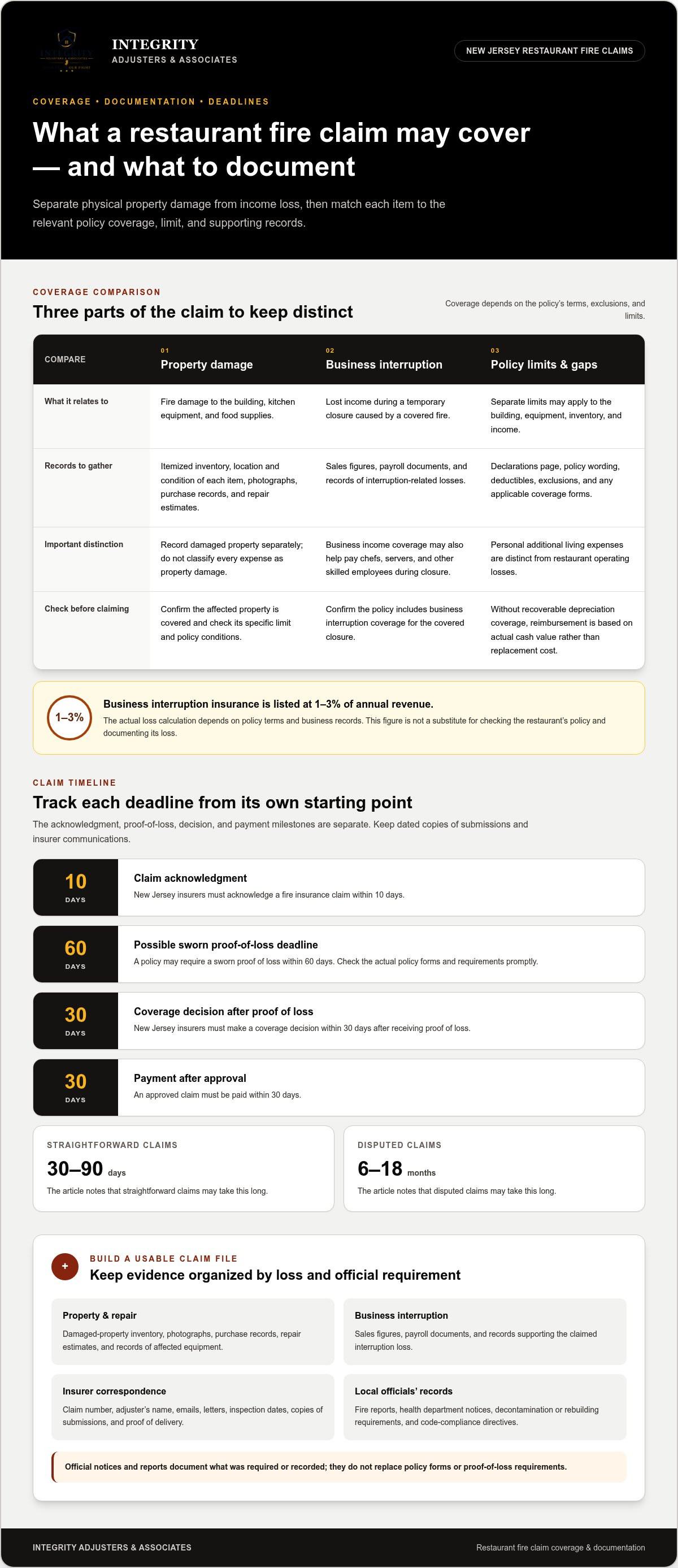
The fire scene is only the beginning of a restaurant insurance claim. A Plainfield, NJ restaurant fire insurance claim may cover damage to the building, kitchen equipment, and food supplies, while business interruption coverage may help replace income lost during a covered closure. New Jersey insurers must acknowledge a fire insurance claim within 10 days, and a policy may require a sworn proof of loss within 60 days.
Your policy helps determine what happens next, but a well-documented loss and timely submissions matter too. Keep an inventory of damaged equipment, records of business interruption, and fire-related evidence to support your claim.
This guide explains what restaurant fire insurance may cover in New Jersey, how insurer response timelines and filing deadlines work, and how to document kitchen equipment, refrigeration, and other losses. It also explains when public-adjusting support can help organize a comprehensive claim for the insurer.
Key Takeaways
- Review your commercial property and business interruption coverage to understand which fire losses and closure-related costs may be included.
- Track insurer communications and note that New Jersey insurers must acknowledge a fire claim within 10 days.
- Read your policy’s proof-of-loss requirements promptly; a sworn proof of loss may be due within 60 days.
- Photograph damaged kitchen equipment and refrigeration, and document smoke contamination or hidden electronic damage before cleanup.
- Organize fire reports, health department notices, repair records, and business income documents to build a more complete claim.
What Is a Fire Insurance Claim and What Does It Cover in New Jersey?
A restaurant fire claim asks the insurer to assess covered property damage and related losses under the policy. Separate building and equipment damage from lost income, then match each loss to the relevant coverage and limit.
-
Identify Covered Restaurant Property Damage
Inventory the building, kitchen equipment, and food supplies affected by the fire. Commercial property insurance may cover fire damage to these items, subject to the policy’s terms, exclusions, and limits. Record each item separately, including its location and condition. Don’t classify every expense as property damage: lost sales and repairs may fall under different coverage.
-
Review Business Interruption and Living Expenses
Check whether the policy includes business interruption coverage for a temporary closure caused by a covered fire. In New Jersey, this coverage may replace lost income while the restaurant cannot operate; business income insurance may also help pay chefs, servers, and other skilled employees during closure. Keep sales and payroll records to document the claimed loss.
Separate business costs from personal housing needs. Additional living expenses are distinct from restaurant operating losses; New Jersey fire victims can request an advance when first reporting a fire to the insurer. Review the applicable policy before treating personal living costs as a restaurant claim expense.
-
Check Policy Types, Limits, and Gaps
Compare the declarations page with the property coverage, business interruption terms, deductibles, and exclusions. The building limit may differ from the limits for equipment, inventory, or income. Without recoverable depreciation coverage, reimbursement is based on actual cash value rather than replacement cost.
Check that the policy covers the restaurant’s current operations. A policy covering fire losses during construction may not cover losses after operations begin. Make sure application details about open-flame cooking, fire suppression systems, and staff safety training are accurate. Misrepresentations can jeopardize a claim.
-
Assess Restaurant Fire Restoration Costs
Build a cost record from repair estimates, damaged-property inventories, and documented interruption losses. Restoration costs depend on the building damage, affected equipment, and work needed before reopening. Business interruption insurance for New Jersey restaurants is listed at 1-3% of annual revenue, while the actual loss calculation depends on policy terms and business records.
There is no single restoration total for every restaurant. Itemize repair and replacement needs separately from lost income. Use local fire officials’ reports to record investigation findings and any cited safety violations, rather than assuming what caused the fire.
Claim timelines and insurer response requirements
For a Plainfield NJ restaurant fire insurance claim, track notice, policy submissions, and insurer responses separately. Gather the policy, photographs, repair records, and business documents. Notify the insurer promptly and check the policy for any proof-of-loss requirements.
- Record each deadline and insurer contact. Save the claim number, adjuster’s name, emails, letters, and inspection dates in one file. New Jersey insurers must make a coverage decision within 30 days after receiving proof of loss. An approved claim must be paid within 30 days. These are separate milestones, so record when the insurer receives each submission.
- Build a complete proof-of-loss package. Follow the policy’s forms and instructions, and support each claimed amount with relevant records. Include an inventory of damaged property, photographs, repair estimates, purchase records, sales figures, and payroll documents where applicable. Keep copies of submitted materials and proof of delivery. Identify the policy deadline promptly and calendar it for the Plainfield NJ restaurant fire insurance claim.
- Respond methodically to delay or denial. Compare the insurer’s written decision with the policy language and submitted evidence. List each disputed item, attach supporting records, and send a clear written response through the insurer’s stated claim process. Preserve the denial letter and all correspondence. Straightforward claims may take 30 to 90 days; disputed claims may take 6 to 18 months.
- Coordinate reopening and employee claims separately. A local health department may require decontamination or rebuilding before the restaurant can legally reopen. Keep its notices and related work records with the claim file. New Jersey restaurants with even one worker must carry workers’ compensation insurance. That coverage addresses injured employees’ medical care and lost wages, separately from property damage.
- Keep local officials’ records with your documentation. The local health department may set reopening requirements, and fire marshal reports can document the investigation. Preserve notices, reports, and code-compliance directives for the insurer’s review. These records show what officials required or documented, but do not replace policy forms or proof-of-loss requirements.
For a Plainfield NJ restaurant fire insurance claim, keep local health department notices and fire officials’ records alongside insurer correspondence. Response timelines depend on milestones such as claim acknowledgment and receipt of proof of loss, so retain dated copies of every submission.
Fire damage to kitchen equipment and refrigeration
Map each affected item before preparing the equipment portion of your claim. Restaurant fire losses can include visible flame damage, smoke contamination, compromised refrigeration, and electronic damage that may not be immediately apparent.
- Create an equipment-by-equipment inventory. List each affected range, fryer, oven, hood, walk-in cooler, freezer, and point-of-sale device separately. Record its location, manufacturer, model, serial number, approximate age, and condition. Note whether damage appears direct, smoke-related, heat-related, or uncertain. This detail helps distinguish an appliance from a system or building component and gives the insurer a specific item to assess.
- Photograph the kitchen and each item. Take wide shots showing where equipment was located, then close-ups of visible damage, labels, and control panels. For example, photograph smoke residue around the hood and duct system, followed by the oven’s model plate. Keep the original files and note when and where each image was taken. One room-wide photograph won’t document every piece of equipment.
- Document refrigeration performance concerns. Identify each refrigerator, freezer, and walk-in unit, then record visible damage and any interruption to normal operation. A fire can compromise refrigeration even when the exterior looks intact. Note error messages, damaged wiring or controls, and changes observed after the incident. Keep your observations separate from a technician’s findings or an insurer’s inspection.
- Track smoke and hidden electronic damage. Smoke may affect hood and duct systems, while heat or smoke can damage electronics without obvious exterior signs. List ventilation controls, kitchen displays, payment terminals, and refrigeration electronics as separate entries. Add photographs, repair findings, and replacement estimates as they become available. Describe observed symptoms rather than assuming a cause before assessment.
- Match each documented loss to supporting records. Gather purchase invoices, equipment schedules, maintenance records, and repair or replacement estimates for inventoried items. Compare these records with the policy’s equipment limits and valuation terms. Cooking equipment is the leading cause of restaurant fires, so document ranges, fryers, ovens, and related components carefully. Organize the file by item, not just by room.
Commercial property insurance can help New Jersey restaurants with damage to buildings, equipment, or food supplies caused by fire, theft, or natural disasters. Keep the kitchen equipment inventory tied to the broader property record, so equipment and affected building components are presented distinctly. During its pre-fire inspection, the insurer could see open flames from multiple gas stoves in the restaurant kitchen. Preserve that inspection detail with other claim materials, while keeping it separate from item-level damage evidence.
An insurer may deny a claim and rescind a policy back to its issue date after a commercial property fire. An inventory alone cannot establish coverage, so keep the policy and inspection information with invoices and equipment records for review. Restaurants may remain closed for weeks or months while fire damage repairs are underway. Ordinance upgrade coverage may help pay to repair a fire-damaged structure to better-than-new condition. Keep structural repair needs separate from appliance and refrigeration estimates, and track both against the policy terms.
New Jersey fire claim reporting and filing deadlines
Treat notice, policy submissions, and any lawsuit deadline as separate milestones. For a Plainfield restaurant fire, notify the insurer promptly and maintain a dated record of each action.
- Report the fire to your insurer promptly. New Jersey policyholders are advised to notify the insurer ideally within 24 hours after a fire. Give the restaurant’s name and location, the date of the loss, and a brief description of what happened. Record the time and method of notice, the claim number, and the representative’s name. If details are still developing, report known facts and document later updates.
- Keep proof that notice was received. Save confirmation emails, claim portal receipts, letters, and notes from phone calls. Create a timeline of when you reported the fire, sent documents, and received replies. A dated record distinguishes the initial notice from later claim submissions. Keep copies in a secure business file and a backup, so staff changes don’t interrupt the record.
- Read the policy’s reporting and filing instructions. Identify the insurer’s required notice method, forms, and deadlines. Put each policy deadline on a calendar and assign someone to track it. A fire claim may involve separate steps for reporting, submitting requested documents, and proving the amount of loss. Don’t assume the initial phone call replaces other submissions required by the policy.
- Preserve evidence while the claim is being assessed. Photograph the restaurant, equipment, inventory, and visible smoke or fire damage before cleanup changes the scene. Save fire marshal reports, health department notices, repair records, and receipts for necessary protective work. Date each item and connect it to the location or loss it documents. Avoid altering or discarding fire evidence before the insurer has an opportunity to inspect.
- Track any denial and the time available for legal action. Save the denial letter, the policy provisions cited, and the materials submitted with the claim. New Jersey policyholders have six years to file a lawsuit over a denied fire insurance claim. Record the denial date and related correspondence in the claim timeline. This lawsuit period is separate from policy reporting requirements and does not replace earlier claim deadlines.
Fire preparedness also sits within a broader risk picture for restaurants: New Jersey has approximately 11,500 structure fires annually. Typical New Jersey personal property coverage is 50-70% of Coverage A; review how the policy describes covered property and limits before a loss. General liability and liquor liability are separate considerations from a fire claim.
New Jersey restaurants that serve alcohol are required by law to have liquor liability insurance.
Public adjuster assistance for restaurant fire losses
Restaurant fire claims can become more complex than they appear during the first 24 hours. A public adjuster can help the policyholder document property losses and organize a comprehensive claim for presentation to the insurer. In New Jersey, public adjusters are required to be licensed. Their role is claim support, not legal representation or physical restoration.
- Bring in claim support when the loss spans several categories. A restaurant fire may damage the building, cooking equipment, inventory, ventilation, and electronics, while also interrupting operations. A public adjuster can help organize these losses into a coherent claim instead of treating the kitchen as one undifferentiated damage area. This can be especially useful when smoke or heat effects are less visible than direct flame damage.
- Build an evidence-based inventory. Group damage by location and type, such as the dining room, kitchen, hood system, refrigeration, and food supplies. Link each item to photographs, purchase records, repair estimates, or other available documentation. A clear inventory helps the insurer review specific losses and can reveal omissions, such as smoke contamination in ducts or compromised refrigeration behind an intact exterior.
- Include official records in the claim file. Restaurant documentation can include fire marshal reports, health department notices, and code-compliance directives. Keep each report with the related repair or reopening issue. For example, a health department notice requiring decontamination can help explain why operations remain suspended. These records support loss documentation but do not replace policy forms or proof-of-loss requirements.
- Compare the documented loss with policy terms. Organize the claim by coverage category, including building damage, equipment, inventory, and business interruption. Track limits, deductibles, valuation terms, and exclusions alongside supporting records. If a commercial property policy treats equipment differently from building repairs, separating those items makes potential gaps easier to identify and gives the insurer a clearer basis for reviewing each part.
- Use support to keep claim handling organized. Maintain a dated record of insurer requests, inspections, submissions, and responses. A public adjuster can help prepare and present the documented claim, while the policyholder remains responsible for timely notice and required submissions. Consider this assistance when evidence is extensive, losses overlap, or the insurer disputes the scope. For a straightforward, well-documented loss, a policyholder may handle the claim directly.
Integrity Adjusters & Associates: Residential Water Damage Claim Support
Integrity Adjusters & Associates helps commercial policyholders document fire losses and organize comprehensive claims for presentation to the insurer. Its Commercial Fire Loss Claim Support can help with restaurant fires affecting the building, kitchen equipment, inventory, or business records, or when assembling the claim file feels difficult.
The process focuses on documenting the loss clearly by organizing photographs, itemized damage records, repair documentation, and relevant business information. This support can help you build a structured account of what the fire affected and gather evidence for the claim. It does not replace policy deadlines, legal representation, or physical restoration.
Contact Integrity Adjusters & Associates to discuss support for your commercial fire claim.
Move the claim toward a clear next step
A fire claim can shape decisions well beyond the initial emergency, including reopening plans, employee communications, and business-record priorities. Assign one person to maintain the claim file and record decisions affecting the restaurant’s recovery. A consistent record helps preserve continuity if responsibilities shift among owners or managers.
For a Plainfield restaurant fire insurance claim, public-adjusting support can help organize the documented commercial loss for the insurer. Integrity Adjusters & Associates also offers Residential Water Damage Claim Support, Residential Storm Damage Claim Support, and Residential Fire Loss Claim Support.
If you want support organizing a commercial fire loss claim, contact Integrity Adjusters & Associates. A deliberate next step can help you keep the claim process focused while you plan what comes next for your restaurant.
Frequently Asked Questions
How can a New Jersey restaurant file a commercial property insurance claim after a fire?
To support a Plainfield NJ restaurant fire insurance claim, notify the insurer and create a dated record of the fire’s effects. Record which rooms were inaccessible, which services stopped, and what steps protected undamaged property. Keep the policy information, incident details, and supporting documents together. This connects claimed losses to the fire and gives the insurer a clear account to review.
What insurance coverage may pay for restaurant fire damage, equipment, inventory, and cleanup?
Commercial property coverage may apply to fire damage involving a restaurant building, equipment, and food supplies. Review the policy’s coverage categories and limits, then record cleanup or debris-removal expenses separately. Don’t assume these expenses share a limit with equipment or building repairs. An itemized estimate can distinguish work on damaged property from cleanup tasks and help organize supporting claim records.
Does business interruption insurance cover lost income while a Plainfield restaurant is closed after a fire?
A Plainfield NJ restaurant fire insurance claim may include lost income under business interruption coverage when a covered fire forces a temporary closure. Gather point-of-sale reports, deposit records, and operating records from before the incident. Separate interrupted sales from costs that continued during closure, and document changes such as reduced service or partial reopening. The policy wording determines which losses and periods are covered.
Which Plainfield or Union County agencies assist restaurants after a fire?
The local health department may set decontamination or rebuilding requirements before reopening. Fire officials or the fire marshal may provide investigation records for the claim.


