

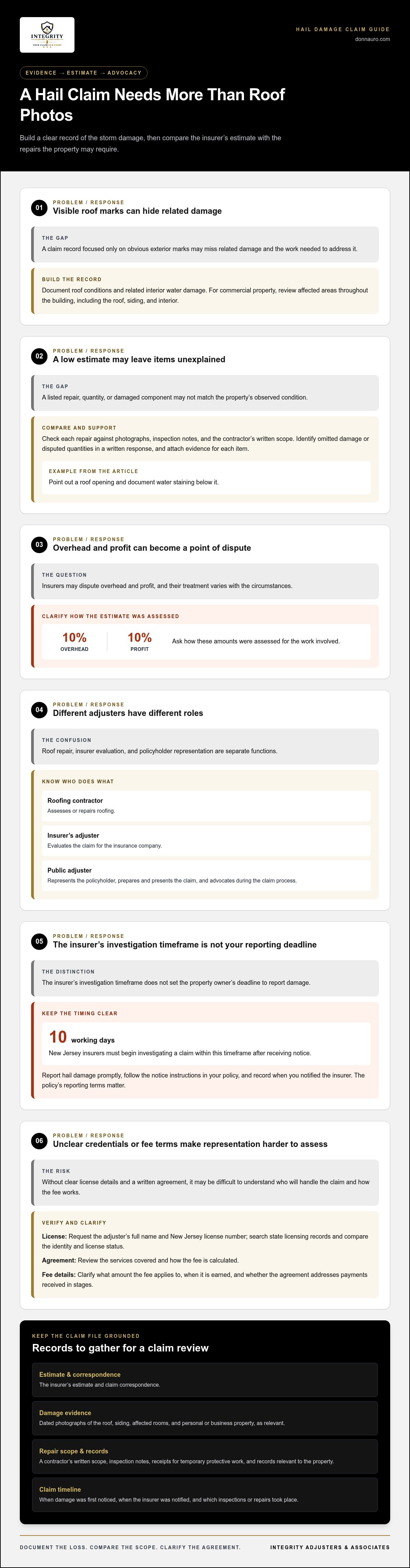
A general contractor’s absence doesn’t, by itself, settle whether overhead and profit belong in a hail-damage estimate. A Perth Amboy, NJ public adjuster for hail damage can review how the claim is documented and whether the estimate accounts for the work involved. Insurers may dispute 10% overhead and 10% profit, and their treatment varies by the circumstances.
If you’re questioning a hail damage estimate, you need more than a debate over percentages. You need a clear record of roof damage, related water intrusion, and the repairs the property may require. This article explains how a Perth Amboy NJ public adjuster for hail damage can help document losses, prepare a detailed claim, and advocate on your behalf.
You’ll also learn what can affect overhead and profit, how adjuster fees are explained, and what to look for when reviewing a claim. The goal is a better-grounded estimate and a clearer understanding of your next steps.
Key Takeaways
- Learn how a public adjuster can organize damage evidence and build a detailed claim for a Perth Amboy property.
- See what to clarify about an adjuster’s fee arrangement before moving forward, and which claim details can affect it.
- Understand why hail damage records should include roof conditions and any related water intrusion, not just visible exterior marks.
- Explore how contractor overhead and profit may be evaluated in an estimate, and why the circumstances of the repair work matter.
- Find out how to approach claim reporting, review an adjuster’s New Jersey license, and decide what support fits your loss.
Why should New Jersey property owners hire a public adjuster for property damage claims?
A public adjuster represents New Jersey property owners in insurance claims by documenting covered losses and preparing a detailed claim for the insurer. For hail or wind damage in Perth Amboy, that means looking beyond obvious roof marks to related damage and the work needed to address it.
Hail and Wind Damage Claims
Hail can crack roofing materials, while strong winds can damage roofing or siding and drive debris into a building. A public adjuster documents visible damage and related interior water damage, then organizes the evidence for the claim. Commercial property owners should also review affected areas throughout the building, including the roof, siding, and interior. Check that the estimate identifies each damaged component and connects it to the reported storm.
Understand each role when deciding what help you need. A roofing contractor assesses or repairs roofing. The insurer’s adjuster evaluates the claim for the insurance company. A public adjuster represents the policyholder, prepares and presents the claim, and advocates for the policyholder during the claim process.
License Verification
Before discussing representation, request the public adjuster’s full name and New Jersey license number. Use those details to search state licensing records and compare the person’s identity and license status. Also review the written agreement before signing, including the services covered and how the fee is calculated. This gives property owners a clear record of who will handle claim documentation and communication.
Prepare for future losses by keeping a dated property inventory, purchase records, prior inspection reports, and clear photos of the roof, siding, and business equipment. After hail, these records can help distinguish existing wear from newly observed damage. A dated file also gives the adjuster a useful baseline when documenting a loss.
Claim Reporting Deadlines
Report hail damage to the insurer promptly and follow the notice instructions in your policy. The policy’s reporting terms matter, so record when you notified the insurer and keep a copy of the notice. New Jersey insurers must begin investigating a claim within 10 working days after receiving notice. That investigation timeframe is not a deadline for property owners to report damage.
Disputing a Low Settlement
Start with the insurer’s estimate. Compare each listed repair with photographs, inspection notes, and the contractor’s written scope. Identify omitted damage or disputed quantities in a written response, then attach evidence supporting each item. For example, point out a roof opening and document water staining below it. If the estimate includes 10% overhead and 10% profit, ask how those amounts were assessed for the work involved. Insurer treatment can vary with the circumstances.
Public adjuster fees and consultation
A claim review can help clarify how a public adjuster would approach your insurance claim, which records are useful, and what the written agreement covers. For a Perth Amboy roof loss, gather the insurer’s estimate, claim correspondence, photographs, and any contractor’s scope of work. Reviewing these materials gives the discussion a practical starting point.
Fees depend on the agreement between the policyholder and the public adjuster. Read the fee basis closely: identify what amount it applies to, when the fee is earned, and whether the agreement addresses payments received in stages. Ask for a plain-language explanation of how the fee calculation would work in an example involving your claim. A public adjuster’s fee depends on the case and is given after a quote request; cost factors include the scope of damage, claim complexity, and work required.
Use the claim review to understand the work involved, not just the fee. Clarify how damage documentation, claim preparation, and communication with the insurer fit into the advocacy process. If a storm damages a roof, for example, the claim record should distinguish roof damage from resulting interior water damage and include evidence for each.
- Compare the written fee basis with the verbal explanation.
- Identify the services included and any work outside the agreement.
- Clarify when the agreement starts and how either party can end it.
- Ask how claim payments and fee calculations will be recorded.
Before signing, look for conflicts and unclear terms. Check whether the adjuster has a financial relationship with a contractor or another party involved in the loss, and ask how that relationship is disclosed. Review any language about referrals, authority to communicate, expenses, and cancellation. A contract should identify the parties, describe the assignment, and explain the fee calculation without relying on verbal promises.
Prepare a short timeline for your claim review. Note when you first noticed damage, when you notified the insurer, and which inspections or repairs have taken place. Gather receipts for temporary protective work and dated photos of affected rooms, roofing, and personal property. These records help connect the reported loss with the evidence supporting each claimed item.
For a commercial property, include the affected building areas and business property records relevant to the claim. For a home, organize roof and interior damage separately. A clear file lets you compare the proposed work with the claim’s actual needs, then decide whether the agreement’s scope and fee terms fit your situation.
Storm damage documentation and repair estimates
After a Perth Amboy hailstorm, photograph visible damage, note when you found it, and save inspection and repair records. Include roof and interior conditions: an unnoticed crack may allow water to enter during a later storm.
Storm Damage Documentation
Build a dated record before filing: photograph each affected area, label the location, and keep original images. Record ceiling stains, wet materials, and damaged belongings alongside exterior roof or siding marks. If water appears after a later storm, note when it began and where it entered. These details help a licensed public adjuster represent the damage claims with evidence tied to specific parts of the property.
Keep earlier property photos, maintenance documents, and roof information with the storm evidence. They can help show the difference between prior wear and newly observed hail damage. Save receipts for temporary protective measures and inspection records. Before damaged materials are removed, photograph and document their condition so the evidence can help explain what the estimate includes or leaves out.
Repair Estimates and Pre-Claim Steps
Before filing, write down the damage you can observe and gather relevant documents. A useful repair estimate identifies affected components, materials, measurements, and proposed work. Compare each item with your photographs and inspection notes. “Siding repair” alone is less informative than an estimate that identifies the damaged side of the building, material, and scope of work.
Measurement differences deserve attention. In one hail-damage claim involving aluminum siding, one adjuster estimated thickness at .024, while another estimated .19. Those figures describe a substantial discrepancy in the recorded material thickness. Compare the underlying inspection notes and estimate descriptions rather than relying on a total alone. Accurate material identification can affect how the repair scope is presented.
Review roof depreciation separately from repair scope. Insurers may apply roof depreciation ranging from 10% to greater than 50%. Check how the estimate describes the roof’s condition, age, and materials, then compare that description with your property records. The estimate should make clear which work is proposed and how depreciation affects the amount shown.
Overhead and profit also require a close estimate review. Some hail-damage estimates dispute 10% overhead and 10% profit, and insurer treatment varies with the circumstances. Compare the proposed work and project coordination needs with the estimate’s explanation. A public adjuster can organize supporting documentation and present the policyholder’s position on the claim.
- Save dated photos, inspection notes, and repair records together.
- Compare material measurements and repair descriptions line by line.
- Review depreciation and overhead separately from the repair scope.
Which New Jersey public adjusters are licensed and how can their licenses be verified?
New Jersey public adjusters who hold state licenses can represent policyholders in property insurance claims. Before discussing a hail loss, ask the adjuster for their full legal name and license number. Use those details to search New Jersey state licensing records, then compare the record with the person offering representation. A matching name is a starting point, not a substitute for reviewing the written agreement.
Check the license status shown in the state record and make sure it belongs to the individual who will handle your claim. If a firm introduces several adjusters, verify the person assigned to your file, not only the person who first speaks with you. Keep a note of the search date and the name or number you checked. This gives you a clear reference if assignments change later.
A license check answers a specific question: whether the individual appears in state licensing records as a licensed public adjuster. It does not tell you whether the proposed contract fits your claim or defines every task. For example, a Perth Amboy homeowner should separately confirm who will inspect the hail damage, organize claim documents, and communicate with the insurer.
- Request the adjuster’s full name and license number.
- Search New Jersey state licensing records using both details.
- Compare the listed identity with the person named in the agreement.
- Save your search notes with the claim file.
Review the agreement before signing. The document should identify the adjuster and explain the work they will perform for your property damage claim. Compare its terms with what you discussed. If the agreement names one adjuster but another person will represent you, request a clear written explanation of that arrangement before proceeding.
A public adjuster represents the policyholder, while the insurance company’s adjuster evaluates the loss for the insurer. That distinction matters during a roof claim: your public adjuster can organize supporting evidence and present your position on disputed damage or repair scope.
Alongside reviewing the agreement, ask how communication and claim records will be handled. Clarify who will receive insurer correspondence and how inspection findings and claim materials will be organized. Keep copies of estimates and photographs of the damaged roof with your claim file so the evidence remains accessible.
What is the deadline to report a hail damage claim to a New Jersey insurer?
New Jersey claim-handling timeframes do not create one reporting deadline for every hail loss. Notify your insurer promptly and follow the notice requirements in your policy. The insurer’s investigation deadlines are separate from your obligation to report damage.
Separate the notice deadline from insurer response times
After receiving notice of a claim, New Jersey insurers must begin investigating within 10 working days. That requirement governs the insurer’s response, not how long a property owner may wait before reporting hail damage. Check your policy for its notice terms, then notify the insurer using the required method and keep a dated copy.
Do not wait for a contractor’s final estimate before notifying the insurer. If you find a roof mark after a hailstorm but have not confirmed a leak, report what you observed and explain that inspection is ongoing. Add photographs or an estimate when available. Timely notice and documenting the full extent of the loss are separate steps.
Understand proof-of-loss and claim updates
New Jersey regulations set a 30-calendar-day period from receipt of a properly executed proof of loss for first-party claims. This is not the same as a deadline to report hail damage. A proof of loss is a claim document, so keep a copy of what you submit and record when the insurer receives it.
If an insurer needs more time to handle a claim, it must explain the reason in writing and provide updates every 45 days, subject to stated exceptions. Keep each written update with the claim file. If a response refers to missing information, note what was requested and when you supplied it. That timeline can help you track the claim’s progress without confusing insurer processing periods with policy notice terms.
Build a clear notice record
Use a simple sequence to preserve the reporting record:
- Review the policy’s notice instructions and identify the stated reporting method.
- Send notice with the date you discovered the damage and the affected areas.
- Save confirmation, correspondence, photographs, and inspection records together.
- Provide further documentation as it becomes available, keeping copies of submissions.
For a Perth Amboy roof claim, describe what you observed without assuming there is hidden damage. If water staining appears later, record when and where it appeared, then add that information to your claim file. A dated timeline helps distinguish the initial hail report from later evidence of water intrusion.
Organizing your notice and supporting records can make the next claim discussions more precise. Get help organizing your storm damage claim if you need support documenting the reported loss.
Integrity Adjusters & Associates: Residential Water Damage Claim Support
Integrity Adjusters & Associates helps New Jersey policyholders document residential property losses and prepare comprehensive insurance claims. After hail damages a roof, related water intrusion may also need to be documented in the claim. The firm provides Residential Storm Damage Claim Support and Residential Water Damage Claim Support for these related parts of a loss.
Turn to the firm when you need help organizing damage evidence, preparing claim materials, or advocating for your documented loss with the insurer. Photographs, inspection notes, and repair estimates can help explain the damage and work involved. Integrity Adjusters & Associates provides claim advocacy, not physical restoration or repair.
For support with a residential storm or water damage claim, contact Integrity Adjusters & Associates to discuss your claim.
Move Forward With a Clear Claim Strategy
Your next step is to decide what support would help you manage the claim. A public adjuster for hail damage in Perth Amboy, NJ, can help organize claim records and present documented losses. Gather your photographs, insurer correspondence, estimates, and notes so the review can focus on your property and the available evidence.
Integrity Adjusters & Associates supports residential storm, water, and fire loss claims in New Jersey. That support can be relevant when a hail-damaged roof leads to interior water damage or another residential loss needs organized claim documentation. The firm advocates for policyholders; it does not perform repairs.
If you’re ready to discuss your claim and the support it may need, contact Integrity Adjusters & Associates. Take the next step with your records in hand and a steady focus on documenting the property damage.
Frequently Asked Questions
Can my insurance company withhold the 10% profit and 10% overhead they say is only paid if a general contractor is involved?
Not solely because a general contractor isn’t involved; the estimate and repair circumstances matter. Some hail-damage estimates dispute 10% overhead and 10% profit, and insurer treatment varies. Compare the work required with the estimate’s explanation of those amounts. If you’re challenging an omission, identify the coordination or repair tasks involved and support your position with the scope of work and claim documents.
What if the insurance company offers to just patch or fix part of my roof?
Compare the insurer’s proposed repair scope with the documented damage before treating it as a complete resolution. Check which roof areas the estimate includes and whether it accounts for related interior damage. If the estimate addresses one section but your records show damage elsewhere, organize the evidence by location and explain the difference in writing.
Which public adjusters serve Perth Amboy, New Jersey, for hail damage claims?
Integrity Adjusters & Associates provides public-adjusting advocacy for New Jersey property policyholders, including storm-damage claim support. A Perth Amboy homeowner looking for a public adjuster for hail damage can review the adjuster’s New Jersey license and the agreement’s scope before retaining representation. The firm helps document property losses and prepare a claim for the insurer. Its role is policyholder advocacy, not roof repair.
What hail damage do New Jersey homeowners insurance policies typically cover?
Coverage depends on your policy and the cause and type of damage. Review the sections addressing wind or hail, roof materials, exclusions, deductibles, and resulting interior water damage. Document a roof impact and a ceiling stain as separate observed conditions, then review them against the policy terms. Keep your declarations and relevant policy wording with your claim records.
How do I document hail damage to a roof, siding, windows, and gutters?
Record each affected area separately: roof, siding, windows, and gutters. From a safe position, photograph each damaged location, include wider images that show where it sits on the building, and note the date and visible condition. Save close-ups of dents, cracks, or displaced materials with relevant receipts and inspection notes. Don’t climb onto a roof; use ground-level views or professional inspection documentation for elevated areas.
How much do public adjusters charge in New Jersey, and what fee limits apply?
Fees depend on the written agreement, so review how the fee is calculated, what amount it applies to, and when payment is due. Integrity Adjusters & Associates uses a contingency fee based on the final settlement, with no upfront fees and payment only after recovery. Its initial claim review costs nothing. The agreement’s specific terms let you understand the fee arrangement before deciding whether to proceed.


