

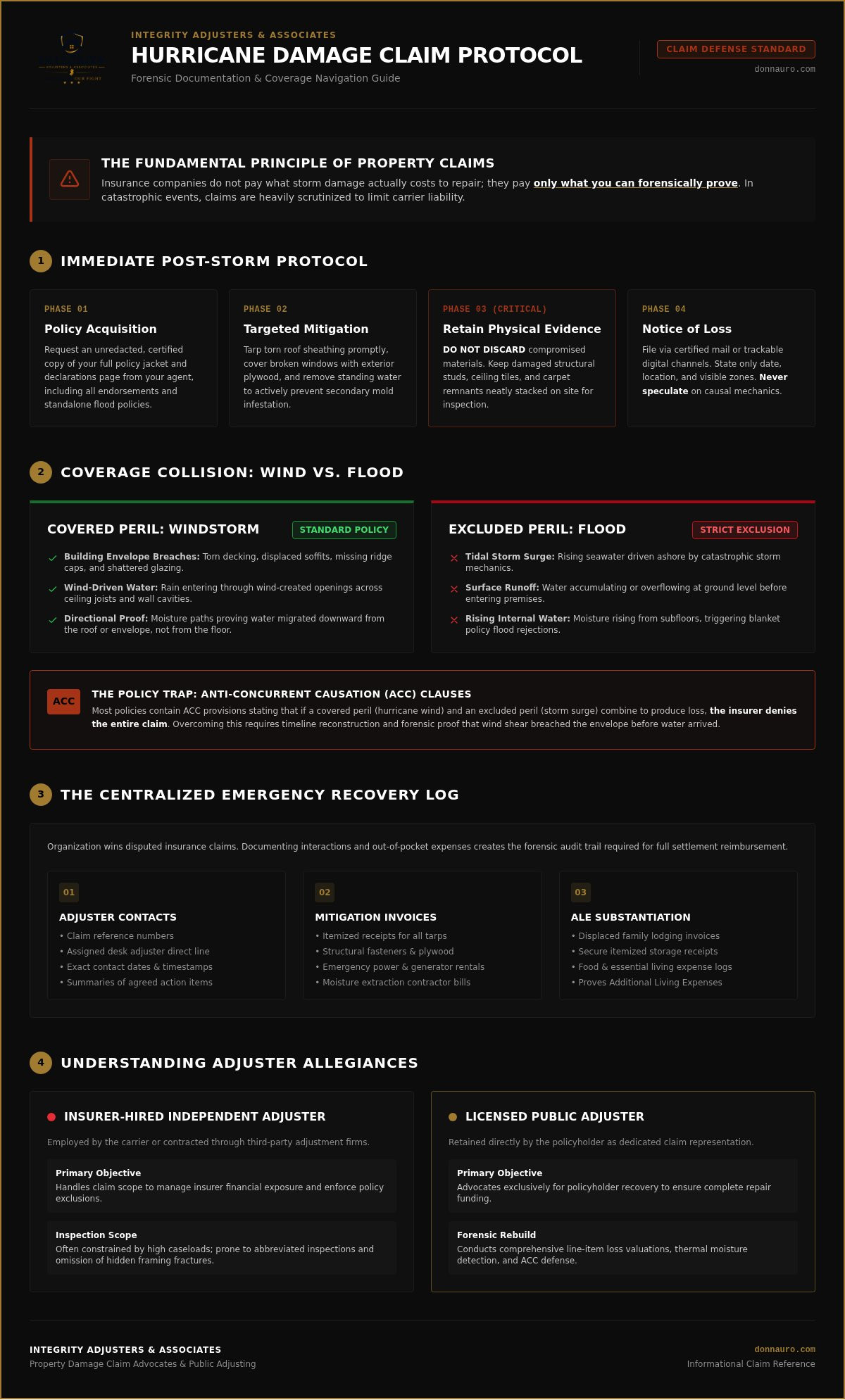
Insurance companies don't pay what storm damage actually costs to repair; they only pay what you can forensically prove. Following a catastrophic event, securing reliable hurricane damage insurance claim help is often the deciding factor between a fully funded rebuild and a devastating out-of-pocket loss.
You're likely facing tight mitigation deadlines while sorting through contradictory instructions from carrier adjusters. It's completely normal to feel overwhelmed, especially when trying to decipher tricky policy exclusions between wind-driven rain and flood damage. The fear of having severe structural damage undervalued or dismissed outright is valid; carriers scrutinize catastrophic claims heavily to limit their exposure.
This guide equips you with the exact steps to document property losses systematically, decode complex coverage terms, and take command of the adjustment process. Ahead, you'll find a sequential recovery protocol, strategic methods for handling insurer inspections, and the critical indicators for when professional claim advocacy is necessary to protect your investment.
Key Takeaways
- Execute mandatory emergency mitigation to protect your property without discarding vital physical evidence carriers require for proof of loss.
- Untangle complex policy exclusions, including anti-concurrent causation clauses that insurers use to attribute covered wind damage to excluded storm surge.
- Build an indisputable structural inventory through systematic, high-resolution documentation that exposes hidden moisture intrusion and concealed roof framing fractures.
- Discover why dedicated hurricane damage insurance claim help is essential for contesting undervalued line-item estimates and truncated insurer inspections.
- Recognize the clear distinction between insurer-hired independent adjusters and licensed public adjusters who advocate exclusively for your full recovery.
Immediate Actions: Securing Your Property and Starting the Claim
Personal safety takes absolute priority after a catastrophic storm. Downed power lines, compromised roof trusses, and hidden structural shifts turn post-storm assessments into hazardous operations. Once local authorities confirm the area is secure, establish immediate control over the property. Request an unredacted, certified copy of your full policy jacket and declarations page from your agent immediately, including any endorsements or standalone flood insurance policies.
To understand the critical steps required before contacting your insurer, watch this essential breakdown of storm-related claims:
Securing specialized hurricane damage insurance claim help early provides the structural framework needed to protect your claim value before carrier representatives set foot on your property.
Mitigating Secondary Damage Without Compromising Evidence
Standard property contracts obligate you to protect the premises from progressive destruction. Tarp torn roof sheathing promptly, cover broken windows with exterior plywood, and remove standing water to suppress mold growth. Crucially, do not discard compromised building materials. Keep damaged structural studs, ceiling tiles, and carpet remnants neatly stacked on site. Insurance adjusters require physical evidence to authenticate the severity of your primary storm loss.
Filing the Notice of Loss Correctly
Transmit your initial notice of loss through trackable digital channels or certified mail rather than relying solely on a phone call. State the basic facts clearly: report the loss date, location, and visible damage zones. Never speculate on causal mechanics. Do not guess whether moisture entered through failed flashing, compromised shingles, or rising water. Secure an official claim reference number immediately, along with the direct contact information of your assigned desk adjuster.
Establishing an Emergency Recovery Log
Organization wins disputed claims. Maintain a centralized, chronological log detailing every insurer contact, including dates, names, direct phone lines, and summaries of discussed action items. Retain itemized receipts for every expenditure, from tarps and fasteners to emergency power rentals. For displaced families, track every out-of-pocket invoice for lodging, storage, and meals. These documentation logs substantiate your Additional Living Expense (ALE) reimbursement requests directly against carrier scrutiny.
Deciphering Hurricane Coverage: Wind Damage Versus Flood Exclusions
Insurance carriers routinely deny or reduce storm settlements by exploiting the line between wind destruction and rising water. Standard property policies cover windstorm impacts, such as torn decking or blown-in windows, but exclude rising tidal surge and surface runoff. Consumer advocacy resources on how to file a hurricane claim emphasize establishing causation before adjusters attribute losses to excluded perils. When both elements strike simultaneously, policy language dictates whether you receive a settlement check or a total denial.
The Mechanics of Wind-Driven Water Claims
To secure coverage under a standard property policy, you must prove wind created an opening in the building envelope before water entered. Document missing ridge caps, shattered glazing, and displaced soffits. Track the directional path of moisture intrusion through ceiling joists and wall cavities to prove water did not rise from the floor. Establishing wind shear as the proximate cause of loss prevents the carrier from treating internal moisture as excluded storm surge.
Navigating Anti-Concurrent Causation Clauses
Most commercial and residential property policies contain anti-concurrent causation (ACC) clauses. These provisions state that if an excluded peril (like flooding) and a covered peril (like hurricane winds) combine to cause damage, the insurer denies the entire claim. Overcoming this requires timeline reconstruction:
- Chronological evidence: Gather radar logs, wind gauge readings, and barometric data to confirm gale-force winds breached your structure hours before coastal surge arrived.
- Physical watermarks: Photograph elevated wall staining to clearly delineate roof runoff damage from lower water marks.
- Dual-claim coordination: File concurrently with the National Flood Insurance Program (NFIP) and your wind carrier, ensuring neither insurer shifts liability to the other without verified proof.
Evaluating Hurricane Deductibles and Policy Endorsements
Hurricane deductibles function differently than standard fixed-dollar deductibles. They apply as a percentage, typically between 2% and 10%, calculated against your total Coverage A dwelling value rather than the loss itself. For example, a 5% deductible on an $800,000 commercial or residential structure leaves you responsible for the first $40,000 of repairs.
Verify whether your contract contains Law and Ordinance endorsements to pay for mandated municipal building code upgrades, along with Business Income provisions to recover suspended revenue. If you face contested concurrent causation clauses or restrictive percentage deductibles, obtaining hurricane damage insurance claim help provides the technical leverage needed to defend your policy rights against carrier exclusions.
How to Build an Indisputable Property Damage Inventory
Vague snapshots of damaged siding won't satisfy a carrier claims adjuster. Insurers settle property claims based on verifiable facts, which makes a forensic proof-of-loss inventory your strongest financial asset. When policyholders seek professional hurricane damage insurance claim help, the first order of business is transforming raw destruction into an organized, evidence-grade portfolio before contractors alter the site.
Forensic Photo and Video Protocols
Approach documentation systematically from exterior perimeters to interior spaces. Capture wide-angle, panoramic photographs of every building elevation to establish context, then move in for high-resolution close-ups. Follow this visual capture checklist:
- Macro photography: Photograph shingle mat tears, cracked mortar lines, failed window seals, and distorted roof flashing alongside a physical measuring scale.
- Continuous video logs: Record unbroken walkthrough videos with narrated observations, filming wall-to-ceiling corners to document racking and settlement displacement.
- Asset identifiers: Take clear photographs of data plates, manufacturer serial plates, model numbers, and material grade stamps on HVAC units and high-value fixtures.
Detecting Latent and Concealed Building Failures
The most expensive storm losses hide behind intact interior surfaces. High-velocity winds twist structural framing without immediately rupturing the exterior envelope. Use non-invasive moisture meters and calibrated thermal imaging cameras to map temperature anomalies behind drywall, baseboards, and subflooring. Check attic roof trusses for nail pullout, micro-fractures, and displaced spray-foam insulation. If moisture penetrates structural cavities unnoticed, carriers will later dismiss secondary rot as pre-existing neglect.
Compiling the Personal Property Contents Schedule
Never rely on carrier-provided generic estimates for personal or business contents. Catalog every damaged item in an itemized spreadsheet detailing the room location, brand, model, age, and verified replacement value. Search digital purchase receipts, online store order histories, and bank archives to prove pre-storm condition and historical ownership.
Classify damaged inventory into two distinct schedules: total economic losses requiring outright replacement, and salvageable structural items requiring certified restoration. A well-organized, itemized recovery ledger removes guesswork from structural evaluations and forces carrier adjusters to justify any proposed settlement reductions line by line.
Managing Insurer Inspections and Challenging Low Settlements
Insurance company field adjusters frequently handle dozens of files a week following a hurricane. Rushed walkthroughs inevitably lead to truncated assessments and omitted line items. You cannot afford a passive stance during this visit. Directing the field inspection ensures that every layer of structural destruction ends up on the carrier's initial loss sheet.
Controlling the On-Site Adjuster Walkthrough
Lead the carrier adjuster through the property rather than following behind them. Present an organized physical binder containing your pre-mitigation photo log, moisture readings, and structural fracture evidence. Walk the perimeter first, then direct them to compromised roof joints, attic truss separations, and interior wet zones. Secure verbal confirmation on the physical damage boundaries before the adjuster departs, establishing an agreed baseline of damaged building assemblies.
Identifying Undervaluation in Carrier Loss Estimates
Insurers price claims using computerized estimating platforms like Xactimate. These calculations often fail to capture real-time market realities after a disaster, resulting in severe settlement shortages:
- Outdated labor pricing: Standard software price lists frequently lag behind localized post-storm surges in material costs and contractor labor rates.
- Improper depreciation deductions: Carriers often apply aggressive actual cash value (ACV) depreciation against permanent structural elements that shouldn't be depreciated.
- Patchwork repairs: Insurers often scope spot repairs for brittle roofs or mismatched flooring instead of full slope or continuous elevation replacements.
Carefully compare the insurer's line-item estimate against local contractor bids to uncover omitted tear-out costs, missing dump fees, and neglected code-mandated upgrades.
Utilizing Appraisal to Resolve Scope Disputes
When negotiations break down over structural repair costs, invoking your policy's appraisal clause provides an efficient alternative to lengthy courtroom battles. The appraisal clause serves as a binding contractual mechanism to settle valuation disputes without legal proceedings. You appoint an independent appraiser, the carrier selects theirs, and an agreed-upon neutral umpire settles any remaining differences.
Executing an appraisal demand requires bulletproof damage documentation and comprehensive structural estimates. If your carrier insists on an undervalued settlement or ignores critical structural repairs, get hurricane damage insurance claim help to review your scope and establish the true value of your property loss.
Enlisting Professional Advocacy: The Role of a Public Adjuster
Property owners often assume that the adjuster sent by their insurance carrier is an impartial evaluator. That assumption proves costly. Staff adjusters work directly for the insurance company, while independent adjusters are third-party contractors hired to represent the carrier's financial interests. Neither works for you. A licensed public adjuster is the only adjusting professional contractually bound to represent the policyholder exclusively.
How Public Adjusters Protect Policyholder Interests
Navigating structural claims without dedicated advocacy leaves you vulnerable to one-sided negotiations. Public adjusters act as strategic shields against carrier delays and low valuations:
- Granular scope development: Licensed advocates create independent, contractor-grade damage scopes using industry-standard estimating platforms, ensuring real-world construction costs replace insurer defaults.
- Direct claim management: They manage time-consuming communications, policy inquiries, and on-site re-inspections, shielding you from confusing insurer demands.
- Technical negotiation: Advocates counter arbitrary carrier exclusions with building code mandates, engineering reports, and photographic evidence.
When to Bring in an Independent Claim Advocate
Minor gutter repairs rarely warrant outside representation. However, substantial roof failures, pervasive interior water intrusions, or hidden framing racked by gale-force winds require specialized oversight. You should engage independent advocacy immediately if your insurer issues an outright denial, attempts to categorize structural wind damage as excluded storm surge, or offers a payout that leaves you thousands of dollars short of local rebuilding estimates.
For commercial operators, securing reliable hurricane damage insurance claim help protects against catastrophic financial interruption. Commercial storm damage claim support ensures that vital code compliance additions, structural stabilization expenses, and business interruption losses are captured accurately before settlement releases are executed.
Taking the Next Step in Your Storm Recovery
Rebuilding after a disaster requires a methodical, evidence-driven approach. Assemble your complete policy declarations, reservation of rights letters, and carrier settlement schedules. Do not sign final release documents or cash checks marked as full settlement if structural repair scopes remain incomplete or disputed.
Policyholders managing contested losses can contact Integrity Adjusters & Associates to schedule an independent damage review and deploy experienced residential or commercial storm damage claim support to secure the settlement their policy promises.
Reclaim Control of Your Storm Damage Settlement
Recovering fully from catastrophic storm destruction requires disciplined preparation. Securing equitable compensation hinges on preserving physical proof during emergency mitigation, disproving concurrent flood exclusions, and confronting undervalued insurer estimates with contractor-grade documentation. Insurers pay what policyholders substantiate.
You don't have to navigate institutional claim delays alone. Securing dedicated hurricane damage insurance claim help ensures your property rights remain protected against premature carrier closures. If your home or business sustained severe storm impacts, request a comprehensive claim evaluation with Integrity Adjusters & Associates. Through licensed, policyholder-exclusive advocacy and granular structural loss estimation using industry-standard protocols, our team brings a proven track record negotiating complex residential and commercial wind claims. Take the decisive step today to secure the funds you need to rebuild with total confidence.
Frequently Asked Questions
Is hurricane damage covered under a standard homeowners insurance policy?
Yes, wind and wind-driven rain from a hurricane are generally covered, but rising water and storm surge are strictly excluded. Standard policies in New Jersey protect against structural wind impacts, roof tearing, and broken glass. However, surface flooding and tidal surges require a separate National Flood Insurance Program policy or private flood coverage. Check your declarations page for specific named-storm endorsements and separate windstorm deductibles.
Can an insurance company deny my claim by citing flood water exclusions?
Yes, insurers frequently invoke anti-concurrent causation clauses to deny claims involving mixed wind and water damage. If rising storm surge occurs alongside wind damage, carriers often claim the excluded flood caused the loss. Overcoming this requires forensic proof, such as moisture readings and structural wind-shear documentation, showing wind opened the building envelope first. Obtaining professional hurricane damage insurance claim help ensures you establish an indisputable causation timeline.
How much time do I have to file a hurricane damage claim?
Filing deadlines depend on your policy terms and state insurance regulations, but you should report damage as quickly as possible. In New Jersey, policies typically mandate prompt notice of loss, often requiring filing within 30 to 60 days following storm impact. Waiting introduces carrier scrutiny regarding pre-existing neglect or unmitigated secondary moisture decay. Review your contract's conditions section immediately to avoid forfeiting coverage through technical reporting delays.
What happens if my insurance company initial payout is too low to cover repairs?
You don't have to accept an inadequate initial settlement check as the final resolution of your claim. Initial payments from insurers usually represent undisputed actual cash value rather than total repair costs. You can challenge lowball estimates by submitting detailed contractor bids, supplemental repair scopes, and municipal code upgrade costs. If informal negotiations stall, policyholders can invoke their contract's appraisal clause to demand full structural indemnification.
What is the difference between a company adjuster and a public adjuster?
A company adjuster works directly for the insurance carrier, while a public adjuster works exclusively for you, the policyholder. Company adjusters, including insurer-hired independent adjusters, focus on limiting insurer liability by applying policy exclusions and depreciation. A licensed public adjuster evaluates every damaged structural assembly, itemizes hidden moisture damage, and negotiates directly with the insurer on your behalf. In New Jersey, hiring a public adjuster provides dedicated policyholder advocacy.
How do hurricane deductibles work compared to standard policy deductibles?
Unlike standard flat-rate deductibles, hurricane deductibles are calculated as a percentage of your total Coverage A dwelling limit. In coastal New Jersey properties, these deductibles typically range from 2% to 5% of your insured structural value. For example, a 5% deductible on a $600,000 policy means you must absorb the first $30,000 of damage out of pocket before coverage applies. These special deductibles activate only when storms meet specific meteorological criteria.
Can I begin cleaning up storm damage before the insurance adjuster visits?
You can execute temporary emergency mitigation immediately, but you should never perform permanent repairs or discard damaged property before inspection. Insurance policies require you to prevent secondary damage by boarding up shattered openings, tarping torn roofing, and extracting standing water. Before starting, photograph and record video of all damage thoroughly. Professional hurricane damage insurance claim help ensures your emergency mitigation aligns perfectly with strict carrier evidentiary standards.


