

Insurance adjusters don't write property estimates to rebuild your home; they write them to protect company margins. After severe weather strikes, watching an insurer spend twenty minutes glancing at your roof only to deliver a settlement offer far below actual contractor estimates is infuriating. You shouldn't have to decipher complex policy language, track filing deadlines, or worry about hidden water intrusion alone. Partnering with a licensed residential storm damage claim advocate immediately shifts the balance of power. You gain an objective ally who documents structural reality and negotiates directly with the carrier on your behalf.
Discover how a residential storm damage claim advocate levels the playing field against insurance companies to secure your full property settlement. Below, we break down the four-stage recovery process, explain how detailed line-item scoping prevents vital repairs from being omitted, and demonstrate how seasoned representation eliminates negotiation stress so your home is restored completely.
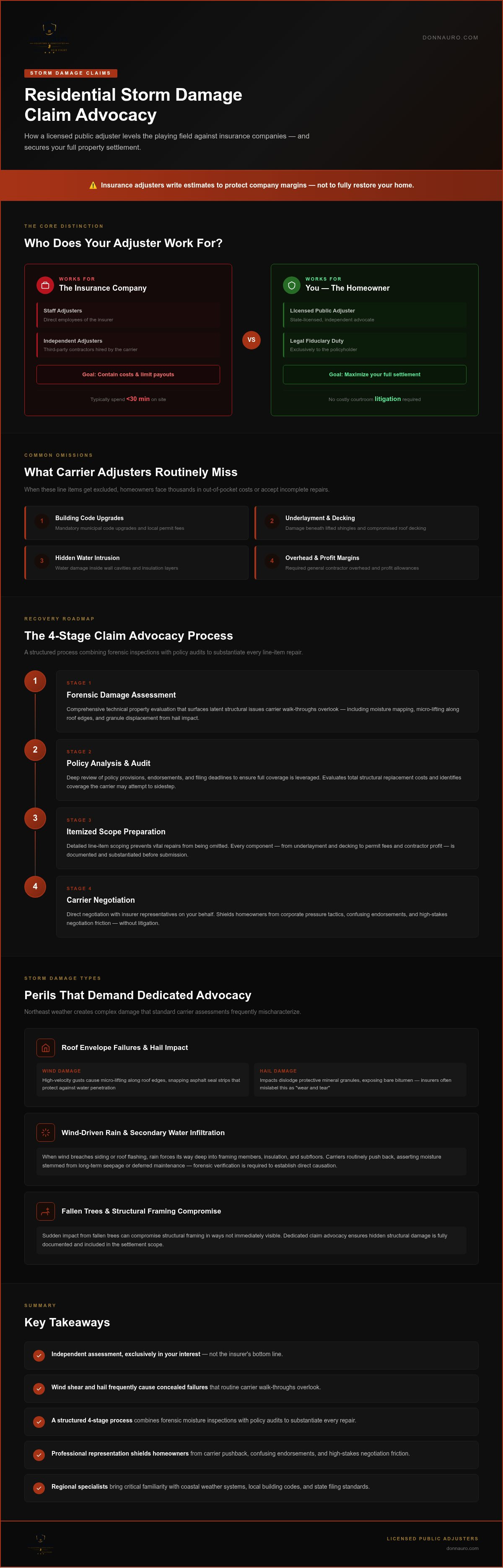
Key Takeaways
- Hiring an independent residential storm damage claim advocate ensures your property assessment is conducted exclusively in your best interest, not the insurer's.
- Wind shear and hail impacts frequently cause concealed structural and roofing failures that routine carrier walk-throughs overlook.
- A structured four-stage claims process combines forensic moisture inspections with policy audits to substantiate every line-item repair.
- Professional representation shields homeowners from carrier pushback, confusing policy endorsements, and high-stakes negotiation friction.
- Regional claim specialists bring critical familiarity with coastal weather systems, local building codes, and state filing standards.
What Is a Residential Storm Damage Claim Advocate?
A residential storm damage claim advocate is a licensed public adjuster who works exclusively for you, the homeowner, rather than the insurance company. Many law firms suggest that filing an expensive lawsuit is the only path to resolving an underpaid claim. That isn't true. State-licensed public adjusters provide dedicated representation through technical property evaluation and policy negotiation, securing full settlements without costly courtroom litigation. They manage the entire claim cycle, including forensic damage assessments, policy analysis, itemized scope preparation, and carrier negotiations.
To better understand the realities of how carriers handle weather losses, watch this brief breakdown:
Independent Policyholder Representation vs. Company Adjusters
The core distinction comes down to fiduciary duty. Staff adjusters are direct employees of the insurance company, and independent adjusters are third-party contractors hired by the carrier. Both answer to the insurer's bottom line. Their job involves containing claim costs and limiting payout exposures.
In contrast, a dedicated residential storm damage claim advocate holds a legal duty strictly to the policyholder. They possess the regulatory authority to evaluate policy provisions, calculate total structural replacement costs, and negotiate directly with insurer representatives. This protective shield insulates you from corporate pressure tactics.
The True Cost of Unrepresented Storm Damage Claims
Navigating a claim alone often results in severe financial shortfalls. Carrier adjusters frequently spend under thirty minutes on site, missing critical damage components. Common omissions in insurer-prepared scopes include:
- Mandatory municipal building code upgrades and local permit fees.
- Underlayment damage beneath lifted shingles and compromised roof decking.
- Water intrusion hidden inside wall cavities and insulation layers.
- Overhead and profit margins required for general contractors.
When these line items get excluded, the homeowner faces an agonizing choice: pay thousands out of pocket or accept substandard, incomplete repairs. Meticulous claim documentation levels this imbalance from day one.
Severe Storm Perils That Demand Dedicated Claim Advocacy
Severe weather events across the Northeast create multifaceted property damage that standard carrier assessments often mischaracterize. Unlike simple tropical storm claims, regional weather patterns, from coastal nor'easters to severe summer convective squalls, inflict complex mechanical and moisture-related damage to residential envelopes. Engaging an experienced residential storm damage claim advocate ensures that latent structural issues are surfaced before you sign a premature settlement release.
Roof Envelope Failures and Hail Impact
High-velocity gusts cause micro-lifting along roof edges, snapping the asphalt seal strips that protect your home from water penetration. Once these seals fail, wind-driven moisture slips beneath the felt layer. Hail presents equally insidious challenges. Impacts dislodge protective mineral granules, exposing bare bitumen to accelerated ultraviolet deterioration without leaving obvious punctures. Insurers often label this gradual wear and tear during cursory ground inspections, denying coverage for what is actually direct storm impact.
Wind-Driven Rain and Secondary Water Infiltration
When wind breaches siding or roof flashing, rain forces its way deep into framing members, insulation, and subfloors. Carriers routinely push back on interior losses, asserting that moisture stemmed from long-term seepage or deferred homeowner maintenance. Establishing a direct chain of causation between the initial storm breach and interior staining requires forensic verification. For homes experiencing pervasive interior saturation, securing comprehensive residential water damage claim support helps prove moisture mapping data before insurer disputes stall repairs.
Fallen Trees and Structural Framing Compromise
Sudden impact from tree limbs or falling trunks produces structural consequences extending well beyond visible puncture holes. Point loads frequently displace trusses, compromise load-bearing studs, and cause subtle framing racking across the entire residential footprint. Securing proper compensation requires managing multiple distinct policy limits:
- Emergency limb stabilization and removal limits.
- Debris haul-away allowances and landfill fees.
- Dwelling coverage allocations for structural realignment and interior drywall repairs.
Before proceeding with any major filing, review the non-profit guidance in Questions to Ask Before Hiring a Public Adjuster to understand your rights. If you need dedicated guidance to substantiate severe property losses against insurer pushback, consider working directly with a proven team through Integrity Adjusters & Associates to lead your recovery forward.
The 4-Stage Storm Damage Claim Advocacy Process
Securing a full settlement demands a methodical, evidence-first framework. While carrier adjusters frequently rely on rapid visual sweeps, a professional residential storm damage claim advocate implements a structured four-stage procedure. This approach transforms property damage into verifiable forensic data, stripping away an insurer's ability to arbitrarily minimize settlement figures.
Stage 1 & 2: Forensic Inspection and Policy Analysis
Every successful claim begins with objective physical verification. Before natural weathering obscures fresh impact signatures, advocates conduct comprehensive diagnostics across the property footprint:
- Thermal imaging and pinless moisture meters locate water hidden inside exterior wall assemblies.
- Digital pitch gauges and elevation assessments record structural shifts and roof line deflections.
- Macro-photography captures granular loss on shingles and micro-fractures along vinyl siding.
- Local weather station records match localized gust speeds and hail diameters to the exact date of loss.
Simultaneously, the advocate conducts an exhaustive policy audit. They scrutinize complex language, identifying Ordinance or Law endorsements, matching provisions, and specialized weather deductibles. If disputes arise regarding bad-faith practices, policyholders can cross-reference state regulatory standards through National Association of Insurance Commissioners tools and resources to confirm their statutory protections.
Stage 3 & 4: Comprehensive Estimating and Defense
Stage three centers on building a line-item estimate using the same unit-cost estimating platforms accepted across the property insurance industry. Unlike generalized contractor bids, these scopes price out every specific building operation, including labor classifications, disposal fees, and local code-mandated materials.
In the final stage, the advocate compiles a formal Proof of Loss package and engages directly with carrier personnel. When the insurer attempts to apply aggressive depreciation schedules or omit mandatory roof decking replacements, the advocate methodically counters using the initial forensic records and local building codes. This defensive wall shields the property owner from bad-faith pressure tactics until every justified dollar is secured. Commercial operators facing severe structural damage follow an equally rigorous protocol when navigating commercial property insurance claim help.
Public Claim Advocates vs. Company Adjusters: Key Differences
The fundamental conflict during any weather loss comes down to conflicting business objectives. Insurance company adjusters handle substantial caseloads under strict corporate guidelines designed to minimize payout liabilities. An independent residential storm damage claim advocate manages far fewer claims, dedicating extensive hours to examining every damaged building assembly. Where the carrier seeks rapid closure through minimum acceptable repairs, an advocate pursues comprehensive indemnity to fund full structural restoration.
| Feature | Staff or Independent Adjuster | Residential Storm Damage Claim Advocate |
|---|---|---|
| Allegiance | The insurance carrier | The policyholder |
| Primary Focus | Cost containment and fast settlement | Full structural replacement verification |
| Scope Methodology | High-volume, rapid visual audits | Detailed unit-cost and building-code analysis |
Understanding Carrier Cost-Containment Strategies
Insurers frequently deploy systemic levers to reduce claim exposure. They routinely cite cosmetic damage waivers to deny partial hail impact claims on aluminum siding or metal flashing, even when micro-dents compromise water drainage channels. Another tactic involves applying excessive holdback depreciation to materials, leaving homeowners with inadequate initial actual cash value payments to begin reconstruction.
How Professional Advocacy Protects Policyholder Rights
Securing an independent advocate alters the dynamic entirely. Instead of facing dense policy exclusions alone, homeowners gain a technical buffer that systematically dismantles carrier underpayment strategies:
- Eliminates confusing direct communications with carrier claim handlers.
- Forces company representatives to support every line-item denial with explicit policy provisions.
- Ensures recoverable depreciation conditions are documented and collected without administrative friction.
- Validates true local material availability and tradesman pricing rather than deflated regional averages.
When you encounter severe property destruction, don't let the insurer dictate what your home is worth. Protect your property recovery and demand full accountability by choosing to connect with Integrity Adjusters & Associates today.
Partnering With Integrity Adjusters & Associates for Your NJ Storm Recovery
New Jersey weather poses unique threats to residential structures. Salt air along coastal corridors corrodes roofing fasteners, while gale-force nor'easters and severe convective squalls test building envelopes across the state. Integrity Adjusters & Associates serves as New Jersey's dedicated policyholder advocacy firm. We don't represent corporate insurance carriers. As licensed public adjusters, we act as an uncompromising buffer between you and company claim handlers. Retaining a regional residential storm damage claim advocate ensures your loss is documented with thorough knowledge of local construction practices and state-specific policy endorsements.
Navigating New Jersey Storm Regulations and Policy Hurdles
New Jersey property policies present distinct regulatory challenges that national adjusters often misinterpret. In coastal counties like Ocean, Monmouth, and Cape May, policies frequently trigger complex hurricane or named-storm percentage deductibles rather than standard flat-rate deductibles. Calculating these thresholds incorrectly can easily cost you thousands in rightful settlement proceeds.
Local municipalities enforce the New Jersey Uniform Construction Code stringently. When storm repairs mandate structural rafter bracing, continuous underlayment barriers, or township permits, those costs must be explicitly scoped into the claim. We integrate these mandatory building code requirements into your documentation so you aren't forced to cover code-mandated upgrades out of pocket.
Taking Action: How to Initiate Your Storm Claim Review
Taking prompt, methodical steps protects your claim against policy deadlines and arbitrary insurer reductions. If you received an initial payment that falls drastically short of true reconstruction estimates, do not sign a final settlement release. You have the right to reopen and supplement your claim.
To initiate a comprehensive claim audit, gather these essential documents:
- Your complete policy declaration page detailing dwelling limits and endorsements.
- The specific date and confirmed timeframe of the severe weather event.
- Any initial scope sheets, denial notices, or repair estimates provided by the insurer.
Securing an independent residential storm damage claim advocate immediately halts carrier delay tactics and establishes an evidence-based negotiation path. Contact our team to initiate dedicated residential storm damage claim support and safeguard your home's total restoration.
Secure Your Property Settlement Before Signing Carrier Releases
Severe weather doesn't just strip shingles and siding; it threatens your household's financial security. Carrier adjusters operate under corporate directives to control loss payouts. Partnering with an independent residential storm damage claim advocate ensures your home is evaluated on factual structural reality. Through forensic moisture testing, industry-standard estimating platforms, and thorough policy audits, you hold your insurer accountable to the true scope of your coverage.
Integrity Adjusters & Associates serves New Jersey homeowners with disciplined, conflict-free representation. Our licensed adjusters uncover hidden building envelope failures, challenge improper depreciation, and negotiate directly with your carrier so you don't absorb unfair repair shortfalls. Take charge of your property's recovery. Secure dedicated storm damage claim advocacy with Integrity Adjusters & Associates today and restore your home with complete peace of mind.
Frequently Asked Questions
What does a residential storm damage claim advocate do?
A residential storm damage claim advocate is a licensed public adjuster who manages your property loss from start to finish. They perform forensic structural assessments, audit your policy provisions, compile line-item estimates using industry software, and negotiate directly with the insurer. Their sole duty is protecting the homeowner, ensuring all hidden envelope failures, code compliance costs, and legitimate repairs are fully documented and reimbursed.
Can I hire a claim advocate if my insurer has already made an offer?
Yes, you can hire an advocate even after receiving an initial settlement offer or check. As long as you haven't signed a full and final release waiver, your claim can be reopened and supplemented. An advocate reviews the insurer's line-item estimate against the physical damage, identifies omitted building components or aggressive depreciation, and presents a revised Proof of Loss to negotiate the remaining funds.
How does a public claim advocate get compensated for their services?
Public claim advocates operate on a contingency fee model, meaning their fee is a percentage of the settled claim amount paid by the insurer. There are no upfront, out-of-pocket costs required from the policyholder. In New Jersey, state regulations dictate that all public adjuster fees must be reasonably related to the services rendered, and the agreed-upon terms are explicitly stated in a written contract before representation begins.
What is the difference between a public adjuster and an insurance company adjuster?
The fundamental difference lies in fiduciary representation. Company adjusters, including staff and independent adjusters, work directly for or are hired by the insurance carrier to manage costs and protect company profits. A public adjuster is an independent advocate licensed by the state who represents only the policyholder. They work exclusively to document, substantiate, and recover the maximum rightful repair funds for your property.
How much time do I have to file a residential storm damage claim in New Jersey?
Most standard New Jersey homeowners policies require policyholders to give prompt notice of property loss, typically within 30 to 60 days following the storm event. Waiting too long risks claim denial or disputes regarding secondary moisture causation. If your policy involves specialized hurricane or windstorm endorsements, specific reporting timelines apply. Reviewing your policy declaration page with a residential storm damage claim advocate helps verify all strict filing deadlines.
What happens if the insurance company denies my roof damage claim?
A denial is not the end of the claim process. Insurers frequently issue denials by attributing wind and hail impacts to pre-existing wear, age, or cosmetic blemishes. An advocate challenges this determination by conducting a detailed forensic inspection, documenting thermal seal breaches and uplift damage, and linking physical marks to verified meteorological storm data. This objective evidence forces the insurer to re-evaluate the claim under formal dispute mechanisms.
Do I need to hire a lawyer or a storm damage claim advocate?
Most storm damage disputes don't require costly litigation; they require technical property adjusting. Public adjusters are licensed insurance professionals who resolve claims through physical scoping, building-code analysis, and carrier negotiation, avoiding expensive legal retainers. While attorneys provide legal representation for bad-faith lawsuits or contract breaches in court, a claim advocate handles the operational and estimating work needed to settle property disputes directly with the carrier.


