

The insurance adjuster walking through your front door does not work for you; they work to protect the carrier's bottom line. When property loss strikes, knowing how to deal with home insurance adjuster inspections determines whether your property is fully restored or left with serious, unfunded damage.
It is normal to feel defensive during this process. Standing amid damaged rooms while an adjuster rushes through an inspection creates immense stress, especially when you fear that one misspoken word could trigger an unfair denial. Trying to decipher complex line-item estimates, rapid depreciation cuts, and hidden structural issues only adds to the confusion.
You don't have to navigate this unbalanced process at a disadvantage. This comprehensive guide will show you how to master every interaction with your insurance adjuster to protect your claim and secure your full settlement. You will learn how to lead the on-site walkthrough with authority, assemble undeniable physical evidence, and challenge undervalued scopes with absolute confidence.
Key Takeaways
- Understand the critical fiduciary distinctions between carrier representatives and policyholder advocates, learning how to deal with home insurance adjuster tactics to safeguard your recovery.
- Build an airtight physical claim file with systematic photo audits and detailed room inventories before an adjuster sets foot on the property.
- Maintain firm control during the on-site walkthrough by keeping discussions strictly factual and ensuring every damaged zone is thoroughly inspected.
- Detect severe deficiencies in computerized insurer scopes, including suppressed local labor rates, missing contractor overhead and profit, and omitted trade items.
- Challenge unfair settlement offers successfully using evidence-backed supplemental filings and contractual appraisal rights.
Understanding the Adjuster's Role: Staff vs. Independent vs. Public
Understanding who controls the clipboard is your first line of defense. When severe property damage occurs, knowing how to deal with home insurance adjuster inspections requires recognizing that property claims are financial negotiations, not simple customer service requests. Insurance carriers deploy specific personnel to evaluate structural loss, and their contract structure dictates their legal allegiance.
Who Pays the Adjuster and Where Their Loyalty Lies
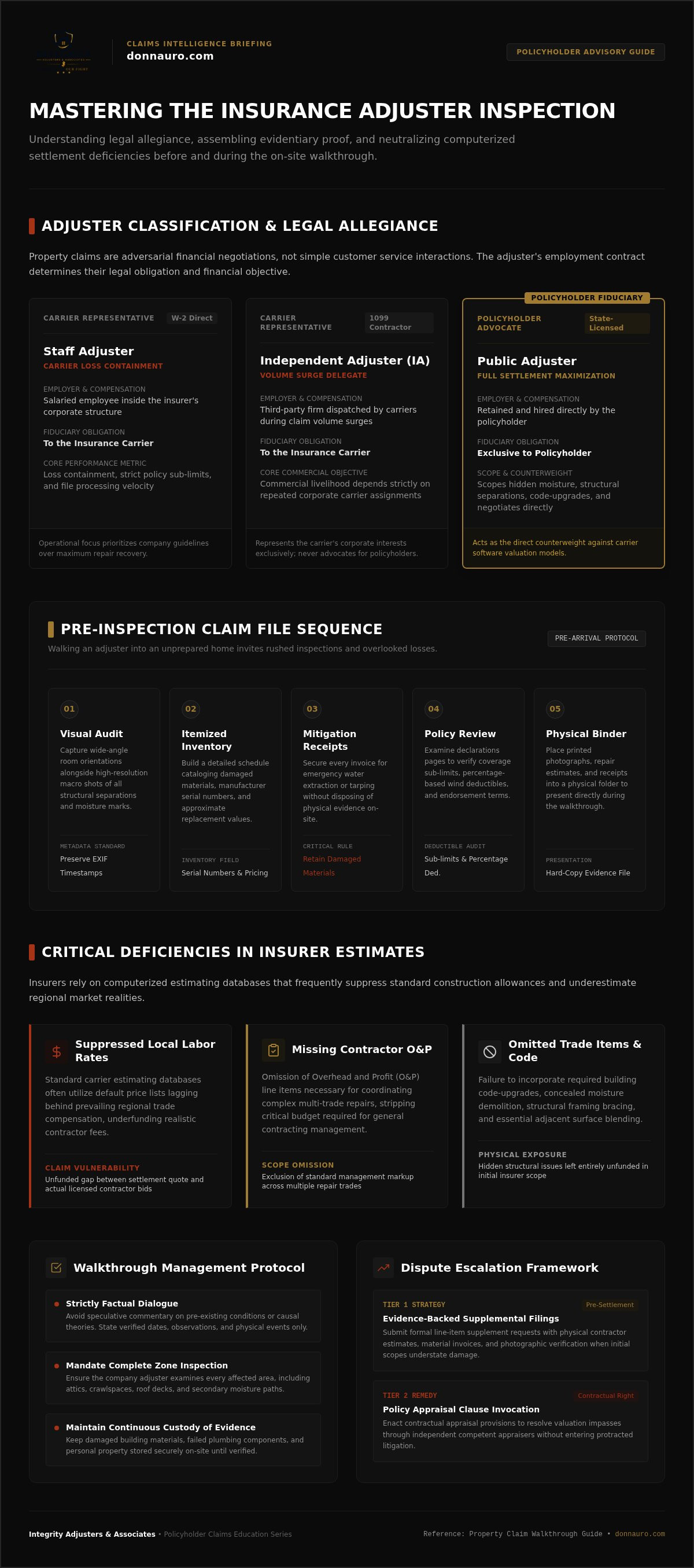
Field representatives generally fall into distinct categories. Reviewing standard claims adjuster roles and classifications reveals why property owners often misjudge an adjuster's true objective on-site:
- Staff Adjusters: Salaried W-2 employees working directly inside the insurance company's corporate structure. Their internal performance metrics align with carrier loss containment and strict policy limits.
- Independent Adjusters (IAs): Third-party contractors dispatched by carriers during claim volume surges. Despite the title, their commercial livelihood depends on repeated corporate assignments. They represent the carrier, never the policyholder.
- Public Adjusters: State-licensed property loss advocates hired directly by you to scope damage, assess policy coverage, and negotiate directly with insurer representatives.
Relying on company-assigned adjusters for unbiased repair advice leaves your recovery vulnerable. Their operational task is processing files efficiently within insurer guidelines, not finding ways to maximize your payout.
The Fiduciary Difference Between Company and Public Adjusters
The divide between adjusters is fundamentally rooted in fiduciary duty. Both staff and independent adjusters owe their legal obligation to the insurance carrier. Their scope of work prioritizes carrier interests, validating coverage exclusions, and calculating baseline structural pricing using computerized estimating systems.
In contrast, a public adjuster maintains an exclusive fiduciary duty to the policyholder. Examining the critical differences in public adjuster vs insurance adjuster representation clarifies why having an independent advocate matters. Public adjusters serve as a counterweight against carrier valuation methods, ensuring structural damage, hidden moisture, and code-upgrade requirements are accounted for correctly.
Recognizing these conflicting incentives changes how to deal with home insurance adjuster meetings. When you understand that company representatives work to protect insurer capital, you can set clear communication boundaries, insist on thorough documentation, and retain dedicated claims advocacy when disputes arise.
Pre-Inspection Preparation: Building Your Claim File Before They Arrive
Thorough preparation dictates settlement outcomes long before the company representative arrives. When mapping out how to deal with home insurance adjuster appointments, walking them into an unprepared home invites rushed inspections and overlooked losses. Establish clear control by assembling a complete physical claim file first.
Executing this disciplined sequence establishes undeniable proof of your loss:
- Step 1: Visual Audit. Capture wide-angle room orientations alongside high-resolution macro shots of all structural separations and moisture marks.
- Step 2: Itemized Inventory. Build a detailed schedule cataloging damaged materials, manufacturer serial numbers, and approximate replacement values.
- Step 3: Organize Mitigation Receipts. Secure every invoice for emergency water extraction or tarping without disposing of physical evidence.
- Step 4: Policy Review. Examine declarations pages to verify coverage sub-limits, percentage-based wind deductibles, and endorsement terms.
- Step 5: Prepare a Physical Binder. Place printed photographs, repair estimates, and receipts into a physical folder to present during the walkthrough.
Documenting Property Damage With Evidentiary Precision
Record continuous video and high-resolution digital photographs before moving debris or starting clean-up efforts. Retain original image files with preserved EXIF timestamp metadata to confirm the exact timeline. Keep damaged personal property and building materials stored safely on-site until the adjuster inspects them personally. For detailed water-extraction guidelines, refer to our protocol on residential water damage claim support to prevent premature material disposal.
Navigating Policy Exclusions and Deductibles in Advance
Carefully analyze your policy declarations page to uncover critical claim conditions. Identify specific endorsement limits governing sewer back-up, mold remediation, or mandatory ordinance and law upgrades. Distinguish whether your personal property is adjusted under Replacement Cost Value (RCV) or depreciated Actual Cash Value (ACV). Additionally, identify the strict deadlines set by standard ISO forms, which frequently mandate submitting a signed, sworn proof of loss within 60 days of written request.
Mitigating Further Loss Without Compromising Your Evidence
Policies require homeowners to protect property from secondary harm under contractual post-loss duties. Review the official NAIC guide on filing a homeowners claim to confirm regulatory standards for post-disaster protection. Tarp roof openings and extract standing water promptly, but save damaged structural components, burst pipes, and subfloor cuts for the adjuster to examine. If you need dedicated claim scoping before the carrier inspects your property, consult with Integrity Adjusters & Associates to build a comprehensive damage file.
Knowing how to deal with home insurance adjuster visits starts with rigorous evidence collection. Clear records prevent premature claim disputes and force accurate scopes.
Managing the On-Site Inspection: Rules for Clear Communication
The on-site walkthrough is the critical pivot point of your property claim. Insurers often handle heavy claim volumes by assigning independent contractors or field staff who face tight inspection schedules. If you step back and let them rush through your property alone, subtle damage gets missed, and incomplete scopes become official record. Knowing how to deal with home insurance adjuster walkthroughs means taking active control of the physical inspection from start to finish.
Controlling the Scope: Guiding the Physical Walk-Through
Never hand the adjuster free rein while waiting in the kitchen. Walk side-by-side through every damaged room, attic cavity, crawlspace, and exterior elevation. Point directly to hidden structural separations, buckled subflooring, and water stains behind baseboards. Carry your own notepad. Write down every dimension the adjuster measures, every elevation they photograph, and every fixture they bypass. If an adjuster declines to climb into an attic or inspect an elevated roof section, request that they record your specific structural concerns directly into their field file.
Verbal Pitfalls: What Never to Say to an Adjuster
Careless statements during casual walkthrough conversation can permanently damage an otherwise legitimate claim. Wear-and-tear exclusions account for roughly 30% to 40% of initial partial or full claim denials in residential roofing disputes. Avoid making speculative statements that invite these exclusions:
- Never guess installation dates: If asked how old your roof or plumbing line is, do not estimate offhand. State calmly that you will check your historical records.
- Never volunteer opinions on prior wear: Phrases like "the ceiling was already showing small cracks" or "the shingles were getting a bit old" give carriers justification to classify storm damage as deferred maintenance.
- Decline unvetted recorded statements: Politely decline on-the-spot recorded interviews until you have thoroughly reviewed your compiled claim binder.
- Never agree to verbal settlement figures: Make no verbal agreements on-site. Insist on reviewing a fully itemized written scope before discussing payout adequacy.
Establishing Written Communication Chains for Accountability
Verbal understandings evaporate the moment an adjuster leaves your driveway. Within hours of the inspection, draft a detailed, time-stamped email summarizing the walkthrough. Detail the exact rooms inspected, the physical damage shown, and any areas the adjuster skipped. If you encounter resistance or severe undervaluation later, consulting state insurance department dispute resolution options provides regulatory recourse against unfair settlement practices.
Disciplined communication is your best protection. When you master how to deal with home insurance adjuster inspections using written accountability and verified facts, you remove subjectivity from your claim.
Analyzing the Insurer's Scope: Uncovering Hidden Deficiencies
When the carrier's initial estimate arrives, treat it as an opening position rather than an objective accounting. Mastering how to deal with home insurance adjuster estimates requires understanding the automated estimating software they rely upon. Carriers rarely deliver an exhaustive scope on the first pass, leaving homeowners to identify omitted repair operations, suppressed labor pricing, and unapplied markups.
Auditing Software-Generated Repair Estimates
Over 80% of insurance carriers and independent firms utilize Verisk's Xactimate platform to price property claims. While updated regularly, these regional price databases often lag behind real-time market spikes for trade labor and raw materials. Scrutinize line items line by line. Look for missing support tasks, such as content manipulation, containment barriers, disposal fees, and surface preparation. Confirm that finish grades accurately reflect your existing home rather than basic builder-grade defaults.
Depreciation Traps and Withheld Replacement Costs
Carriers split payments between Actual Cash Value (ACV) and withheld recoverable depreciation. Adjusters frequently apply aggressive, blanket depreciation across entire categories, deducting 30% to 50% even on durable materials with minimal wear. Challenge excessive percentages on framing, wiring, and structural framing. Most standard replacement cost policies require you to complete repairs and submit invoices within 180 to 365 days to collect withheld funds, making realistic upfront ACV payouts essential for project cash flow.
Evaluating Contractor Bids Against Insurer Allowances
Secure itemized estimates from local, licensed general contractors to expose valuation gaps. Discrepancies often center on General Contractor Overhead and Profit (O&P). Restoration projects requiring multiple trade disciplines, such as roofing, drywall, and electrical, justify standard 10 and 10 contractor markups (10% overhead and 10% profit). Adjusters routinely invoke internal guidelines like the three-trades rule to strip this necessary expense from their estimates.
If major scope omissions persist, learn when to hire a public adjuster to protect your financial recovery. Knowing how to deal with home insurance adjuster scopes ensures you don't absorb contractor price gaps out of pocket. If your insurer's estimate falls short of your real repair costs, request a comprehensive claim scope evaluation from Integrity Adjusters & Associates to secure the settlement you are owed.
Resolving Claim Disputes: Escalating Beyond a Lowball Settlement
An inadequate initial payout does not finalize your claim. When an insurer delivers an undervalued check, knowing how to deal with home insurance adjuster pushback means shifting from field inspection to formal dispute escalation. Insurance policies provide specific, legally binding avenues to challenge inaccurate scopes without immediately resorting to expensive courtroom litigation.
Filing an Evidence-Based Supplemental Claim
Supplemental claims bridge the financial gap between initial insurer allowances and real-world restoration costs. As work begins, hidden water intrusion, charred framing, or structural cracking often emerge behind opened drywall. Document these discoveries immediately using high-resolution photographs, moisture logs, and itemized contractor change orders. Submit a formal written request citing the policy provisions that cover hidden, consequential loss, demanding a revised scope from carrier management.
Invoking the Insurance Policy Appraisal Clause
When negotiations reach an impasse strictly over the dollar valuation or scope of covered repairs, invoke your policy's contractual appraisal clause. This process bypasses the insurer's claims adjuster entirely. Under this framework, you hire an independent, competent appraiser, the carrier selects theirs, and both appraisers agree on an impartial umpire. An award signed by any two of these three individuals establishes a legally binding settlement figure. Before choosing this path, examine how public adjuster fees vs settlement outcomes compare to gauge your net financial recovery.
Leveling the Playing Field With Professional Advocacy
Insurers often rely on administrative delays, complex policy endorsements, and algorithmic pricing models to exhaust policyholders. While learning how to deal with home insurance adjuster tactics is essential, managing structural loss negotiations alone while balancing daily responsibilities creates enormous friction. Licensed public adjusters serve as your exclusive fiduciary shield. They re-scope the property loss using detailed building science, enforce carrier deadlines, and negotiate directly with insurer representatives.
You don't have to accept a suppressed claim valuation. Contact Integrity Adjusters & Associates for an independent claim review to ensure your property is fully documented and fairly compensated.
Take Full Command of Your Property Recovery
Navigating structural property loss requires discipline, meticulous evidence, and strategic patience. Mastering how to deal with home insurance adjuster inspections transforms you from a passive policyholder into an active defender of your investment. When you document structural loss early, guide the inspection with precision, and systematically audit computerized repair estimates, you eliminate the insurer's pricing leverage.
You don't have to face institutional claims processes alone. Dedicated policyholder advocacy ensures complete damage identification, protecting you against hurried visits, omitted trade items, and suppressed labor pricing. Integrity Adjusters & Associates exclusively represents residential and commercial property owners, never insurance carriers. Our team provides thorough line-item scoping that directly counters deflated insurer estimating software.
Take the decisive step toward securing your full payout. Request a professional claim assessment to ensure your property damage is scoped completely and settled fairly.
Frequently Asked Questions
Can I refuse to let the insurance adjuster into my house?
No, you cannot refuse entry without jeopardizing your coverage. Standard property insurance contracts contain strict "duties after loss" clauses requiring policyholders to allow reasonable physical inspections. Refusing entry can lead to immediate claim denial. However, you do not have to allow an unannounced inspection. You have the right to reschedule the walkthrough to ensure your chosen representative or independent advocate is present to monitor the inspection.
What happens if the insurance adjuster's estimate is too low to cover repairs?
An inadequate estimate is never final; it represents an initial calculation. Understanding how to deal with home insurance adjuster scopes involves filing a formal supplemental claim backed by detailed contractor estimates and photographic evidence. In New Jersey, property owners frequently encounter computerized scopes that miss local trade costs. You can challenge line-item discrepancies directly with insurer management or invoke your policy's contractual appraisal clause to resolve valuation deadlocks.
Should I sign a settlement check immediately after receiving it from my insurer?
You can deposit initial undisputed funds, provided the check does not include full-release language. Carefully inspect the memo line and endorsement section on the back of the check. Never sign if it states "payment in full" or "full and final settlement." Initial payouts usually represent Actual Cash Value advances. Depositing an undisputed payment should leave your claim open for subsequent supplements and recoverable depreciation claims.
Do I have to use the repair contractor recommended by my insurance adjuster?
No, you have the absolute legal right to choose your own licensed repair professionals. Insurance companies often suggest their preferred vendor networks to maintain tighter control over labor costs and project scopes. These third-party contractors owe allegiance to the insurer providing continuous corporate referrals. Selecting an independent contractor ensures that your property's restoration adheres to high craftsmanship standards rather than the insurer's preferred cost caps.
What should I do if the adjuster misses hidden water or structural damage?
Document the overlooked areas immediately with detailed photographs and moisture readings before disturbing the materials. Hidden structural damage and trapped moisture behind walls are common in severe water and storm losses. Issue a formal, written supplemental request to your claims handler detailing the newly discovered areas. Request an immediate re-inspection so the adjuster can verify the physical conditions before repairs close up the structure.
How long does a home insurance adjuster have to respond to my claim?
Deadlines depend on state regulations and individual contract terms. Under New Jersey Department of Banking and Insurance guidelines, carriers must maintain timely communication and acknowledge claims promptly upon receipt. Insurers are generally required to begin investigations and accept or reject claims within statutory timeframes once formal proofs of loss are submitted. Review your policy's condition section and hold your adjuster accountable to documented communication deadlines.
Is it worth hiring a public adjuster to deal with the insurance company?
Yes, especially for substantial water, storm, or fire losses. Knowing how to deal with home insurance adjuster negotiations alone often leads to settling for undervalued software scopes. In New Jersey, public adjusters hold an exclusive fiduciary duty to the policyholder, never the insurance carrier. They inspect hidden structural damages, prepare comprehensive building estimates, and negotiate directly with insurer representatives to secure the complete payout contractually owed to you.


