

Will paying an expert a percentage of your property claim leave you with less money to rebuild, or is managing the claim alone the real financial risk? When evaluating public adjuster fees vs settlement outcomes, many property owners assume that handling the process independently is the only way to protect their bottom line.
Facing property damage while deciphering complex policy exclusions is exhausting. The fear of being shortchanged by an initial carrier estimate is entirely valid, especially when documenting every structural loss requires specialized technical proof. You shouldn't have to carry the stress of insurer bureaucracy while trying to put your property back together.
This guide explains how public adjuster fee structures directly impact your net settlement, showing why professional advocacy often results in a higher net recovery even after commissions. We examine the practical return on investment behind representation, state consumer safeguards, and how forensic documentation ensures no covered damage is overlooked.
Key Takeaways
- Understanding the true balance of public adjuster fees vs settlement totals reveals why your bottom-line net recovery, not the initial gross offer, determines your ability to fully rebuild.
- Learn how standard contingency models eliminate upfront out-of-pocket expenses while aligning your advocate's incentives directly with a complete claim valuation.
- Discover how forensic scoping and itemized estimating uncover hidden structural losses and recoverable depreciation that self-managed claims routinely overlook.
- Identify the exact operational thresholds where professional claim management acts as a shield against insurer bureaucracy, preventing costly omissions and procedural delays.
Understanding the Relationship Between Public Adjuster Fees and Net Settlements
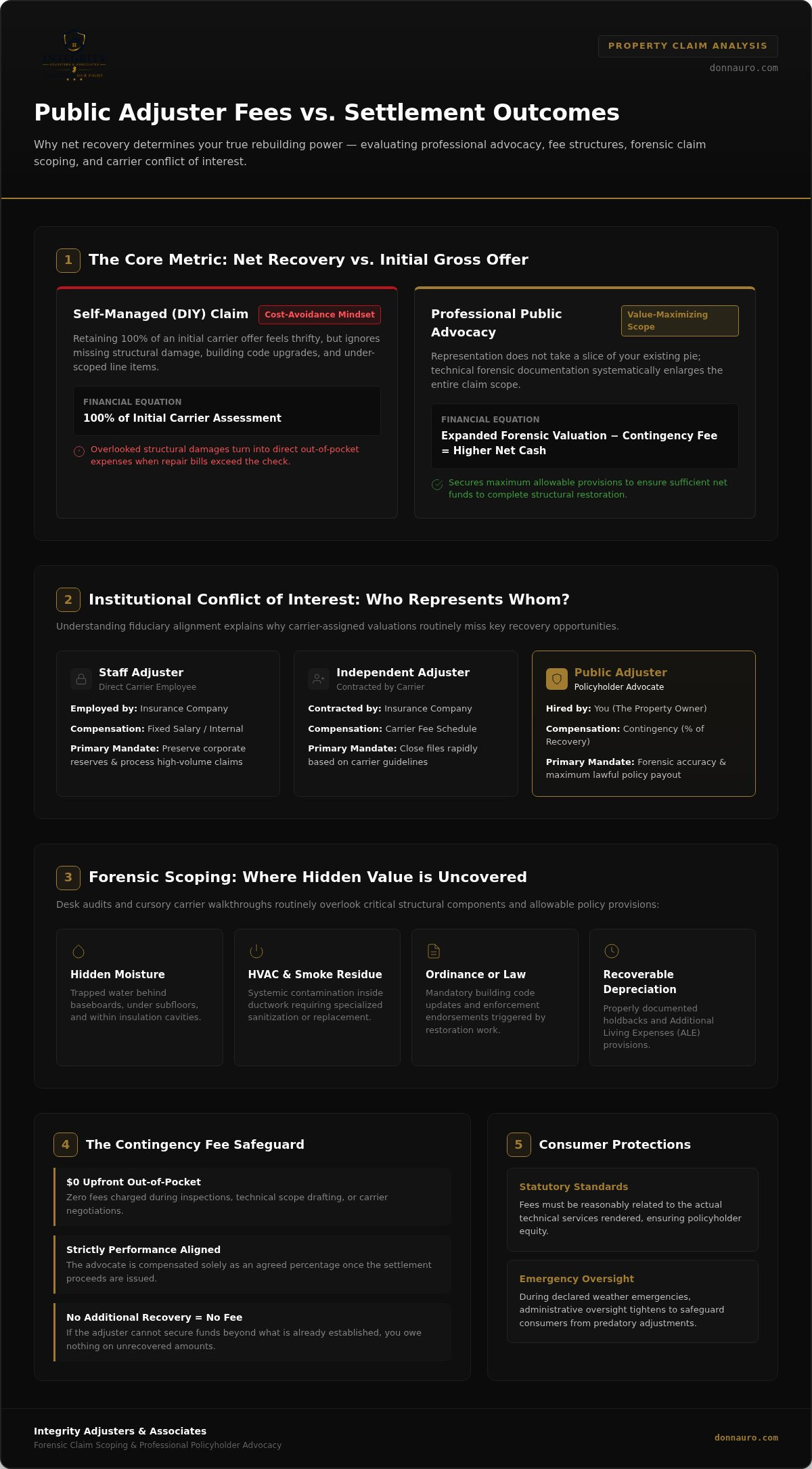
Every property claim comes down to a fundamental financial balance: the total payout you receive minus the professional cost of securing it. When analyzing public adjuster fees vs settlement figures, you must focus on your net settlement. This is the actual cash in hand left to rebuild your property after deducting any representative commission.
Property owners often default to a cost-avoidance mindset. Retaining 100% of an initial carrier offer feels thrifty, but it ignores an inherent institutional conflict of interest. Staff adjusters work directly for the insurer. Independent adjusters are paid by the carrier to close files rapidly. Both serve the carrier's bottom line by preserving corporate reserves. A public adjuster represents you alone. True settlement value isn't created through aggressive bargaining; it's built on exhaustive, forensic claim accuracy.
To better understand how representation affects claim finances, watch this practical breakdown of the trade-offs:
The True Cost of an Underpaid Claim
Rushing to accept an insurer's first assessment often conceals deep financial hazards. Desk audits and cursory walkthroughs routinely miss hidden moisture trapped behind baseboards, compromised insulation, or systemic smoke residue within HVAC ductwork. When policyholders sign off on incomplete payouts, these overlooked line items turn into direct, out-of-pocket expenses months later. Keeping 100% of an underpaid settlement guarantees a net loss when repair bills eclipse the check.
Why Net Recovery Matters More Than Gross Payout
Evaluating public adjuster fees vs settlement potential requires looking at the total scope rather than a fixed percentage. An advocate does not take a slice of your existing pie; their technical documentation enlarges the entire valuation. By systematically detailing every component through itemized software scoping, line items the insurer bypassed are formally brought to light.
Professional representation bridges the gap between basic visible repairs and your policy's maximum allowable provisions. Reviewing our guide on Public Adjuster vs Insurance Adjuster: Understanding the Vital Differences demonstrates how independent advocacy identifies policy endorsements, ordinance or law upgrades, and additional living expenses that unrepresented policyholders consistently miss.
Typical Public Adjuster Fee Structures in New Jersey
Hiring an advocate requires clear financial terms up front. In New Jersey property adjustment, the standard framework is a contingency fee model. This structure guarantees that compensation is directly tied to the final recovery: no recovery, no fee. You pay nothing out of pocket during inspections, scope drafting, or negotiations. The fee is deducted strictly as an agreed percentage once the insurer issues the settlement proceeds.
When assessing public adjuster fees vs settlement dynamics in New Jersey, regulatory baselines establish consumer boundaries. Unlike states that impose arbitrary, rigid percentage caps across all claim types, New Jersey statutes require fees to be reasonably related to the actual services rendered. During major weather events or declared emergencies, state oversight tightens to prevent exploitative practices, ensuring emergency claims reflect fair administrative standards.
The Contingency Fee Model Explained
Contingency alignment shifts the financial risk entirely away from the policyholder. Because the advocate's compensation hinges on the total recovered sum, their primary incentive is uncovering every legitimate line item your carrier omitted. If the adjuster cannot secure funds beyond what you have already established, they do not collect on unrecovered amounts. This setup provides essential protection for homeowners and commercial managers navigating complex losses. If you need a methodical evaluation of your coverage after property damage, you can consult our claims team to assess your baseline recovery options.
New Jersey Department of Banking and Insurance (DOBI) Standards
The New Jersey Department of Banking and Insurance (DOBI) regulates licensed public adjusters by establishing strict contractual transparency standards, ethics requirements, and mandatory consumer disclosures across the state. Under N.J.A.C. § 11:1-37.13 and N.J.S.A. § 17:22B-1 et seq., contracts must meet specific legal criteria:
- Written Contracts in Duplicate: Agreements must clearly define the fee calculation basis and be signed and timestamped by all parties.
- Right of Rescission: New Jersey law provides policyholders a mandatory three-business-day right of rescission to cancel the agreement without penalty.
- Solicitation Blackouts: Adjusters are strictly prohibited from soliciting property owners between 6:00 PM and 8:00 AM within the first 24 hours of a loss.
- Escrow Safeguards: Any claim proceeds handled by an adjuster must be deposited into federally insured escrow accounts.
These consumer safeguards ensure that the balance of public adjuster fees vs settlement proceeds remains transparent, defensible, and legally compliant throughout every phase of your recovery.
DIY Settlements vs. Professional Advocacy: A Comparative Analysis
Self-managing a claim often creates a false sense of security. Policyholders document surface damage with smartphones, submit basic contractor receipts, and wait. This creates a severe documentation gap. While a property owner sees stained drywall, an institutional carrier looks for reasons to limit scope. Professional advocacy deploys calibrated moisture mapping, thermal imaging, and hygrometric logs to prove the structural path of the loss before repairs begin.
The divide widens during settlement valuation. Insurers routinely issue checks based on Actual Cash Value (ACV), withholding substantial funds in recoverable depreciation under Replacement Cost Value (RCV) provisions. Recovering those holdbacks requires meeting rigid carrier deadlines with verified completion records. Consider a typical residential water damage claim: a homeowner filing independently might only secure funds for baseboard removal and carpet drying, completely missing wall framing saturation. When calculating public adjuster fees vs settlement yields, the difference lies in proving this hidden scope before the claim file closes.
Identifying Overlooked Scope in Property Damage
Major perils cause systemic damage that isn't visible during a walk-through. Fire claims routinely leave microscopic soot, corrosive chemical residue, and odor inside HVAC ducts and attic insulation. Severe storm events inflict subtle wind uplift that compromises roof decking integrity without immediately tearing off shingles. Missing these items forces property owners to absorb immense long-term liabilities. Review our guide on When to Hire a Public Adjuster: 2026 Insurance Guide to identify the critical milestones where forensic inspection becomes vital.
Negotiating with Institutional Insurers
Insurers process claims through complex policy conditions, demanding strict adherence to "Duties After Loss" clauses and notarized "Proof of Loss" deadlines. Desk adjusters rely on centralized scoping software like Xactimate, often stripping out line items such as local building code upgrades or labor minimums. A public adjuster levels the playing field by drafting comprehensive, line-by-line Xactimate estimates that speak the insurer's exact language. This technical rigor eliminates artificial delays and forces the insurer to evaluate verifiable evidence rather than algorithmic shortcuts.
Transforming raw physical damage into organized documentation changes how institutional carriers handle your file. The return on investment becomes clear: the balance of public adjuster fees vs settlement dollars shifts decisively when every covered detail is accounted for under policy terms.
Evaluating the ROI: When Does the Fee Pay for Itself?
Every claim carries an operational tipping point where self-representation costs more than hiring an advocate. Minor claims with obvious, surface-level losses rarely justify an external fee. The equation changes dramatically when structural repairs, hidden cavities, or specialized coverages enter the fold. When analyzing public adjuster fees vs settlement figures, the commission pays for itself whenever an advocate uncovers legitimate scope that exceeds what you could document on your own.
Property owners frequently ignore the heavy soft costs of managing their own claim. Handling carrier requests requires dozens of hours drafting inventories, securing subcontractor bids, and sitting through circular phone calls with rotating desk adjusters. These administrative burdens pull business owners away from revenue generation and disrupt families in crisis. Unforced filing errors create months of administrative delays, stretching project timelines while mortgage and operational overhead pile up.
The Complexity Factor in Commercial Claims
Commercial losses introduce layers of operational complexity that routine property policies never face. Structural fire or major storm damage at a commercial site triggers Business Interruption and Extra Expense coverages. Proving these claims demands forensic financial reconstruction alongside structural scoping. New Jersey commercial facilities, like logistics warehouses and retail plazas, must navigate local building subcodes, mandatory staging logistics, and tenant lease obligations. For in-depth guidance on handling these institutional disputes, explore our Commercial Property Insurance Claim Help: A Guide to Business Advocacy in 2026.
The Peace of Mind Dividend
Delegating carrier bureaucracy to a seasoned navigator eliminates the risk of fatal filing errors. Institutional adjusters often look for premature statements or unverified proof-of-loss figures to limit exposure. Professional representation establishes an immediate buffer, ensuring every document meets strict carrier standards before submission. Having an experienced advocate command the adjustment process eliminates the constant anxiety of facing an institutional insurer alone.
Evaluating public adjuster fees vs settlement yields proves that the investment protects your ultimate net recovery against costly carrier omissions. When you face significant fire, storm, or water damage, partner with Integrity Adjusters & Associates to take command of your claim from day one.
How Integrity Adjusters & Associates Maximizes Your Net Recovery
Securing an equitable recovery requires a methodical counterweight against institutional insurers. Integrity Adjusters & Associates serves as that protective shield. We step directly between you and the insurance carrier, taking command of all adjusters, inspectors, and correspondence. This buffer stops aggressive carrier tactics immediately, preventing early statements that could compromise your final payout.
Our advocacy centers on forensic precision. We compile exhaustive claim packages supported by structural line items, moisture migration records, and current local labor pricing. By building files designed to withstand insurer audits, we transform disputed claims into verified settlements. When balancing public adjuster fees vs settlement figures, our detailed scoping ensures that your net funds remain focused entirely on real-world reconstruction.
A Strategic Ally in Your Recovery
Our team specializes in residential water damage, fire loss, and severe storm claims across New Jersey. Local expertise matters. We understand the specific regional building codes, localized replacement costs, and New Jersey Uniform Construction Code mandates that generic insurance software frequently discounts. Learn more about our process by exploring our guide to Residential Water Damage Claim Support: A Homeowner’s Guide to Fair Settlements.
Every claim handled by our firm follows a transparent protocol designed for accountability:
- Methodical Loss Scoping: Conducting complete physical inspections to uncover structural, mechanical, and code-mandated repairs.
- Carrier Management: Directing all meetings, letters, and carrier adjusters so you never have to negotiate alone.
- Clear Financial Reporting: Providing regular status updates and transparent accounting at every milestone.
Next Steps: Securing Your Professional Advocacy
Taking control of your recovery starts with understanding where your coverage stands. We examine your policy language, evaluate initial carrier estimates, and identify any missing scope without upfront expense. Whether you are dealing with a fresh loss or struggling with an undervalued offer, professional representation brings order to the claim process. Contact Integrity Adjusters for a professional claim review to protect your settlement and begin moving forward today.
Take Strategic Control of Your Property Settlement
Evaluating public adjuster fees vs settlement outcomes reveals a clear reality: your net recovery dictates your rebuild, not the insurer's initial estimate. Leaving property valuations to carrier-assigned adjusters risks leaving critical repairs unfunded. A methodical documentation process uncovers hidden structural damage, enforcing your coverage and closing the documentation gap. The contingency fee isn't an arbitrary cost; it's an investment in securing the full, defensible scope of your loss.
As specialized residential and commercial advocates, Integrity Adjusters & Associates operates in full compliance with the NJ Department of Banking and Insurance. We act as your protective shield against carrier bureaucracy, preventing premature concessions and demanding complete line-item accuracy. You don't have to face an institutional insurer alone. Secure Your Professional Claim Advocacy with Integrity Adjusters and move forward with the disciplined backing your property deserves.
Frequently Asked Questions
What is the standard public adjuster fee in New Jersey for 2026?
New Jersey does not establish a rigid statutory percentage cap on public adjuster fees. State law under N.J.A.C. § 11:1-37.13 mandates that all fees must remain reasonably related to the actual services rendered. Public adjusting contracts operate on contingency agreements that specify the exact percentage upfront, ensuring terms comply with New Jersey Department of Banking and Insurance standards.
Can a public adjuster help if I have already received a check from my insurer?
Yes, provided you have not signed a full and final release of claims with your insurer. If the initial payment fails to cover your actual reconstruction costs, an advocate can reopen the file as a supplemental claim. In these scenarios, the evaluation of public adjuster fees vs settlement returns often focuses strictly on securing additional funds above the carrier's undisputed baseline payment.
Will hiring a public adjuster delay my insurance settlement?
Hiring an advocate typically speeds up final resolution by eliminating procedural rejections. Desk adjusters often stall claims when documentation lacks line-item detail or technical proof. By presenting a fully supported Xactimate scope adhering to policy terms from the start, a public adjuster prevents back-and-forth carrier requests, moving the claim directly toward an accurate adjustment.
Is the fee tax-deductible for commercial property owners in NJ?
Commercial policyholders can often deduct adjusting fees as ordinary and necessary expenses incurred to collect taxable income or protect business property. Tax treatment depends on whether the underlying settlement covers capital assets, inventory losses, or lost business profits. Commercial building owners in New Jersey should always review specific fee deductions directly with a certified public accountant.
What happens if the public adjuster doesn't increase my settlement offer?
Because licensed public adjusters work on a contingency model, they do not collect a fee if they cannot secure funds beyond what the insurer has already formally committed. You pay zero upfront costs for their scoping and advocacy work. The fee is earned only when additional capital is successfully negotiated and disbursed by the carrier.
Can I fire a public adjuster if I'm not happy with the fee vs. settlement progress?
New Jersey law provides an automatic three-business-day right of rescission to cancel any signed public adjuster contract without penalty. After that initial statutory window passes, contracts can still be terminated according to the specific cancellation terms outlined in your written agreement, though the adjuster may retain a lien for the reasonable value of itemized services completed to date.
Do public adjusters charge for the initial damage inspection?
Reputable public adjusting firms do not charge for an initial policy review or structural walk-through. This diagnostic step allows the advocate to assess the scope of damage, review your policy language, and confirm whether professional representation provides a viable financial benefit before executing a formal contract.
Are fees different for residential fire damage vs. storm damage claims?
Fee percentages reflect the technical complexity and estimated loss volume of a claim rather than just the peril type. Fire losses require extensive soot tracing, structural testing, and personal property itemization, while storm damage often focuses on roofing and exterior envelope failure. Both claim types use clear contingency models structured around the documentation effort required.


