

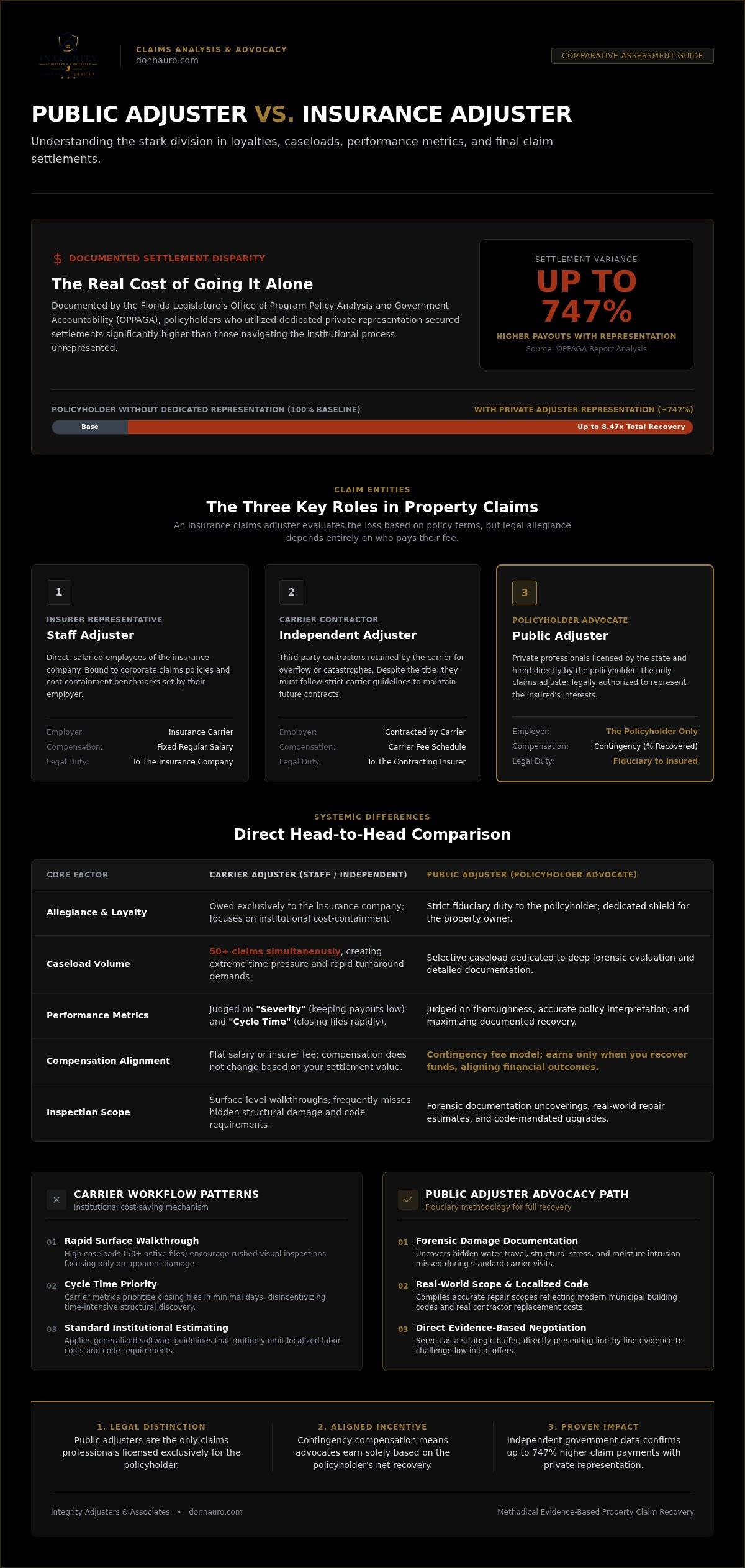
Did you know that property owners who hire their own representation often receive settlements up to 747 percent higher than those who go it alone? This staggering gap, documented by the Florida Legislature's OPPAGA report, highlights a reality many homeowners miss until it's too late. When you file a claim, the person who shows up to inspect your home isn't necessarily there to maximize your payout. Understanding the roles of a public adjuster vs insurance adjuster is the first step toward protecting your property's value.
It's normal to feel overwhelmed by complex policy language and the mountain of documentation required after a fire, storm, or water leak. You likely suspect that the insurance company's initial offer might not cover the full extent of the damage. You're right to be cautious. In this article, you'll discover the fundamental differences in loyalty, incentives, and outcomes between the insurance company's staff and your own private advocate. We'll examine how these professionals operate and why having a strategic ally can move your claim from a state of chaos to a fair and factual resolution.
Key Takeaways
- Identify the fundamental conflict of interest between staff adjusters and private advocates.
- Examine the critical differences between a public adjuster vs insurance adjuster regarding financial loyalty and settlement outcomes.
- Learn why surface-level inspections often miss hidden structural damage that forensic documentation uncovers.
- Recognize the specific indicators of an underpaid claim and when to request a strategic buffer against the insurance system.
- Secure a methodical path toward recovery using evidence-based advocacy tailored to the New Jersey landscape.
Defining the Roles: Who Is Who in the Property Claims Process?
The aftermath of property damage is chaotic. You're forced to deal with complex paperwork while managing immediate repairs. The property claims process involves several professionals with similar titles but conflicting goals. Understanding the distinction between a public adjuster vs insurance adjuster is the first step toward a successful recovery. An insurance claims adjuster evaluates the loss and determines the payout based on policy language. However, their loyalty depends entirely on who pays their fee. A Public Adjuster is the only professional licensed to represent the insured.
To better understand how these roles differ in practice, watch this helpful video:
The Insurance Company Adjuster (Staff and Independent)
Insurance carriers use two types of representatives to handle their side of the claim. Staff adjusters are salaried employees of the insurance company. Independent adjusters are third-party contractors hired by the carrier to handle overflow, especially during catastrophes. Despite the title, independent adjusters are not neutral parties. They are paid by the insurance company and must follow the carrier’s strict estimating guidelines to maintain their contracts. These adjusters often manage 50 or more claims simultaneously. This extreme volume often leads to rushed inspections, surface-level walkthroughs, and missed structural details that can significantly lower your settlement.
The Public Adjuster: Your Private Advocate
Public adjusters are private professionals hired directly by you, the policyholder. They don't work for the insurance company. Their legal duty is to protect your interests and ensure you receive the full amount allowed under your policy. Comparing a public adjuster vs insurance adjuster reveals a fundamental split in loyalty. While company adjusters focus on corporate cost-saving metrics, public adjusters focus on forensic damage documentation and real-world repair costs. They are licensed by the state to negotiate directly with the insurance company on your behalf. This role acts as a strategic buffer and a dedicated shield for your property, providing the methodical expertise needed to challenge institutional systems.
Loyalty and Incentives: Understanding the Financial Conflict
The fundamental difference between a public adjuster vs insurance adjuster isn't their technical training. It's their paycheck. Every professional in the claims process operates under a specific set of incentives that dictates their thoroughness and final estimate. When property damage occurs, you must recognize whose financial interests are being protected during the inspection. This conflict of interest is the primary reason why initial settlement offers often fall short of actual repair costs.
Who Pays the Bill?
Insurance company adjusters are either salaried employees or independent contractors paid directly by the carrier. Their compensation remains the same regardless of your settlement amount. In many corporate environments, these adjusters are evaluated based on "severity" and "cycle time." Severity refers to the average payout per claim; keeping this number low is a key performance metric for the insurance company. Cycle time measures how quickly they can close a file. These metrics prioritize speed and cost-savings over meticulous damage discovery.
Public adjusters operate on a contingency fee model. They only earn a fee if they successfully recover funds for you. This structure aligns their success directly with yours. Because their income is a percentage of the final payout, they are financially incentivized to find every damaged shingle, every hidden water stain, and every code-required upgrade. The Texas Department of Insurance guidance on public adjusters clarifies that these professionals work exclusively for the policyholder, providing a necessary counterweight to the carrier's cost-containment strategies.
Fiduciary Duty vs. Corporate Interest
A public adjuster has a fiduciary duty to the policyholder. This is a legal obligation to act in your best interest above all else. They are your strategic ally, acting as a dedicated shield against complex institutional systems. Conversely, a staff adjuster's primary duty is to their employer. They must follow internal "company guidelines" that often conflict with the goal of full property restoration. These guidelines might include restrictive labor rates or aggressive depreciation schedules that don't reflect the local New Jersey market.
Securing a professional to handle the stressful negotiations allows you to focus on your recovery while an expert manages the documentation. While the insurance adjuster focuses on fulfilling the minimum requirements of the contract, a public adjuster focuses on the actual cost of making you whole. This distinction is vital. One party is looking for reasons to limit the claim; the other is looking for the evidence required to maximize it. Choosing between a public adjuster vs insurance adjuster is ultimately a choice about who you want in control of your financial outcome.
The Claims Workflow: Two Very Different Approaches to Damage
The process of resolving a property claim is not a neutral investigation. It is a formal negotiation where the burden of proof rests entirely on the policyholder. You are legally responsible for proving the full extent of your loss to the insurance carrier. This requirement creates a significant divide in the workflow of a public adjuster vs insurance adjuster. One party is looking to settle the claim according to corporate guidelines; the other is building a case based on forensic evidence. This difference in approach determines whether your settlement covers a quick patch or a full restoration.
Documenting Loss: Estimates vs. Reality
Insurance company adjusters typically perform surface-level walkthroughs. They focus on visible damage that fits into pre-set categories in their estimating software. This method often overlooks critical issues like smoke residue in HVAC systems or moisture trapped behind drywall. For homeowners in our region, identifying hidden water damage for NJ insurance claims is vital to ensure long-term property stability. Public adjusters take a forensic approach to documenting a loss. This Forbes Advisor breakdown of public adjusters vs. insurer adjusters highlights how specialized documentation protects the policyholder from being lowballed on complex repairs.
Public adjusters use various tools to ensure no damage is missed:
- Infrared thermal imaging to detect hidden moisture behind walls.
- Moisture meters for subfloor and wall cavity analysis.
- Matterport 3D scans for precise room measurements and visual evidence.
- Independent engineering reports for structural integrity assessments.
The estimating software used by carriers often relies on regional averages that don't reflect real-world New Jersey repair costs. Labor and material prices in the Tri-State area frequently exceed the default market rates found in corporate databases. A public adjuster corrects these discrepancies by providing localized contractor bids and factual data to support a higher valuation. This methodical approach ensures the claim reflects actual costs rather than software-generated estimates.
Negotiation and Settlement Authority
Negotiating with an insurance company is an exercise in power dynamics. Homeowners are often overwhelmed by the carrier's tactical delays or complex policy language. A public adjuster acts as a buffer and a strategic ally. They use their expertise to challenge restrictive interpretations and push for a settlement that covers actual restoration costs. When comparing the workflow of a public adjuster vs insurance adjuster, the primary difference is the level of advocacy. One professional is checking boxes for a corporation; the other is fighting to recover every cent you are owed under your policy. This professional advocacy brings order to the chaos of the claims process.
When to Hire a Public Adjuster vs. Relying on the Insurer
Deciding when to bring in professional representation depends on the severity of your loss and the carrier's responsiveness. For minor cosmetic issues, the company adjuster might suffice. However, as the scope of damage increases, the functional difference between a public adjuster vs insurance adjuster becomes a financial pivot point. You must identify the "red flags" that indicate your claim is being undervalued or mismanaged. Large-loss events like fires or major coastal storms in New Jersey almost always require professional advocacy to navigate technical disputes.
Indicators of a Complex Claim
Complexity isn't always visible to the naked eye. A claim becomes complex when it involves structural integrity, electrical systems, or environmental hazards. If residential water damage affects multiple rooms or levels, the risk of hidden mold and rot increases significantly. Disputes often arise regarding "actual cash value" versus "replacement cost." Carriers may offer a depreciated value that won't cover the materials needed for a quality repair. Common triggers for professional help include:
- The insurance company denies coverage for a portion of the damage.
- The adjuster classifies storm damage as "wear and tear."
- You are facing business interruption or loss of use claims.
- The carrier’s estimate is significantly lower than local contractor bids.
Evaluating the Cost-Benefit Ratio
Many homeowners hesitate to hire an advocate because of the contingency fee. You should view this as an investment in the final outcome. Data from the Florida Legislature’s OPPAGA report indicates that policyholders with representation received settlements significantly higher than those without. For catastrophe claims, the increase was documented at 747 percent. This surplus typically covers the adjuster's fee while leaving the homeowner with more funds for actual repairs. It shifts the burden of proof from you to a trained expert.
Beyond the numbers, consider the administrative burden. Documenting a loss requires hundreds of photos, itemized contents lists, and detailed repair scopes. If you don't have the time or expertise to manage this process, the stress can lead to costly mistakes. The "Lowball" test is a simple way to decide. Compare the insurer's estimate to two independent contractor bids. If the insurance offer is 20 to 40 percent lower than real-world repair costs, the gap between a public adjuster vs insurance adjuster is already affecting your recovery.
If your claim is stalled or the offer seems insufficient, contact Integrity Adjusters & Associates for a professional review of your documentation and a methodical path toward a fair settlement.
Navigating Your Recovery with Integrity Adjusters & Associates
Recovering from a major property loss requires a disciplined approach to documentation and negotiation. At Integrity Adjusters & Associates, we act as a strategic buffer between you and the insurance carrier's complex institutional systems. While the choice between a public adjuster vs insurance adjuster often comes down to financial alignment, the real value lies in the execution of the claim. Our methodical, evidence-based advocacy ensures that your loss is presented with factual integrity, leaving no room for corporate guesswork or underestimation.
New Jersey property owners face unique environmental challenges that require local expertise. From coastal storms along the shore to freezing pipes in the northern counties, these events create specific types of damage that often go overlooked by out-of-state independent adjusters. For those dealing with the aftermath of a blaze, Cherry Hill public adjuster for fire damage expertise is essential for identifying secondary losses like soot infiltration and structural racking. We provide the steady, methodical confidence needed to bring order to the chaos of a large-scale claim.
The Advantage of Professional Advocacy in New Jersey
Our firm maintains a deep understanding of New Jersey insurance statutes and policyholder rights. We don't rely on generic software defaults. Instead, we utilize a local network of damage assessment experts and engineers to verify repair costs. This local focus allows us to challenge the carrier's "market rates" with real-world data from the Tri-State area. We prioritize transparent communication throughout the process. You'll always know the status of your claim and the next logical action required for resolution. This level of detail establishes a professional standard that emphasizes reliability and factual accuracy.
Securing Your Settlement: Next Steps
Time is a critical factor in any property claim. Acting quickly before damage is repaired or improperly mitigated is vital for preserving evidence. When you choose to hire a private advocate, you're choosing a dedicated shield against the carrier's cost-containment strategies. The distinction between a public adjuster vs insurance adjuster is most apparent during the final settlement phase. We focus on the facts to ensure you recover the maximum policy proceeds without upfront out-of-pocket costs.
Moving from a state of confusion to a state of clarity starts with a professional review of your current situation. We offer a complimentary claim review to evaluate your policy and the extent of your property damage. This initial step provides the stability needed to navigate the turbulent waters of insurance bureaucracy. Let us handle the stressful negotiations while you focus on rebuilding your home or business.
Secure Your Full Recovery with Professional Advocacy
The fundamental difference between a public adjuster vs insurance adjuster is ultimately a choice between corporate cost-savings and your complete financial restoration. You now understand how financial incentives and forensic documentation dictate the strength of your claim. Proving your loss is a legal responsibility that requires more than a surface-level inspection. A methodical approach to evidence ensures that hidden structural issues and environmental hazards are fully accounted for before you sign a final release.
Integrity Adjusters & Associates provides specialized New Jersey advocacy for residential and commercial fire, water, and storm damage claims. We act as your dedicated shield. Our team navigates the insurer's bureaucracy so you don't have to. We ensure every detail is documented with factual integrity, and our fee structure means there are no upfront costs. We only get paid when you successfully receive your settlement proceeds. Contact Integrity Adjusters & Associates for a Free Claim Review to transition from a state of confusion to a state of clarity. You deserve a professional ally who is fully in control of the process and committed to your recovery.
Frequently Asked Questions
Can I hire a public adjuster if I already started the claim with the insurance company adjuster?
Yes; you can hire a private advocate at any point during the claims process. Many New Jersey policyholders realize they need help only after receiving a low initial estimate from the carrier. Whether you just filed the claim or have already met with the insurance company's representative, an advocate can step in to take over the documentation and negotiation. This allows you to correct errors in the initial scope before they become permanent settlement figures.
Will my insurance company drop me or get angry if I hire a public adjuster?
No; hiring a public adjuster is a protected right for policyholders in New Jersey. Insurance companies view this as a standard business transaction and cannot legally cancel your policy or retaliate against you for seeking professional representation. Your carrier has their own experts protecting their financial interests. It's only logical that you have a strategic ally protecting yours. Professional advocacy often leads to a more efficient and factual resolution for both parties involved.
How much does a public adjuster cost compared to the extra money they find?
Public adjusters typically work on a contingency fee basis; meaning they only receive a percentage of the final settlement. There are no upfront out of pocket costs for the policyholder. While the percentage varies based on the claim size, the objective is to recover enough additional funds to cover the fee and the full cost of repairs. This structure ensures your advocate is financially incentivized to document every detail that the insurance company's adjuster might have overlooked.
What happens if the public adjuster cannot get me more money than the insurance company offered?
Because most public adjusters work on a contingency basis, they generally do not collect a fee if they cannot increase the settlement amount. This structure protects you from financial risk. Before taking your case, a reputable firm will conduct a methodical review of your current offer and property damage. If they determine the insurance company's offer is already fair and accurate, they will tell you. This transparency ensures that advocacy is only utilized when it adds genuine value.
Is a public adjuster the same thing as an insurance lawyer?
No; these are distinct roles. A public adjuster is a licensed expert in property damage assessment, policy interpretation, and claim negotiation. They handle the administrative and forensic side of the claim. An insurance lawyer focuses on litigation and legal disputes in court. While both advocate for the policyholder, public adjusters are often the first line of defense. If a claim requires legal action due to bad faith, the case may then transition to an attorney for legal representation.
How do I know if the adjuster sent by the insurance company is being fair?
The best way to evaluate fairness is to compare the insurance company's estimate against real world contractor bids from the local New Jersey market. If the carrier's offer is 20 to 40 percent lower than the actual cost of materials and labor, they aren't being fair. When comparing a public adjuster vs insurance adjuster, remember that the carrier's representative follows corporate cost saving guidelines. A private advocate uses forensic tools to ensure the estimate reflects the true scope of work.
Do public adjusters handle small claims like a single broken window?
Most public adjusters focus on significant residential or commercial losses where their expertise adds the most value. For a single broken window or minor cosmetic repair, the cost of the fee might not be practical for the policyholder. However, seemingly small issues like a ceiling stain can indicate larger structural or water damage. If you're unsure about the severity of your loss, a professional claim review can help determine if the damage warrants a public adjuster vs insurance adjuster comparison.
Can a public adjuster help if my claim was already denied?
Yes; a denial is not always the final word on a claim. A public adjuster can perform a methodical review of the denial letter and your policy language to identify errors in the carrier's reasoning. Many denials stem from a lack of documentation or a misinterpretation of how the damage occurred. By providing forensic evidence and factual integrity, an advocate can often reopen the claim and successfully negotiate for the settlement proceeds you are legally owed under your policy.


