

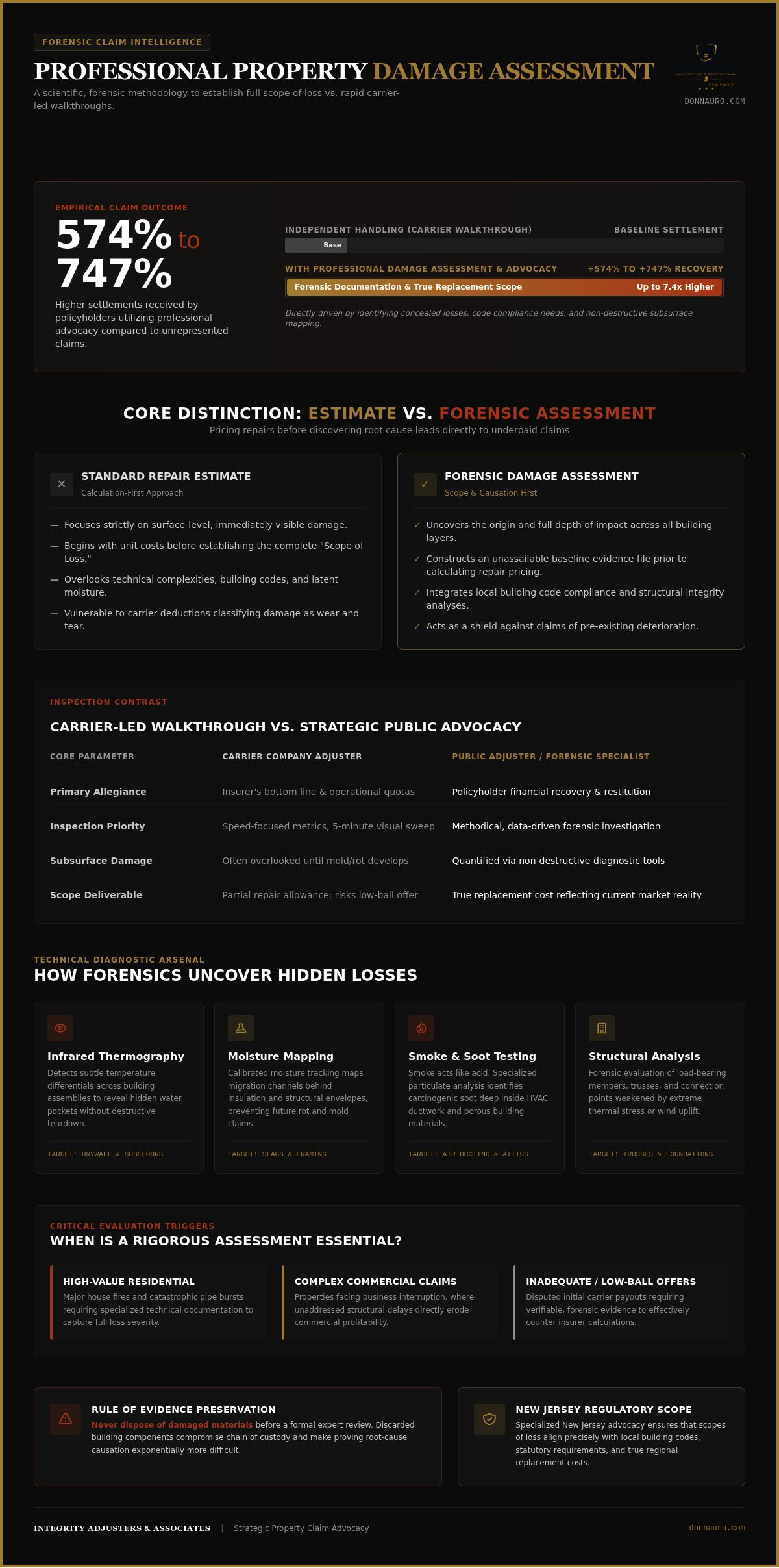
Did you know that policyholders who utilize professional advocacy often receive settlements between 574% and 747% higher than those who handle claims independently? This staggering difference isn't a matter of luck. It's the direct result of a rigorous professional property damage assessment that uncovers what the carrier's adjuster often misses. When a disaster occurs, your insurance company's representative works for their bottom line, not yours. You likely feel undervalued and overwhelmed by technical jargon and repair estimates that don't reflect the true cost of rebuilding.
It's natural to worry that hidden issues like mold or soot are being overlooked, leading to future costs. You need a comprehensive scope of loss that provides expert documentation and stands up to insurer scrutiny. This guide explains exactly what a professional property damage assessment entails and how it serves as the foundation for a fair settlement. We'll preview the forensic tools used to track moisture and smoke, the importance of building code compliance, and the methodical steps required to secure your recovery. You'll gain the peace of mind that comes from having a strategic ally in your corner.
Key Takeaways
- Understand why a professional property damage assessment functions as a forensic investigation to uncover hidden structural losses that standard walkthroughs miss.
- Learn how advanced diagnostic tools like thermal imaging and moisture mapping identify subsurface issues like mold and water intrusion.
- Recognize the fundamental conflict of interest in carrier-led inspections and why accuracy must take precedence over the insurer's speed-focused metrics.
- Identify the essential steps to protect your claim evidence, such as why you should never dispose of damaged materials before a formal expert review.
- See how specialized New Jersey advocacy ensures your scope of loss reflects the true replacement cost while meeting local regulatory standards.
What is a Professional Property Damage Assessment?
A professional property damage assessment is a comprehensive forensic evaluation of your property's condition after a loss. It isn't a quick visual inspection or a five-minute walkthrough. Instead, it's a methodical deep dive into the structural and cosmetic integrity of your building. While insurance company adjusters often focus on obvious, surface-level damage, a professional assessment looks for what's hidden. The goal is to establish a complete record of every impacted component, from smoke-damaged insulation to moisture trapped behind drywall.
To better understand how these assessments are properly quantified and defended, watch this detailed guide:
This process serves as the cornerstone of a successful insurance claim. Without a detailed evidence base, you're essentially guessing at the value of your loss. A thorough investigation ensures that your claim accounts for "hidden" issues that might not manifest for months. In many cases, this involves a forensic engineering investigation to determine exactly how a specific peril caused structural failure. This level of detail acts as a shield, protecting you from insurer attempts to categorize damage as pre-existing wear and tear.
The Difference Between an Estimate and an Assessment
Estimates and assessments are often confused, but they serve different purposes. An estimate is simply a calculation of costs based on a list of repairs. A professional property damage assessment, however, identifies the root cause and the full extent of the damage first. If you start with numbers before defining the "Scope of Loss," you'll likely end up with an underpaid claim. You can't accurately price a repair until you understand every layer of the damage. A numbers-only approach ignores the technical complexity of modern building codes and restoration standards.
When is a Professional Assessment Necessary?
Certain situations demand a more rigorous investigation than a standard carrier inspection provides. High-value residential losses, such as house fires or major pipe bursts, require specialized documentation to capture the full severity. Complex commercial claims involving business interruption also benefit from this level of scrutiny, as structural delays directly impact your bottom line. If your insurer's initial offer feels inadequate or "low-balled," a professional assessment provides the factual integrity needed to challenge their findings. It brings order to the chaos of a disaster by focusing on verifiable evidence.
Key Elements of a Forensic Damage Investigation
A professional property damage assessment moves beyond what the naked eye can see. It's a disciplined, data-driven process designed to capture the full reality of your loss. This begins with a meticulous visual inspection of every accessible area, from the roofline to the foundation. We don't just look for broken windows. We look for the subtle signs of stress that indicate a compromised building envelope. This level of detail is essential for documenting business assets and personal property correctly, ensuring that every item is accounted for in the final inventory.
Technical tools transform the assessment into a forensic investigation. Infrared thermography and moisture mapping allow us to see through drywall and flooring. These non-destructive methods identify subsurface water intrusion that would otherwise remain hidden until mold or rot sets in. If you've suffered a storm or fire, a structural integrity analysis is vital to ensure the building remains safe for occupancy. We examine load-bearing members and connection points that may have been weakened by extreme heat or wind pressure.
Detecting Hidden Damage: Smoke, Soot, and Water
Smoke behaves like an acid. It penetrates porous materials and lingers deep within HVAC systems long after the flames are extinguished. A smoke soot damage insurance claim requires specialized testing to verify the presence of carcinogenic particulates in areas that appear clean. Without this evidence, carriers often deny the need for professional duct cleaning or insulation replacement. Secondary damage is an equally high risk. Trapped moisture leads to wood rot and microbial growth within 24 to 48 hours. Identifying these issues early prevents long-term health hazards and structural decay from compromising your property value.
Building Code Compliance and Upgrades
Property recovery isn't just about returning to "pre-loss" condition. It's about meeting current safety standards. A professional assessment must cross-reference your damage with local New Jersey building codes to ensure legal compliance. If your electrical or plumbing systems were damaged, simply repairing them to outdated standards might violate current safety laws. This is where "Law and Ordinance" coverage becomes critical when settling a homeowners insurance claim. We ensure the carrier pays for the mandatory upgrades required by modern statutes. This methodical documentation serves as your dedicated shield against institutional pushback. If you're navigating a complex loss, seeking professional claim support ensures no detail is left to chance.
Public Adjuster vs. Insurance Company Adjuster Assessments
The core difference between a company adjuster and a public adjuster lies in their legal duty. A staff or independent adjuster represents the insurance carrier's financial interests. Their primary objective is often to resolve claims quickly while minimizing the company's liability. In contrast, a public adjuster is the only professional licensed to represent you. This distinction transforms the nature of the professional property damage assessment from a routine inspection into a strategic investigation. While a carrier's representative might focus on volume, an advocate focuses on the factual integrity of the loss.
The Insurance Company's 'Preferred' Adjuster
Carrier-appointed adjusters operate under strict corporate guidelines. These "preferred" vendors often miss complex structural issues, such as smoke residue in wall cavities or hairline foundation cracks after a storm. They typically use Xactimate software to generate pricing, but they may fail to adjust for localized New Jersey labor rates or specific material costs. This speed-focused methodology often results in an incomplete scope of loss. According to the Insurance Information Institute's homeowners claim guide, property owners must be proactive in substantiating their losses to ensure the final estimate reflects reality. Relying solely on the insurer's assessment often leaves thousands of dollars on the table because the carrier's goal is to settle for the lowest defensible amount.
The Public Adjuster's Advocacy Role
A public adjuster acts as a disciplined navigator through a chaotic institutional system. We provide a buffer between you and the carrier, handling all technical correspondence and inspections. Our professional property damage assessment links every forensic finding directly to your policy's specific coverage language. If an insurer denies a portion of your claim, we use documented evidence to challenge their determination. This involves creating a strategic counter-estimate that accounts for every damaged item, from structural framing to business inventory. By prioritizing accuracy over speed, we build a case that withstands carrier scrutiny and forces a fair evaluation of the replacement cost. This methodical documentation is why policyholders with professional representation often see significantly higher settlement outcomes compared to those who settle without an advocate. We ensure the burden of proof is met with overwhelming evidence rather than simple assertions.
How to Prepare for Your Property Damage Assessment
Proper preparation ensures that your professional property damage assessment captures the full scope of loss without interference. It's a critical phase where your actions can either strengthen or compromise the forensic evidence needed for your claim. To ensure accuracy, you must act as a guardian of the scene. Do not clean or dispose of any damaged items before the assessment takes place. Charred debris, water-logged furniture, and compromised equipment are essential pieces of evidence that prove the severity of the loss.
You should also secure the property to prevent secondary damage, such as tarping a leaking roof or boarding up shattered windows. This is known as your duty to mitigate further loss. However, you must perform these temporary fixes without altering the underlying evidence of the original damage. Before the expert arrives, gather your insurance policy documents and all previous correspondence with the carrier. Creating a preliminary list of known damages helps the professional focus their investigation on high-priority areas while ensuring nothing is overlooked during the walkthrough.
Documenting the Immediate Aftermath
Visual proof is your strongest asset. Use your smartphone to capture comprehensive photos and videos of the damage as soon as it's safe to enter the property. Document every room, including areas that seem unaffected, to establish a baseline for the entire structure. Alongside visual evidence, maintain a rigorous log of all interactions with the insurance company. Record the date, time, and name of every representative you speak with, as well as a summary of the conversation. Most importantly, never sign a settlement offer or a "full and final" release before a professional property damage assessment is completed. Early offers rarely account for the hidden structural issues identified during a forensic review.
Commercial Considerations for NJ Businesses
For business owners, the assessment process involves additional layers of complexity. You must gather detailed financial records, including tax returns and profit and loss statements, to support business interruption claims. Specialized environments like warehouses, retail spaces, or manufacturing plants require a high level of technical expertise to evaluate. For instance, industrial property fire claim help requires detailed asset inventories that account for specialized machinery and raw materials. Preparing these records in advance allows the adjuster to link structural damage to operational downtime. If you're managing a significant commercial loss, you should schedule a professional claim review to ensure your business assets are fully protected and accurately valued.
Integrity Adjusters: Strategic Advocacy for NJ Property Owners
Integrity Adjusters & Associates operates with a blend of professional authority and protective advocacy. We specialize in building comprehensive claims for fire, water, and storm loss across New Jersey. Our methodical approach to a professional property damage assessment ensures that no detail is lost to technical complexity. We don't rely on the carrier's cursory walkthroughs. Instead, we perform a deep forensic investigation to document the true extent of residential and commercial losses. This commitment to factual integrity serves as your dedicated shield against institutional pushback.
Navigating the New Jersey insurance market requires local expertise. We understand the specific regulatory environment and property loss standards unique to our state. This knowledge allows us to act as a strategic ally for policyholders who feel overwhelmed by the system. We prioritize clarity and reliability in every document we produce. Our goal is to bring stability to a turbulent situation through disciplined navigation. We focus on the facts, ensuring your recovery is based on evidence rather than insurer assumptions.
A Disciplined Navigator for Complex Claims
Complex claims, especially those involving commercial business property, require more than just a list of repairs. They demand a sophisticated understanding of how structural damage impacts operations. We translate technical assessment data into a persuasive claim package that addresses both physical loss and business interruption. This professional management reduces the emotional burden on the policyholder. You shouldn't have to fight a multi-billion dollar entity alone. If you're dealing with a fire loss, our Cherry Hill public adjuster for fire damage services offer the local support necessary to secure your full recovery. We manage the process from the initial forensic review to the final settlement negotiation.
Get the Settlement You Deserve
A professional property damage assessment is your most powerful tool for a fair recovery. It provides the evidence required to withstand insurer scrutiny and challenge inadequate offers. Our firm has an established track record in disputing lowballed estimates and overturning wrongful denials. We focus on the facts to ensure your settlement covers all damages, including hidden issues like soot or subsurface moisture. Peace of mind comes from knowing that your claim is backed by expert documentation and local advocacy. Don't let your recovery be dictated by an insurer's bottom line. Contact Integrity Adjusters & Associates for a consultation on your NJ property loss. We act as your dedicated shield, ensuring you receive the settlement your policy promises.
Secure Your Full Recovery with Expert Documentation
A professional property damage assessment is the only way to ensure your recovery is based on forensic facts rather than insurer assumptions. We've explored how specialized tools uncover hidden losses and why the distinction between a carrier's estimate and a public adjuster's assessment is critical for your bottom line. By following methodical preparation steps and documenting every asset, you build a claim package that can withstand institutional scrutiny. It's about bringing order to chaos through disciplined evidence collection.
Integrity Adjusters & Associates provides expert public-adjusting advocacy for NJ residents. We offer specialized support for residential and commercial fire, water, and storm claims, focusing on the methodical documentation required to secure fair settlements. You don't have to navigate this complex institutional system alone. Our team acts as your dedicated shield, ensuring every structural and cosmetic issue is accounted for in your final recovery.
Schedule your professional property damage assessment with Integrity Adjusters & Associates today.
Take the first step toward reclaiming your property's value with a strategic ally by your side. You deserve a recovery that reflects the true extent of your loss.
Frequently Asked Questions
What is included in a professional property damage assessment?
A professional property damage assessment includes a forensic review of structural integrity, cosmetic finishes, and mechanical systems. We use advanced diagnostic tools like thermal imaging cameras and moisture meters to detect subsurface water intrusion. In New Jersey, this also involves verifying that all repair estimates comply with current local building codes. The result is a comprehensive scope of loss that documents every impacted area, ensuring no detail is overlooked during the recovery process.
How long does a professional damage assessment typically take?
The duration depends on the property's size and the severity of the loss. For a standard residential water or storm claim in New Jersey, the on-site inspection usually takes between two and four hours. Large-scale commercial fire losses or complex industrial assessments can take several days to document fully. This time allows for a methodical review of every room and structural component to ensure the factual integrity of your claim package.
Can I use a professional assessment to dispute a low insurance offer?
Yes, a professional assessment is the most effective tool for disputing an undervalued settlement offer. It provides the forensic evidence needed to challenge a carrier's low-ball estimate. By presenting a detailed scope of loss that links damage directly to your policy coverage, you force the insurer to address documented facts rather than their own internal metrics. This methodical approach is essential for navigating the complex New Jersey insurance market successfully.
What happens if the professional assessment finds damage the insurance company missed?
When new damage is identified, we file a supplemental claim with your insurance provider. We present the forensic evidence, such as moisture logs or thermal images, to prove the damage was caused by the covered peril. Carriers are required to review this new information under New Jersey's prompt-settlement guidelines. This process ensures that hidden issues like mold or structural weakening are addressed before you sign a final release or settlement agreement.
Is a professional property damage assessment different for commercial properties?
Commercial assessments are more complex and involve specialized asset inventories and business interruption calculations. We evaluate the impact of structural damage on your operations, focusing on specialized machinery, raw materials, and large-scale building systems. For New Jersey businesses, this also includes a rigorous review of commercial building codes. Our team specializes in commercial business property claim support, ensuring that your operational downtime is accurately reflected in the final recovery package.
Does a public adjuster perform the assessment personally?
A licensed public adjuster leads the assessment process to ensure all findings meet state regulatory standards. At Integrity Adjusters & Associates, we personally conduct the inspection and may coordinate with forensic engineers or industrial hygienists for highly technical losses. This collaborative approach ensures that every aspect of your professional property damage assessment is legally sound and practically helpful. We act as your dedicated shield, personally managing the documentation from start to finish.
Will the insurance company accept an assessment from a private firm?
Insurance companies are legally obligated to review and consider any evidence you provide, including assessments from private public adjusting firms. Under the New Jersey Administrative Code, insurers must acknowledge your documentation and provide a written response to your claim. A professionally prepared scope of loss carries significant weight because it is built on verifiable forensic data. This makes it much harder for the carrier to dismiss your claim as subjective or exaggerated.
What should I do if my insurance company refuses to pay for a professional assessment?
Most insurance policies don't directly reimburse the cost of a private assessment; instead, public adjusters typically work on a contingency basis. This means our advocacy is funded by a percentage of the final settlement we secure for you. The value of a professional assessment lies in its ability to uncover hidden damage and secure a higher recovery. This expert documentation often pays for itself by identifying thousands of dollars in losses that carriers originally missed.


