

Industrial and manufacturing fires account for $1.5 billion in direct property damage annually, yet the structural loss is often the smallest part of the financial equation. When specialized machinery is melted and production lines stop, your business faces an existential threat. If you are currently looking for industrial property fire claim help, you already know that standard insurance assessments rarely capture the true cost of your specialized assets. The pressure to settle quickly or use insurer-preferred vendors can leave millions on the table.
We understand that your priority is resuming operations. You shouldn't have to fight an uphill battle with an adjuster who doesn't understand your specific equipment or New Jersey's unique regulatory landscape. This guide will show you how to master the complexities of industrial fire claims and leverage professional advocacy to secure the settlement your business needs to recover. We will break down the methodical documentation required for high-value machinery and explain the data needed for accurate business interruption calculations. You'll learn how a strategic ally acts as a shield against insurer pressure. Let’s bring order to the chaos of your recovery.
Key Takeaways
- Understand the critical distinction between Replacement Cost Value and Actual Cash Value to ensure your settlement covers the true cost of modern industrial equipment.
- Identify "invisible" soot and smoke damage that can cause long-term corrosion in sensitive electronics and specialized machinery if not documented immediately.
- Discover how professional industrial property fire claim help serves as a strategic buffer between your business and the inherent conflicts of interest of insurance company adjusters.
- Implement a methodical "Fire Claim Diary" to track every expense and protect your business interruption claim from being undervalued by the insurer.
- Leverage New Jersey-specific expertise to navigate complex state regulations and optimize recovery timelines in major industrial hubs like Port Newark and the Meadowlands.
The Unique Complexity of Industrial Property Fire Claims
An industrial fire isn't just a larger version of a retail fire. It's a different category of disaster. Scale changes everything. When a 100,000-square-foot facility burns, the thermal dynamics create unique challenges for evidence preservation and damage assessment. You need specialized industrial property fire claim help because the technical requirements for these buildings often exceed the knowledge of general commercial adjusters.
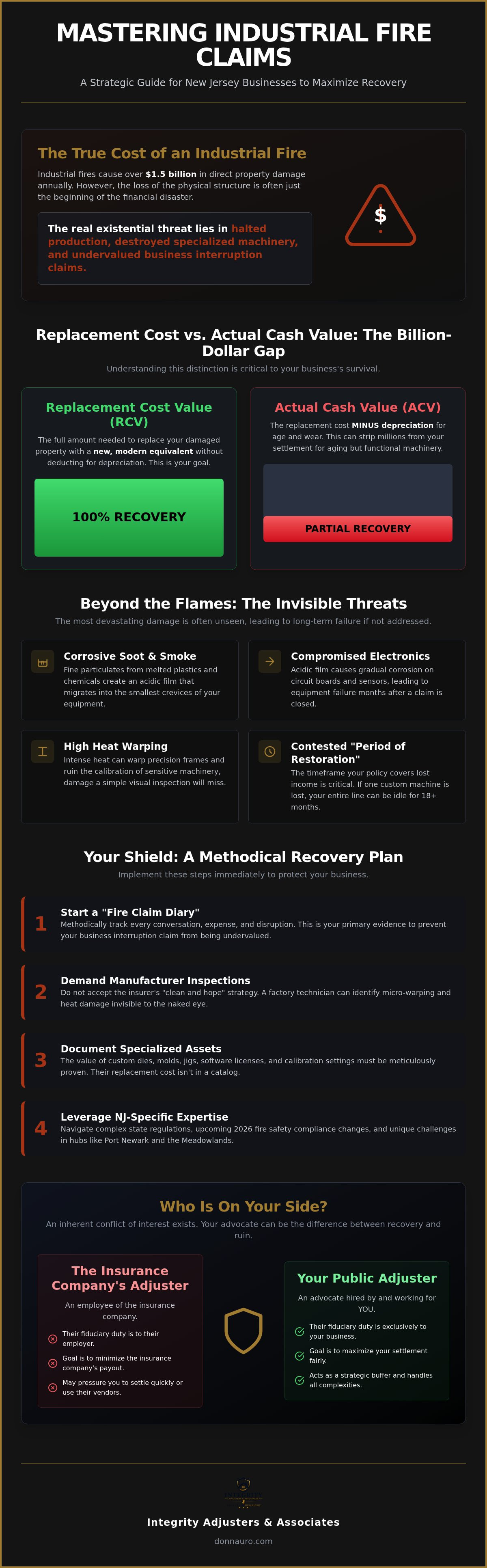
Understanding Property insurance basics is the first step in protecting your assets. Most industrial policies center on Replacement Cost Value (RCV) or Actual Cash Value (ACV). In an industrial setting, the gap between these two can be catastrophic. ACV factors in depreciation, which can strip millions from your settlement for aging but functional machinery. RCV is essential for recovery, yet insurers often push for ACV payouts by citing the "obsolescence" of your equipment.
General adjusters frequently overlook industrial-specific code upgrades. In 2026, New Jersey fire safety compliance is under intense scrutiny. If your facility requires upgraded fire suppression or electrical systems to meet current standards, those costs must be captured. Professional industrial property fire claim help ensures these requirements aren't ignored. This is where forensic accountants become vital. They don't just count lost inventory; they quantify the granular financial impact of every hour of lost production.
Why Industrial Fires Differ from Standard Commercial Losses
Large-span warehouses allow soot and smoke to migrate thousands of feet from the fire's origin. This isn't just a cleaning issue. Fine particulates corrode sensitive CNC electronics and contaminate specialized HVAC systems designed for clean-room or high-filtration environments. If your facility handles hazardous materials, environmental compliance adds another layer of complexity. Soil and water runoff from firefighting efforts can trigger mandatory remediation that must be included in your claim.
The Financial Stakes of Industrial Downtime
The "Period of Restoration" is the most contested part of an industrial claim. It's the timeframe your policy covers for lost income while you rebuild. If one custom-built machine is destroyed, your entire production line might sit idle for eighteen months. The multiplier effect of a single failure point can turn a manageable loss into a total business failure. You need a claim strategy that prioritizes these operational realities over simple structural repairs.
Beyond the Structure: Assessing Machinery, Inventory, and Smoke Damage
The most devastating damage in an industrial fire is often the kind you can't see. Smoke and soot aren't just aesthetic issues; they're chemically reactive. In a manufacturing environment, fire particulates often contain melted plastics, oils, and industrial chemicals that create an acidic film. This film migrates into the smallest crevices of circuit boards and sensors, causing gradual corrosion that leads to equipment failure months after the claim is closed. If you don't secure expert industrial property fire claim help, you risk accepting a settlement that only covers surface cleaning while your core technology remains compromised.
Evaluating Specialized Machinery and Equipment
Insurers often push a "clean and hope" strategy to minimize their payout. They want you to wipe down a CNC machine or an automated assembly line and return to work. This approach is dangerous. High heat can warp precision frames and ruin the calibration of sensitive sensors. You must demand manufacturer inspections for any high-value assets. A factory technician can identify micro-warping or heat-damaged components that a visual inspection will miss. Don't forget to document software licenses and custom calibration settings. These are often lost when hardware is destroyed, and their recovery costs are significant.
Proving the loss of specialized tooling or custom-built assets requires deep documentation. If your dies, molds, or jigs are unique to your proprietary process, their replacement cost isn't found in a standard catalog. You need a strategic ally to ensure these values are properly represented to the insurer. For businesses facing immediate cash flow gaps during this assessment, SBA disaster loans can provide a necessary bridge while your primary claim is negotiated.
Inventory Loss and Supply Chain Disruption
Inventory valuation is a technical minefield in an industrial setting. Raw materials are relatively simple to value, but work-in-progress (WIP) is far more complex. WIP includes the labor, overhead, and energy costs already invested in a product that isn't yet finished. Finished goods should be valued at their selling price, not just the cost of manufacture. Smoke-tainted inventory creates a "salvage" dispute. An insurer might claim your goods are still sellable at a discount, but your brand reputation might not survive the release of compromised products.
Managing these nuances is about protecting the future of your operations, not just replacing what's gone. If you're feeling overwhelmed by the technical requirements of your loss, you can consult with a public adjuster to clarify your rights and options.
Who Is on Your Side? Evaluating Your Advocacy Options
The moment the fire is extinguished, your facility will likely be swarmed by different representatives. Each one claims to offer the best industrial property fire claim help. However, their legal duties and financial incentives vary wildly. Choosing the wrong advocate at this stage can lead to a settlement that covers only a fraction of your actual losses. You need to distinguish between those who work for the insurance corporation and those who work for you.
Public Adjuster vs. Insurance Company Adjuster
The company adjuster is a staff member or a third-party contractor hired by your insurance carrier. Their primary duty is to the corporation, not your business. They use standardized software to estimate damage; these tools often fail to capture the nuances of custom industrial systems. This creates a massive advocacy gap in complex industrial negotiations. While the company adjuster looks for ways to limit the insurer's liability, a public adjuster is a state-licensed professional who works exclusively for the policyholder. They look for every dollar you're owed under the policy terms. They don't just estimate damage; they build a comprehensive case for your recovery.
The Risk of Relying Solely on Restoration Vendors
Restoration contractors specialize in physical cleanup and repair. They're often "preferred vendors" for insurance companies. This relationship creates an inherent conflict of interest. A contractor's primary goal is securing the repair contract. This often leads them to agree with the insurer's lower damage assessment simply to begin the work. Contractors aren't licensed to negotiate your insurance settlement; in many states, doing so is illegal. Separating the damage assessment from the physical repair is the only way to ensure your claim isn't undervalued. You need a buffer between your business and the insurer's preferred network.
Industrial losses involve complex machinery, specialized electronics, and massive business interruption. A generalist adjuster who handles residential or retail claims won't understand the specific hurdles of the New Jersey industrial landscape. You need an advocate who acts as a disciplined navigator through the chaos. This strategic ally ensures that the facts of your loss dictate the settlement, not the insurer's corporate bottom line. Integrity Adjusters & Associates specializes in this level of protective advocacy for New Jersey businesses.
Critical Steps to Protect Your Business Interruption Claim
Protecting your revenue stream is just as critical as rebuilding your walls. A Business Interruption (BI) claim is often the most scrutinized portion of a loss. You need immediate industrial property fire claim help to ensure you don't inadvertently waive your rights during the chaotic first days. The insurer expects you to mitigate further damage, but doing so without proper documentation can erase the evidence of your loss. You must act as a disciplined navigator of your own recovery.
Start a "Fire Claim Diary" immediately. This is a chronological log of every action taken, every person spoken to, and every dollar spent. If you move inventory to a temporary warehouse, log the mileage and labor. If you pay overtime to secure the site, save the payroll records. These small details form the backbone of your "Extra Expense" claim. Without a methodical record, these costs are often dismissed as standard operating expenses rather than claimable losses.
The First 48 Hours: Securing the Industrial Site
Speed is essential. Most insurance policies require notification within 24 to 72 hours of the incident. Delays can lead to immediate disputes. Your first priority is balancing emergency repairs with evidence preservation. If you board up a window or tarp a roof, photograph the damage first. Record video of the entire industrial process line, even if it looks untouched. Smoke residue on a control panel is evidence; cleaning it before it's documented is a mistake. Establish a single point of contact for the insurer to prevent conflicting statements from different department heads. This ensures a unified, factual narrative.
Calculating and Proving Lost Profits
The insurance company will examine your historical production data and sales forecasts with a skeptical eye. They look for "avoidable" costs, which are expenses that stop when production stops, to reduce your payout. You must prove your "unavoidable" costs, such as key personnel salaries and debt service. This is where a public adjuster builds a comprehensive BI package. They track "Extra Expenses," which are the costs of maintaining operations at a temporary facility or outsourcing production to fulfill contracts. In New Jersey, the DOBI sets specific timelines for claim responses in 2026. A strategic ally ensures the insurer meets these deadlines while you focus on your workforce. If you need a methodical professional to handle these complex calculations, contact Integrity Adjusters & Associates for an expert claim review.
Professional Representation for NJ Industrial Fire Losses
New Jersey’s industrial landscape is among the most complex in the nation. From the high-volume logistics hubs of Port Newark to the manufacturing corridors of the Meadowlands, local regulations dictate the speed and success of your recovery. You need industrial property fire claim help that understands these specific geographic and regulatory hurdles. Integrity Adjusters & Associates acts as your strategic ally, bringing order to the chaotic aftermath of a major loss. We don't just file paperwork; we build a methodical evidence package designed to survive the intense scrutiny of corporate insurance adjusters.
Navigating New Jersey Insurance Regulations
New Jersey insurance regulations require a specialized touch. In 2026, the NJ Department of Banking and Insurance (DOBI) maintains strict timelines for claim acknowledgments and decisions. We ensure your carrier adheres to these windows to prevent unnecessary delays in your capital flow. Local building codes in NJ often require significant upgrades during fire recovery. Enforcement agencies in 2026 are specifically focusing on fire alarm system functionality and monitoring reliability. If your advocate doesn't know the local NJ landscape, they may miss these mandatory code-related costs in your settlement. We specialize in identifying NJ-specific policy endorsements that protect industrial properties from underpayment due to these regulatory shifts. Our team understands the nuance of New Jersey state laws, including proposed changes like Bill A1339 that affect how out-of-state insurers operate within our borders.
Securing Your Industrial Future with Integrity Adjusters
Our approach is rooted in factual integrity and professional documentation. We serve as a protective shield between your business and the insurance corporation. While the insurer focuses on minimizing their liability, we focus on the granular details of your loss. This includes everything from specialized CNC machinery to environmental compliance in sensitive NJ watersheds. We move quickly from identifying pain points to executing a concrete resolution. This purposeful pace is essential in an industry where every day of downtime equals lost market share. We bring a high level of formality and reliability to the process, ensuring every piece of evidence is practically helpful and documented with precision.
The path from a devastating fire loss to a fair settlement requires a disciplined navigator. You shouldn't have to manage a complex institutional system while trying to keep your workforce together. We provide the steady, methodical confidence you need to regain control of your facility's future. Speak with a New Jersey Public Adjuster about your industrial fire claim to ensure your recovery is handled with the local expertise it deserves.
Securing Your Industrial Recovery and Future Growth
Recovery from a major industrial fire requires more than just rebuilding a structure. It demands a precise, data-driven approach to valuing complex machinery and protecting your revenue through accurate business interruption calculations. You've learned that standard insurer assessments often ignore the micro-corrosion of electronics and the true cost of operational downtime. Securing professional industrial property fire claim help ensures that these technical nuances are documented with factual integrity rather than estimated through generic software.
Integrity Adjusters & Associates provides specialized commercial fire loss claim support and dedicated New Jersey local advocacy. We act as your strategic buffer, bringing order to the chaos of complex industrial losses. Our methodical documentation of complex industrial assets prevents underpayment and keeps your focus on your workforce. Don't let an institutional system dictate the value of your recovery or the timeline of your return to market. We provide the steady, methodical confidence needed to regain control of your facility's future.
Contact Integrity Adjusters & Associates for an Industrial Claim Evaluation.
We are ready to navigate the path to your full financial recovery and operational stability.
Frequently Asked Questions
What is the role of a public adjuster in an industrial fire claim?
A public adjuster acts as your exclusive advocate to document damage and negotiate with the insurance carrier. They provide industrial property fire claim help by building a comprehensive package that includes structural loss, machinery damage, and inventory valuation. Unlike the company adjuster, their loyalty is solely to the policyholder. They serve as a protective buffer between your business and the insurer's corporate interests; this ensures that every technical aspect of your loss is captured in the settlement.
How is business interruption calculated for a manufacturing facility?
Business interruption is calculated by comparing your historical production data and sales forecasts against your actual performance during the restoration period. This process includes identifying unavoidable fixed costs like key personnel salaries and debt service. It also captures "Extra Expenses" incurred to maintain operations at a temporary site. A public adjuster uses forensic accounting to quantify these losses. This prevents the insurer from undercounting your lost profits based on generic industry averages that ignore your specific output.
Can I use my own contractors for industrial fire repairs?
You have the right to choose your own specialized contractors for industrial repairs. You aren't required to use the insurance company's preferred vendors. Using independent experts is often necessary for specialized machinery or environmental remediation. While the insurer may recommend their own network, your priority should be quality and operational integrity. Using your own team ensures the work meets your specific industrial standards rather than the insurer's cost cutting goals.
What if my insurance company denies my industrial fire claim?
If your claim is denied, you should immediately request a written explanation citing the specific policy language used for the decision. Many denials stem from technicalities or misinterpretations of policy endorsements. You can seek professional industrial property fire claim help to challenge the denial through an appraisal process or a formal appeal. In New Jersey, you can also file a complaint with the DOBI if the insurer acts in bad faith or violates state response timelines.
How much does it cost to hire a public adjuster in New Jersey?
Public adjusters in New Jersey typically work on a contingency fee basis. This means they earn a percentage of the final settlement amount. This fee structure aligns their interests with yours; they only get paid when you recover funds. There are no upfront costs for their advocacy. This allows industrial owners to secure expert representation without increasing their immediate financial burden. You should review the specific percentage in your service agreement before the documentation process begins.
How long does it typically take to settle a large industrial fire claim?
Settlement for a large industrial fire claim can take from nine to 18 months, or even longer for catastrophic losses. The complexity of machinery inspections and business interruption audits naturally extends the process. However, New Jersey DOBI regulations in 2026 require insurers to adhere to specific response timelines. A public adjuster monitors these deadlines to prevent the insurer from stalling. Their methodical approach ensures that the claim moves forward at a purposeful pace toward resolution.
Should I sign the insurance company’s initial proof of loss form?
You should not sign an initial proof of loss form until you have independently verified the full extent of your damages. Signing too early can lock you into an undervalued settlement before all invisible smoke damage or business interruption costs are identified. If the insurer pressures you to sign, it's often a tactic to close the claim quickly. Wait until a comprehensive assessment of your specialized equipment and structural needs is complete to ensure your rights are protected.
What is smoke remediation and why is it critical for industrial equipment?
Smoke remediation is the specialized process of removing acidic soot and fine particulates that settle inside industrial machinery. This is critical because fire residues can corrode sensitive electronics and ruin the calibration of precision tools over time. Standard cleaning is often insufficient for high tech manufacturing equipment. Professional remediation ensures that these hidden threats are neutralized. This prevents equipment failure months after the fire, which is a common risk in improperly settled industrial claims.


