

Imagine waking up to the rhythmic thud of water hitting your bedroom floor while snow piles up on your roof. It isn't a burst pipe. It's an ice dam, and it's currently compromising your home's structural integrity. Filing an ice dam damage claim NJ carriers will approve requires more than just photos of a leak. You must prove the damage was a sudden weather event rather than a gradual maintenance issue. This distinction is often where homeowners lose their footing and their funding.
We understand the urgency you feel when water breaches your ceiling. It's a high-stakes situation that demands a methodical response. You deserve a settlement that covers both the visible interior damage and the necessary roof repairs. This guide provides the clarity you need to navigate the complexities of New Jersey insurance policies. We'll explain the "sudden" nature of these claims, detail the state's strict 10-day acknowledgment deadlines, and show you how professional advocacy ensures your carrier treats your property loss with the gravity it deserves. From documenting evidence to interpreting policy language, you'll learn the exact steps to secure a fully funded restoration.
Key Takeaways
- Understand the "sudden and accidental" clause to prevent insurers from misclassifying weather-driven ice dams as gradual maintenance issues.
- Identify hidden moisture and compromised attic insulation that standard carrier inspections often overlook during the initial assessment.
- Follow a methodical documentation process for your ice dam damage claim NJ to ensure all interior and structural losses are fully evidenced.
- Navigate the critical differences between Actual Cash Value and Replacement Cost Value to avoid underfunded repair settlements.
- Leverage professional advocacy to act as a buffer between you and the insurance company, ensuring a fair and comprehensive recovery.
Understanding Ice Dam Damage and NJ Insurance Coverage
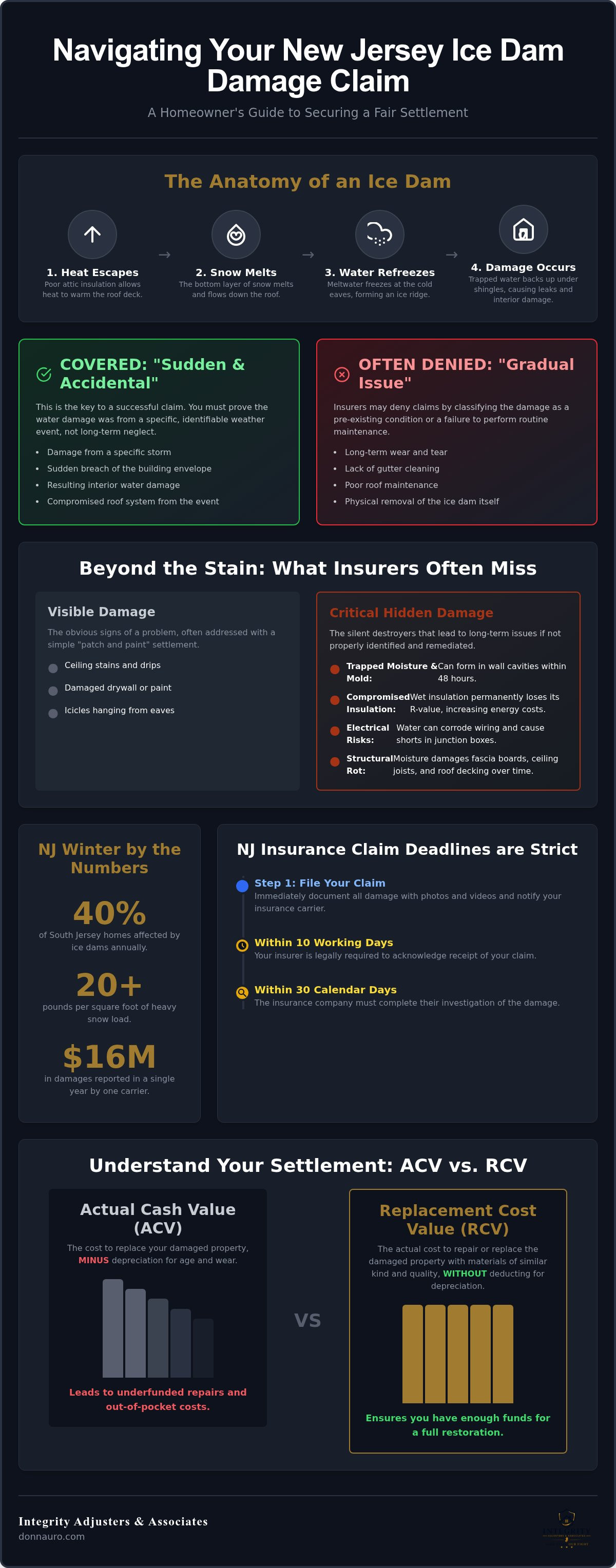
New Jersey winters are unpredictable. Heavy snow loads often exceed 20 pounds per square foot. When temperatures swing rapidly from sub-zero to the high 30s, your roof becomes a battleground. This cycle is the primary driver for a complex ice dam damage claim NJ homeowners must face. Approximately 40% of homes in South Jersey are affected by some level of ice dam damage annually, making it one of the most common winter property losses in the state.
How Ice Dams Form on New Jersey Roofs
The process starts with poor attic insulation or ventilation. Heat escapes from your living space and warms the upper portion of the roof deck. This melts the bottom layer of snow. As the meltwater flows toward the colder eaves, it refreezes into a solid ridge of ice. You can learn more about what is an ice dam to understand the mechanical failure involved. This ridge traps subsequent meltwater, forcing it upward and under your shingles.
Icicles are more than a winter aesthetic. They're often a visual indicator of structural ice damming. Once water gets under the shingles, it migrates into critical zones. It destroys the R-value of your attic insulation and compromises interior drywall. In severe cases, it can lead to structural rot in your fascia boards and ceiling joists. State Farm once reported $16 million in damages from ice dams and frozen pipes across New Jersey in a single year, highlighting the scale of this destruction.
Is Ice Dam Damage Covered in NJ?
Most standard New Jersey HO-3 policies cover damage caused by the "weight of ice and snow." However, carriers look for any reason to classify the loss as a maintenance issue. Proving your ice dam damage claim NJ depends on the "Sudden and Accidental" clause. This means the discharge of water must be a specific, identifiable event triggered by the storm. It isn't enough to show that your roof is leaking; you must show that the weather caused a sudden breach of the building envelope.
There's a critical distinction in NJ insurance law. Carriers rarely pay for the physical removal of the ice itself, as they view this as preventative maintenance. They do, however, cover the "resulting damage" caused by the water that breached the interior. In New Jersey, the "resulting damage" rule means that while the ice dam removal is your responsibility, the destruction it causes to your interior and roof system is a covered loss.
Navigating these claims is time-sensitive. New Jersey regulations require insurers to acknowledge your claim within 10 working days. They must complete their investigation within 30 calendar days. If they fail to meet these deadlines or try to blame "gradual" wear and tear, you need a strategic ally to protect your interests. We act as a protective shield, ensuring your carrier respects these legal timelines and pays the full value of your loss.
The Science of Ice Dam Destruction: What Insurers Often Miss
Insurance adjusters frequently view an ice dam as a minor leak. They see a ceiling stain and offer a "patch and paint" settlement. This approach ignores the underlying physics of the loss. A successful ice dam damage claim NJ requires a deep dive into the home's structural health. Water doesn't just drip; it migrates. It follows the path of least resistance, often tracking along electrical conduits or structural studs deep into wall cavities where it remains hidden from the naked eye.
Interior Damage: Beyond the Ceiling Stain
Hidden moisture is a silent destroyer. In New Jersey's humid winter environment, trapped water creates a breeding ground for mold within 48 hours. If your carrier's adjuster isn't using thermal imaging or moisture meters, they're missing the true scope of the damage. Electrical risks are also a major concern. When water tracks down wall cavities, it can corrode wiring or cause shorts in junction boxes. Professional moisture mapping is non-negotiable to ensure these safety hazards are identified and remediated.
Wet insulation is another critical loss insurers often ignore. When fiberglass or cellulose insulation becomes saturated, it compresses. This compression is permanent. It destroys the material's R-value, leaving your home under-insulated. A fair settlement must include the cost of removing and replacing all compromised insulation to restore your home's energy efficiency. If you're struggling to get the carrier to acknowledge these hidden costs, professional claim advocacy can provide the technical evidence needed to bridge the gap.
Exterior Damage: Gutters and Shingle Integrity
The science of ice dam formation involves immense pressure. As water refreezes at the eaves, the expanding ice can rip gutters directly from the fascia boards. This often causes secondary damage to the home's exterior envelope. Shingle "lifting" is equally destructive. Ice prying under the shingles breaks the factory sealant bond. Even if the shingles appear to lay flat once the ice melts, their wind resistance is compromised. This leaves your roof vulnerable to future storm damage.
New Jersey homeowners have an additional layer of protection through the state's "matching" regulations. The NJ Department of Banking and Insurance generally requires that repairs result in a reasonably uniform appearance. If the carrier cannot find an exact match for your shingles or interior finishes, they may be responsible for replacing the entire area to maintain aesthetic consistency. We act as your tactical ally to ensure the insurer doesn't cut corners on these essential structural and cosmetic requirements.
Why NJ Ice Dam Claims Get Denied or Underpaid
Insurance carriers are businesses focused on cost containment. When you file an ice dam damage claim NJ, the insurer's default position is often to minimize the payout. They frequently employ the "Maintenance Exclusion" to shift the financial burden back to you. By claiming the ice dam resulted from clogged gutters or aged shingles, they argue the loss was gradual rather than sudden. This tactic ignores the reality of New Jersey's volatile freeze-thaw cycles that can overwhelm even well-maintained homes.
Sudden Event vs. Gradual Neglect
Proving the "storm-created" nature of your loss is the first step in defeating a denial. Insurers want to see a specific date of loss tied to a weather event. We recommend pulling historical weather data from local NJ airports, such as Newark Liberty or Atlantic City, to document the exact temperature fluctuations that led to the damming. You must also be prepared to show "reasonable care." Providing receipts for gutter cleanings or prior roof inspections acts as a shield against claims of neglect. Understanding what to know about ice dam insurance claims is essential when the carrier tries to reclassify a sudden breach as a long-term maintenance failure.
The "Pre-existing Damage" trap is another common hurdle. NJ carriers often cite the age of your roof to justify a lower payout. They might claim that granular loss or shingle brittleness existed before the storm. This is why professional documentation is vital. If your roof was functional before the ice dam, the insurer is responsible for the resulting damage, regardless of the roof's age.
The Problem with Company-Appointed Adjusters
The adjuster sent by your insurance company works for the company, not you. Their primary loyalty is to their employer's bottom line. This conflict of interest often leads to "Scope of Loss" omissions. They might overlook the R-49 insulation standards required by the New Jersey Uniform Construction Code or fail to account for the actual labor costs of NJ-certified contractors. These contractors often charge between $150 and $700 per hour for specialized steam removal, yet company adjusters may use outdated national averages that don't reflect the local market.
Many homeowners also fall into the Actual Cash Value (ACV) vs. Replacement Cost Value (RCV) pitfall. The carrier may issue an initial check based on ACV, which includes heavy depreciation. Without a methodical navigator to track the repair process and "recover" the depreciation, you could be left with a significant financial gap. We ensure every line item, from debris removal to site protection, is included in the final settlement so your restoration is fully funded.
How to File an Ice Dam Claim in NJ: A Step-by-Step Guide
Success with an ice dam damage claim NJ starts the moment you identify the intrusion. You must act as a disciplined navigator of your own recovery. This involves balancing the need for immediate mitigation with the necessity of preserving evidence for the carrier's inspection. If you handle this phase haphazardly, you risk a partial denial based on "failure to mitigate" or "lack of evidence."
Immediate Actions After Noticing a Leak
Safety is your absolute priority. If water is leaking near light fixtures or outlets, shut off the power at the breaker immediately. Falling ice from eaves also poses a significant physical risk. Once safe, you must stop the water's progress. Use buckets and towels to manage interior drips, but avoid aggressive roof tactics. Never use a hammer or shovel to chip away at the ice. These tools will inevitably gouge your shingles, giving the insurer a primary reason to deny your claim due to homeowner-inflicted damage.
Documenting the Evidence Like a Pro
Capture wide-angle photos of every affected room to show the full context of the damage, followed by high-resolution close-ups of the specific ice formations and gutter blockages on the exterior. This dual perspective prevents the carrier from downplaying the scale of the loss. Maintain a dedicated communication log for every interaction with the insurance company. Record the date, the name of the representative, and a summary of the discussion. Keep every receipt for emergency drying services or tarping. These costs are typically reimbursable and serve as evidence of your "reasonable care" to protect the property.
Navigating the NJ Claim Timeline
New Jersey law provides strict protections for policyholders. Insurers must acknowledge your claim within 10 working days and complete their investigation within 30 calendar days. If they request more time, they must provide a written explanation every 45 days. Understanding how to file a home insurance claim correctly ensures these statutory clocks start ticking immediately. If your carrier misses these deadlines or stops communicating, you have the right to escalate the matter to the NJ Department of Banking and Insurance.
The final step in the formal process is filing the "Proof of Loss" statement. This is a sworn document that outlines the total extent of your damages. It's a high-stakes filing where errors can lead to underpayment. For those facing complex structural losses, seeking expert representation for your NJ ice dam claim can prevent these institutional delays and technical errors from stalling your home's restoration.
Securing Your Recovery with a NJ Public Adjuster
The insurance claim process is an adversarial system. When you file an ice dam damage claim NJ, you're essentially entering a negotiation where the carrier holds the initial keys to the funding. Integrity Adjusters & Associates acts as your tactical ally. We provide a protective shield between you and the insurance company's cost-containment strategies. Our goal is a fully funded restoration that addresses every structural and cosmetic detail.
Commercial properties in New Jersey face even steeper challenges. Large-scale roofs and complex HVAC systems mean that an ice dam can lead to significant business interruption losses. Specialized advocacy is required to document these high-value claims. We ensure that commercial policyholders receive a settlement that reflects the true complexity of their property and the urgency of their operations. Our methodical approach brings order to the chaos of large-loss documentation.
How Public Adjusters Maximize NJ Settlements
Carriers often use simplified estimating tools that don't account for local New Jersey labor rates or specific material costs. We utilize Xactimate, the same professional estimation software used by the industry, but we apply it with your recovery as the priority. We build a comprehensive "Scope of Work" that includes every necessary task, from content manipulation to professional dehumidification. This level of detail prevents the insurer from "forgetting" essential line items.
Our expertise allows us to identify "unseen" damage that a company adjuster might overlook. We investigate wall cavities for moisture and check attic rafters for structural stress caused by heavy snow loads. This thoroughness is the foundation of our residential water damage claim support. By documenting the loss at this level of detail, we create a claim that the insurer cannot easily ignore or underpay.
The Integrity Adjusters & Associates Difference
We bring methodical confidence to a chaotic situation. Our team acts as the primary buffer between the homeowner and the complex institutional system. You don't have to spend your days arguing over policy language or chasing down adjusters for updates. We handle the documentation, the meetings, and the intense negotiations on your behalf. This allows you to focus on your family or business while we manage the recovery logistics.
This strategic approach ensures that the "resulting damage" rule and New Jersey's matching regulations are strictly enforced. We don't settle for "good enough" repairs. We fight for a settlement that restores your property to its pre-loss condition. If you're dealing with the aftermath of a winter storm, don't face the carrier alone. Schedule a professional property damage assessment today.
Restore Your Home with Methodical Advocacy
You now understand that a successful ice dam damage claim NJ hinges on proving the sudden nature of the weather event and documenting hidden moisture that company adjusters frequently overlook. We have detailed how New Jersey's matching regulations and strict statutory timelines provide you with essential protections during the recovery process. Proper documentation and immediate mitigation are the foundations of your financial recovery.
Integrity Adjusters & Associates specializes in NJ residential storm damage advocacy. As professional property damage assessment experts, we provide the methodical confidence needed to challenge biased estimates and secure a fair settlement. Contact Integrity Adjusters & Associates for a Free NJ Claim Review today to ensure your property restoration is fully funded and professionally managed. Our team acts as the dedicated shield you need when dealing with complex insurance bureaucracies.
You don't have to navigate this complex institutional system alone. With a strategic ally acting as your navigator, you can move from the initial chaos of property loss to a state of total clarity and structural resolution. Your home deserves a complete recovery, and the right representation makes that outcome possible.
Frequently Asked Questions
Does NJ homeowners insurance cover ice dam removal?
Standard policies usually cover the resulting damage, such as water leaks and ruined drywall, but not the preventative removal of the ice itself. However, if the ice dam removal is necessary to stop active damage during a covered loss, it might be included as a mitigation expense. You should check your specific policy language for "reasonable and necessary repairs" clauses that apply during a sudden storm event.
How long do I have to file an ice dam claim in New Jersey?
Most New Jersey HO-3 policies require you to file a claim within two years of the date of loss. However, you must notify your carrier promptly after discovering the damage. Waiting too long can lead to a denial based on a failure to mitigate the loss. New Jersey law requires insurers to acknowledge your claim within 10 working days of receipt to ensure the process moves forward.
What happens if my insurance company denies my ice dam claim?
A denial is not the final word on your property recovery. You have the right to request a formal letter explaining the specific policy exclusion used to deny the claim. If the denial is based on gradual damage or maintenance issues, you can dispute this with evidence of a sudden weather event. Hiring a public adjuster allows you to reopen the claim and present a strategic, evidence-based argument for coverage.
Can I hire my own contractor for ice dam repairs in NJ?
Yes, you have the legal right to choose your own NJ-registered contractor for all property repairs. Insurance companies often suggest preferred vendors, but these contractors may have pre-negotiated rates that favor the carrier's bottom line. Ensure any contractor you hire has a valid Home Improvement Contractor registration with the New Jersey Division of Consumer Affairs. This protects your right to a high-quality, code-compliant restoration of your property.
Will my insurance premiums go up if I file an ice dam claim?
Filing a single claim for weather-related damage doesn't automatically trigger a premium increase, but it is a factor insurers consider. New Jersey regulations generally prevent carriers from non-renewing a policy based on one weather claim. However, multiple claims within a short window can affect your risk profile. Focus on securing a fair settlement for your ice dam damage claim NJ to ensure your home is properly restored and protected against future winter losses.
What is the difference between a public adjuster and a company adjuster?
A company adjuster is an employee of the insurance provider and works to protect their employer's financial interests. A public adjuster is an independent professional hired by you, the policyholder. We act as your tactical ally, documenting every detail of the loss and negotiating directly with the carrier. Our priority is your full recovery, ensuring the final settlement covers the actual cost of repairs rather than a minimized carrier estimate.
Is interior water damage covered if the roof is old?
Yes, interior damage caused by an ice dam is typically covered regardless of the roof's age. While the carrier may apply depreciation to the roof itself, the resulting water damage to your ceilings, walls, and floors is a separate category of loss. Don't let an adjuster's focus on pre-existing wear distract you from your right to a fully funded interior restoration. We advocate for the full scope of your resulting interior damage.
What is the "matching rule" for NJ roof repairs?
The New Jersey Department of Banking and Insurance requires that repairs result in a reasonably uniform appearance. If your roof shingles are damaged by an ice dam and an exact match is unavailable, the carrier may be required to replace the entire roof slope or the entire roof. This prevents patchwork repairs that decrease property value. We ensure the carrier adheres to these regulations to maintain your home's aesthetic and structural integrity.


