

The most dangerous part of a fire isn't always the flames; it's the microscopic chemical invasion that remains long after the fire department leaves. You might see a thin layer of ash, but the real threat lies in the acidic soot and toxic particulates embedded deep within your walls and ventilation. Filing a successful smoke soot damage insurance claim requires more than just showing a few charred surfaces. It demands technical evidence that proves your property is no longer a safe environment.
We understand the frustration of dealing with adjusters who downplay invisible damage or suggest that a simple cleaning will fix the problem. You're likely worried about lingering odors and the long-term health effects of breathing in fine particulates. This guide provides the strategic roadmap you need to identify hidden hazards and document every loss with precision. You'll learn how to navigate the claims process to secure a settlement that reflects the true cost of professional remediation and the replacement of porous materials that cannot be saved.
Key Takeaways
- Understand why a smoke soot damage insurance claim requires technical evidence of microscopic contamination rather than just visual proof of ash.
- Learn to identify the corrosive nature of soot and why simple cleaning is often an inadequate solution for porous materials and soft goods.
- Master a strategic documentation plan using professional wipe samples and laboratory analysis to validate the true extent of your property loss.
- Discover how professional advocacy acts as a protective shield to prevent the under-scoping of damage by insurance carrier representatives.
- Develop a comprehensive recovery roadmap that prioritizes thorough decontamination and a settlement reflecting the true cost of remediation.
Defining Smoke and Soot Damage in Property Insurance
Smoke isn't a single substance. It's a volatile cocktail of gases, vapors, and solid particulates created by incomplete combustion. When property burns, it releases complex chemicals from synthetic materials, plastics, and treated woods. Soot is the oily, carbon-based residue left behind by this process. Unlike dry ash, soot is adhesive. It clings to surfaces and migrates deep into porous materials like drywall, wood framing, and textiles. For a successful smoke soot damage insurance claim, you must recognize that these are distinct physical contaminants, not just temporary odors.
Insurance adjusters often draw a hard line between "visual" soot and "invisible" odors. This is a strategic distinction used to limit payouts. They may offer to clean surfaces you can see while ignoring the particulates trapped behind walls or inside insulation. However, the absence of a black smudge doesn't mean the property is restored. Secondary smoke infiltration can be just as damaging as direct fire contact, often affecting areas far from the point of origin. Your recovery depends on proving the presence of these hidden particles.
The Health and Safety Risks of Lingering Soot
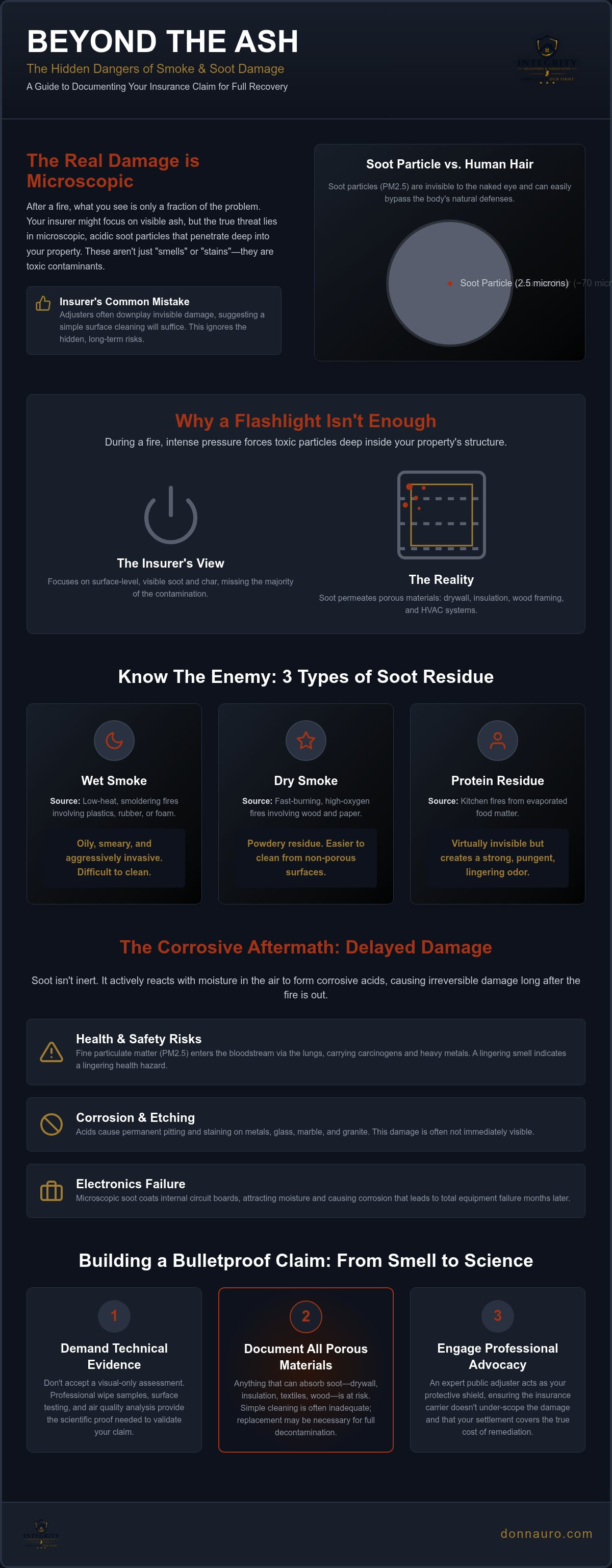
Soot contains fine particulate matter known as PM2.5. These particles are small enough to enter the bloodstream through the lungs. Depending on what burned, this residue can carry heavy metals, dioxins, and known carcinogens. Removing the smell isn't the same as removing the hazard. Professional air quality testing and surface lift samples are mandatory to prove that a home or office is safe for re-occupancy. This data transforms a subjective complaint about a "smell" into a documented health risk that the insurer cannot easily dismiss.
Secondary Damage: When the Fire Was Next Door
You don't need a fire on your own property to suffer a significant loss. Smoke travels. It moves through HVAC ductwork, settles in attic insulation, and enters through soffit vents during neighboring structure fires or wildfires. This is a smoke-only loss, and it's frequently underpaid because there's no charred debris to point to. Acidic soot is particularly destructive to electronics and metallic finishes. If left unaddressed, these microscopic particles react with atmospheric moisture to form corrosive acids that permanently etch glass and destroy circuit boards. Documenting this infiltration requires a methodical inspection of the building's envelope and mechanical systems.
The Science of Soot: Why Your Insurer’s Assessment May Be Flawed
Insurance adjusters often rely on flashlights and naked eyes to determine the scope of loss. This approach is scientifically flawed and routinely leads to underpaid claims. Soot particles are microscopic, frequently measuring smaller than 0.1 microns. They're invisible to the human eye but highly invasive. During a fire, thermal expansion creates intense pressure within the structure. This force drives smoke particles deep into wall cavities, attic insulation, and porous wooden framing. A simple visual inspection by a carrier's representative ignores this physical reality. It fails to account for the particulates trapped in the building's skeleton, where they continue to release toxins and odors long after a surface-level cleaning is finished.
Types of Smoke Residue and Their Impact
The fuel source determines the physical characteristics of the residue. Dry smoke originates from fast-burning, high-oxygen fires. It's typically powdery and easier to remove from non-porous surfaces. Wet smoke results from low-heat, smoldering fires involving plastics, rubber, or foam. This residue is oily, smeary, and aggressively invasive. Protein residue is common in kitchen fires. It's virtually invisible but produces an extremely pungent, lingering odor that attaches to every surface. Each type requires a distinct decontamination protocol to ensure the property is truly restored and safe for occupancy.
Chemical Corrosion and Long-Term Degradation
Soot isn't just a stain; it's a chemical reactant. When these particles mix with atmospheric moisture, they form aggressive acidic compounds. These acids cause permanent pitting in stainless steel, chrome, and brass fixtures within days. On high-end porous surfaces like marble, granite, or limestone, the acidity causes deep staining and irreversible structural etching. Electronics are particularly vulnerable to this invisible threat. Microscopic soot settles on internal circuit boards, attracting moisture and causing electrical bridging or corrosion. This often leads to total equipment failure months after the initial event. Securing a fair smoke soot damage insurance claim settlement requires accounting for these delayed, scientifically verifiable effects. If you're facing resistance from your insurer, you can request a professional claim assessment to document these technical details and protect your property's value.
Common Obstacles in Smoke Damage Insurance Settlements
Policyholders often face a fundamental conflict with insurance carriers regarding the definition of "restored." Carriers frequently push for cleaning as a universal solution to reduce claim costs. However, cleaning a surface doesn't address the deep-seated contamination within porous materials. A smoke soot damage insurance claim often stalls when an adjuster classifies structural damage as merely cosmetic. This ignores the fact that soot is a physical pollutant. If a material cannot be returned to its pre-loss chemical state, it isn't restored; it's damaged. This distinction is critical for securing the funds necessary for a true recovery.
Soft goods present another significant hurdle. Items like clothing, upholstery, and attic insulation act as high-efficiency filters during a fire. They trap microscopic particulates that are impossible to wash out completely. Insurers may offer a dry cleaning allowance, but this rarely removes the carcinogens embedded deep in the fibers. You must also watch for policy sub-limits. Some modern policies include restrictive caps on pollutant cleanup or smoke remediation. These clauses can leave you underfunded for a professional decontamination plan if you don't identify them early in the process.
The 'Cosmetic Only' Denial Tactic
Insurance companies often use visual-only standards to minimize payouts. They argue that if a wall looks clean after a quick wipe-down, the damage is resolved. This tactic ignores the reality of functional loss. A professional ozone treatment might mask odors temporarily, but it doesn't remove the acidic residue eating away at your property's value. Proving functional loss requires moving beyond aesthetics. You must establish that the presence of chemical contaminants makes the material unfit for its intended purpose. Documentation of the chemical profile of the soot is your best defense against this denial tactic.
Hidden Odors and HVAC Contamination
Odors are notorious for reappearing weeks or months after a claim is closed. This usually happens during periods of high humidity when moisture reacts with trapped soot particles. This phenomenon proves that the initial remediation was insufficient. The HVAC system is the primary culprit in these cases. It pulls smoke into the ductwork and distributes it throughout the entire building. Simply cleaning the vents is rarely enough. A full system evaluation is mandatory. Securing residential fire damage help ensures that your HVAC components are properly tested for internal contamination. If the system's heat exchanger or internal insulation is compromised, full replacement is often the only way to ensure long-term air safety.
Documenting Your Loss: A Strategic Evidence Collection Plan
Evidence is the foundation of your smoke soot damage insurance claim. You must prove the extent of the contamination before the insurance carrier attempts to minimize the loss. Start by capturing high-resolution photos and videos of all visible soot patterns. Focus on ghosting patterns on walls and ceiling corners; these indicate how smoke circulated through the structure. Don't wipe any surfaces yet. Disturbed soot is harder to test and can be driven deeper into finishes if handled improperly.
A systematic approach ensures no detail is missed. Follow these steps to build a bulletproof file:
- Step 1: Photograph soot tags, which look like dark spiderwebs in corners, and record video of the property's condition.
- Step 2: Secure professional wipe samples or tape lifts for laboratory analysis to confirm the chemical profile of the residue.
- Step 3: Maintain a log of lingering odors, noting if they intensify during high humidity or when the HVAC system runs.
- Step 4: Hire an independent expert for a professional property damage assessment to quantify the true scope of restoration.
Using Technology to Prove Your Claim
Visual inspections are scientifically insufficient. Thermal imaging cameras detect temperature variations that reveal where heat-driven smoke traveled behind wall surfaces and into cavities. Particle counters provide objective data on air quality, measuring contaminants far too small to see. For high-value claims, industrial hygienists provide the expert testimony needed to override an insurer's "cleaning only" estimate. This technical data transforms a subjective complaint into an undeniable physical fact.
Creating a Comprehensive Inventory of Damaged Items
Organize your inventory by material porosity. Non-porous items like metal or glass might be salvageable through professional ultrasonic cleaning. Semi-porous materials like finished wood require careful evaluation for acidic etching. Porous items, including clothing, upholstery, and insulation, often require full replacement because they cannot be fully decontaminated. Food and medicine should be discarded immediately. Smoke particulates penetrate packaging and pose a severe ingestion risk. For high-value art or complex electronics, document serial numbers and current condition before moving them to secure storage. If you're overwhelmed by the technical requirements of evidence collection, contact our team for expert claim assistance to ensure no damage is overlooked.
Navigating the Recovery Process with Professional Advocacy
The insurance company's adjuster works for the carrier. Their primary goal is to settle the smoke soot damage insurance claim for the lowest possible amount. A public adjuster works exclusively for you. We act as a strategic ally and a protective shield. Professional representation prevents the common "under-scoping" of smoke damage, where hidden particulates behind walls or inside ventilation are ignored. In New Jersey, specific insurance regulations govern how losses are handled. Local expertise ensures your carrier complies with these standards. For business owners, this level of advocacy is vital for commercial property insurance claim help, where business interruption and complex equipment loss require technical precision.
Leveling the Playing Field in Negotiations
Public adjusters interpret complex policy language in your favor. We don't accept the insurer's summary at face value. Instead, we build a comprehensive, line-itemed damage estimate. This document covers every technical detail, from specialized cleaning protocols to the full replacement of compromised porous materials. Managing communications with the insurer is equally important. We handle all discussions. This prevents you from answering "trap" questions that might inadvertently limit your coverage or suggest the damage is less severe than the evidence shows.
Securing a Fair Settlement for Total Restoration
The insurer’s first offer is often a "best-case scenario" for their bottom line. It rarely accounts for the full scope of professional remediation or the scientific reality of soot infiltration. We push for a settlement that includes all related costs. This includes Additional Living Expenses (ALE) for temporary relocation if the property is uninhabitable due to poor air quality. The process isn't over until the final walkthrough. We verify that the property is truly safe and soot-free. Our goal is a settlement that reflects the actual cost of returning your property to its pre-loss condition.
Secure Your Property’s Future with Professional Advocacy
Recovery from a fire is about more than removing visible ash. It requires a technical understanding of the chemical interactions between acidic soot and your building’s structure. You now have the strategic roadmap to identify hidden hazards and the evidence required to challenge an insurer’s limited assessment. A successful smoke soot damage insurance claim depends on moving beyond surface-level cleaning and demanding a settlement that covers professional decontamination and the replacement of compromised materials.
Don't let a company-assigned adjuster dictate the scope of your recovery. Integrity Adjusters & Associates provides expert public adjusting advocacy for NJ property owners. We are specialists in documenting complex fire and smoke loss. Our team acts as your dedicated shield, ensuring that technical facts, not insurer bottom lines, drive the negotiation process. We represent you, not the insurance company. Secure your full recovery with Integrity Adjusters & Associates today.
You deserve a property that is scientifically safe and fully restored. Take the next step toward a fair settlement and move forward with the confidence that your property is in expert hands.
Frequently Asked Questions
Is smoke damage covered if there was no fire in my house?
Yes, smoke damage is typically covered even if the fire originated elsewhere. Standard New Jersey property policies include smoke as a named peril. This applies to smoke from a neighbor’s house fire, a nearby commercial blaze, or wildfires. Because smoke travels through HVAC systems and attic vents, it causes significant secondary damage. You don't need charred debris to file a smoke soot damage insurance claim; you only need proof of contamination within your property.
Can soot damage be cleaned, or does everything need to be replaced?
Cleaning is only effective for non-porous surfaces like metal or glass. Porous materials such as insulation, upholstery, and unfinished wood absorb microscopic soot particles that cannot be washed away. These particulates are often acidic and toxic. If a material's structural or chemical integrity is compromised, replacement is the only way to ensure the property is restored to its pre-loss condition. We advocate for full replacement when cleaning fails to meet safety standards.
How long do I have to file a smoke damage insurance claim in New Jersey?
Filing deadlines vary based on your specific policy language. Most New Jersey insurance contracts require you to give prompt notice of the loss. While the statute of limitations for property claims in NJ is often six years, your policy likely contains a shorter suit against us provision, typically one or two years. Waiting too long allows the insurer to argue that the damage worsened over time. It's best to document the loss immediately.
Will my insurance rates go up if I file a claim for smoke and soot?
Filing a claim for smoke damage can influence your future premiums, but it depends on the circumstances. If the damage resulted from a fire that wasn't your fault, such as a neighboring structure fire, your insurer might not increase your rates immediately. However, your total claim history affects your overall risk profile. Avoiding a necessary claim often leads to higher out-of-pocket costs later when hidden corrosion causes expensive mechanical or structural failures.
What should I do if my insurance company denies my smoke damage claim?
You should immediately request a written explanation for the denial and consult a professional advocate. Many denials are based on insufficient evidence or a visual-only inspection that missed hidden particulates. A public adjuster can reopen the file, conduct a technical reassessment, and present the insurer with scientific proof of loss. This professional second opinion often forces the carrier to reconsider their position based on documented facts rather than surface-level assumptions.
How do I prove that my furniture still smells like smoke after cleaning?
Proving a lingering odor requires technical documentation rather than subjective complaints. You can secure professional wipe samples or air quality reports that detect the presence of combustion byproducts. These tests identify specific chemical markers associated with smoke. If these particulates are still present after a cleaning attempt, it proves the remediation was unsuccessful. This data provides the leverage needed to demand the replacement of furniture that continues to harbor toxic smells.
What is the difference between a public adjuster and an insurance company adjuster?
The primary difference is who they represent. An insurance company adjuster is an employee of the carrier whose goal is to protect the insurer’s bottom line. A public adjuster is an independent professional hired by you, the policyholder. At Integrity Adjusters & Associates, we act as a shield between you and the carrier. We handle all documentation and negotiations to ensure your smoke soot damage insurance claim results in a fair and comprehensive settlement.
Does insurance pay for professional air quality testing after a fire?
Most policies cover the cost of professional air quality testing if it's required to determine the scope of the loss. This testing is essential to prove that microscopic soot or toxic gases have infiltrated the living space. Insurers may resist paying for these tests initially, but they are a legitimate part of the claim process. Documenting the air quality provides the scientific evidence necessary to justify expensive remediation or the replacement of contaminated materials.


