

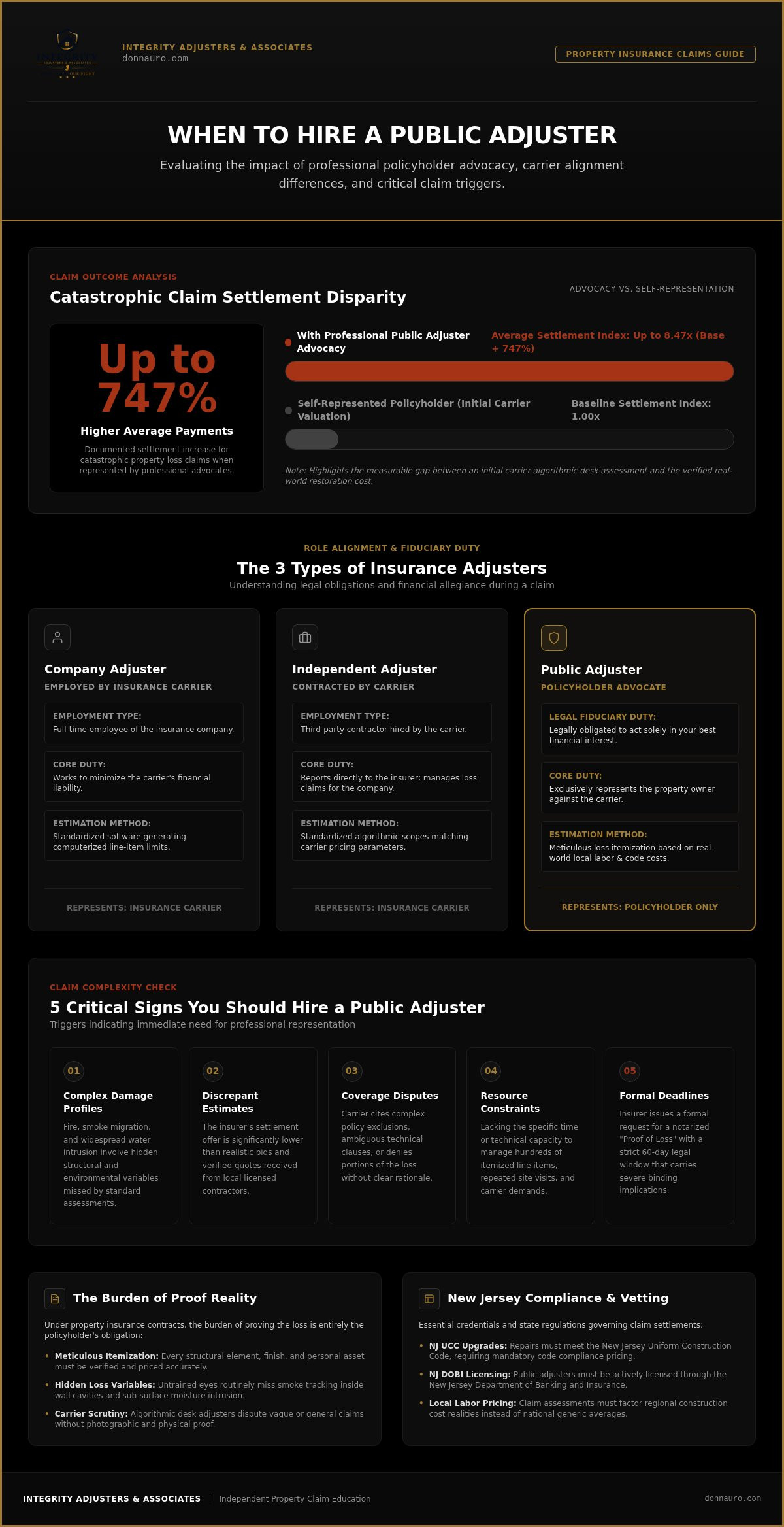
Policyholders who utilize professional advocacy receive payments averaging up to 747 percent higher for catastrophic claims than those who represent themselves. It's a staggering figure that highlights the massive gap between an initial insurance offer and the actual cost of restoration. When you're staring at a flooded basement or a fire-damaged storefront, the pressure to sign a quick settlement is intense. You likely feel intimidated by complex policy jargon and exhausted by the demand to document every single itemized loss. Knowing when to hire a public adjuster is the most critical decision you'll make in the recovery process.
You deserve a settlement that reflects the true value of your damage, not just what a desk adjuster's algorithm suggests. We understand the stress of managing administrative burdens while trying to rebuild your life or business. This guide identifies the specific triggers that signal you need professional advocacy to secure a fair property insurance settlement. We'll examine the 2026 New Jersey regulatory environment and explain how a strategic ally can act as a shield between you and the insurance carrier to ensure your interests are protected.
Key Takeaways
- Distinguish between carrier-employed adjusters and public adjusters to understand who truly advocates for your financial recovery during a property loss.
- Recognize critical triggers, such as widespread water intrusion or settlement offers that fail to meet contractor estimates, to determine exactly when to hire a public adjuster.
- Evaluate the net recovery benefits of professional advocacy, which uses methodical evidence gathering to challenge algorithmic assessments and secure fair market value for repairs.
- Verify essential credentials, including New Jersey DOBI licensing and local market experience, to select a strategic ally who understands regional construction costs and state-specific regulations.
- Adopt a structured documentation process to shift the administrative burden and ensure every itemized loss is accounted for in your final insurance settlement.
Understanding the Public Adjuster’s Role in Your Recovery
Recovery starts with understanding who is on your side. A public adjuster is the only professional licensed to represent the property owner exclusively. Unlike other adjusters you meet after a loss, a public adjuster has a fiduciary duty to you. This means they are legally obligated to act in your best interest throughout the claim process. Understanding the role of a licensed public adjuster is the first step in deciding when to hire a public adjuster for your specific loss.
The insurance landscape involves three types of adjusters. Company adjusters are full-time employees of the carrier. Independent adjusters are third-party contractors hired by the carrier. Both report to the insurance company. Only a public adjuster works for you. They handle the documentation and negotiation to ensure your settlement covers the real-world costs of repair and replacement.
To better understand how these roles impact your recovery, watch this helpful video:
Public Adjuster vs. Insurance Adjuster: The Core Difference
The primary difference lies in the bottom line. A company adjuster's priority is to minimize the carrier's financial liability. They often use standardized software to generate estimates that overlook the nuances of high-end materials or local labor rates. Hiring an advocate shifts the power dynamic. It moves the conversation from what the insurance company wants to pay to what the policy requires them to pay. For a deeper look at these roles, read our guide on Public Adjuster vs Insurance Adjuster: Understanding the Vital Differences.
The Burden of Proof in Property Claims
Many homeowners don't realize that the burden of proof rests on their shoulders. You must prove the extent of your loss to the insurance company. This requires meticulous itemization of every damaged asset. A public adjuster identifies hidden damage that an untrained eye might miss, such as smoke migration in wall cavities or structural weaknesses after a storm. In New Jersey, this process is even more complex. You must account for the New Jersey Uniform Construction Code (UCC). If local ordinances require specific upgrades during a repair, your claim must reflect those costs. Determining when to hire a public adjuster often comes down to whether you have the technical expertise to document these requirements yourself.
5 Critical Signs You Should Hire a Public Adjuster Immediately
Deciding when to hire a public adjuster often depends on the complexity of your loss and the responsiveness of your carrier. Property claims are not just about fixing what is broken. They are about navigating a rigid institutional system that prioritizes its own financial stability. If you encounter any of these five triggers, you need professional advocacy to protect your equity.
- Complex Damage Profiles: Fire, smoke, and widespread water intrusion involve structural and environmental variables that standard assessments often miss.
- Discrepant Estimates: The settlement offer from the insurance company is significantly lower than the quotes you've received from local NJ contractors.
- Coverage Disputes: The insurance company cites complex policy exclusions or denies specific portions of the claim without a clear technical explanation.
- Resource Constraints: You lack the specific expertise or the time required to manage hundreds of line items, multiple site visits, and constant carrier communication.
- Formal Deadlines: The insurer issues a formal request for a 'Proof of Loss' statement with a strict 60 day deadline, which carries significant legal weight.
Handling Significant Water and Storm Damage
Water damage in New Jersey properties is rarely limited to what you see on the surface. Moisture migrates behind baseboards and into wall cavities, creating long-term risks for mold and structural rot. Storm damage requires forensic documentation to prove causation, especially when carriers try to blame pre-existing wear and tear. A professional advocate identifies these hidden issues early, ensuring they are included in the initial scope of work. For a detailed breakdown of this process, see our Residential Water Damage Claim Support: A Homeowner’s Guide to Fair Settlements.
When the Insurer Offers a 'Lowball' Settlement
Policyholders often struggle to understand the difference between Actual Cash Value (ACV) and Replacement Cost Value (RCV). Carriers may apply heavy depreciation to building materials, leaving you with a massive out-of-pocket gap. We focus on disputing these depreciated values by providing market-specific evidence of current construction costs. If an insurer ignores specific damage line items, we shift the burden of proof back to them using methodical site data.
Reliable representation begins with verifying that your advocate meets the New Jersey Department of Banking and Insurance licensing standards. This ensures your claim is handled by a professional who adheres to state-mandated ethics and solicitation rules. If your current settlement feels insufficient, you may need a strategic ally to review your claim before you sign any final releases.
Complexity vs. Settlement: Analyzing the Value of Professional Advocacy
Professional advocacy operates on a contingency fee model. This means your advocate is only paid if they successfully secure a settlement. According to the Insurance Information Institute's claim settlement guide, these fees typically range between 10 and 15 percent of the total payout. While some policyholders hesitate at the thought of a fee, the data suggests that the net recovery is significantly higher with professional help. A landmark study by the Florida Legislature's OPPAGA revealed that represented policyholders received 574 percent more for non-catastrophic claims compared to those who handled the process alone.
The financial outcome is only part of the equation. DIY claims carry heavy "soft costs" that many property owners overlook. Managing a complex loss requires hundreds of hours of documentation, phone calls, and site inspections. For business owners, this translates to lost wages and operational downtime. For homeowners, it means months of emotional stress and administrative fatigue. Deciding when to hire a public adjuster is often a choice between spending your own time or delegating the burden to an expert who handles the carrier's institutional pressure.
The ROI of Expert Claim Management
Expert adjusters look beyond the obvious physical damage. They identify secondary losses and hidden coverages within your policy, such as Law and Ordinance or Business Interruption. Law and Ordinance coverage is vital in New Jersey, where building code upgrades can add thousands to a repair bill. Commercial claims require even more precision. These losses often necessitate forensic accounting to prove lost revenue and ongoing expenses. If you are managing a commercial loss, read our Commercial Property Insurance Claim Help: A Guide to Business Advocacy in 2026.
Avoiding Common Claim Errors
Early mistakes in documentation can lead to permanent claim denials. Many policyholders provide recorded statements or sign settlement releases before the full scope of damage is known. Once you sign a final release, reopening a claim becomes nearly impossible. A public adjuster acts as a shield, preventing these procedural errors. They also manage the Appraisal Clause process if a stalemate occurs. This formal dispute resolution mechanism is a powerful tool to resolve valuation differences without litigation. Understanding when to hire a public adjuster ensures you have a strategic ally before these critical errors occur.
The Selection Process: How to Vet a New Jersey Public Adjuster
Selecting the right advocate requires more than a quick search. You need a professional who understands the specific regulatory environment of the Garden State. Every public adjuster operating in New Jersey must be licensed by the New Jersey Department of Banking and Insurance (DOBI). This isn't just a suggestion; it's a legal mandate that ensures the adjuster has passed state exams and maintains an active surety bond. Verifying this credential is the first step in determining when to hire a public adjuster who is actually qualified to represent your interests.
New Jersey law provides specific protections for policyholders that you must verify in any contract. For instance, you have an unconditional right to cancel a public adjusting contract within three business days without penalty. Additionally, state regulations strictly prohibit adjusters from soliciting your business between 6:00 P.M. and 8:00 A.M. during the 24 hours immediately following a loss. These "quiet period" rules are designed to protect you during a crisis. A reputable firm will always respect these boundaries and provide a written agreement that clearly outlines your rights and their responsibilities.
Local NJ Expertise Matters
Local knowledge is indispensable for a successful recovery. New Jersey's coastal storms and freeze-thaw cycles create unique damage profiles that out-of-state "storm chasers" often misinterpret. Your advocate should have deep experience with local construction costs and the New Jersey Uniform Construction Code. They must be able to physically visit the site to document evidence firsthand. For example, our work as a Cherry Hill Public Adjuster for Fire Damage demonstrates how local expertise helps navigate the specific rebuilding requirements and ordinance issues common in South Jersey municipalities.
Questions to Ask During the Consultation
Don't hesitate to interview potential adjusters. You are hiring a strategic ally to act as a buffer between you and a large institution. Ask who will be the lead adjuster handling your file daily. It shouldn't be a salesperson who disappears after the contract is signed. Inquire about their experience with your specific insurance carrier. Different companies have different internal cultures and negotiation styles. Finally, ask how they handle disputes if the insurer refuses to move. A disciplined navigator will have a clear, methodical plan for mediation or the appraisal process.
Review the contract for fee structures and payout schedules carefully. Under 2026 regulations, adjusters cannot take their entire fee from the first insurance installment if multiple payments are expected to resolve the claim. This ensures you have the cash flow needed to begin repairs immediately. If you're ready to secure professional advocacy for your property, schedule a methodical claim review with our team today.
Navigating Your Claim with Integrity Adjusters & Associates
A property loss is a turbulent event. You shouldn't face a complex institutional system alone. Integrity Adjusters & Associates acts as your dedicated shield, ensuring your interests remain the priority from the moment you file a loss. We bring stability through expertise and a disciplined focus on the facts. Deciding when to hire a public adjuster is about choosing a navigator who understands the gravity of your situation and the technical requirements of a fair settlement. We act as a professional buffer, allowing you to focus on recovery while we manage the carrier's demands.
Our Methodical Advocacy Process
We follow a structured, sequential format to ensure no detail is overlooked. Our process breaks down complex procedures into manageable phases, providing order and predictability during a chaotic time:
- Step 1: Comprehensive site inspection and evidence gathering. We conduct a thorough forensic review of the property. We identify both visible and hidden damage, documenting everything with factual integrity to ensure the carrier cannot overlook secondary losses.
- Step 2: Detailed itemization of every structural and personal property loss. We build a comprehensive claim by itemizing every asset. This includes assessing building code requirements and local New Jersey ordinances that impact real-world repair costs.
- Step 3: Direct negotiation with the insurer to secure a fair settlement. We represent you in all meetings and communications. Our team challenges lowball estimates with evidence-based data to secure a payout that reflects the true value of your damage.
Your Protective Expert in New Jersey
Our firm focuses exclusively on the New Jersey market. We understand the unique needs of local property owners, from coastal storm damage to urban fire losses. We prioritize clarity and transparency over marketing fluff. Our commitment to factual accuracy establishes the professional authority needed to resolve disputes effectively. We don't just process paperwork. We provide protective advocacy that reduces your administrative burden and emotional stress. By shifting the burden of proof from you to our experts, we ensure the insurance company adheres to the terms of your policy.
The decision of when to hire a public adjuster is most effective when made early in the process. Early intervention prevents documentation errors and ensures the carrier's initial scope is accurate. We offer a steady hand to help you move from a state of confusion to a state of clarity. If you are ready to secure your recovery and protect your property equity, contact Integrity Adjusters & Associates for a claim consultation.
Secure Your Recovery with Professional Advocacy
Navigating a property claim requires more than just filling out forms. It requires a strategic ally who can shift the power dynamic back in your favor. The burden of proof rests on your shoulders, but professional documentation can transform an insufficient offer into a settlement that covers actual repair costs. Understanding when to hire a public adjuster is the most critical step toward reclaiming your peace of mind and protecting your property's value.
Integrity Adjusters & Associates provides expert documentation for fire, water, and storm damage. We serve as a strategic ally in complex insurance negotiations, offering dedicated advocacy for NJ property owners. Our methodical approach ensures every itemized loss is accounted for and every local ordinance is addressed. Don't let the administrative burden of a claim stall your progress toward a full recovery.
Secure Your Fair Settlement – Contact Integrity Adjusters Today
You have the right to professional representation. We are ready to help you navigate this process with confidence and clarity. Your path to a fair resolution starts with a single, informed decision.
Frequently Asked Questions
What is the best time to hire a public adjuster for a property claim?
The ideal time to hire a public adjuster is immediately following the property loss. Engaging an expert before the insurance company's field adjuster arrives ensures that the initial scope of damage is accurate and comprehensive. Early intervention prevents the carrier from setting a low baseline for the claim. This proactive approach establishes a professional buffer and shifts the burden of proof from you to your advocate from day one.
Can I hire a public adjuster if I have already started the claim process?
You can hire a public adjuster at any stage of the claim process, even if you have already received an initial payment. Many policyholders realize when to hire a public adjuster only after receiving a settlement offer that fails to cover real-world repair costs. An advocate can step in to file supplemental claims, dispute depreciated values, and manage the extensive paperwork required to reopen a closed or underpaid file.
How much does a public adjuster typically charge for their services in NJ?
Public adjusters in New Jersey typically work on a contingency fee basis, meaning they are paid a percentage of the final settlement. Industry averages in the Mid-Atlantic region generally range between 10 and 15 percent. Under New Jersey P.L.2025, c.84, adjusters cannot take their entire fee from the first payment if multiple installments are expected. All fees must be clearly defined in a written agreement and reasonably related to the services provided.
Will hiring a public adjuster make my insurance company drop my policy?
Hiring a public adjuster will not cause your insurance company to drop your policy. It is your legal right to have professional representation during the claim process. Insurance companies are accustomed to working with licensed advocates. Retaliatory cancellation for exercising your right to representation is a violation of fair claims practices. Your policy status is determined by your risk profile and claim history, not by your choice of advocate.
What happens if the insurance company has already denied my claim?
If your claim has been denied, a public adjuster can perform a forensic review to determine if the denial was valid. Carriers often cite policy exclusions that may not apply to your specific situation. By identifying missed evidence or misapplied policy language, an advocate can challenge the denial through formal dispute resolution channels. This methodical review often reveals covered losses that the carrier's initial assessment overlooked or incorrectly categorized as excluded.
Do public adjusters handle small claims, or only large catastrophes?
Public adjusters handle a wide range of residential and commercial losses, but their value is most significant in complex or large-scale claims. While some firms may take on smaller losses, claims under $10,000 might not always benefit from a contingency fee structure. Professional advocacy is most effective for fire, widespread water intrusion, or storm damage where the technical documentation requirements exceed the typical property owner's expertise and available time.
How long does the public adjusting process typically take?
The public adjusting process typically takes longer than a DIY claim because it involves more thorough documentation. While unrepresented claims may close in approximately 41 days, represented claims often take a median of 115 days to reach a final resolution. This extended timeline reflects the time needed for detailed scope itemization, engineering assessments, and rigorous negotiation. The goal is a settlement that reflects the true value of the damage, not a fast payout.


