

A burst-pipe claim turns on the documented facts, the resulting damage, and your policy, not just the adjuster’s title. If you’re trying to understand what an insurance adjuster for burst pipes will assess, it helps to know who the adjuster represents and what evidence may shape the review.
It’s reasonable to worry that hidden water damage could be missed or that you may misunderstand what your policy covers. Coverage depends on your policy and the circumstances of the loss. Don’t assume the pipe repair or every resulting cost will be covered.
This guide explains what the insurer’s adjuster does, how that role differs from a public adjuster who advocates for policyholders, and what to gather before discussing your claim. You’ll learn how to document visible and less obvious damage, organize relevant policy details, and consider whether independent claim support may help you present the loss. The goal is a clearer next step, not a promise of coverage or a particular settlement.
Key Takeaways
- An insurance adjuster for burst pipes evaluates the reported loss for the insurer. The insurer considers the adjuster’s findings alongside your policy, evidence, and claim circumstances.
- Know the difference between the insurer’s adjuster and a public adjuster, who represents the policyholder in documenting and presenting a property claim.
- Keep a clear claim file: save dated photos and videos, receipts, communications, and notes about the actions you take.
- If an estimate appears incomplete, compare it with the damage you observed and the records you submitted. Then ask in writing how the scope and relevant policy provisions were assessed.
- Before engaging a public adjuster in New Jersey, check current requirements with the appropriate state authority and review the written agreement.
A burst pipe just happened: what an insurance adjuster will assess
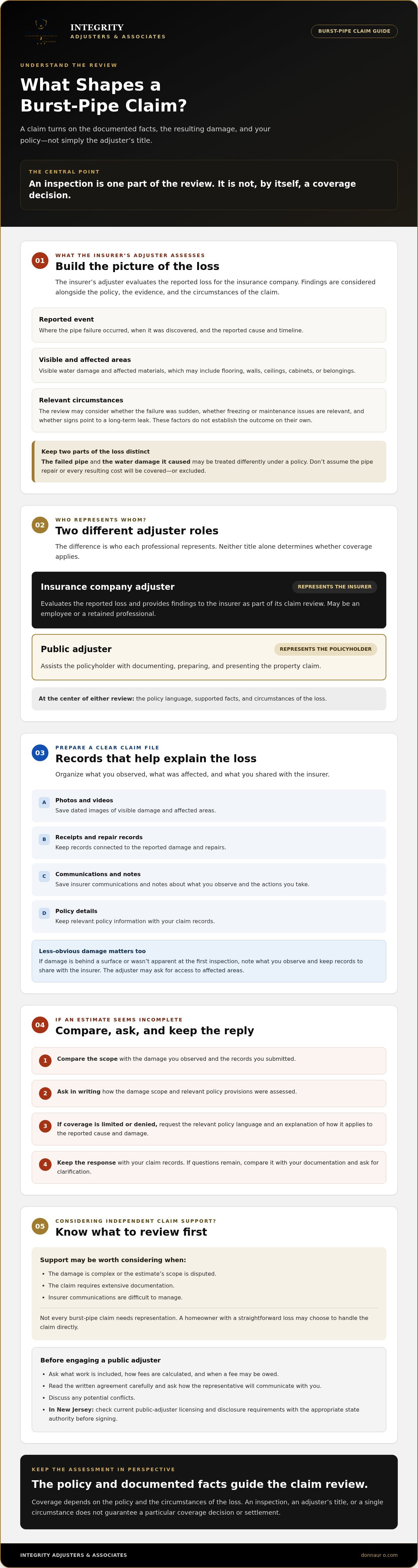
An insurer’s adjuster evaluates a reported loss for the insurance company. After a pipe bursts, the insurance adjuster for burst pipes may document where the failure occurred, when it was discovered, and what damage is visible. Those findings are considered alongside the policy, the evidence, and the circumstances of the claim. An inspection is one part of the review, not a coverage decision by itself.
The failed pipe and the water damage it caused are separate parts of the loss. A policy may treat the cost to repair the pipe differently from damage to building materials or belongings. Coverage depends on the specific wording and facts. A public adjuster is a separate type of professional who represents the policyholder, rather than the insurer, in preparing and presenting a claim.
The reported cause, timeline, and documented damage help inform how a burst-pipe claim is assessed. Clear records can help connect what happened to the damage you’re reporting.
What does an insurance adjuster inspect after a pipe bursts?
The adjuster may record the reported location and timing of the leak, visible water damage, and affected materials such as flooring, walls, ceilings, or cabinets. They may ask for photographs, repair records, receipts, and access to affected areas. If damage is behind a surface or wasn’t apparent at the first inspection, note what you observe and keep records to share with the insurer. Inspection findings don’t replace a review of policy terms and exclusions.
Does a burst pipe automatically mean the damage is covered?
No single fact guarantees coverage. The insurer’s review may consider whether the failure was sudden, whether freezing or maintenance issues are relevant, and whether signs point to a long-term leak. These circumstances may affect how policy wording and exclusions apply, but they don’t establish an outcome on their own. Don’t assume that either the pipe repair or all resulting damage is covered or excluded.
Ask the insurer to explain its position in writing. If coverage is limited or denied, request the relevant policy language and an explanation of how it applies to the reported cause and damage. Keep that response with your claim records. If the assessment leaves questions unanswered, compare it with your documentation and ask for clarification before deciding what to do next.
Insurance adjuster vs. public adjuster: who represents you?
The key difference is whom each professional represents. An insurer’s adjuster evaluates the claim for the insurance company. A public adjuster represents the policyholder and helps document and present the property claim. These are different roles, not proof that either person is acting unfairly. The policy language, documented facts, and circumstances of the loss remain central to the claim assessment.
| Adjuster | Who they work for | Role and claim involvement |
|---|---|---|
| Insurance company adjuster | The insurer, as an employee or retained professional | Evaluates the reported loss and provides findings to the insurer as part of its claim review. |
| Public adjuster | The policyholder | Assists with documenting, preparing, and presenting the property claim on the policyholder’s behalf. |
What is the difference between an insurance adjuster and a public adjuster?
An insurance adjuster for burst pipes assesses the loss for the insurer, while a public adjuster helps the policyholder organize and present the claim. A public adjuster may help assemble records and communicate the scope of the damage. Neither title alone determines whether coverage applies. The policy and supported facts matter.
When might a homeowner consider public-adjusting help?
Support may be worth considering if the damage is complex, the estimate’s scope is disputed, the claim requires extensive documentation, or insurer communications are difficult to manage. That doesn’t mean every burst-pipe claim needs representation. A homeowner with a straightforward loss may choose to handle the claim directly.
Before engaging anyone, ask what work is included, how fees are calculated, and what the written agreement requires. Review the terms carefully, including how the fee is determined and when it may be owed. In New Jersey, verify current public-adjuster licensing and disclosure requirements with the appropriate state authority before signing. Ask how the representative will communicate with you and whether any potential conflicts need to be discussed.
If organizing the damage records or presenting the claim feels difficult, an initial discussion about residential water damage claim support may help you understand what assistance could involve. It’s an option, not a guarantee of coverage or a particular claim outcome.
How to document burst-pipe damage before and during the inspection
A clear record helps the insurer’s adjuster understand what happened and what was affected. Put safety first, then build your claim file as you take action. Don’t delay urgent steps to protect people or limit further damage just to take photos.
- Address immediate safety. If it’s safe, shut off the water supply. Keep people away from electrical hazards and contact the appropriate utility or emergency help if needed.
- Contact appropriate help. Arrange for a plumber to assess the pipe and address urgent needs. Keep invoices, work descriptions, and available records of temporary mitigation. Temporary steps to limit further damage are different from permanent repairs.
- Notify your insurer. Follow the notice instructions and requirements in your policy. Record when and how you reported the loss, who you spoke with, and any claim number or follow-up instructions.
- Record the damage. Once it’s safe, take dated photos and videos of affected rooms, belongings, visible water, and the apparent pipe location. Take both wide views and close-ups.
A useful claim file brings together a timeline, images, communications, and expense records. Keep copies in one organized place, whether digital or paper. Add the date to each new photo, receipt, conversation, or note about an action taken.
What evidence should you gather for a burst-pipe insurance claim?
Write down when you discovered the leak, what you observed, who you notified, and what happened next. List damaged belongings with identifying details and receipts when available. Photograph items before moving or disposing of them, if practical. If urgent cleanup or safety concerns require action first, keep records of what was removed or changed and why.
How should you prepare for the insurer's adjuster visit?
Have your policy, claim number, timeline, images, mitigation records, and plumber or contractor documents ready. Walk through affected areas methodically, including spaces where damage may not be immediately visible. The insurance adjuster for burst pipes may need access to those areas. Ask how to submit additional records after the visit, and log follow-up requests and responses.
Organized evidence doesn’t decide coverage, but it can help keep the review grounded in the property’s condition and the steps taken. Keep copies of everything you submit, along with confirmation that the insurer received it.
What to Do if Burst Pipe Estimates Miss Damage
An estimate that seems incomplete deserves a careful review, not an immediate conclusion. Compare the listed work with the damage you observed, the inspection notes, and the records you already submitted. A difference may raise questions about the scope, documentation, or policy terms. Review those details before deciding whether the estimate reflects an underpayment.
How do you respond when damage appears to be missing?
Start with a room-by-room comparison. Note each damaged area or item that you can’t find in the estimate. For example, if water affected a wall and adjacent flooring, check whether both appear in the scope and whether the inspection notes describe them.
- List the damage you observed and identify what appears absent or unclear in the estimate.
- Gather relevant dated photos, invoices, contractor observations, and other supporting records.
- Submit the information through the insurer’s stated process. Ask in writing for clarification about the estimate’s scope, the records considered, and the policy provisions applied.
- Keep copies of your submission and the insurer’s response, including dates and follow-up instructions.
Be specific in your questions. Rather than saying only that the estimate is too low, identify the room, material, or item in question and ask whether it was inspected or considered. Broader documentation guidance is available in How to Document Water Leak Damage for Your Insurer.
When does a claim disagreement call for additional support?
Repeated questions about the scope, extensive damage, or difficulty organizing records may be reasons to seek guidance. A public adjuster can help a policyholder document and present a property claim. That support is optional and doesn’t guarantee coverage or a particular outcome. Review the representative’s written terms and verify current New Jersey requirements before engaging one.
Public adjusting is not legal representation. If the disagreement turns on legal rights, policy interpretation, or a legal dispute, consider whether a qualified attorney or another appropriate professional is needed. For a focused discussion of claim concerns, see Why Your NJ Water Damage Claim Might Be Underpaid.
If you want help organizing damage documentation and presenting a residential water damage claim, discuss residential water damage claim support. An initial discussion is an option, not a commitment or promise about the insurer’s decision.
New Jersey burst-pipe claims: choose a clear next step
A burst pipe can leave you managing property concerns and a claim at the same time. Keep the next steps in order: protect people from hazards, document conditions when safe, notify your insurer according to your policy, and retain copies of records and communications. An insurance adjuster for burst pipes assesses the reported loss for the insurer, while a public adjuster may help the policyholder document and present the claim. Neither role guarantees a coverage decision or settlement.
What should you ask before hiring a public adjuster in New Jersey?
Before signing an agreement, ask what services are included, how fees are determined, how often you can expect updates, and what responsibilities remain yours. Review the written terms carefully. Verify current licensing and disclosure requirements with the New Jersey Department of Banking and Insurance before engaging a representative. Requirements can change, so confirm current details directly with the appropriate state authority rather than relying on assumptions.
Ask questions until you understand the scope of representation and the fee arrangement. Public-adjusting support may help organize a complex claim, but it doesn’t promise coverage, a specific settlement, or a faster resolution. Your policy, the evidence, and the circumstances of the loss remain important.
How can Integrity Adjusters & Associates help with a water-damage claim?
Integrity Adjusters & Associates assists policyholders with documenting property losses, preparing a comprehensive claim, and navigating communications during the insurer’s review. The firm’s role is to help present the claim on the policyholder’s behalf. It doesn’t sell insurance, provide legal representation, or perform repairs.
For related guidance, see Residential Water Damage Claim Support: A Homeowner’s Guide to Fair Settlements. If you’re weighing whether policyholder advocacy fits your situation, you can discuss your burst-pipe claim with Integrity Adjusters & Associates. An initial discussion is an option, not a commitment or a promise about the claim outcome.
Move forward with a clear, documented claim
A burst-pipe claim is assessed through the policy, the circumstances of the loss, and the evidence you provide. The insurance adjuster for burst pipes evaluates the claim for the insurer, while a public adjuster can represent you in documenting and presenting it. Understand the difference before deciding whether you need additional support.
Keep a reliable record of the damage, your communications, and the actions taken. If an estimate seems incomplete, compare it with what you observed and the documents you submitted, then ask the insurer for a written explanation. Coverage depends on the policy and claim facts, so no adjuster can promise a particular result.
Integrity Adjusters & Associates assists policyholders with documenting property losses and building comprehensive residential and commercial property claims in New Jersey. If you’re weighing whether advocacy may help with a residential water-damage claim, discuss your burst-pipe claim with Integrity Adjusters & Associates. Take the next step at your own pace, with better-organized information and a clearer understanding of your options.
Frequently Asked Questions
Should I call my insurance company after a pipe bursts?
Yes. Notify your insurer according to the notice instructions in your policy. First address immediate safety concerns and take reasonable steps to limit further damage. Document affected areas when safe, then report what happened, when you discovered it, and what actions you’ve taken. Keep the claim number, contact details, and copies of messages or documents you submit. Don’t assume there’s one notice deadline for every policy.
Is damage from a burst pipe covered by homeowners insurance?
It may be covered, but coverage depends on your policy wording and the facts of the loss. A policy may treat sudden and accidental water damage differently from damage related to long-term leakage, maintenance issues, or other exclusions. The cost to repair the pipe itself may also be treated differently from damage to walls, flooring, or belongings. Ask your insurer to explain its position and identify the relevant policy language.
What does an insurance adjuster do for a burst-pipe claim?
An insurance adjuster for burst pipes evaluates the reported loss for the insurance company. The adjuster may document the reported cause, timing, affected areas, visible damage, and supporting records, then provide findings for the insurer’s claim review. An inspection doesn’t determine coverage on its own. The insurer considers the policy, evidence, and circumstances together. Keep your own notes and copies of the documents and photographs you share.
Can I hire my own adjuster for water damage?
Yes, you can consider hiring a public adjuster to represent you in documenting and presenting a property claim. This is optional, not necessary for every loss. Before engaging one in New Jersey, verify current licensing and disclosure requirements with the New Jersey Department of Banking and Insurance. Ask what services are included, review the written agreement and fee terms, and understand that representation can’t guarantee coverage or a particular settlement.
What should I do if the insurance estimate misses burst-pipe damage?
Compare the estimate with the damage you observed, inspection notes, and records submitted to the insurer. Make a room-by-room list of items or areas that appear absent or unclear. Provide relevant photographs, invoices, or contractor observations through the insurer’s stated process, and ask in writing how the scope and supporting information were assessed. Keep copies of every submission and response. A difference warrants review, but doesn’t by itself establish an underpayment.
How do I prove what caused a pipe to burst?
Build a factual timeline and preserve evidence that may help explain the cause. Record when you discovered the leak, where it appeared to originate, and what conditions you observed. Keep dated photographs or videos, plumber findings, repair records, and communications about the incident. Avoid presenting a guess as a confirmed cause. Share relevant information with the insurer and ask what additional documentation it needs to assess the reported circumstances.
Does a public adjuster handle pipe repairs or emergency water removal?
No. A public adjuster helps the policyholder document damage, prepare and present the insurance claim, and navigate the insurer’s process. The role doesn’t include physically repairing a pipe or removing water. Contact an appropriate plumber or mitigation provider for those needs, and keep available invoices and work records for your claim file. Integrity Adjusters & Associates provides policyholder advocacy, not repair, restoration, or emergency mitigation services.


