

A low property claim offer isn’t the final word. If an insurer’s estimate leaves out damage or values repairs too low, you can challenge specific items with evidence. Understanding how to dispute low insurance offer decisions starts with comparing the estimate against your policy, the property damage, and the documented cost of repairs.
It’s understandable to feel uncertain when claim language is unfamiliar or the insurer’s numbers don’t match what you’re seeing. A clear, organized response helps explain what’s missing and why your evidence supports a different assessment. This guide walks New Jersey policyholders through reviewing an offer, identifying disputed items, assembling photos, records, and estimates, and submitting a written response. It also explains when a public adjuster may help organize damage documentation and present a more comprehensive claim, and when you may need other qualified advice. The goal is a fact-based next step, not a promise of a particular outcome.
Key Takeaways
- To understand how to dispute low insurance offer terms, separate the insurer’s estimate from the repair scope and your policy’s coverage.
- Preserve claim communications and organize photos, repair records, and other evidence before submitting a focused written response through the insurer’s stated claim channel.
- Compare estimate items against observed damage, materials, quantities, and labor tasks to identify exactly what needs review.
- Check your policy for applicable response, proof-of-loss, and appraisal time limits. Appraisal may address valuation disputes, but it doesn’t automatically resolve coverage questions.
- A public adjuster may help document and present a property claim. This role is distinct from legal representation, repairs, and emergency mitigation.
How to Dispute a Low Insurance Offer: Start by Checking What It Covers
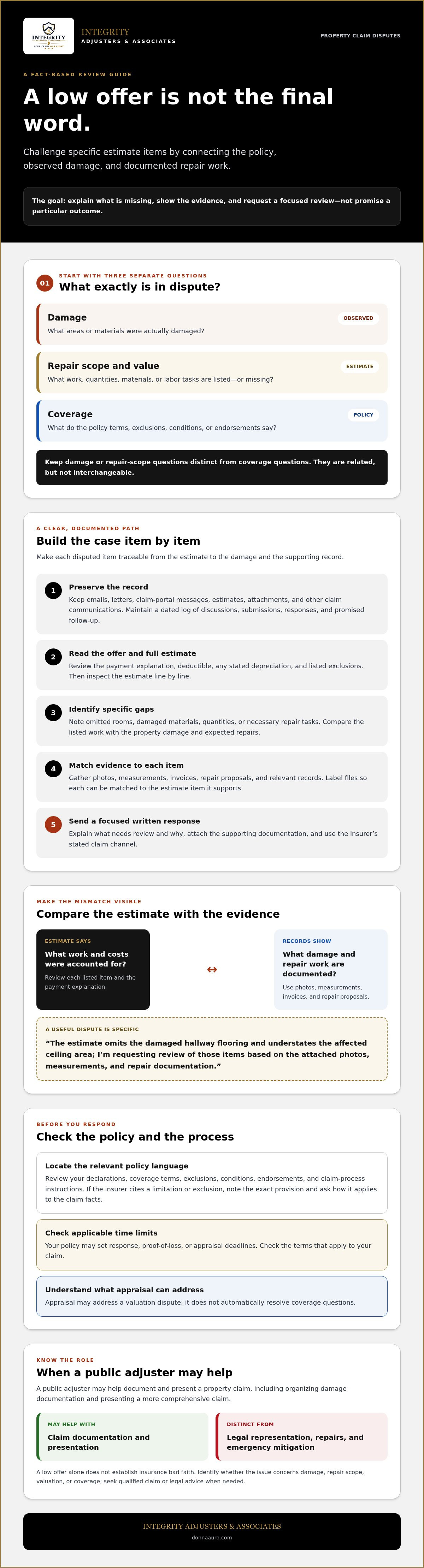
A low property claim offer is a proposed payment based on the insurer’s review, not proof that every damaged area or covered repair has been included. The estimate lists the work and costs the insurer accounted for. Your repair scope may identify additional damage or tasks, while the policy’s coverage terms determine which losses may be covered. These questions are related, but they aren’t interchangeable.
If you’re researching how to dispute low insurance offer decisions, start with the documents rather than a general demand for a higher payment. An offer isn’t necessarily the last word, but your policy’s terms and applicable deadlines matter. Identify whether your disagreement concerns damage, missing work, quantities, pricing, or a coverage decision you want explained.
This video discusses responses to a low settlement offer; its examples may concern injury claims rather than property damage.
What to review in the offer and estimate
Read the payment explanation alongside the full estimate. Check how the deductible, any stated depreciation, and listed exclusions affect the proposed payment. Then compare each line item with the property damage and expected repair work. Mark any omitted rooms, materials, quantities, or tasks, such as removal or replacement steps, that appear necessary but aren’t listed. Keep damage or scope questions separate from coverage questions. For example, a room may be missing from the estimate, while the policy may separately limit or exclude a particular type of loss.
Define the dispute precisely: “The estimate omits the damaged hallway flooring and understates the affected ceiling area; I’m requesting review of those items based on the attached photos, measurements, and repair documentation.”
What the policy can tell you
Locate your declarations, relevant coverage language, exclusions, conditions, and claim-process instructions. Check the wording that applies to the type of loss and property involved, along with any endorsements. Don’t assume a term you’ve seen in another policy applies to yours; wording can differ. If the insurer cites an exclusion or limitation, note the exact provision and ask how it applies to the facts of your claim.
A low offer alone doesn’t establish insurance bad faith. First identify what the insurer included, what it left out, and whether the dispute concerns damage, repair scope, valuation, or coverage. That distinction gives you a clearer basis to request a review and helps you decide whether you need qualified claim or legal advice.
How to Dispute a Low Insurance Offer in Five Documented Steps
A strong disagreement is specific and supported. Rather than sending a broad objection, create a record that connects each disputed estimate item to the damage, relevant documentation, and the review you’re requesting. These five steps show how to dispute low insurance offer decisions in a clear, organized way.
Build a clear record before responding
Start with the policy, insurer’s estimate, payment explanation, photographs, invoices, repair proposals, and relevant claim communications. Keep originals and label copies so each file can be matched to an estimate item. For example, name a photo file with the room and date, then refer to that filename in your notes. If water damage is involved, this residential water damage claim support guide offers additional context.
- Preserve records. Save emails, letters, claim portal messages, estimates, and attachments. Start a dated communication log with the person’s name, contact method, what was discussed, what you submitted, and any response or promised follow-up.
- Compare the scope. Go line by line through the estimate. Note missing rooms, damaged materials, quantities, or repair tasks. Distinguish an omitted repair from a question about whether the policy covers it.
- Gather supporting evidence. Match dated photos, invoices, measurements, and contractor or specialist findings to the specific items you dispute. Evidence is most useful when it explains the difference, not merely when it adds volume to your file.
- Submit a written response. Identify each disputed line item, state what you believe is inaccurate or missing, and cite the records that support your position. Ask the insurer to review the item or explain the basis for its estimate. Use the insurer’s stated claim channel, and retain a complete copy with attachments and proof of submission.
- Track follow-up. Record when the response was sent, any acknowledgment, requests for more information, and the insurer’s decision. Check your policy and claim instructions for applicable time limits instead of assuming a standard deadline.
Keep the tone factual and the request focused. For broader preparation guidance, see this property insurance settlement guide. United Policyholders also provides a consumer-oriented overview of options in Resolving Claim Disputes. If organizing damage records or presenting disputed items feels difficult, public-adjusting advocacy may help you prepare and present a more comprehensive property claim. It doesn’t guarantee a particular outcome.
Compare the Insurer's Estimate With the Documented Property Damage
A useful comparison connects each estimate line to a specific area of damage and the work needed to address it. Review locations, materials, quantities, labor tasks, and supporting records side by side. This turns “the offer is too low” into clear questions the claim handler can assess.
Identify omissions and differences in scope
Check whether the estimate accounts for every affected room and documented component. A line may name the right area but use a different material, quantity, or repair task than your records support. Note discrepancies, such as flooring measured for only part of a damaged room or a documented repair step missing from the estimate. Ask for an explanation rather than assuming a contractor’s preferred scope must be accepted. The policy, evidence, and circumstances of the loss all matter.
Make evidence easy for the claim handler to assess
Pair each disputed item with a reference the reviewer can find quickly, such as a dated photo, invoice, report, or contractor estimate. Label files by room and item, then explain briefly what the evidence shows and what you’re asking the insurer to review. Keep statements tied to what the records establish. Don’t overstate damage or assume its cause without support.
| Estimate item | Observed damage | Evidence | Requested review |
|---|---|---|---|
| Living room flooring | Damage extends beyond the area listed | Dated room photos and measurements | Review the measured area and explain any difference |
| Wall finish | Visible damage is not included in the scope | Close-up photos and inspection notes | Assess whether this item should be added |
Example summary: “The estimate includes only part of the living room flooring, while dated photos and measurements document damage across the room; please review the recorded area and clarify the quantity used.” Adapt the wording to your own evidence.
A contractor’s estimate can help explain proposed materials, quantities, and labor, but it doesn’t by itself establish that the policy covers every listed item. Compare the proposal with the policy terms and documentation, then ask the insurer to explain any difference in scope or coverage. For business property losses, see the commercial property claim help guide.
This item-by-item method is central to how to dispute low insurance offer decisions: show what the estimate says, what the records document, and precisely what review you’re requesting.
Escalate a New Jersey Property Claim Dispute Without Missing Key Steps
If the insurer’s response doesn’t address your documented concerns, tie your next step to your policy and the claim record. There’s no single escalation path for every property policy. Review the policy’s conditions and claim instructions for response deadlines, proof-of-loss requirements, appraisal provisions, and any other dispute process. Missing a policy-specific step or deadline may affect your options, so don’t rely on general timelines from another claim.
Request further review and clarify the next step
Ask the claim handler to respond to each disputed item and identify any additional information needed. Keep the request in writing through the communication channel specified for your claim. Record when you sent it, who responded, and what action or documentation the insurer requested. If the response points to appraisal or another process, check the policy wording before proceeding. Appraisal, if available under the policy, may address disagreement about the value of damage. It doesn’t automatically decide whether the policy covers the loss.
New Jersey policyholders may also submit a complaint to the New Jersey Department of Banking and Insurance (NJDOBI) about issues such as claim delays, denials, or underpayments. Check NJDOBI’s current complaint instructions and public adjuster information directly before taking action. A regulator complaint isn’t a substitute for following the policy’s claim procedures, and it can’t provide individualized legal advice. Keep copies of your complaint and supporting documents with the rest of your claim file.
Know when to seek other qualified help
If your main challenge is documenting damage, organizing estimate differences, or presenting a comprehensive property claim, a public adjuster may be able to advocate for you during the insurer’s process. Verify current New Jersey licensing requirements and status through NJDOBI, and review the terms of any engagement carefully. A public adjuster isn’t an attorney and doesn’t provide legal representation. For legal questions, coverage litigation, or advice about your rights and deadlines, consult an attorney qualified to advise on your situation.
Professional claim support may be useful when disputed items are difficult to document or the insurer’s estimate remains hard to reconcile with the damage record. Explore property claim advocacy support if you need help organizing and presenting your claim. No advocate can guarantee a particular claim outcome. The purpose is to make your position clearer and better documented while you follow the policy’s applicable procedures.
When a Public Adjuster Can Help Challenge a Low Property Insurance Offer
A public adjuster represents the policyholder’s interests in documenting and presenting a property claim to the insurer. This support may be useful when damage affects multiple areas, the repair scope is complex, or the estimate has substantial documented gaps. If you’re working out how to dispute low insurance offer terms, claim advocacy is one option for organizing evidence and presenting disputed items. It can’t guarantee a particular payment or claim outcome.
Signs that claim advocacy may be useful
Consider whether your challenge is mainly about building a clear property claim: locating and recording damage, organizing supporting documents, or explaining differences between the insurer’s estimate and the documented repair scope. A public adjuster may help assemble a comprehensive claim and communicate the policyholder’s position during the insurer’s process. For weather-related damage, the residential storm damage claim guide offers additional context.
Know the role’s limits. A public adjuster isn’t an attorney and doesn’t provide legal representation. The adjuster also isn’t the insurer, a repair contractor, or an emergency mitigation provider. Legal interpretation, litigation, physical repairs, and urgent damage-control work require the appropriate separate professional.
Questions to ask before choosing a public adjuster
Before signing an agreement, ask who will manage your claim, what damage-documentation and claim-preparation support is included, and how updates and submissions will be handled. Request the compensation terms and full written agreement, then review the services covered and any conditions carefully. Don’t rely on verbal assurances about the outcome.
- How will the adjuster document and organize disputed items?
- Who will communicate with the insurer, and how will you receive updates?
- What services are included in the written agreement, and how is compensation described?
- How can you verify the adjuster’s current New Jersey licensing status?
Check current New Jersey public adjuster licensing information and applicable requirements directly with the New Jersey Department of Banking and Insurance (NJDOBI). If your concerns involve legal rights, policy interpretation, or a potential lawsuit, consult an attorney separately. Claim advocacy can help prepare and present your property claim, but it doesn’t replace legal advice.
If you’d like to discuss whether claim documentation and presentation support may fit your situation, Discuss your property claim with Integrity Adjusters & Associates.
Move Forward With a Clear, Documented Claim
A low offer is a reason to review the details, not a reason to guess. The strongest response identifies specific gaps between the insurer’s estimate and documented damage, then connects each disputed item to clear evidence. Keep communications organized, submit a focused written request, and check your policy for applicable deadlines and dispute procedures.
Knowing how to dispute low insurance offer decisions also means recognizing when support may help. Integrity Adjusters & Associates provides public-adjusting advocacy for residential and commercial property claims, including assistance documenting damage and preparing comprehensive claim submissions. Public adjusting is distinct from legal representation, repairs, and emergency mitigation, and no particular claim outcome can be guaranteed.
If you need help organizing your claim and presenting disputed items, discuss your property claim with Integrity Adjusters & Associates. A careful, evidence-based next step can bring greater clarity to a difficult process.
Frequently Asked Questions
Can I dispute a low insurance offer after I accept it?
Possibly, but what you signed and how the payment was issued can affect your options. Review any release, settlement agreement, check endorsement, or other document tied to acceptance. A payment may not have the same effect in every claim. In New Jersey, don’t assume you can reopen a claim or that you can’t. Have an attorney review the documents if you’re unsure, especially before signing a release or accepting terms you don’t understand.
How do I write a letter disputing a low insurance offer?
Write a concise letter identifying your claim, the specific estimate items you dispute, and why each needs review. Refer to supporting photos, measurements, invoices, or repair documentation, and ask the insurer to explain omitted items or clarify its estimate. Send the letter through the claim channel specified by the insurer and keep a complete copy, including attachments and proof of submission. Check your policy for applicable response or proof-of-loss requirements before sending it.
What evidence do I need to dispute a property insurance estimate?
Use evidence that connects directly to the disputed damage or repair scope. This may include dated photos or videos, measurements, invoices, inspection findings, contractor estimates, and relevant claim communications. Label each item so the insurer can match it to a room, material, or estimate line. A contractor’s estimate can help explain proposed work, but it doesn’t establish policy coverage by itself. In New Jersey, compare the evidence with your policy terms as well as the insurer’s estimate.
Can a public adjuster help with a low insurance offer in New Jersey?
Yes. A public adjuster can advocate for a policyholder by helping document property damage, organize disputed estimate items, and prepare a comprehensive claim for the insurer. Integrity Adjusters & Associates provides public-adjusting advocacy for residential and commercial property claims. A public adjuster isn’t an attorney, insurer, repair contractor, or emergency mitigation provider, and can’t guarantee a particular outcome. Verify current New Jersey licensing information through the New Jersey Department of Banking and Insurance, and review the written agreement before engaging anyone.
Does disputing an insurance offer affect my claim?
Raising a focused, evidence-based disagreement doesn’t automatically determine the outcome of your claim. The effect depends on your policy, the claim circumstances, and any documents you’ve signed. Follow the policy’s communication and dispute instructions, preserve copies of what you send, and note insurer responses. Don’t assume a dispute pauses a deadline or changes coverage. For a New Jersey property claim, review your policy’s time limits and seek qualified advice if the consequences are unclear.
What happens if the insurer does not respond to my dispute?
Follow up in writing through the insurer’s stated claim channel, refer to your earlier submission, and ask for a response and any next steps. Keep a dated log of contacts and retain copies of all documents. Check your policy for applicable deadlines and procedures. New Jersey consumers can review current complaint instructions with the Department of Banking and Insurance, but a complaint doesn’t replace policy requirements or individualized legal advice. Consult an attorney if you need guidance on legal rights or deadlines.
Can I dispute only part of an insurance claim offer?
Yes. You can identify particular estimate items or coverage decisions you disagree with rather than objecting to the entire offer. State which items you’re challenging, explain the factual basis, and attach evidence that supports review. Clearly distinguish those disputed items from parts of the estimate you aren’t contesting. Before accepting or endorsing a payment, check any related documents and your policy terms so you understand whether doing so could affect unresolved parts of your New Jersey property claim.


