

A historic home's age is not proof that new damage is ordinary wear. A Montclair NJ historic home insurance claim should start with evidence of what was damaged, when it happened, and what repairs may be needed. That distinction matters when older materials or workmanship affect an estimate, or when the insurer’s scope leaves out work you believe is necessary.
It’s understandable to feel uncertain about whether the policy covers the damage, how age may affect the estimate, and what to do when the insurer’s assessment doesn’t match what you see. A clear record helps move the discussion from assumptions to the property’s condition and the documented loss.
This guide explains how to preserve evidence, organize photos and records, and compare an insurer’s estimate with the damage and proposed repair scope. You’ll also learn how to distinguish a covered physical loss from wear or maintenance concerns, and why an insurance claim is separate from a municipal claim or historic-preservation review. When documentation or settlement discussions become difficult to manage, public-adjusting support can help organize and present a comprehensive property claim.
Key Takeaways
- For a Montclair NJ historic home insurance claim, compare the documented damage with the insurer’s estimate before deciding what needs follow-up.
- Keep a clear record of conditions, photos, communications, and claim documents, and follow your policy’s reporting and cooperation instructions.
- Review estimate line items for rooms, quantities, materials, labor, and related damage. A difference calls for clarification, not an assumption of underpayment.
- Keep a private insurance claim separate from a claim against the Township, since they follow different routes.
- When evidence, claim preparation, or insurer discussions become difficult to manage, public-adjuster advocacy can help organize and present the claim.
Montclair Historic Home Insurance Claims: What Makes the Loss Distinct?
A Montclair NJ historic home insurance claim depends on evidence: what physical damage occurred, what caused it, and what repairs fall within the policy. A home’s age or architectural character doesn’t decide coverage by itself. The policy wording and documented facts matter.
Montclair’s Victorian and Craftsman homes may have distinctive materials, finishes, additions, or past alterations that affect how damage is recorded and repairs are estimated. Those features don’t necessarily mean a property has formal historic designation. Historic preservation provides broader context for why retaining a building’s character can influence repair choices, but an insurance claim still depends on the policy and the loss.
For a general overview of the claim process, watch this video:
Why older Montclair homes may need more detailed damage records
Document the conditions before temporary repairs or cleanup change what is visible. Take dated photographs from wide and close angles, and note the affected rooms, surfaces, and materials. Record distinctive trim, plaster, flooring, windows, and additions, along with any known prior alterations. This gives the insurer and anyone preparing an estimate clearer context for evaluating the damage and proposed work.
Repair methods and material availability can affect an estimate, especially when matching existing features requires specialized work. That alone doesn’t establish whether those costs are covered. It does make a clear record of the damage and proposed scope useful when reviewing the estimate.
Documented physical damage is different from pre-existing wear or deferred maintenance. The cause and evidence help distinguish them.
What a homeowners claim does, and does not, decide
A claim evaluates reported damage under the terms of the homeowners policy. Age alone doesn’t establish coverage, and the word “historic” doesn’t automatically mean every repair method or material is included. Review the policy language that applies to the reported cause, damaged property, and repair costs.
A covered repair and a preferred restoration or upgrade aren’t necessarily the same thing. Work to restore damaged property may differ from elective improvements or broader modernization. Compare the insurer’s scope with the damage you observed and documented, noting specific differences in materials or work. A scope difference is a reason to ask for clarification, not proof by itself that the estimate is wrong.
How to Document Historic-Home Damage for a Montclair Insurance Claim
Strong documentation connects the reported loss to the conditions in the home and the work proposed to address it. For a Montclair NJ historic home insurance claim, keep the process orderly and follow your policy’s reporting and cooperation requirements. Don’t rely on a universal deadline. Use the instructions in your policy and communications from your insurer.
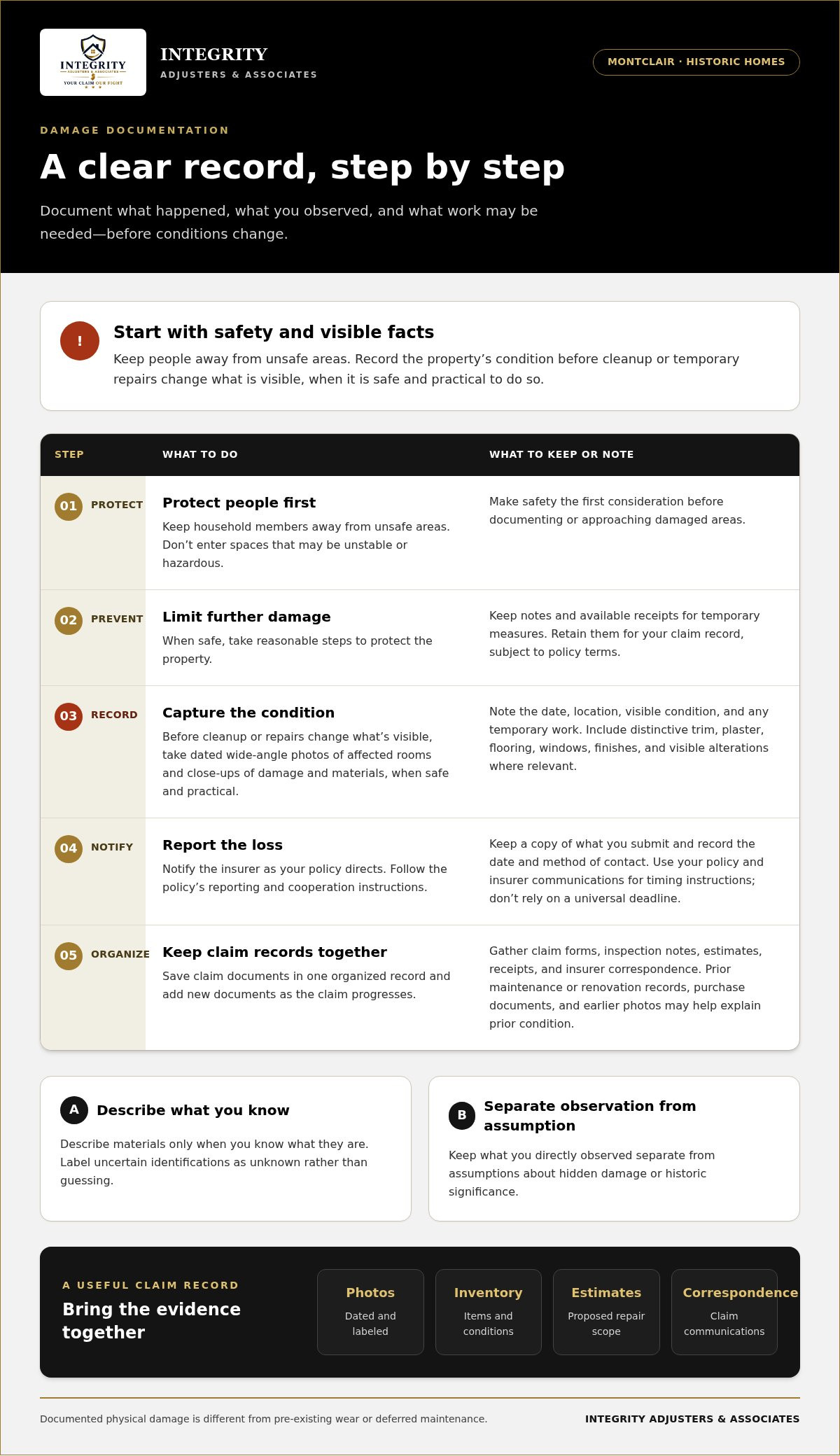
Follow a clear documentation sequence
- Protect people. Keep household members away from unsafe areas. Don’t enter spaces that may be unstable or hazardous.
- Prevent further damage. When safe, take reasonable steps to protect the property. Keep notes and receipts for temporary measures, and retain them for your claim record, subject to policy terms.
- Record conditions. Before cleanup or repairs change what’s visible, take dated wide-angle photos of affected rooms and close-ups of damage and materials, when safe and practical. Note the date, location, visible condition, and any temporary work.
- Notify the insurer. Report the loss as your policy directs. Keep a copy of what you submit and record the date and method of contact.
- Organize records. Save claim forms, inspection notes, estimates, receipts, and insurer correspondence together. Add new documents as the claim progresses.
A useful claim record brings together the policy, dated photos, inventories, estimates, and correspondence.
Photograph materials and preserve useful records
Capture the overall room as well as close views that show the affected area in context. Describe materials only when you know what they are. Label uncertain identifications as unknown rather than guessing. Include distinctive finishes, trim, flooring, and visible alterations where relevant. If temporary work changes the condition, record what was done and when, and keep available receipts.
Gather records that may help explain the home’s prior condition, such as maintenance or renovation documents, purchase documents, and earlier photographs. Keep what you directly observed separate from assumptions about hidden damage or historic significance. For general information about preservation programs and resources, consult the New Jersey Historic Preservation Office.
Compare the documented conditions with the insurer’s repair scope. If water caused the loss, the residential water damage claim guide offers additional claim-specific guidance. Integrity Adjusters & Associates helps residential property owners document damage and prepare comprehensive claims, including water damage claims.
How to Review a Historic-Home Insurance Estimate and Spot Scope Gaps
For a Montclair NJ historic home insurance claim, review the estimate line by line against the damage you recorded. The total won’t show whether the estimate accounts for each affected room, the right quantities, the materials involved, or the labor described. A mismatch is a reason to seek clarification, not proof by itself that the insurer has underpaid the claim.
An estimate review compares documented damage and proposed scope, not totals alone. Use a simple comparison to organize questions and connect each concern to evidence.
| Observed damage | Insurer estimate line | Supporting evidence | Question to resolve |
|---|---|---|---|
| Ceiling damage in a specific room | Listed repair, if any | Dated photos and inspection notes | Does the line address the documented area and work? |
| Damaged flooring or trim | Material and quantity shown | Close-up photos and room measurements, if available | Do the description and quantity match what was observed? |
| Related damage needing further review | Not listed or scope unclear | Notes identifying the location and reason for follow-up | What additional inspection or documentation is needed? |
Compare the scope with documented conditions
Match each estimate item to its location in the home and to the relevant photos or inspection notes. Check that the rooms, quantities, material descriptions, and labor scope correspond with the visible damage. For example, if the estimate describes work in one room but your records show damage in an adjoining area, identify the locations separately and ask whether the related area was evaluated.
Keep confirmed damage distinct from concerns that still need inspection or supporting records. For anything unclear, note the estimate page or line, explain the specific difference, and request a written explanation. This keeps the discussion factual and makes follow-up easier to track.
Review material and code-related questions carefully
Record the existing material and the replacement described in the estimate. Don’t assume the policy pays for an identical match or a preferred restoration method. Instead, ask how the policy addresses matching, repair methods, and any applicable ordinance-or-law coverage.
Code-related work depends on the policy’s provisions and verified requirements that apply to the repair. A code requirement alone doesn’t establish that the expense is covered. Likewise, don’t describe a home as formally historic unless its designation has been verified. Tie each estimate question to the observed damage, available documentation, and relevant policy wording.
What Montclair Homeowners Should Do Next: When a Township Claim Is Different
Once you’ve documented the damage and reviewed the estimate, keep the insurance process moving with a short, consistent routine. For a Montclair NJ historic home insurance claim, the route depends in part on who you believe is responsible for the loss: your homeowners policy or a government entity. These are separate claims with different procedures.
Keep the homeowners-policy claim organized
- Review the policy. Locate the provisions for reporting a loss, submitting any proof of loss, and cooperating with the insurer’s investigation.
- Follow the reporting instructions. Use the method and requirements described in your policy and claim communications. Don’t assume a deadline that applies to one claim applies to every claim.
- Preserve the evidence. Keep photos, receipts, estimates, and other records together. Add new documents as repairs, inspections, or discussions reveal information about the loss.
- Track each communication. Record the date of calls, inspections, document submissions, and written decisions. Note who you spoke with and what follow-up was requested.
A dated log helps you see what has been submitted, what remains outstanding, and which questions need an answer. Keep copies of anything you send, along with the insurer’s responses. If storm damage is part of the loss, the residential storm damage claim guide provides additional context for organizing that type of claim.
Separate private insurance from a Township claim
A homeowners-policy claim asks the insurer to evaluate damage under the terms of your policy. A claim against the Township is a separate process involving an allegation that the municipality is responsible for the damage. Contacting your insurer does not, by itself, establish that you have filed a municipal claim, and municipal procedures should not be applied automatically to a private insurance claim.
If you believe the Township may be responsible, consult Montclair’s current official Notice of Claim instructions for the applicable process. Municipal requirements and deadlines can depend on the circumstances and current rules. For questions about liability, required notice, or a legal deadline, seek advice from a qualified attorney. Keep that inquiry distinct from your insurer’s reporting and cooperation requirements.
Integrity Adjusters & Associates helps residential property owners organize claim records, review estimate questions, and present a comprehensive insurance claim. Clear documentation helps keep the insurance process focused on the evidence.
How Public Adjuster Advocacy Can Support a Montclair Historic-Home Claim
A public adjuster works on the policyholder’s side of a property claim. For a Montclair NJ historic home insurance claim, that can mean organizing damage records, assembling a comprehensive claim, reviewing the documented loss, and presenting claim information through the insurer’s process. The role is to help clarify what the evidence shows and support the policyholder’s claim presentation, not to guarantee coverage or a particular settlement.
When claim documentation or scope review needs added support
Additional advocacy may be useful when damage affects several rooms, records have accumulated across inspections and repairs, or estimate questions remain unresolved. Organized evidence connects each reported condition to photographs, notes, estimates, and other supporting documents. It can also make specific questions easier to explain, such as whether a listed repair addresses the observed area or whether a material description reflects what was damaged.
Not every claim needs representation, and advocacy cannot promise a higher settlement. Coverage depends on the policy and the facts of the loss. The practical value is a more structured claim file and a clear presentation of the policyholder’s documented damage.
How Integrity Adjusters & Associates helps policyholders move forward
Integrity Adjusters & Associates supports residential property claims by helping policyholders document damage and prepare a comprehensive claim. The firm organizes evidence, navigates the insurer’s process on the policyholder’s behalf, and advocates for a fair settlement based on the claim presented.
This work is distinct from legal representation, insurance sales, and physical repair. A public adjuster supports the policyholder’s insurance claim; the insurer evaluates it under the policy, while legal questions and physical restoration are separate matters. The focus stays on the loss, the available documentation, and the claim process.
If the evidence, scope, or insurer discussions feel difficult to manage, discuss your property insurance claim with Integrity Adjusters & Associates.
Move Your Claim Forward With a Clear Record
A well-documented Montclair NJ historic home insurance claim is grounded in evidence of the damage, the circumstances of the loss, and the repair scope. Preserve dated records, compare the insurer’s estimate with observed conditions, and follow the reporting and cooperation requirements in your policy. If the issue involves possible Township responsibility, keep that process separate from your homeowners-policy claim and verify the applicable official instructions.
Integrity Adjusters & Associates supports residential and commercial property claims by helping policyholders document damage, prepare comprehensive claims, and navigate the insurer’s process. Advocacy can help present the documented loss clearly, without guaranteeing coverage or a particular settlement.
If evidence, estimate questions, or claim communications feel difficult to manage, discuss your property insurance claim with Integrity Adjusters & Associates. A clear next step can make a complex process more manageable. Your records and a steady plan are a practical place to begin.
Frequently Asked Questions
Does a historic home qualify for a different homeowners insurance claim process?
Not automatically. The policy terms and documented cause of damage guide how a homeowners claim is evaluated. A home’s age or historic character alone doesn’t establish coverage or create a separate insurance claim process. For a Montclair NJ historic home insurance claim, review your policy’s reporting and cooperation requirements, and document the actual damage and repair scope. If exterior work may be subject to preservation rules, verify whether the property has a formal historic designation.
How do I document damage to an older Montclair home for insurance?
Start by making sure it’s safe to document the affected areas. When practical, take dated wide-angle and close-up photos before cleanup or repairs change visible conditions. Note the affected rooms, visible damage, existing materials, and any temporary work. Identify materials only if you know what they are. Keep receipts for temporary measures, along with available maintenance or renovation records, then report the loss according to your policy’s instructions.
Can an insurer require modern materials instead of matching historic features?
Whether matching materials or a particular repair method is covered depends on your policy and the facts of the loss. Don’t assume identical replacement or a preferred restoration method is included. Compare the existing material with the estimate’s proposed replacement, then ask how the policy addresses matching and any applicable ordinance-or-law coverage. If the property has a verified historic designation, check separately whether local preservation requirements affect proposed exterior work.
What if the insurance estimate leaves out damage to my historic home?
Compare the estimate with your photos, inspection notes, and the affected locations before drawing conclusions. Identify the specific room, item, quantity, or repair scope that seems unclear or absent, and ask the insurer for written clarification. Provide supporting documentation or request further evaluation if damage needs inspection. A difference between your records and the estimate deserves review, but an apparent omission alone doesn’t prove underpayment or establish coverage.
Is a claim against the Township of Montclair the same as a homeowners insurance claim?
No. A homeowners claim asks your insurer to evaluate damage under your policy. A claim against the Township involves an allegation that the municipality is responsible and follows a separate process. In New Jersey, claims against government entities generally have formal notice requirements, so consult Montclair’s current official Notice of Claim instructions and seek legal advice promptly about liability or deadlines. Don’t apply municipal notice requirements automatically to a private insurance claim.
Can a public adjuster help with a historic-home insurance claim?
Yes. A public adjuster can assist the policyholder with documenting property damage, assembling a comprehensive claim, and navigating the insurer’s process. That support can be useful when records are extensive or estimate questions remain unresolved. It doesn’t guarantee coverage or a particular settlement. Public-adjusting advocacy is distinct from legal representation, insurance sales, and physical repairs. The insurer still evaluates the claim under the policy and the facts presented.
What should I do first after discovering damage to my Montclair home?
Protect people first and avoid unsafe areas. If it’s safe, take reasonable steps to prevent further damage, then photograph and note visible conditions before temporary work changes them. Contact your insurer according to the policy’s reporting instructions, and keep copies of your messages, photos, receipts, and claim documents. Don’t assume one deadline applies to every policy. Follow the specific reporting and cooperation requirements in your policy and claim communications.


