

The flames may stop at the stove. The damage may not. Smoke and soot can spread into adjoining rooms or HVAC systems, while water used to extinguish the fire can affect floors, walls, and belongings. If you’re looking for kitchen fire insurance claim help, document the full loss, not just what appears burned.
It’s natural to focus first on damaged cabinets, appliances, or the cooking area, especially while making the home safe. But smoke residue, affected contents, and damage in nearby rooms can be overlooked. Cleanup can also remove evidence before it has been recorded.
This guide explains what to do first, how to record damage, and how to organize documents as the insurer investigates and asks questions. You’ll also learn how to compare your records with an estimate and when public-adjusting advocacy from Integrity Adjusters & Associates may help document the loss and communicate it clearly. The goal is a fact-based claim that accounts for damage beyond the flames.
Key Takeaways
- Put life safety first, then report the fire loss and preserve evidence before items are discarded or changed.
- Record direct flame, heat, and smoke effects separately. Note the affected rooms, surfaces, appliances, and belongings.
- Compare your observations and damage records with the insurer’s estimate. A small fire does not establish the full scope of loss.
- Use a claim file to organize an incident log, dated photos, receipts, inventory records, and insurer communications.
- When damage records are complex or the scope is disputed, claim advocacy can help prepare the documented loss and manage insurer communications.
Kitchen fire insurance claim help in New Jersey: protect people, property, and evidence
A kitchen fire can leave you dealing with urgent safety concerns and difficult questions at the same time. Start with people, not paperwork. Follow fire-department instructions, and don’t re-enter the home until emergency responders say it’s safe. After immediate hazards are addressed, notify your insurer and begin preserving what you can safely document.
These first steps create a clearer record without requiring you to determine the cause or scope of damage on the spot. A kitchen fire insurance claim should be based on observed facts and the applicable policy, not assumptions that every fire-related loss is covered.
For background on how grease buildup in exhaust systems relates to fire prevention, see Kitchen Exhaust Cleaning. Prevention information does not establish the cause of a particular fire or determine insurance coverage.
To hear general homeowner guidance on kitchen fire claims, watch this video:
What to do before starting claim documentation
Keep initial actions focused on safety and preventing additional damage. Don’t touch unstable structures, damaged wiring, or contaminated materials. If responders or other qualified personnel advise a temporary protective measure, follow their direction and keep records of related expenses. Temporary protection is not the same as permanent repair, and neither step determines the final claim scope.
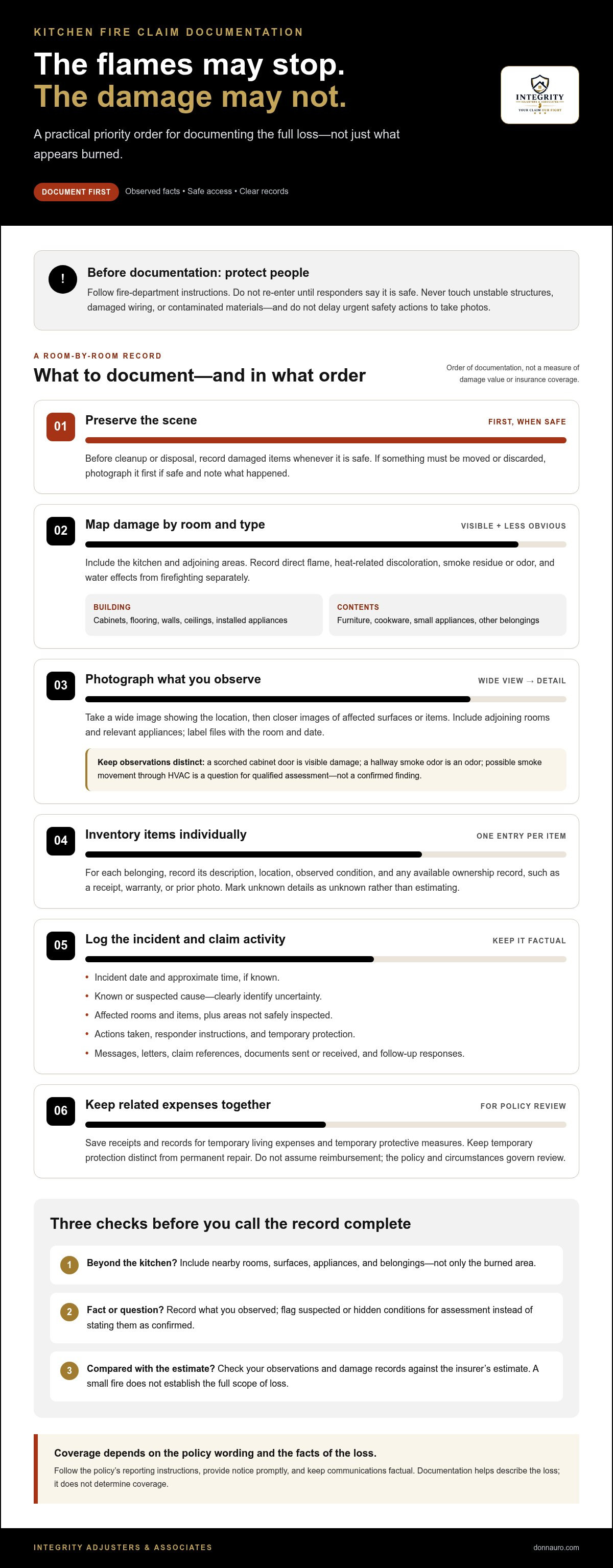
Once access is safe, preserve the scene as much as practical. Avoid discarding fire-damaged items before recording them, unless safety requires their removal. If something must be moved or disposed of, photograph it first when safe and note what happened. Don’t delay urgent safety actions to take pictures.
How to make an initial report without guessing
Give the insurer a concise account based on what you know. If the cause is uncertain, say so. Separate confirmed observations from questions that still need investigation.
- Record the incident date and approximate time, if known.
- Describe the known or suspected cause without presenting a guess as fact.
- List the rooms and items you’ve observed as affected, and note any areas you haven’t been able to inspect safely.
- Summarize steps already taken, including instructions from emergency responders and temporary protective actions.
- Keep copies of messages, letters, claim references, and documents you send or receive. Note follow-up requests and when you respond.
Review your policy’s reporting instructions and provide notice promptly in the manner it describes. Coverage depends on the policy wording and the facts of the loss. Keep communications factual, ask for clarification when a request is unclear, and avoid agreeing to a damage assessment before the affected areas have been documented. In New Jersey, Integrity Adjusters & Associates helps homeowners document residential fire losses, prepare a comprehensive claim, and navigate insurer communications.
Kitchen fire damage can extend beyond the burned cabinets
A burned cabinet or scorched cooktop is easy to identify. Other conditions may be less obvious. Heat can leave discoloration or affect nearby materials, while smoke residue or odor may be noticeable in rooms beyond the kitchen. Record and assess these as observations, not automatic coverage categories. The policy terms and facts of the loss determine how the insurer reviews each item.
Visible burn marks alone may not describe the full documented loss. Record each observed condition and location so the damage can be assessed as a whole.
How to record smoke, heat, and related property damage
Make a room-by-room record, separating what you can see from what you smell or suspect. For example, note a scorched cabinet door as visible damage, a smoke odor in the hallway as an odor, and a dark film on a nearby surface as residue. Describe heat-related discoloration separately. If you haven’t observed a condition, don’t label an item damaged. Instead, note that it may need assessment.
When it’s safe and practical, photograph each area before cleanup. Take a wide view to show where the damage is, then closer images of individual surfaces or items. Include adjoining rooms and relevant appliances, and label files with the room and date. Don’t put yourself at risk to reach a location or handle debris. Some conditions, such as possible smoke movement through an HVAC system or damage inside a wall, may not be reliably evaluated by a homeowner. Record them as questions for a qualified assessment rather than stating them as confirmed loss.
How to organize damaged contents and household areas
A structured inventory helps distinguish building components from personal belongings and other expenses. Use a separate entry for each item when possible. Include its description, location, observed condition, and any available ownership record, such as a receipt, warranty, or prior photograph. If you don’t know an item’s age or purchase details, mark that information as unknown instead of estimating.
- Building components: List affected cabinets, flooring, walls, ceilings, and installed appliances by room and observed condition.
- Personal belongings: Record furniture, cookware, small appliances, and other contents individually. Note visible residue, odor, discoloration, or other observed effects.
- Temporary living expenses: Keep related receipts and records together for policy review. Don’t assume reimbursement. The policy and circumstances govern how these expenses are considered.
Keep damaged items in place when practical until they’ve been documented or inspected, but never at the expense of safety. If an item must be removed, photograph it first if safe, record its condition and location, and retain any related paperwork. This creates a traceable record without treating every nearby object as damaged.
Integrity Adjusters & Associates helps New Jersey homeowners organize fire-loss documentation and build a comprehensive claim. If the record spans several rooms or includes conditions that need further assessment, structured kitchen fire insurance claim help can keep observations, supporting records, and insurer communications aligned.
Small kitchen fire, big questions: understand the estimate and policy review
A small flame doesn’t establish the complete extent of damage. The fire may have been contained quickly, but the affected rooms and items still need to be identified and assessed. Keep three records distinct: what you observed, the damage included in the documented scope, and what appears in the insurer’s estimate. They serve different purposes. Differences between them are questions to investigate, not proof of an error.
For example, you may have documented a smoke odor in an adjoining room, while the estimate lists only kitchen surfaces. That creates a scope question: is the observed condition included or addressed? If an item is listed but the proposed amount or repair approach differs from another assessment, that’s a valuation question. A coverage decision is different. It concerns whether the policy applies to a particular loss or item. Don’t treat a scope or valuation disagreement as a final coverage determination.
What to compare when reviewing an insurer’s estimate
Read the estimate line by line and compare it with your records. Check the rooms, building components, appliances, and contents you documented. Look for clear descriptions of the work or items included, and note anything that seems absent, combined, or difficult to match to the observed damage. A difference may have an explanation, so ask a focused question rather than assuming the estimate is wrong.
- Location: Does each listed item identify the room or area where it was observed?
- Description: Does the entry appear to address the condition you recorded, such as residue on a surface or damage to a cabinet component?
- Supporting record: Can you connect the entry or question to a dated photo, inventory item, inspection note, or insurer communication?
Keep a review sheet with separate columns for your observation, the estimate entry, and the question that remains. This makes follow-up more precise. Instead of saying “the estimate is incomplete,” identify the room or item and explain which document supports your question. If the estimate uses terms you don’t understand, request an explanation in writing and keep the response with your claim file.
How policy wording and the fire’s circumstances affect review
Coverage depends on the actual policy, the facts of the event, and the insurer’s review. Cooking circumstances may be part of that fact-gathering. If questions arise about whether cooking was unattended or whether a safety concern contributed to the fire, record what you know and distinguish firsthand knowledge from assumptions. Don’t guess about the cause or make broad conclusions about coverage.
Review the relevant policy language alongside the insurer’s explanation. If a decision cites a particular provision, note the wording and ask how it applies to the facts presented. This keeps kitchen fire insurance claim help grounded in evidence while separating three issues: what was affected, how the estimate values the documented scope, and whether the policy responds. Each requires its own supporting information and careful review.
Build a kitchen fire insurance claim file in clear, practical steps
A clear claim file makes it easier to connect each observation to the records that support it. Keep original documents, organize copies for submission, and update the file as the insurer asks questions or provides an estimate. This process keeps evidence, expenses, and communications together without turning uncertain details into facts.
- Start an incident log. Record the date, known facts about the fire, rooms you’ve observed, and steps taken. Add entries as new information becomes available, identifying what you know firsthand and what remains uncertain.
- Save dated photos and video. Organize images by room and describe what each shows. Keep original files where possible, and add inspection notes or later photos in a separate, dated folder so changes remain traceable.
- Build separate damage records. Maintain one inventory for building components and another for personal belongings. Include descriptions, locations, observed conditions, and available receipts, ownership records, or prior photographs.
- Track expenses and insurer documents. Preserve receipts for reasonable temporary expenses and review the applicable policy terms to understand how those costs may be considered. Save claim forms, letters, emails, estimates, and other insurer communications.
- Review the estimate against the file. Compare its listed rooms, items, and work with your documentation. Record questions about missing descriptions or differences, and link each question to a photo, inventory entry, inspection note, or correspondence.
Create a usable evidence and correspondence file
Use labeled folders for photographs, building damage, contents, expenses, and insurer documents. For each record, note the date, location, what it shows, and who provided it. Keep originals in your own file and submit copies unless an original is specifically requested. Consistent labels, such as a date followed by a room name, help you retrieve evidence quickly and distinguish one area from another.
Track questions, inspections, and requested information
Maintain a timeline of calls, appointments, inspections, requests, submissions, and responses. Note who you spoke with and what follow-up was requested. If an estimate entry or document request is unclear, ask for an explanation in writing and save the response. State observed facts plainly. Avoid speculation about the fire’s cause, the necessary repair scope, or whether a specific item is covered.
For additional New Jersey fire-loss context, the New Jersey fire-damage public-adjuster guide discusses documenting and organizing a fire claim. A well-kept file also helps public-adjusting advocacy communicate the documented loss and manage insurer correspondence. Get help organizing your kitchen fire claim when the records or estimate review become difficult to manage.
When kitchen fire claim advocacy can help you move forward
Some kitchen fire claims are difficult to manage because documentation spans several rooms, the estimate doesn’t appear to address every recorded condition, or the insurer continues requesting information that’s hard to organize. Advocacy may help when you need support connecting observations and records to a comprehensive claim or responding to questions about the documented scope.
These challenges don’t automatically mean the insurer has made an error or that a particular item is covered. They do point to the value of a clear record and careful communication. Integrity Adjusters & Associates provides public-adjusting advocacy for residential fire losses in New Jersey, helping homeowners document damage, prepare a comprehensive claim, and navigate insurer communications. That support can bring structure to a process that feels difficult to manage.
What public-adjusting advocacy does in a residential fire claim
Public-adjusting advocacy focuses on the property claim. It involves organizing evidence of the loss, preparing claim documentation, and supporting communication with the insurer through its review process. For a kitchen fire, that may mean bringing together records about observed conditions, affected building components, personal belongings, and insurer questions so the reported loss is clearly presented.
The role has limits. Claim advocacy is not legal representation, and it isn’t physical restoration or repair work. It also can’t guarantee that an insurer will cover a particular item or reach a specific settlement. Policy wording and the facts of the loss remain central to the insurer’s review. Kitchen fire insurance claim help is most useful when it keeps the claim grounded in organized evidence and clear communication.
Choose a clear next step after a kitchen fire
You don’t need a perfect file before seeking guidance. Gather what’s available, then identify what’s missing. A useful starting packet can include:
- Your policy documents and claim reference information.
- Photos, videos, and notes about affected areas or belongings.
- An inventory and available ownership records, such as receipts.
- The insurer’s estimate, letters, emails, and requests for information.
- A brief timeline of inspections, conversations, and actions taken.
Keep the original records and organize questions separately from confirmed observations. This gives an advocate a practical starting point to understand the claim, identify documentation needs, and communicate the recorded loss. If you’re ready to discuss residential fire-loss claim support, Integrity Adjusters & Associates can help you assess the documentation and insurer process. Talk with Integrity Adjusters & Associates about the next step for your kitchen fire claim.
Take the next step with a clear claim strategy
A kitchen fire can leave uncertainty even after the immediate danger has passed. You don’t have to resolve every question at once. Focus on what remains unclear, identify the records you have, and decide what support would help move the claim forward. That may mean organizing unanswered estimate questions or getting help presenting a complex loss.
For New Jersey homeowners, kitchen fire insurance claim help from Integrity Adjusters & Associates can bring structure to that next stage. The firm supports residential fire-loss claims through damage documentation, comprehensive claim preparation, and advocacy as you communicate with the insurer. Claim advocacy doesn’t guarantee coverage or a particular settlement, but it can help you present the documented loss clearly.
Talk with Integrity Adjusters & Associates about your kitchen fire claim and discuss a practical path forward. With support organizing the loss and insurer communications, you can approach the process with greater clarity.
Frequently Asked Questions
Is a kitchen fire covered by homeowners insurance?
A kitchen fire may be covered, but coverage depends on the policy language and the facts of the loss. Policies can differ in covered causes, exclusions, limits, and deductibles, so the type of fire alone doesn’t determine the outcome. Review the policy provisions cited by the insurer and compare them with the circumstances described in the claim. New Jersey homeowners should base their understanding on their own policy, not a general promise of coverage.
Can an insurer deny a kitchen fire claim because cooking was left unattended?
Not automatically. The insurer may examine how the fire started and whether relevant policy wording applies, but unattended cooking by itself doesn’t establish the claim outcome. Give a factual account of what you know, and distinguish firsthand information from what someone else reported. If the insurer raises unattended cooking as a concern, ask which policy provision and specific facts inform its position, then keep that explanation with your claim records.
What happens if there is smoke damage but no visible flame damage?
Smoke-related damage may still be considered even if flames didn’t visibly burn the affected area, but the policy and claim facts determine the review. Describe the specific condition, such as residue on a nearby room’s painted surface or a persistent odor in a fabric item, rather than labeling an entire room damaged. Note when and where you observed it, and ask how the insurer wants the condition assessed.
Can I clean my kitchen before the insurance inspection?
You may need to address an urgent hazard or prevent further damage before an inspection, but avoid broad cleanup that could remove useful evidence if it’s safe to wait. Photograph affected areas first when practical, and record what you clean, move, or discard. Don’t delay a safety measure to preserve evidence. If the insurer has scheduled an inspection, ask whether planned cleaning or disposal could affect its review.
Does homeowners insurance cover temporary housing after a kitchen fire?
Temporary housing may be covered under some policies if the home can’t be occupied, but the policy’s terms and the circumstances control. Look for language addressing additional living expenses or loss of use, and ask the insurer how it evaluates eligibility and what records it needs. Keep documents showing why you had to stay elsewhere and the dates involved. Don’t assume every related expense is reimbursable.
How much does it cost to hire a public adjuster for a kitchen fire claim?
The cost depends on the public adjuster’s fee agreement, so there isn’t one figure that applies to every kitchen fire claim. Before engaging an adjuster, review the written agreement carefully. Make sure you understand how compensation is calculated, what claim-support work it covers, and any terms that apply if the engagement ends. Integrity Adjusters & Associates provides public-adjusting advocacy for residential fire-loss claims in New Jersey.
How long do I have to report a kitchen fire insurance claim in New Jersey?
There isn’t one reporting period that applies to every New Jersey homeowners policy. Check your policy’s notice instructions and report the fire promptly rather than waiting for a complete damage assessment. If you’ve already delayed, notify the insurer as soon as possible, provide the incident date, and explain the reason for the delay accurately. Keep a record of when and how you gave notice.


