

A storm claim can turn on the evidence you collect once it’s safe to do so. If you’re unsure what to photograph, concerned hidden damage may be overlooked, or trying to keep a reliable record, start with a clear, dated account. That record is the foundation for documenting storm damage for insurance NJ policyholders may need to support a claim.
This guide explains what to record before, during, and after an insurance inspection. You’ll learn how to photograph damage safely, organize images and receipts, note affected rooms and belongings, and track temporary protective measures. You’ll also see how to document changes over time so your records tell a clear, consistent story of the loss.
When damage is extensive or records are difficult to organize, professional claim documentation support can help bring the evidence together. Integrity Adjusters & Associates helps residential and commercial property owners document storm losses and navigate the insurer process. Start with what you observed, preserve what you can safely, and keep a record from discovery through the inspection.
Key Takeaways
- Build a dated record of observed damage and related events to keep your claim history clear and organized.
- Photograph safely in sequence: establish a baseline, take wide views, then capture close-up details with location labels.
- Pair images with concise notes. Separate what you directly observed from what you think may have caused the damage.
- Use a chronological checklist to prepare for the inspection, and follow your policy and insurer’s instructions for notice and documentation.
- Documenting storm damage for insurance NJ claims can feel complex when records are scattered. Public-adjusting support can help organize and present the loss.
Why careful storm damage documentation matters for New Jersey insurance claims
Storm damage documentation is an organized record of observed property loss and related events. It can include photographs, written notes, receipts for temporary protective measures, and a timeline of discovery and communications. A clear record shows the property’s condition after the storm and how it changes. It also gives you a consistent reference as you move through the insurance claim process.
Begin recording damage as soon as it’s safe. Details can become harder to recall later, such as which room first showed water, where debris landed, or when a ceiling stain appeared. Keep your notes factual. A damaged shingle after high winds is an observation; concluding that it caused a particular interior leak is an assumption unless the connection has been assessed. Record what you see without deciding whether the policy covers it.
Storm effects vary across New Jersey. Coastal communities may face storm surge, wind, and wind-driven rain, while inland areas can experience strong winds, hail, heavy rainfall, or falling trees. Record the conditions and resulting damage you actually observe. Wind, hail, rain entering through an opening, and rising water are distinct observations, not automatic conclusions about coverage. Policy terms and the circumstances of the loss determine how damage is considered.
Which storm-related property damage should you record?
Record visible damage to the roof, siding, windows, fences, and exterior structural elements. Indoors, note damage to ceilings, walls, floors, and belongings, as well as visible signs of water entry. Record detached structures, such as a shed or garage, separately so their condition isn’t confused with the main residence.
- Identify the affected location and describe what you see, such as a broken window or water staining in a specific room.
- List damaged belongings individually when practical. Keep related purchase or repair records if available.
- Note fallen trees or branches and the areas where they appear to have made contact. Don’t enter unsafe locations to investigate.
Why does a New Jersey storm record need dates and context?
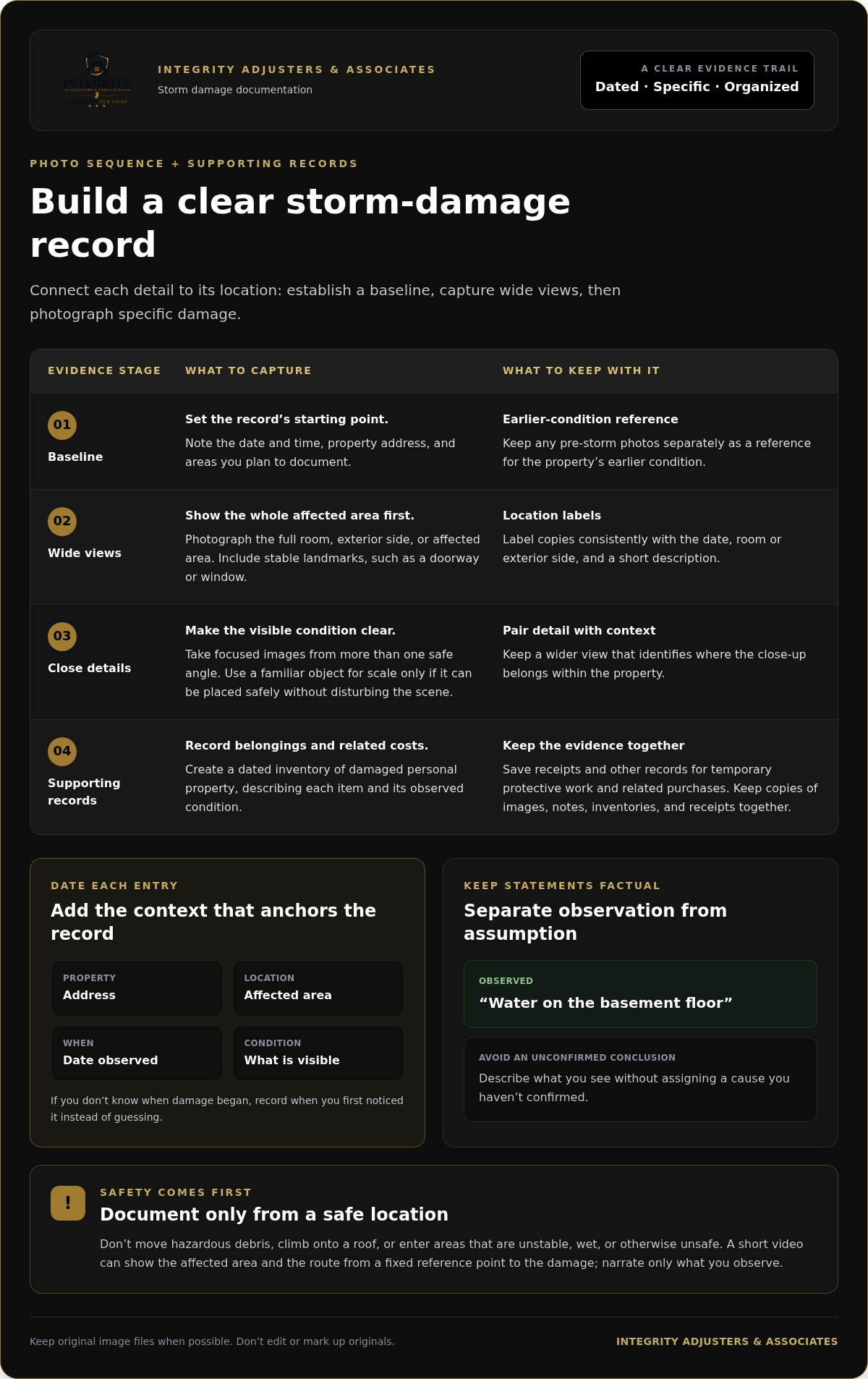
Dates connect the storm, your discovery of damage, changes in its condition, and communications with your insurer. For each entry, include the property address, affected area, date observed, and visible condition. If you don’t know when the damage began, record when you first noticed it instead of guessing.
A storm damage evidence trail is a dated, organized record connecting observed property conditions with the events and communications surrounding a loss. This context can help distinguish what was present initially from what appeared later. When documenting storm damage for insurance NJ policyholders should keep descriptions specific and be clear about uncertainty. Write “water on the basement floor” rather than assigning a cause you haven’t confirmed. A careful record won’t decide coverage, but it can make the reported loss and its history easier to understand.
How to photograph and record storm damage for insurance
A useful photo set does more than show a close-up of a cracked window or ceiling stain. It connects each detail to its location and captures the surrounding condition, so someone reviewing the record can understand where the damage is and how it fits into the property. For documenting storm damage for insurance NJ policyholders can use a simple sequence: establish a baseline, take wide views, then photograph specific damage.
- Establish a baseline. Note the date and time, property address, and areas you plan to document. If you have pre-storm photos, keep them separately as a reference for the property’s earlier condition.
- Capture wide views. Photograph the full room, exterior side, or affected area first. Include stable landmarks, such as a doorway or window, to show where the damage is located.
- Record close details. Take focused images from more than one angle. Add a familiar object for scale only if it can be placed safely without disturbing the scene.
Pair close-up details with a wider view that identifies the location. The detail shows the condition, while the context shows where it belongs within the property. Keep original image files when possible. Label copies consistently, for example with the date, room or exterior side, and a short description. Don’t edit or mark up original files. If you need to clarify an image, make a separate copy and retain the unaltered version.
What should storm damage photos and videos show?
Photograph visible damage from several safe angles. Don’t move hazardous debris, climb onto a roof, or enter areas that are unstable, wet, or otherwise unsafe. A short video can show the affected area and the route from a fixed reference point to the damage. Narrate only what you observe, such as the room and visible condition, rather than guessing at the cause.
What records should accompany photos?
Photos are more useful as part of a complete record. Save receipts and other records for temporary protective work and related purchases. Create a dated inventory of damaged personal property, describing each item and its observed condition. Keep National Weather Service alerts with your files as general context for storm conditions, not as proof that a specific property was damaged.
Store copies of images, notes, inventories, and receipts together in a clearly named digital folder, with a backup in a separate location. Keep insurer messages and claim-related documents in the same timeline or a clearly linked folder. This makes it easier to retrieve the right record when questions arise. Public-adjusting claim documentation support can help organize storm-loss records and present them as part of a comprehensive claim.
How to make storm damage evidence clear and credible
Evidence is easier to assess when each record answers three questions: when was it created, where was the damage, and what does it show? A dated photo labeled “March 14, upstairs hallway, ceiling stain” gives useful context. A set of unlabeled images may show damage, but without dates, locations, or descriptions, it can be difficult to connect each image to a specific part of the property.
Keep observations separate from conclusions. Write “water staining visible below the north-facing window” rather than “wind-driven rain caused the leak” unless that cause has been established. You can note what happened during the storm, but make clear which details you observed and which are possibilities. Weather alerts or reports can support the broader storm context; they don’t establish that a particular property sustained damage. Coverage depends on the individual policy and the facts of the claim.
How do you organize evidence for an insurer review?
Use a consistent folder structure, such as folders by date and subfolders by location or damage category. Keep original image files unchanged, and save working copies if you need to add labels or notes. Store insurer correspondence and receipts with the claim records, or in clearly linked folders, so you can find each document without altering the originals.
A simple log connects records to the property. Include the date, room or exterior area, image filename, brief description, and any related receipt or communication. For example, an entry could link a dated living-room ceiling photo to a note describing a change in the visible stain. Don’t rely on memory to explain a photo weeks later.
- Group records by date, location, and damage category.
- Use clear filenames that match entries in your log.
- Keep original photos, relevant correspondence, and receipts.
- Add a dated note when visible conditions change, and preserve earlier records for comparison.
What makes a damage record hard to assess?
Undated photos, unclear locations, missing descriptions, and unexplained changes can leave gaps. A close-up without a wider view may not show which room or exterior area it depicts. If a condition changes, create a new dated record rather than editing an earlier photo or replacing it. For documenting storm damage for insurance NJ policyholders benefit from records that show what they observed while clearly labeling assumptions.
Weather records describe storm conditions; property-specific photos and notes show what was observed at the insured location. Keep both kinds of information, but don’t treat a weather alert as proof of damage or as a coverage decision. An organized evidence file supports a clearer account of the loss, while the policy’s terms and the claim’s specific circumstances guide how coverage is evaluated.
A New Jersey storm damage documentation checklist from discovery to inspection
A practical checklist helps keep immediate priorities and claim records in the right order. Protect people first. Don’t delay necessary safety measures or urgent steps to prevent further property damage just to take photos. Document what you safely can, then follow your policy and insurer’s instructions for claim notice and required records. Policies and claim circumstances differ, so use those instructions as your guide.
What to do in the first documentation pass
Once an area is safe to approach, make an initial record of what you found. Note when you discovered the damage, which rooms or exterior areas are affected, and what you can see. If conditions allow, photograph accessible damage before moving items. Don’t enter an unsafe area or disturb hazardous debris for the sake of a complete record.
- Prioritize safety. Keep clear of downed wires, unstable structures, standing water near electrical hazards, and other unsafe conditions. Take protective action as needed, even if you haven’t documented the area first.
- Record what you observe. Write down when you discovered the damage and where it appears. Describe visible conditions plainly, without guessing at the cause.
- Document accessible areas. Take overview and detail photographs where safe and practical. If you can’t photograph an area safely, note why and don’t enter it.
- Track protective actions. Record what was done to protect the property and when. Keep receipts and other records related to purchases or work.
- Report and retain instructions. Follow your policy and insurer’s directions for notice and claim documentation. Save messages, claim references, and any instructions you receive.
For broader claim context, the residential storm damage claim guide explains how storm-related records fit into a property claim. Keep your own notes grounded in what you observed; general storm information isn’t a substitute for documenting your property.
How to prepare an organized inspection handoff
Before the inspection, arrange your records so you can find them quickly. Use clearly named folders for photos, damaged-item lists, receipts, and insurer correspondence. Prepare a short timeline that identifies the storm date if known, when you discovered damage, any visible changes, and key communications. List questions about areas that remain unclear rather than filling gaps with assumptions.
- Sort photos by date and affected area, and keep original files.
- Group receipts with notes about the related protective action or purchase.
- Keep a dated inventory of damaged belongings and their observed condition.
- Review your policy and insurer instructions so your handoff follows the requested process.
If water entered the home, the residential water damage claim support guide offers related claim context. When records are difficult to bring together, support organizing storm claim documentation can help prepare a clear account of the loss.
When New Jersey storm claim documentation may benefit from public adjusting support
A storm claim can involve several damaged areas and different kinds of records. Roof damage, interior water staining, damaged belongings, and temporary protective work may all need to be accounted for. If photos are scattered, descriptions are unclear, or the record doesn’t tell a complete story, support with organizing the claim documentation can help.
Public adjusters represent policyholders in the insurance claim process. They assist with documenting losses, organizing claim information, and presenting the claim to the insurer. Integrity Adjusters & Associates provides public-adjusting advocacy for residential and commercial property claims, including storm-loss documentation and comprehensive claim preparation. The firm helps bring relevant observations, records, and communications into a clearer presentation. This support doesn’t guarantee coverage, a particular settlement amount, or a specific claim outcome.
What can public-adjusting advocacy contribute to documentation?
Support can be useful when a loss spans multiple rooms, exterior areas, or structures, or when records have accumulated in different places. A public adjuster can help organize observed damage into a comprehensive claim presentation and assist the policyholder in navigating insurer communications. The work focuses on documenting and presenting the loss, not promising how the insurer will decide the claim.
A more complete file can connect each affected area with relevant photographs, inventories, receipts, notes, and claim correspondence. The goal is a coherent account that shows what was observed and how the records relate to one another. If an item or cause remains uncertain, keep that uncertainty clear rather than presenting it as established fact.
How can you decide whether to seek claim support?
Review your records area by area. Can you identify each affected part of the property? Do your images and notes describe what you observed, and can you locate related correspondence or receipts? Make a short list of unresolved questions, such as a damage location without a description or a change missing from the timeline. These gaps can clarify what documentation support would be useful.
- Note which areas or belongings are included in your current record.
- Identify missing dates, unclear descriptions, or records you can’t readily locate.
- Separate confirmed observations from questions about cause or coverage.
Documenting storm damage for insurance NJ policyholders can feel difficult when evidence is incomplete or a claim involves several affected areas. Public-adjusting advocacy helps organize loss documentation and navigate the insurer process while keeping the facts central. Learn about support for your storm damage claim.
Move forward with a clearer claim record
Your documentation doesn’t need to be perfect before you take the next step. Keep adding dated observations as new information becomes available, and note questions you can’t resolve from the evidence you have. A short list of open items can make the next claim conversation more focused and help ensure uncertainties aren’t mistaken for facts.
Careful documenting storm damage for insurance NJ policyholders can support a clearer account of a property loss, but organizing complex records alone can be difficult. Integrity Adjusters & Associates assists with claim documentation and policyholder advocacy through the insurer process. If you’d like support assessing how your records fit together, discuss your storm damage claim with Integrity Adjusters & Associates.
Take it one step at a time. A well-organized record gives you a practical foundation for the conversations ahead.
Frequently Asked Questions
Can I throw away storm-damaged belongings before the insurer inspects them?
Usually, preserve damaged belongings until you’ve photographed and listed them and followed your insurer’s instructions. If an item creates a health or safety risk, don’t keep it in place just to preserve evidence. Take clear photos, note why it had to be removed, and keep receipts or other records related to disposal or replacement. If possible, contact your insurer for direction before discarding items that aren’t an immediate hazard.
How can I document roof damage if I cannot safely get close to it?
Stay on the ground. Use photos from a safe spot and, if available, a camera’s zoom to capture visible areas without climbing a ladder or walking on the roof. Photograph the roof from different sides of the property, and record any related interior signs, such as a new ceiling stain. Note which roof areas aren’t visible from the ground. Don’t enter an unsafe area to improve a photo.
Does homeowners insurance cover flooding caused by a storm in New Jersey?
Standard homeowners insurance generally doesn’t cover damage caused by flooding from rising water; flood damage is typically covered through a separate flood insurance policy. Coverage depends on the policy and the facts of the loss, so don’t assume all water damage is treated the same. For example, rain entering through a storm-damaged roof may be considered differently from water that rises and enters a basement. Review your policy and ask your insurer how to report each type of damage.
What should I do if storm damage appears days after the storm?
Report newly discovered damage to your insurer as soon as you can, following the notice instructions in your policy. Record the date you first noticed it, where it appeared, and what changed. For example, note if a ceiling mark grew or a previously dry room developed a musty odor. Don’t claim to know when damage began if you’re unsure. Documenting storm damage for insurance NJ claims should reflect when you observed each condition, not guessed dates.
Can a New Jersey weather report prove that my home was damaged?
No. A weather report can provide context about conditions in your area, such as a storm or hail, but it can’t establish that your specific home sustained damage. Pair relevant weather information with property-specific records, such as dated photos, inspection notes, or receipts related to the loss. Keep the distinction clear: regional storm data describes the event, while evidence from your property records its observed condition.
Should I keep documenting storm damage after the insurance inspection?
Yes. If you find damage the inspection didn’t address or notice a condition changing afterward, create a dated record and follow your insurer’s instructions for sharing new information. Keep copies of inspection documents and related messages. For example, if a stain spreads or a damaged item’s condition changes, note what you observed and when. Continued records can help clarify the timeline without altering earlier evidence or assuming what caused the change.


