

What if the damage visible after a house fire is only part of the loss? Smoke can affect rooms beyond the flames, belongings may be damaged, and water used to extinguish the fire can create additional concerns. Effective residential fire damage claim help starts with recognizing the full picture and building a clear record of it.
After a fire, it’s understandable to feel unsure what to do first, what to document, and how to respond to the insurance company. Put safety first: don’t re-enter until the fire department says it’s safe. Then notify your insurer, keep claim information together, and document damage before anything is moved, when it’s safe to do so.
This guide explains the next steps, from gathering photos, records, and details about damaged belongings to reviewing the insurer’s estimate and communicating about your claim. You’ll also learn how a public adjuster can advocate for you as the policyholder, organize a comprehensive claim, and help you navigate the insurer’s review. For New Jersey homeowners, a steady, evidence-led approach can bring more clarity to a difficult process.
Key Takeaways
- Put personal safety first, and follow responsible authorities’ directions before re-entering or making utility decisions.
- Organize claim evidence by building damage, personal belongings, and related losses so each part of the fire’s impact has a clear record.
- Compare the insurer’s estimate with your photos, contents inventory, damage records, and submitted documents to identify questions or gaps.
- Keep a dated record of claim notifications, evidence gathered, and estimate reviews; policy deadlines and requirements can vary.
- Residential fire damage claim help from a public adjuster can support policyholders with documenting, preparing, and presenting a comprehensive property claim.
After a residential fire, what should you do first?
A house fire can leave you facing urgent decisions while details are still unclear. Start with people, not paperwork. Follow instructions from fire officials and other responsible safety authorities. Don’t re-enter the home or make decisions about utilities until they say it’s safe. Your first priority is protecting everyone from further harm.
Put safety and temporary needs ahead of claim paperwork
Once you’re safe, address immediate needs such as temporary accommodation or essential supplies. Keep receipts and a simple note explaining each necessary expense. Whether an expense is covered depends on your policy and circumstances, so a checklist alone can’t determine coverage, habitability, or whether an area is safe. Those decisions may require an appropriate assessment.
Urgent protection may also be necessary to prevent further damage. If it’s safe and practical, photograph or record affected areas before items are moved or discarded. When an immediate safety or protection measure can’t wait, keep a record of what was done, when, and why, and preserve relevant receipts or reports. Don’t put yourself at risk to document damage.
Property insurance can involve different risks and policy terms. For general background, see this overview of property insurance and fire-related coverage. It isn’t a substitute for reviewing your own policy.
Notify the insurer and establish a clear record
Notify your insurance company promptly and follow the notice instructions in your policy. Requirements vary, so one timeline or process won’t apply to every homeowner. Ask how the insurer wants the initial information submitted, save a copy of what you send, and note when it was sent.
Keep a single claim record, whether digital or on paper. Start with the fire date and location, the insurer’s contact details, the claim number once assigned, and the names of people you speak with. After each conversation, note the date, who you spoke with, what you discussed, and any next steps. This makes it easier to track communications and connect later documents to the right claim.
Your first report can be brief and factual. Give the known date and basic circumstances, describe the visible impact without guessing at the full extent, and explain that more documentation may follow. You don’t need to calculate the total loss before the damage has been reviewed. Residential fire damage claim help is most useful when the process starts with a clear timeline and accurate records, not rushed estimates or assumptions.
Focus on the next safe, manageable step. Preserve what you can, record what you do, and keep claim communications and temporary-expense records together. That foundation will help you organize detailed damage documentation and review the estimate later.
What should a residential fire damage claim document?
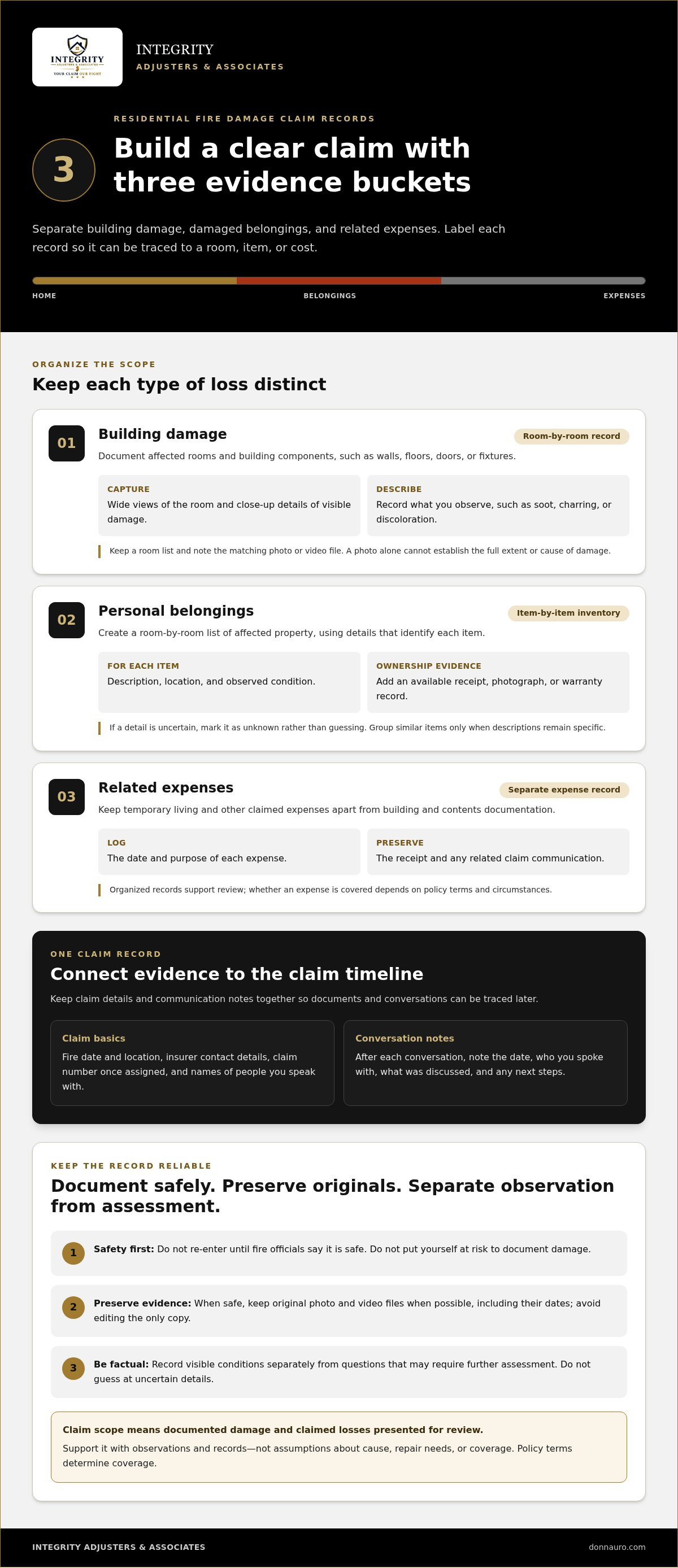
A strong claim record separates damage to the building from damage to belongings and any related expenses. That structure makes it easier to connect evidence to each claimed loss instead of relying on one broad description of “fire damage.” Keep records together and label them so you can trace each photo, item, or receipt to a specific room or category.
A claim scope is the documented damage and claimed losses presented for review, subject to the terms of the insurance policy. It should reflect what you can support with observations and records, not assumptions about cause, repair needs, or coverage.
Record damage to the home and affected areas
When it’s safe to document the property, take photos or videos showing both the overall room and close-up details of visible damage. Preserve original files when possible, including their dates, and avoid editing the only copy. A simple room list helps track what you recorded and which areas still need attention.
Describe what you observe: for example, soot on a wall, visible charring near a doorway, or discoloration on a ceiling. Note the room and building component, such as a wall, floor, door, or fixture. Smoke or soot may be visible beyond the point where flames were present, but a photo alone can’t establish the full extent or cause of damage. Record your observations separately from questions that require further assessment.
Organize belongings and related losses
Build a room-by-room inventory of affected personal property. For each item, record a clear description, its location, its observed condition, and any available proof of ownership, such as a receipt, photograph, or warranty record. If details are uncertain, mark them as unknown rather than guessing. Grouping similar items can help, but keep descriptions specific enough to identify what was affected.
Keep expense records in a separate folder or spreadsheet. For each temporary living or other claimed expense, record the date and purpose, and save the receipt. Coverage depends on policy terms, so organized documentation supports review without deciding coverage by itself.
- Building: room, affected component, visible condition, and photo or video file reference.
- Belongings: item description, location, condition, and available ownership evidence.
- Related expenses: date, purpose, receipt, and any related claim communication.
For local fire-claim context, the Cherry Hill public adjuster for fire damage guide offers a New Jersey-focused perspective. If you want policyholder-side support organizing damage records and preparing a comprehensive residential fire claim, residential fire loss claim support can help bring the documentation into a clear, reviewable record.
How can you assess a residential fire claim estimate?
An insurer’s estimate is a document to review, not an automatic measure of every loss. Compare it with your damage records, contents inventory, photos, and supporting documents. The goal isn’t to assume the estimate is wrong. It’s to identify what matches, what differs, and what needs an explanation.
Compare the estimate against the documented loss
Work through the estimate by room and claim category. Check whether documented rooms, building components, and belongings appear, then compare descriptions and quantities with your records. For example, if your photos and inventory document damaged belongings in a room but you can’t find those items in the estimate, note the specific discrepancy. An omission alone doesn’t establish that the insurer has made a coverage decision.
A comparison table helps turn a long estimate into focused questions:
| Claim category | Homeowner records | Insurer estimate | Open question |
|---|---|---|---|
| Room or building component | Room notes and dated photos | Listed description and quantity | Is this area or item included? |
| Personal property | Inventory, condition notes, available proof | Items and descriptions shown | Does the estimate address each documented item? |
| Related expense | Dated record and receipt | Any related estimate entry | How is this expense being handled? |
For each difference, record the estimate page or line, the relevant evidence, and a concise question. Date the list and update it when you receive a response. This creates a traceable record instead of a general objection that may be difficult to address.
Respond methodically when information is missing
Send focused questions through the insurer’s stated process, attaching the records that support each point. Ask for clarification when an item description, quantity, or estimate entry is unclear. Keep the wording factual: “The attached photo and room record show this area; can you explain how it is reflected in the estimate?” A specific question invites a direct response without alleging underpayment or assuming a coverage decision.
Residential fire damage claim help can include organizing the claim record and presenting documented differences clearly. The same evidence-first approach applies to other property losses; the residential water damage claim support guide discusses shared documentation principles. For policyholder-side assistance preparing and presenting a residential fire claim, residential fire loss claim support can help bring the estimate, records, and open questions into one organized review.
What steps help keep a New Jersey fire claim organized?
A clear claim file helps you see what has been reported, what evidence has been gathered, and which questions still need attention. Build it as the claim progresses rather than trying to reconstruct events later. A dated, organized file connects damage evidence, expenses, and insurer communications.
Use this sequence as a recordkeeping framework, not a substitute for your policy or instructions from safety authorities:
- Record the incident and notice. Note the fire date, when you notified the insurer, how you sent notice, and any claim number or contact details provided.
- Gather evidence as conditions allow. Save dated photos, videos, reports, and notes about observed damage. Safety and mitigation actions may take priority; record what was done and retain related documents when possible.
- Track submissions and responses. Keep copies of forms and supporting records you send, along with the date, method, recipient, and any response.
- Review the estimate and update open issues. Compare estimate entries with your records, then note questions, supporting evidence, and follow-up still needed.
Build a usable claim file
Choose one secure digital folder or paper file and use consistent categories. Keep the policy and claim correspondence together, then group photographs, reports, contents inventories, and receipts separately. Use filenames or labels that identify the date and room, such as “kitchen ceiling, observed condition, date.” Keep original files where possible, and retain copies of everything submitted to the insurer.
A contact log adds context that emails and letters may not capture. Record the date, representative’s name, a brief summary of the discussion, and any next step or requested document. If a follow-up is expected, list it as an open task instead of relying on memory.
Track open issues without guessing at policy rules
Maintain a short list of unanswered estimate questions, missing records, and follow-up you’ve requested. Review the policy’s notice and documentation provisions, and consider how they apply to your situation. Deadlines and New Jersey requirements can depend on the policy and applicable rules, so don’t assume a universal timeline or treat a general checklist as a coverage determination.
Firefighting efforts can also leave water-related damage to document. Keep those observations and records in the same organized claim file, while distinguishing them from fire and smoke impacts. The residential water damage claim guide offers related context on documenting a property loss.
For policyholder-side help organizing records and presenting a residential fire claim, explore residential fire loss claim support. A structured file can make it easier to communicate clearly and keep the insurer’s review connected to the documented loss.
How can a public adjuster help with a New Jersey residential fire claim?
A public adjuster provides policyholder-side support with documenting, preparing, and presenting a property insurance claim. For a fire loss, that can mean organizing records of building damage and belongings, assembling a comprehensive claim, and helping you navigate communications with the insurer. A public adjuster’s role is distinct from that of an attorney, insurer, or restoration contractor.
What policyholder-side claim advocacy involves
A well-organized presentation connects the documented loss to the materials submitted for insurer review. A public adjuster can help bring damage records, inventories, photographs, expenses, and estimate questions into a coherent claim file. Integrity Adjusters & Associates supports residential fire losses by documenting property damage, building comprehensive claims, navigating the insurer process, and advocating for a fair settlement.
That support doesn’t replace the policy’s terms or determine coverage by itself. It also isn’t legal advice or physical repair work. The focus is the claim: clarify what’s documented, identify unanswered questions, and communicate the policyholder’s position using the available evidence. This can be useful when the estimate is difficult to compare with the records or when multiple types of loss need to be organized.
Choose a clear next step after the initial review
Before seeking support, prepare a concise snapshot of the claim. Include the fire date, current stage, records gathered, communications received, and unresolved estimate questions. You don’t need to have every detail settled. A clear list helps keep the discussion focused on what’s known and what needs further review.
- Loss summary: Note the affected property areas and any documented belongings or related losses.
- Claim status: Record insurer contacts, claim correspondence, and the estimate or other materials received.
- Open questions: Identify missing entries, unclear descriptions, or records still being gathered.
If you need help navigating the claim, explore residential fire claim support from Integrity Adjusters & Associates. The firm’s residential fire loss claim support helps policyholders organize and present their claim through the insurer process, without promising a particular settlement or timeline.
Residential fire damage claim help is about creating a clear, evidence-led path through a complicated process. Keep the policy, records, and communications connected, and take the process one documented question at a time.
Keep your next claim decision grounded in the record
A fire claim doesn’t have to be solved all at once. Your next step might be clarifying one estimate entry, organizing a missing document, or understanding what information the insurer needs. Keep decisions tied to the evidence and the terms of your policy, and record new questions as they arise.
If you’re unsure how to move forward, residential fire damage claim help can support you in understanding the claim process and presenting your documented loss. Integrity Adjusters & Associates provides policyholder-side advocacy for residential fire claims, helping bring structure to insurer communications without promising a particular result.
Explore residential fire claim support from Integrity Adjusters & Associates to take a clear next step with your claim. With an organized record and informed support, you can approach the process with greater confidence, one decision at a time.
Frequently Asked Questions
How long does a residential fire insurance claim take to resolve?
There’s no fixed timeline for every residential fire claim. The process can depend on the extent of damage, how much documentation is needed, whether the cause is still under investigation, and how quickly questions are addressed. Keep a dated record of submissions and follow-ups, and request a status update if the next step is unclear. Don’t assume a New Jersey claim’s resolution time from a general estimate or deadline.
Can I reopen a homeowners insurance claim after a fire settlement?
Possibly, but it depends on the policy, settlement documents, the claim’s status, and why you’re asking to revisit it. A newly discovered loss or an unresolved item may raise different issues from a claim settled through a signed release. Review the relevant documents and contact the insurer promptly with the specific concern. If you’re unsure what a release means, a public adjuster can help organize claim records but can’t provide legal advice.
What if the cause of my house fire is still being investigated?
You can report the fire and describe what you know without guessing at its cause. Tell the insurer that an investigation is ongoing, then provide relevant reports or updates as they become available. Keep copies of communications and avoid presenting an unconfirmed explanation as fact. If investigators request information, note what was requested and what you supplied. An unresolved cause doesn’t, by itself, establish whether a particular loss is covered.
Does homeowners insurance pay for code upgrades after fire damage?
It may, if the policy includes applicable ordinance-or-law coverage and the loss meets the policy’s conditions. Coverage can depend on which parts of the home are damaged, applicable building requirements, and relevant limits or exclusions. Don’t assume every upgrade required during rebuilding will be covered. Keep written notices or requirements from the local building department and compare them with the policy language and the insurer’s explanation.
Can my mortgage lender be named on a fire insurance claim payment?
Yes, a mortgage lender may be included as a payee on an insurance payment, depending on the mortgage documents and the insurer’s payment process. If the lender is listed, ask the insurer and lender what steps apply before signing or depositing the check. They may have procedures for endorsing funds or applying them to the loan or property work. Keep copies of payment documents and written instructions.
Is a recorded statement required for a residential fire claim?
Not necessarily; whether a recorded statement is requested or required depends on the policy and circumstances of the claim. Before agreeing, ask who will conduct it, its purpose, and what topics it will cover. Review the relevant policy provisions and answer only from your knowledge. If you don’t know an answer, say so rather than speculate. Keep a record of the request and any instructions provided.
How does a homeowners insurance deductible affect a fire claim payment?
A deductible is generally the amount you’re responsible for on a covered loss, but the policy determines how it applies. For illustration, if an eligible loss were valued at $10,000 and the deductible were $1,000, the amount remaining before other policy terms or adjustments would be $9,000. The actual payment may also depend on limits, coverage decisions, and other provisions. Check the estimate and policy for the calculation used.


