
Most office building claims fail because the insurer treats your complex commercial asset like a standard residential property. You understand that an office building is a delicate ecosystem of tenant leases, shared HVAC systems, and specialized mechanical infrastructure. When a storm hits or fire breaks out, the damage isn't just physical; it's operational. With 710,000 commercial property claims filed in 2025, carriers are often under pressure to process files quickly, which frequently leads to a gap between insurance estimates and actual contractor bids.
Hiring a specialized public adjuster for office building damage ensures that every hidden mechanical failure and lease interruption is documented with forensic precision. You deserve a settlement that reflects the true cost of restoring your asset's value and maintaining tenant trust. This article outlines the specific strategies used to maximize commercial claims in 2026. We cover how to bridge the valuation gap, manage complex documentation, and ensure your mechanical systems are fully restored without placing the burden on your internal staff.
Key Takeaways
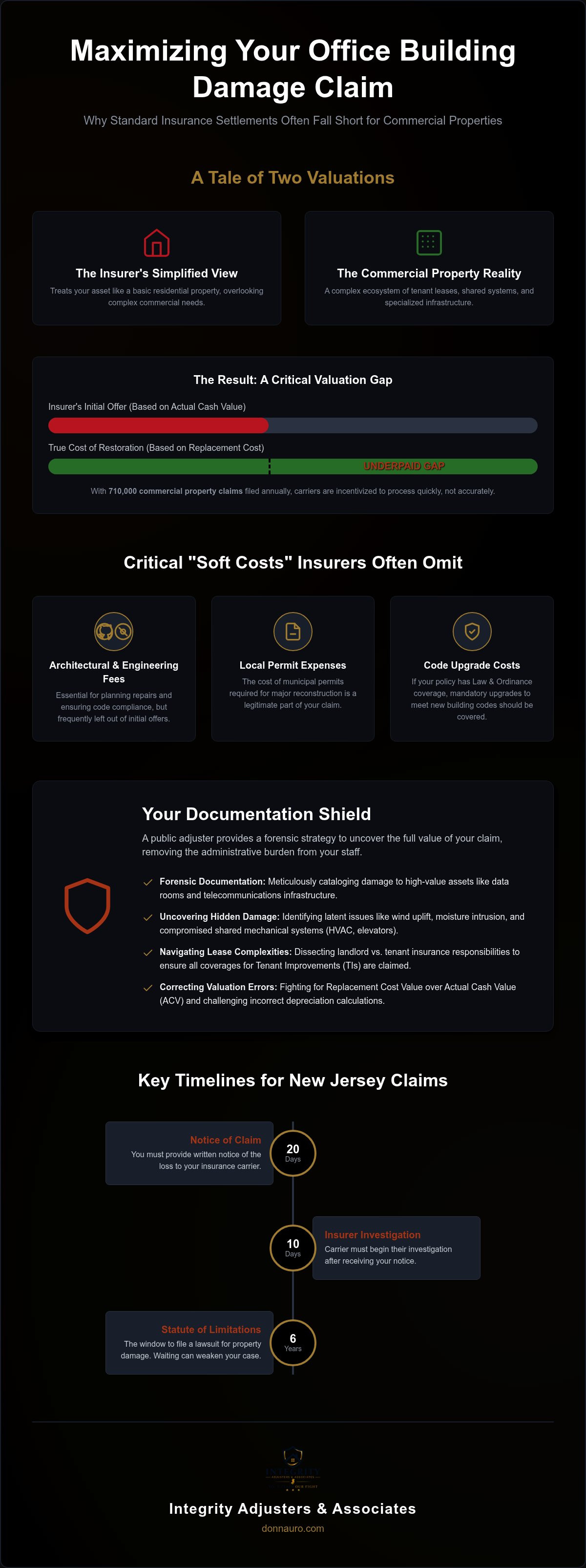
- Identify "soft costs" like architectural fees and permit expenses that insurance carriers frequently omit from initial settlement offers.
- Navigate the complex division of insurance responsibilities between landlords and tenants to ensure shared mechanical systems are fully covered.
- Partner with a public adjuster for office building damage to provide forensic documentation for high-value assets like data rooms and telecommunications infrastructure.
- Uncover hidden structural damage from NJ storms, such as wind uplift and moisture intrusion, which often go unnoticed by carrier-employed adjusters.
- Establish a "Documentation Shield" to manage all insurance correspondence, removing the administrative burden from your management staff.
Why Office Building Damage Claims Often Result in Underpayment
Insurance companies employ their own adjusters to protect their bottom line. This creates an inherent conflict of interest. To understand the landscape, it helps to know what is a public adjuster and why they represent the policyholder instead. Hiring a public adjuster for office building damage provides you with a strategic ally who understands the technical nuances of commercial claims. A company adjuster's goal is to settle the claim quickly and for as little as possible. They often overlook the "soft costs" essential for commercial recovery, such as architectural fees, engineering reports, and local permit expenses.
In New Jersey, you must provide written notice of a claim within 20 days of the loss. Building codes change frequently, and insurers must begin their investigation within 10 days of receiving your claim. If your policy lacks robust Law and Ordinance coverage, you'll pay for mandatory upgrades out of pocket. Many carriers also fail to account for the complexity of tenant rolls. Miscalculating Business Interruption or Loss of Rents can derail your entire operation. While the statute of limitations for property damage in NJ is six years, waiting to document these losses often leads to evidentiary decay.
To better understand the importance of forensic evidence, watch this helpful video:
The Difference Between Market Value and Replacement Cost
Actual Cash Value (ACV) takes depreciation into account, which often leaves a massive funding gap. Professional office finishes require high-end materials like specialized glass or custom millwork. Integrity Adjusters & Associates identifies depreciation errors in carrier estimates. We ensure your settlement reflects the cost of high-quality materials. Our methodical process acts as a buffer between you and the carrier's attempts to reduce your payout.
Hidden Damage in Shared Building Systems
Centralized HVAC, elevators, and fire suppression systems are the lifeblood of your property. Damage here is rarely just cosmetic. Smoke or water can compromise electrical boards and mechanical sensors deep within the building's core. Hiring a public adjuster for office building damage ensures these critical systems are inspected by independent experts. Shared infrastructure requires a specialized forensic approach to identify latent defects that could lead to future operational failures.
Complexities Unique to Commercial Office Property Losses
Office losses involve a complex hierarchy of interests. You aren't just dealing with a building; you're managing a network of lease agreements and shared liabilities. Navigating the "Tenant vs. Landlord" insurance responsibility maze is the first hurdle. Determining which policy covers a specific loss depends heavily on lease language and local regulations. A public adjuster for office building damage dissects these contracts to ensure no coverage is left unclaimed. If you are managing a claim, obtaining professional NJ property loss support early can prevent costly documentation errors.
Standard adjusters often overlook specialized infrastructure. Data rooms, server racks, and telecommunications hubs require climate-controlled environments and precise restoration. If a storm compromises the building's envelope, moisture and heat can destroy millions in hardware. Common areas like lobbies, parking structures, and shared restrooms also present unique valuation challenges. These high-traffic zones require specific materials and code-compliant repairs to maintain the asset's value and tenant safety.
Tenant Improvements (TIs) and Betterments
Who owns the build-out? This question often stalls claims for months. Analyzing lease language is critical to determine if the landlord or the tenant is responsible for insuring custom finishes. If your tenants invested in high-end office suites, you need to ensure these betterments are replaced to pre-loss standards. For a broader look at professional representation, you can find more commercial property insurance claim help through our detailed guides.
Business Interruption and Extra Expense Coverage
When a loss forces tenants to vacate, "Loss of Rents" coverage becomes your primary financial shield. Calculating this requires forensic accounting to track lost revenue and projected growth. Understanding Commercial property insurance basics helps, but applying those principles to a multi-tenant roll is difficult. Extra Expense coverage is also vital for NJ businesses. It covers the immediate costs of temporary relocation or specialized equipment rentals to maintain continuity during the restoration period.
Case Study: Restoring a New Jersey Office Complex After Storm Damage
A NJ Nor'easter doesn't just bring rain. It brings high-velocity winds that compromise commercial roof systems through wind uplift. In a recent recovery project, a property owner faced extensive water intrusion that threatened the building's structural integrity. The carrier's initial estimate focused on visible ceiling tiles, ignoring the moisture trapped within the wall cavities. Engaging a public adjuster for office building damage changed the trajectory of the claim. We moved the focus from cosmetic fixes to forensic reality.
According to the National Association of Public Insurance Adjusters, professional representation is essential for managing such complex losses. Our policy analysis uncovered hidden coverages for debris removal and mandatory code compliance that the carrier had initially omitted. We deployed thermal imaging and moisture mapping to build an undeniable claim file. This evidence allowed us to counter the carrier's "repair" estimate with a "replace" mandate for the entire roof assembly. The negotiation phase is where the "Documentation Shield" proves its value. When the carrier insisted on a localized patch, we presented forensic data showing that the entire roof membrane had failed.
Step 1: The Forensic Inspection Phase
We coordinated with structural engineers to verify the integrity of the office frame. It's not enough to look at the surface. You must document water damage behind the drywall in professional suites to prevent mold growth and future tenant disputes. Our team established a comprehensive "Scope of Loss" before the carrier's adjuster even arrived on site. This proactive documentation acts as a shield, preventing the insurer from dictating a low-ball repair strategy. By acting as a buffer, we allowed the building's management team to focus on tenant retention while we handled the institutional friction of the claim.
Step 2: Navigating NJ-Specific Compliance
Rebuilding in New Jersey requires strict adherence to updated energy codes and environmental regulations. We worked directly with local NJ municipalities to ensure all permitting documentation met expedited standards. Meeting these stringent energy codes is mandatory, not optional. If your claim doesn't account for these costs, you'll face a significant funding gap. Local NJ expertise prevents claim delays caused by regulatory friction, ensuring your project moves forward without bureaucratic interference. This methodical approach removes the burden of proof from your staff and places it squarely on the evidence we provide.
How a Public Adjuster Maximizes Your Office Settlement
Billion-dollar insurance corporations employ teams of experts to protect their interests. You need the same level of advocacy on your side. A public adjuster for office building damage acts as a strategic counterweight, leveling the playing field through technical expertise and methodical documentation. We don't just ask for more money. We prove why it's required under the terms of your specific policy. This isn't a simple negotiation; it's a forensic battle for the funds needed to restore your operations.
Managing an insurance claim is a high-stakes job that your internal staff isn't typically trained to handle. We provide a "Documentation Shield" by managing all correspondence with the carrier. One misplaced word in a formal statement can lead to a partial denial or a significantly reduced settlement. We prevent these policyholder errors by acting as the sole point of contact for the insurance company. This removes the administrative burden from your management team and ensures every communication is strategically sound and legally grounded.
Commercial policies often contain hundreds of pages of complex endorsements. We interpret these clauses to find hidden coverage for business interruptions or extra expenses that company adjusters frequently ignore. Because our fees are contingency-based, our incentives align directly with your goals. We only profit when we successfully maximize your settlement. This creates a results-driven partnership focused on securing the full value of your claim.
Public Adjuster vs. Insurance Company Adjuster
The most critical difference is fiduciary duty. A company adjuster is legally obligated to protect the insurance corporation's bottom line. In contrast, a public adjuster is legally bound to protect your interests. While a carrier's adjuster might spend thirty minutes on a site visit, we spend hours conducting a forensic assessment. We use industry-standard Xactimate software to create detailed, line-item estimates. This allows us to challenge low offers with hard data rather than vague requests, ensuring the carrier pays what the repair actually costs in the current market.
Protecting the Asset's Long-Term Value
A cheap repair is often a precursor to a future liability. If a settlement doesn't cover proper moisture extraction or structural reinforcement, you risk future mold growth and a decline in your property's "Class A" or "Class B" status. We fight for a settlement that allows for high-quality restoration, preserving your asset's market value and tenant trust. For owners managing a diverse portfolio, we also offer residential water damage claim support to protect your private holdings. To ensure your commercial property receives the same level of methodical care, contact our commercial claim experts for a policy review.
Securing Your NJ Office Investment with Integrity Adjusters
Integrity Adjusters & Associates acts as your disciplined navigator through the chaos of commercial property loss. We provide a methodical approach to commercial fire, storm, and business property claims. By acting as a buffer between you and the insurance carrier, we allow you to focus on your primary responsibility: your tenants and your business operations. Our firm brings a steady, professional authority to a process that is often characterized by confusion and institutional resistance.
Our process is sequential and transparent. It begins with a comprehensive policy review to identify the specific endorsements that apply to your office building loss. We then move into a forensic documentation phase, building a comprehensive claim file that standard carrier adjusters often overlook. This methodical progress continues through every negotiation phase until we secure the final settlement check. We prioritize factual integrity over marketing fluff, ensuring that every dollar requested is backed by evidence.
Early involvement is the most effective way to prevent claim denials or significant underpayment. Engaging a public adjuster for office building damage immediately after a loss ensures that physical evidence is preserved and all NJ-specific notice requirements are met. In New Jersey, you must provide written notice of a claim within 20 days of the occurrence. Missing these tight windows or failing to mitigate damage properly can give the carrier grounds to reduce your payout. Our "Shield" approach removes the burden of documentation from your staff and places it squarely on our experts.
Immediate Action Steps for NJ Office Owners
Take control of the situation before the carrier's adjuster dictates the narrative. Mitigate further damage by securing the building envelope, but do so without compromising the physical evidence of the loss. Gather all existing lease agreements and maintenance records; these documents are essential for proving the pre-loss condition and value of the asset. Finally, schedule a no-obligation claim review with our NJ team to establish a strategic path forward. Proactive organization is your best defense against an institutional system designed to minimize payouts.
The Integrity Promise: Professional Authority and Advocacy
We provide assertive representation in all NJ commercial loss negotiations. Our communication is characterized by clear reporting and a serious, grounded tone that reflects the gravity of your property loss. We don't linger on abstract concepts; we focus on the next logical action to move your claim toward resolution. Protect your asset and your tenant relationships by choosing a partner who acts as a dedicated shield for your interests. Contact Integrity Adjusters & Associates for an Office Claim Review to ensure your investment is fully protected.
Take Control of Your Commercial Property Recovery
Office building claims are inherently complex. Success requires more than just submitting a repair bill; it demands forensic evidence of damage to shared systems and a deep understanding of lease-driven liabilities. We've explored how professional advocacy bridges the gap between carrier estimates and the actual costs of high-quality restoration. Protecting your asset's market value depends on a settlement that accounts for every hidden mechanical failure and code-mandated upgrade.
Partnering with a specialized public adjuster for office building damage ensures that your investment is protected through expert documentation and assertive negotiation. Our NJ-licensed team provides the specialized commercial advocacy needed to handle complex office systems and institutional pushback. We act as your dedicated shield, bringing order to the chaos of property loss. Schedule a Free Office Claim Consultation with Integrity Adjusters & Associates today to secure the settlement required to restore your operations and tenant trust.
You don't have to navigate this turbulent process alone. With a methodical ally on your side, you can remain focused on your business while we handle the burden of the claim. Full restoration is possible when you have a disciplined professional in your corner.
Frequently Asked Questions
What is the difference between a public adjuster and the insurance company's adjuster for an office claim?
A public adjuster represents your interests exclusively; the insurance company's adjuster works for the carrier. Their primary goal is to minimize the payout to protect the insurer's bottom line. In contrast, a public adjuster for office building damage works to maximize your settlement by documenting every loss detail. We act as a fiduciary for the policyholder. This ensures your commercial asset is valued based on forensic evidence rather than a carrier's internal cost-saving metrics.
Can a public adjuster help with a denied office building insurance claim in New Jersey?
Yes, we can assist with denied claims in New Jersey. Carriers often deny claims based on technicalities or misinterpretations of policy language. We conduct a methodical review of your policy and the denial letter to identify errors. In NJ, you have a six-year statute of limitations for property damage; however, immediate action is better. We build a comprehensive file to challenge the carrier's decision and advocate for the coverage you've paid for.
How much does a public adjuster charge for a commercial office damage claim?
Public adjusters typically work on a contingency fee basis. This means you pay nothing upfront; instead, the fee is a percentage of the final settlement amount. In New Jersey, fees must be reasonable and clearly disclosed in a written contract. This structure aligns our incentives with yours. We only profit when we successfully secure a higher settlement for your office building. This allows you to access expert advocacy without increasing your initial out-of-pocket expenses.
Does hiring a public adjuster delay the repair process for my tenants?
Hiring a professional actually streamlines the recovery process. While the insurer might take 30 days to complete an investigation after receiving a proof of loss, we ensure all documentation is submitted correctly the first time. This prevents the back-and-forth delays common in complex commercial claims. By securing the funds needed for repairs more efficiently, you can restore operations and tenant trust faster. We handle the carrier so you can focus on property management.
What happens if my office building damage estimate is lower than the contractor's bid?
This valuation gap is common in office claims. Carrier estimates often use generalized pricing that doesn't reflect the cost of high-end commercial finishes or NJ labor rates. We use forensic documentation to prove the necessity of the higher bid. By presenting a line-item Scope of Loss using industry-standard software, we challenge the carrier's low offer. Our goal is to bridge that gap so your out-of-pocket restoration costs are minimized and your asset value is preserved.
Can I hire a public adjuster if I have already started the claim process myself?
Yes, you can engage a public adjuster for office building damage at any stage of the process. Many owners reach out after receiving an initial settlement offer that is insufficient to cover repairs. We step in to re-evaluate the damage and reopen the negotiation with the carrier. It's often easier to document the loss early; however, we can still provide significant advocacy even after the claim has been filed or a partial payment has been issued.
Does a public adjuster handle business interruption and loss of rent claims?
Yes, documenting financial losses is a core part of our service. For office buildings, this includes calculating loss of rents and extra expenses incurred to maintain operations. We employ a methodical approach to forensic accounting to ensure your revenue loss is accurately represented. These "soft costs" are frequently underestimated by insurance company adjusters. We ensure your total settlement reflects both the physical damage and the resulting business interruption to your NJ investment.
Is a public adjuster the same as an insurance lawyer?
No, they are distinct professions. A public adjuster focuses on the technical documentation, valuation, and negotiation of the property claim. We are experts in building codes, construction costs, and policy interpretation. While we act as your advocate, we don't provide legal representation. If a claim requires litigation, you would need an attorney. Our role is to settle the claim through the appraisal or negotiation process, often avoiding the need for a costly legal battle.


