

What if the biggest risk in a water damage claim isn’t the visible damage, but an incomplete record of what was affected? After a leak or burst pipe, it’s understandable to feel uncertain about what your policy covers, how the loss will be assessed, and what the insurer needs next. For New Jersey homeowners searching “water damage claim adjuster New Jersey,” the key is finding out whether policyholder-side claim advocacy fits the situation, not relying on promises about a settlement.
A public adjuster represents the policyholder, not the insurance company. The work centers on documenting property damage, organizing claim information, and advocating through the insurer’s process. A public adjuster can help present the claim, but can’t guarantee coverage or determine what the insurer will pay.
This guide explains what a New Jersey water damage claim adjuster does, where the role begins and ends, and what to assess before engaging claim advocacy. You’ll also learn what to prepare and how to keep the claim record organized. The goal is practical clarity, so you can make an informed decision and move forward with a clear account of the loss.
Key Takeaways
- Consider claim advocacy when damage affects multiple areas, the repair scope is disputed, or claim records and communications are difficult to organize.
- A water damage claim adjuster New Jersey homeowners hire should represent the policyholder and help prepare and present the claim, not promise a specific outcome.
- Before signing, assess the adjuster’s documentation approach, communication process, responsibilities, and written engagement terms.
- Expect a sequence of claim review, evidence organization, presentation, insurer discussions, and follow-up, with your participation throughout.
- Keep photos, reports, correspondence, and repair records organized to make the claim easier to follow.
When a New Jersey Water Damage Claim Adjuster Can Help
Water damage can look straightforward at first, then become harder to assess once moisture reaches flooring, walls, cabinets, or personal property. A public adjuster is a policyholder-side professional who assists with preparing and presenting a property insurance claim. Unlike an adjuster working for the insurer, a public adjuster advocates for the homeowner’s interests in the claim process. The Public Adjuster overview provides general background on this role.
A water damage claim adjuster New Jersey homeowners consider may be useful when a loss affects several rooms, the repair scope is unclear, or managing claim documents and insurer communications feels difficult. The adjuster’s role is to evaluate and present claim information, not to repair the property or provide legal representation. Coverage and claim decisions depend on the policy and the facts of the loss.
This video offers additional context on the adjuster’s role:
Which water-loss situations may call for closer claim review?
The source of water is an important part of understanding a claim, but the cause alone doesn’t determine coverage. A burst pipe may involve sudden indoor water; an appliance leak may develop gradually or go unnoticed until nearby materials are affected. Roof intrusion can follow rain or a storm, while sewer backup involves water entering from a different source. For each event, record what happened, when it was noticed, and which materials or belongings were affected.
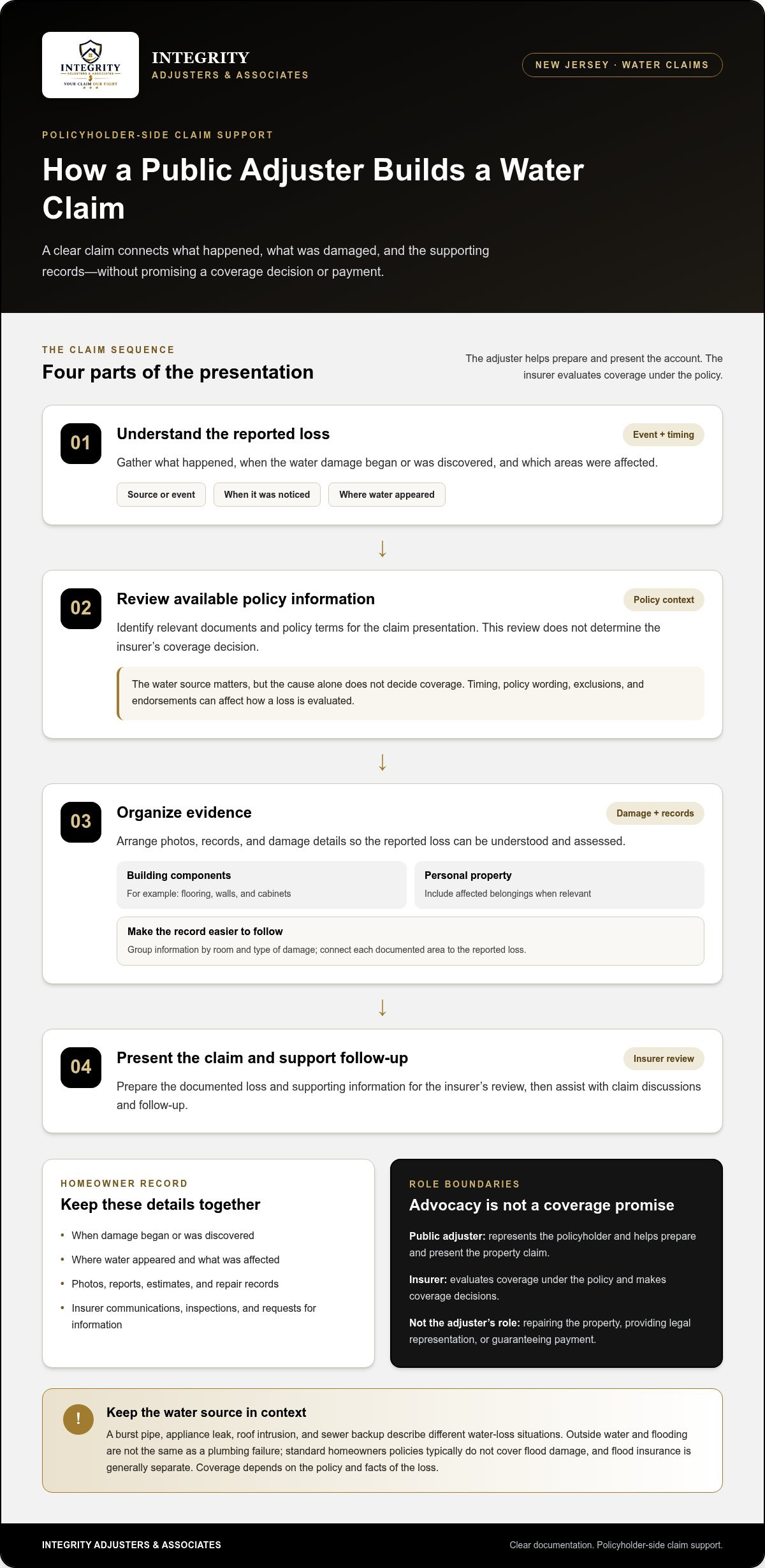
Timing, policy wording, exclusions, and endorsements can all affect how an insurer evaluates a loss. Outside water and flooding shouldn’t be treated as identical to a plumbing failure: standard homeowners policies typically don’t cover flood damage, and flood insurance is generally separate. A public adjuster can help organize and present the facts, but can’t determine coverage in advance or guarantee payment.
When might a homeowner consider claim advocacy?
Advocacy may be worth considering when damage extends across several rooms, affects multiple building components, or leaves uncertainty about the full repair scope. Structured support can also help when photos, estimates, correspondence, and other claim records are hard to keep straight. The purpose is not to assume the insurer’s assessment is wrong, but to make sure the loss information is gathered and presented clearly.
A public adjuster represents the policyholder by helping prepare and present the property claim to the insurer. That work can include organizing information about damaged areas and relevant personal property, then supporting a clear account of the loss. The homeowner remains involved in decisions about the property and should understand what the adjuster will handle.
Before seeking advocacy, make a brief record of what is known: when the damage began or was discovered, where water appeared, what areas were affected, and what communications or records are available. Note any inspection, estimate, or request for information from the insurer. These details can help clarify whether the main challenge is documenting the extent of damage, understanding the repair scope, or managing the claim process. For a complex or disputed loss, an organized presentation can keep the discussion focused on evidence and policy terms without promising a particular result.
What a New Jersey Public Adjuster Does During a Water Claim
A water claim needs a clear connection between what happened, what was damaged, and what the homeowner is asking the insurer to consider. A public adjuster helps the policyholder build and present that account. The adjuster advocates for the homeowner, while the insurer evaluates coverage under the policy and makes coverage decisions.
The work generally follows a practical sequence:
- Understand the reported loss. Gather details about the event, its timing, and the areas affected.
- Review available policy information. Identify relevant documents and policy terms for the claim presentation, without determining the insurer’s coverage decision.
- Organize evidence. Arrange photos, records, and damage information so the reported loss can be understood and assessed.
- Present the claim. Prepare the documented loss and supporting information for the insurer’s review, then assist with claim discussions and follow-up.
How the adjuster builds a documented claim
Claim preparation brings the reported event, observed damage, and available supporting records into a coherent presentation. This may include affected building components, such as flooring, walls, or cabinets, and personal property when relevant. Organizing the information by room and type of damage can make it easier to see what is included and which records support each part of the claim.
A strong claim connects each documented area of damage to the reported loss, giving the insurer a clearer basis for review. Homeowners can learn more about gathering records and images in the separate article, “How to Document Water Leak Damage for Your Insurer.”
How claim advocacy fits alongside restoration work
Claim advocacy and restoration address different needs. Emergency water removal, drying, and physical repairs are property work; a public adjuster organizes and presents claim information. Homeowners may need mitigation or restoration work to address water and protect the property. The adjuster does not perform that work or replace those specialists.
Keep records of property work together with the claim file. Relevant invoices, reports, photographs, and updates can help show what was observed and what work was performed. Organize them by date and affected area, and note which damaged items or rooms are included in the claim. For a water damage claim adjuster New Jersey policyholders engage, the role remains claim advocacy, not control over repairs or a guarantee of coverage.
Homeowners remain involved by providing information, responding to questions, and making decisions about their property. Integrity Adjusters & Associates provides residential water damage claim support focused on documenting losses, building a comprehensive claim, and advocating for policyholders through the insurance process.
How to Evaluate a Water Damage Claim Adjuster in New Jersey
Compare the process, not promises. A clear engagement should explain how the adjuster represents you, what work they’ll perform, how they’ll organize claim evidence, and how they’ll communicate as the claim moves forward. A water damage claim adjuster New Jersey homeowners consider should describe these responsibilities in plain language and distinguish claim advocacy from the insurer’s role in evaluating coverage.
For a focused comparison of the different roles, see “Public Adjuster vs Insurance Adjuster: The Key Difference.” As you assess a potential working relationship, look for specifics rather than broad assurances:
- Role clarity: Can the adjuster explain their responsibilities and what remains your decision?
- Documentation method: Is there a defined approach to organizing damage observations, records, and the claim presentation?
- Communication: Do you understand how updates, questions, and insurer communications will be handled?
- Realistic expectations: Are coverage and settlement outcomes described as dependent on the policy and claim facts, rather than guaranteed?
What should the engagement agreement make clear?
Read the written agreement before signing. Check which services are included, how compensation is calculated, when it may be due, and what cancellation provisions or other conditions apply. Compensation terms can vary, so focus on the specific fee basis and wording in the agreement rather than assuming a standard pricing arrangement.
Make sure the agreement identifies the work the adjuster will handle and any limits on that work. If a phrase about fees, cancellation, or responsibilities is unclear, ask for an explanation before deciding. You should understand the terms well enough to describe what you’re agreeing to and what obligations may follow.
What signals a clear, professional claim process?
A sound process should be explainable from the first review through claim presentation. The adjuster should describe how damage information and supporting records will be organized, how the claim will be presented, and how you’ll be kept informed. Specific answers help you judge whether the approach fits your loss. For example, you should be able to understand how photos, repair records, and insurer requests will be handled.
Before engaging someone, check current public adjuster licensing and consumer information through the New Jersey Department of Banking and Insurance. Use the department’s current resources to verify applicable information rather than relying on an old directory entry or an unsupported claim about credentials.
Notice how the adjuster discusses uncertainty. A credible explanation can identify what information is available, what still needs review, and how policy terms may affect the insurer’s decision. Be cautious of guaranteed outcomes or pressure to sign before you’ve had time to understand the agreement. Strong advocacy rests on clear responsibilities, organized documentation, and candid communication. That gives you a practical basis for deciding whether representation is appropriate, without treating any promised payout as a certainty.
What to Expect After Engaging a New Jersey Water Claim Adjuster
Engaging a public adjuster adds structure to the claim process, but it doesn’t remove the homeowner from it. The work typically moves through an initial review, evidence organization, claim presentation, discussions with the insurer, and follow-up. Each stage may lead to questions or requests for more information, so expect an active process rather than a single handoff.
- Initial review: Discuss the reported loss, available records, and questions about the claim.
- Evidence organization: Sort relevant documents and damage information into a coherent file.
- Claim presentation: Present the organized claim information to the insurer for review.
- Insurer discussions: Respond to questions and provide relevant additional information as needed.
- Follow-up: Track open issues and next steps as the insurer reviews the claim.
The timeline varies. The circumstances of the loss, insurer response, completeness of documentation, and policy questions can all affect how the process unfolds. A water damage claim adjuster New Jersey homeowners engage can advocate for the policyholder and help organize the claim, but can’t control the insurer’s review or promise a decision date, coverage, or payment amount.
What the homeowner can prepare for the first review
Gather the policy or available policy documents, insurer correspondence, photographs, and any repair or mitigation records you already have. A short timeline is useful: note when you first noticed the damage, what happened next, and when you reported it. Keep it factual and concise. This gives the initial discussion a useful starting point without requiring you to build a complete claim file alone.
Stay involved after that first review. Share relevant records as they become available, answer questions about what you observed, and make decisions about your property. Keep new documents or updates from the insurer with the claim records and bring them to the adjuster’s attention. Prompt, organized responses can help keep the file current, though they don’t determine the insurer’s decision.
How insurer communication and decisions proceed
The public adjuster presents organized claim information and can assist with responses to insurer questions. The insurer may request further records, clarification, or additional review before evaluating the claim. Keep track of what was requested, what was provided, and any response received. This simple record helps everyone follow the status of outstanding items.
Coverage and payment remain subject to the policy terms and the insurer’s review. If you’re concerned that an estimate doesn’t reflect the documented loss, the separate article “Why Your NJ Water Damage Claim Might Be Underpaid” addresses estimate concerns. An adjuster can advocate for the policyholder, but cannot make coverage decisions on the insurer’s behalf.
For organized guidance through a residential water damage claim, connect with a policyholder-side claim advocate.
Choose Policyholder-Side Water Damage Claim Support in New Jersey
Deciding whether to engage claim support comes down to fit and clarity. Consider how complex the loss is, whether the repair scope is clear, how the available evidence will be organized, and whether you understand the agreement before signing. These factors matter more than promises about a particular settlement. A water damage claim adjuster New Jersey homeowners engage should explain the role, responsibilities, and process in terms you can follow.
How Integrity Adjusters & Associates supports policyholders
Integrity Adjusters & Associates provides public-adjusting advocacy for residential water damage claims in New Jersey. The firm works on the policyholder’s side by documenting property losses, organizing claim information, and building a comprehensive presentation for the insurer. This creates a structured record of the loss and supports communication through the claim review process.
The firm’s role is claim advocacy. It does not make the insurer’s coverage decision, perform property repairs, or provide legal representation. Understanding that distinction helps set expectations: the adjuster presents and advocates for the claim, while the homeowner remains involved in decisions about the property and the insurer reviews the claim under the policy.
Consider what support would address the challenge you’re facing. For example, a homeowner with several affected areas and a disputed repair scope may need more help organizing the claim than someone with a straightforward loss and complete records. A useful discussion should clarify how evidence will be handled, what insurer communications the adjuster will support, and what tasks remain yours.
A practical next step for New Jersey homeowners
Start with a concise summary of what happened, when you noticed the damage, which parts of the home were affected, and where the claim stands now. Include whether you’ve reported the loss, received an insurer estimate, or been asked for additional information. You don’t need to resolve every question before beginning a conversation. A factual overview can help identify what needs review.
Before making a decision, read the engagement terms carefully. Make sure you understand the services, fee basis, cancellation provisions, and any other stated conditions. Ask for an explanation of anything unclear. A sound decision should leave you with a realistic understanding of the adjuster’s responsibilities and next steps, not an expectation of guaranteed coverage, payment, or timing.
Integrity Adjusters & Associates helps New Jersey homeowners document water damage losses, build comprehensive claims, and navigate insurer communications and review. If you’re weighing policyholder-side support, share the basic circumstances of your loss and the claim’s current stage. The discussion can focus on the facts, the support involved, and an organized path forward.
Take the Next Step With a Clear Claim Plan
The right support should leave you with a clearer view of what happens next, what information is needed, and who is responsible for each part of the claim. As you consider a water damage claim adjuster New Jersey homeowners can work with, focus on a process grounded in evidence and straightforward communication, not promises about the outcome.
Integrity Adjusters & Associates supports New Jersey homeowners with residential water damage claims. The firm documents property losses and builds comprehensive claims for insurer review, helping policyholders approach the process with an organized record and a clear account of the damage.
You can take a practical first step by outlining when the loss occurred, what areas were affected, and where the claim stands. That gives the discussion a useful starting point without requiring you to have every answer in advance. Review any proposed engagement terms carefully, and make sure the responsibilities and process are clear before deciding how to proceed.
Discuss your New Jersey water damage claim with Integrity Adjusters & Associates. A clear next step can make a difficult process feel more manageable.
Frequently Asked Questions
Is a public adjuster the same as the adjuster sent by my insurance company?
No. A public adjuster represents you as the policyholder, while an adjuster sent by your insurer works for the insurance company. Both may examine damage, but they serve different interests. For example, you can ask a public adjuster to help organize information about a damaged room that you believe wasn’t fully included in the insurer’s assessment. The insurer still reviews the claim and makes coverage decisions under your policy.
Can I hire a water damage claim adjuster after the insurer has inspected my home?
Yes, you may seek claim advocacy after an insurer’s inspection. The next steps depend on what’s happened so far and what information is available. Gather the inspection findings, estimate, claim letters, and any unanswered questions, then review them with a water damage claim adjuster New Jersey homeowners can engage for policyholder-side support. Before signing, ask what additional claim work may be appropriate and what responsibilities you would retain.
Does homeowners insurance cover every type of water damage?
No. Coverage depends on the circumstances and the specific policy, so the phrase “water damage” alone isn’t enough to determine whether a loss is covered. For example, a pipe leak inside the home and water entering from outside may be treated differently. Review the policy language, including relevant exclusions and endorsements, alongside the facts of the loss. A general explanation can’t replace a coverage decision based on your actual policy.
Can a public adjuster help with both building damage and damaged belongings?
Yes, a claim may include building damage, personal belongings, or both, if they’re relevant to the loss and policy. For example, the claim file might need to account separately for a damaged cabinet and an affected household item. Keep purchase records, photographs, or other information that helps identify the belongings, and note which rooms or building components were affected. The insurer reviews the submitted information under the applicable policy terms.
Does a water damage claim adjuster perform water removal or home repairs?
No. Claim advocacy focuses on documenting and presenting the insurance claim, not removing water, drying materials, cleaning, or repairing the home. Those are physical property tasks that may require restoration or repair professionals. Keep records of work performed, such as reports, invoices, and photographs, so relevant information can be organized with the claim. The homeowner coordinates property work separately from claim advocacy and makes decisions about the home.
Can a New Jersey public adjuster give legal advice about my insurance policy?
No. A public adjuster can assist with claim documentation and policyholder advocacy, but that isn’t legal representation or legal advice. If you need a legal interpretation of your rights or obligations, speak with a qualified attorney. For current New Jersey licensing and consumer information about public adjusters, consult the New Jersey Department of Banking and Insurance. Review the engagement agreement to understand the adjuster’s role and the work they’ll handle.
What should I ask before signing an agreement with a water damage claim adjuster?
Ask which services are included, how compensation is calculated, what tasks remain yours, and how claim updates will be communicated. Read the cancellation provisions and other agreement conditions, too. For example, if you’re unsure whether the adjuster will help organize a later insurer request, ask for that responsibility to be explained before signing. Clear written terms give you a practical basis for understanding the working relationship and deciding whether it fits your needs.


