

An apartment building claim can involve several property interests, even when the damage began in one place. A leak may affect a shared hallway, multiple units, and residents’ belongings. Owners and managers then need to sort out which damage, records, and policy details belong to each part of the claim. An apartment building insurance claim adjuster can help organize those details into a clear, evidence-based record.
A building claim may seem like one straightforward loss, but shared areas, individual units, and different stakeholders can complicate documentation and insurer review. A public adjuster works on the policyholder’s side, helping document property damage, organize claim information, and navigate the insurance process. For a New Jersey property owner or association, that support can help present the policyholder’s interests clearly without assuming that every party shares the same policy or claim.
This guide explains who may be involved in an apartment building claim, why property interests and records can differ, and what evidence can help build a comprehensive claim. It also describes how Integrity Adjusters & Associates can support New Jersey policyholders with damage documentation and claim advocacy.
Key Takeaways
- Map damage by common areas, building systems, and unit interiors to create a clear record of affected property.
- Use association documents, ownership records, and policy wording to identify relevant property interests without assuming what is covered.
- An apartment building insurance claim adjuster can help the policyholder organize damage evidence and present a comprehensive claim to the insurer.
- After damage, prioritize safety, document visible conditions, preserve records, and track claim communications while following policy instructions.
- Extensive damage, multiple affected locations, or scattered records may make structured public adjuster advocacy useful.
Why an Apartment Building Insurance Claim Needs a Clear Damage Record
An apartment building insurance claim is a policyholder’s request for payment for property loss that may be covered under an applicable policy. The policy wording, the facts of the loss, and the interests insured all matter. A building-wide incident does not automatically mean every damaged area or item is handled under the same policy.
Damage can cross both physical and ownership boundaries. A roof leak, for example, may affect a common stairwell, a building system, and the ceiling or flooring inside several apartments. Recording only the source of the leak can leave the resulting damage unclear. A useful record identifies where damage appears, what property is affected, and how the locations relate to one another.
What makes a multi-unit property claim different?
One event can affect several locations and different types of property. A fire may damage a shared corridor and building systems, while smoke or water impacts extend into individual units. Photograph and describe each affected area separately. Note its location, the visible condition, and when it was observed. This helps explain the scope of the damage without assuming how an insurer will categorize or cover it. Coverage depends on the applicable policy language and the facts of the loss.
Apartment building claims need evidence organized by location, damage, and affected property interest. Clear categories help the policyholder explain what was observed, distinguish common-area impacts from unit-level damage, and present a more complete claim. Keep descriptions factual. Separate what is visible from what still needs assessment, and connect each record to a specific part of the building.
Who may be involved in a New Jersey building claim?
The policyholder may be an individual property owner or an association, depending on ownership and the policy involved. A property manager often coordinates building operations, access, notices, and records. That coordination role differs from representing the policyholder in preparing and presenting an insurance claim. Residents may provide observations about when and where damage appeared. Access to units and personal information should be managed through appropriate procedures.
The parties may have different interests. An association may focus on shared property, an owner on the building, a tenant on belongings or displacement, and a manager on coordinating information. Those roles do not establish that the parties share a policy or the same claim rights. Before combining records, identify who holds each relevant policy and which property or interest each record concerns.
An insurer may assign an adjuster to evaluate and communicate about a claim. The general role of an insurance adjuster is outlined in Insurance Adjuster Wikipedia. A public adjuster, by contrast, advocates for the policyholder by helping document damage, organize supporting information, and present the claim. An apartment building insurance claim adjuster working on the policyholder’s side can bring separate observations and records into a coherent account. Coverage decisions remain subject to the policy and claim facts.
What an Apartment Building Insurance Claim Adjuster Does
A public adjuster represents the policyholder in preparing and presenting a property insurance claim. For an apartment building, that means helping turn observations, records, and damage documentation into a coherent account of the reported loss. This support can be useful when information is spread across building areas, maintenance files, invoices, photographs, and communications with several parties.
An apartment building insurance claim adjuster working on the policyholder’s side can review available policy documents, document damage, organize supporting information, and help navigate communications with the insurer. The aim is a clear, evidence-based claim presentation, not a promised coverage decision or settlement. Whether a loss is covered depends on the applicable policy and the facts.
How public adjusting supports claim preparation
Claim preparation connects reported damage to relevant evidence. A public adjuster can help organize photographs by location, compare observations with available maintenance or incident records, and identify where more information may be useful. For example, a timeline of reported water intrusion alongside photographs of affected units and common areas gives the claim a clearer structure. Organized documentation supports review, but it does not guarantee coverage or a particular outcome.
A well-organized file also prevents distinct records from becoming one undifferentiated collection. The policyholder can see which information relates to a particular area, building component, or reported impact. The insurer can review the claim presentation with those connections in view. An adjuster may also help track insurer questions and responses so submitted documents and follow-up communications stay organized.
How the policyholder-side role differs
A public adjuster works for the policyholder. An adjuster assigned by the insurer participates in the insurer’s claim process. Their roles are different: the public adjuster helps the policyholder document and present the loss, while the insurer evaluates the claim under its process and the relevant policy terms. The policyholder therefore has an advocate focused on claim preparation and communication.
Public adjusting is also different from selling insurance, providing legal representation, or performing physical repairs. A public adjuster may review available policy documents as part of claim preparation, but does not replace legal counsel or sell insurance policies. Documentation work also does not repair a roof, dry a unit, or restore damaged property. Keeping these responsibilities distinct helps owners and association representatives understand the support they are receiving.
For a commercial property policyholder, structured advocacy can bring damage records and claim communications into one organized process. Integrity Adjusters & Associates helps policyholders document property damage, build a comprehensive claim, and navigate the insurer’s process. Learn more about commercial property claim advocacy and how this approach can support a business property claim.
How to Separate Shared-Building Damage From Unit-Level Impacts
A practical claim record shows where damage occurred before drawing conclusions about responsibility or coverage. A roof leak may leave visible damage in a corridor, affect shared plumbing or electrical systems, and stain ceilings inside several apartments. These impacts may relate to the same event, but they involve different locations and potentially different property interests.
The location of damage helps organize a claim, but policy wording determines applicable coverage. Use categories as a documentation tool, not as a coverage decision. One building event does not necessarily mean one policy applies to every item or that all parties have the same claim interests.
Common areas, building systems, and individual units
Record each affected space or component separately. For each entry, note the building location, date observed, visible condition, and available supporting evidence, such as photographs, maintenance records, or reports. A corridor, roof, shared pipe, and apartment interior are useful categories for organizing observations. These examples do not establish whether a particular policy covers the property or resulting damage.
- Common areas: Identify corridors, stairwells, lobbies, or other shared spaces, then describe the specific damage.
- Building systems: Record affected roofs, plumbing, electrical components, or other systems by location and observed condition.
- Unit interiors: Document impacts inside each affected apartment separately, while respecting privacy and access procedures.
This separation preserves the sequence and scope of observations. For example, a photograph of a water stain is more useful when the location and date are recorded. If the source or extent is unknown, say so rather than guessing. Link related evidence where appropriate, while keeping each affected location identifiable.
Association policies and unit-owner policies
Association records, ownership documents, and policy materials can help clarify which property interests are relevant to a claim. Review available declarations, endorsements, and governing documents for context. They may describe insured parties, property, or policy terms, but no single document should be treated as a universal rule for where association interests end and unit-owner interests begin.
Build a reference file that connects each affected area to the records available for it. An apartment building insurance claim adjuster can help organize that information for the policyholder’s claim presentation. Any coverage assessment remains subject to the applicable policy and facts.
- Keep association and unit-owner policy documents distinct.
- Note which records relate to ownership, shared property, or a particular unit.
- Flag unclear or conflicting descriptions for careful review instead of assuming they establish coverage.
This approach avoids treating a building-wide incident as one uniform claim. It gives owners, association representatives, and claim professionals a clearer way to discuss the affected property without suggesting that every stakeholder has the same policy, responsibilities, or interests.
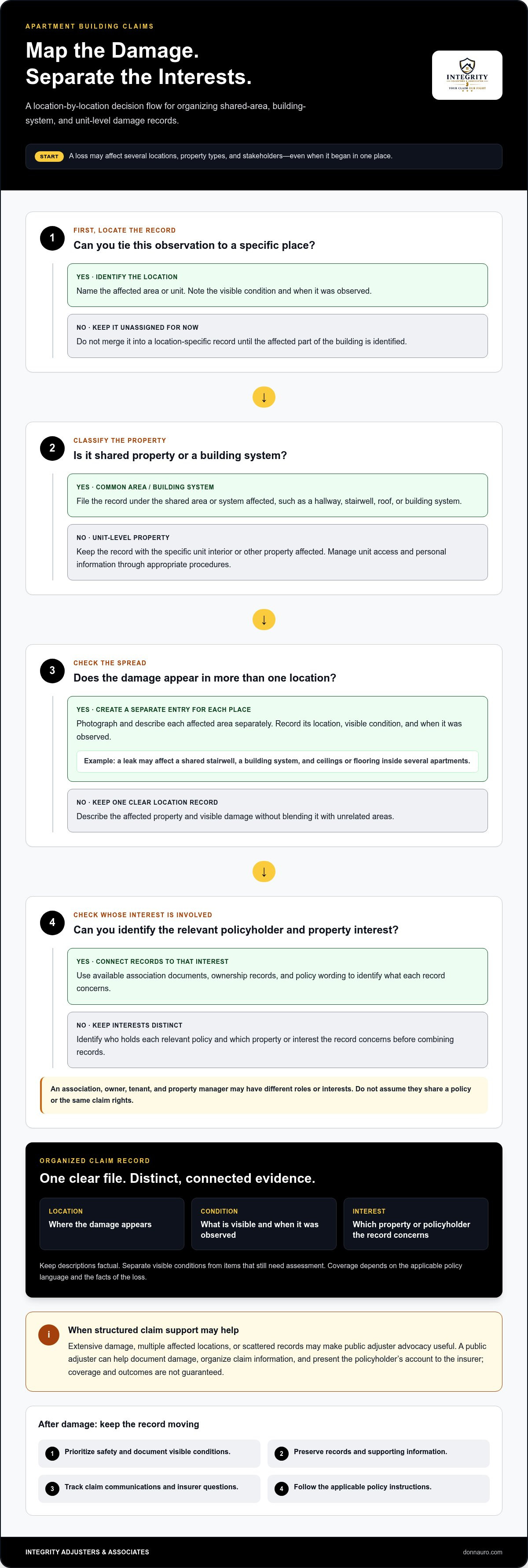
How to Organize an Apartment Building Insurance Claim After Damage
A clear process helps preserve important information while building operations continue. Act promptly, but put people’s safety first. Follow applicable safety guidance and the instructions in the relevant policy. Do not delay urgent protective action to take photographs or assemble paperwork.
- Protect people. Address immediate hazards and follow appropriate safety guidance. Limit access to unsafe areas.
- Record visible damage. Once it is safe, take photographs and notes showing what you observed and where.
- Preserve records. Keep relevant maintenance documents, invoices, estimates, and incident information together.
- Organize affected locations. Separate records for common areas, building systems, and individual units.
- Track communications. Log insurer contacts, inspections, questions, and materials submitted.
Keep observations factual. Note when damage was found, who observed it, and whether the condition changed. If the cause or extent is unclear, identify it as unknown rather than presenting an assumption as fact. Continue necessary protective steps and keep records of related actions and expenses.
Build a location-by-location evidence file
Create a separate record for each affected common area, system, or unit. Label images and notes with the date, location, and visible condition. Keep related communications and access records alongside estimates, invoices, and maintenance documents. This structure connects evidence to the specific place or item it describes, rather than leaving reviewers to sort through a general folder.
- Photographs and videos, labeled by date and location
- Maintenance records, invoices, and available estimates
- Observations from residents, staff, or other stakeholders
- Inspection notes, access records, and relevant communications
Preserve original files when possible and retain copies of materials provided to the insurer. For broader context on organizing a commercial property loss, see this guide to commercial property insurance claim help.
Coordinate information without losing the claim timeline
Assign a central contact to collect building records and stakeholder observations. That person can maintain a dated log of insurer communications, inspections, requests, and submitted documents. Record who participated and what was provided. A public adjuster can help the policyholder organize evidence and navigate insurer communications as the claim develops.
Policy instructions and documentation requirements can vary. Review the applicable policy materials and identify the relevant notice and documentation requirements rather than assuming one deadline applies to every claim. Keep a copy of each submission and note when it was sent. Integrity Adjusters & Associates helps policyholders organize and present complex property losses through apartment building claim support.
When a New Jersey Apartment Building May Need Public Adjuster Advocacy
A property manager may coordinate building operations, resident updates, access, and records. That work is valuable, but it is not the same as preparing and presenting an insurance claim for the policyholder. A public adjuster provides policyholder-side advocacy by helping organize claim evidence and insurer communications. The value of that support depends on the loss, the records available, and the policyholder’s circumstances.
Structured claim support may be useful when damage affects several parts of a property, the loss is extensive, or information is scattered across association files, maintenance records, and resident reports. These are practical reasons to get help organizing a claim, not proof that an insurer has mishandled it or that coverage is owed. Any assessment must be based on the claim facts and applicable policy language.
Signs the claim may benefit from organized advocacy
It can be difficult to assemble a reliable account when damage spans multiple locations or units. Questions about what to submit, how to respond to insurer requests, or how to align correspondence with supporting records can add pressure. An apartment building insurance claim adjuster working for the policyholder can help bring those materials and communications into an organized claim presentation.
- Damage evidence and records are spread across building areas or stakeholders.
- It is unclear which documents relate to a specific reported impact.
- Insurer questions, inspections, or correspondence are becoming difficult to track.
- The policyholder needs support building a complete, clearly organized claim.
What to prepare before discussing claim support
Gather what is available; you do not need a complete file before discussing the claim. A concise overview can establish the known facts and identify missing information. Keep records in their original form when possible, and distinguish firsthand observations from assumptions about the cause, scope, or coverage of damage.
- Available policy documents and claim correspondence
- Photographs or videos, with dates and location notes where available
- Building, maintenance, inspection, or ownership records relevant to the loss
- A brief summary of the reported event, known damage, and affected areas
- Questions or outstanding requests from the insurer
Integrity Adjusters & Associates helps New Jersey policyholders document property damage, build a comprehensive claim, and navigate insurer communications. The firm advocates for the policyholder through the claim process. Clear records and a focused account of the loss give that work a sound foundation.
If a complex building loss is difficult to organize or present, contact Integrity Adjusters & Associates for New Jersey property claim advocacy.
Move Your Building Claim Forward With a Clear Next Step
You do not need every question resolved before deciding how to proceed. Start with the information available, note what remains uncertain, and consider whether policyholder-side guidance would help you approach the claim with greater clarity. An apartment building insurance claim adjuster can help the policyholder organize documentation and prepare a claim presentation grounded in available records.
For New Jersey owners and association representatives, a focused conversation can clarify the property loss and the support needed. Integrity Adjusters & Associates provides public adjusting advocacy for residential and commercial property claims, including help documenting damage and preparing a comprehensive claim. The firm works on the policyholder’s side and helps navigate insurer communications.
Discuss your New Jersey apartment building claim with Integrity Adjusters & Associates. A clear plan can make a complex process more manageable, one well-supported step at a time.
Frequently Asked Questions
Can an apartment building file one insurance claim for damage to multiple units?
Damage to several units may be reported together when the same event affects property insured under the same policy, but that does not mean every impact belongs to one claim. For example, a building owner may report damage to insured building property while residents address damage to their own belongings separately. Identify the policyholder, affected property, and reported event for each claim, then follow the applicable policy’s reporting instructions.
Does a condo association's master policy cover damage inside every apartment?
No. A master policy does not automatically cover every item or area inside every condominium unit. The policy wording and association documents help define the property and interests involved. For example, a damaged built-in feature and a resident’s movable belongings may be treated differently, depending on the documents and circumstances. Review the master policy, any relevant unit-owner policy, and governing records before assuming which policy may apply.
Can tenants make an insurance claim for damage in an apartment building?
Tenants may be able to make a claim under their own policy for covered losses to their belongings, subject to that policy’s terms. Damage to the building itself is generally addressed by the party that holds the applicable property policy, rather than automatically becoming the tenant’s claim. A tenant can report observations to the property manager and keep a dated inventory of affected belongings, receipts, and photographs for their own records.
What documents help with an apartment building insurance claim?
Useful records can include the relevant policy and declarations, claim correspondence, dated photographs, maintenance logs, inspection notes, invoices, estimates, and incident reports. For a multi-unit property, add a location reference to each item, such as the unit number or shared-area name, while limiting access to residents’ private information. Keep copies of submitted materials and note the date and recipient so the policyholder can track what the insurer has received.
What happens if an apartment building's insurance claim includes common areas and private units?
Make clear which damage is in shared spaces and which is inside individual units. The same incident may involve different policyholders or policies, so organize records by property interest rather than blending everything into one description. For example, an association representative can document a shared hallway, while an affected unit owner separately records interior impacts. The relevant policy language and facts guide how each part is considered.
Can a public adjuster help an apartment association with a property damage claim?
Yes. A public adjuster can represent the policyholder, which may be an association, in preparing and presenting a property damage claim. An apartment building insurance claim adjuster working for the policyholder can help organize relevant damage information and navigate insurer communications. This advocacy does not replace the association’s operational coordination. The association’s policy documents and claim circumstances remain central to the work.
Are New Jersey apartment building insurance claim deadlines the same for every policy?
No. Do not assume one deadline applies to every New Jersey building claim. Policy requirements and claim circumstances can differ, including instructions for notice, proof of loss, or other requested documents. Review the relevant policy and insurer correspondence promptly, and keep a record of stated dates and submissions. If timing or a policy requirement is unclear, get guidance specific to the claim rather than relying on a deadline from another building’s experience.


