

What if the property damage is only part of your business’s loss? A fire or storm can disrupt operations, reduce revenue, and add expenses long after the initial damage is found. Getting business interruption insurance claim help starts with connecting covered property damage to the financial impact your business can document.
If your income has fallen or stopped, it’s understandable to be unsure what the policy covers, which records matter, or how to respond to the insurer’s requests. Coverage depends on the policy wording and the circumstances of the loss. A well-supported claim brings the property damage, interruption period, lost income, and additional expenses into a clear, consistent account.
This guide explains how property damage and interrupted operations may relate to business interruption coverage, which financial and event records to gather, and how to organize them into a claim. It also outlines how a policyholder advocate can help document commercial property losses, assemble a comprehensive submission, and navigate the insurer’s process. For New Jersey businesses, the aim is a clear factual foundation for presenting the loss.
Key Takeaways
- Review your policy wording to understand the conditions that may connect covered property damage with business interruption losses.
- Keep financial records separate from evidence of physical damage so each part of the claim is clearly supported.
- Compare claimed losses with relevant policy terms and business records to help identify questions or disputes from the insurer.
- Build your claim file in stages, starting with policy and incident records, then adding a dated timeline of operational effects.
- Business interruption insurance claim help can bring structure to loss documentation and support a comprehensive claim submission without guaranteeing an outcome.
Business interruption insurance claims in New Jersey: what they address
A property loss can affect a business in two connected ways: it can damage the premises or business property, and it can interrupt the work that generates income. Business interruption coverage may address certain financial effects of that interruption, but it isn’t automatic simply because operations slowed or stopped. The policy wording and facts of the loss determine whether coverage applies.
That distinction matters when assembling a claim. The property damage portion documents what happened to the property and what was damaged. The business interruption portion explains how that damage affected operations and provides records of the resulting financial impact. Each part needs support, and together they should tell a consistent account of the disruption.
What does business interruption insurance generally address?
Depending on the policy, business interruption insurance may cover lost business income during an eligible operational disruption. Some policies may also address continuing expenses or other costs, but the scope and calculation method vary. The Business Interruption Insurance Overview describes common forms of coverage, but your policy is the controlling reference for your claim.
Read the provisions that describe the coverage trigger, covered causes of loss, exclusions, limits, waiting periods, and how the period of interruption is determined. These terms can affect whether a particular loss qualifies and which financial effects may be considered. For example, a business may have to reduce services while a damaged area is unusable, but the policy may set conditions for whether that restriction supports a claim.
Keep your account specific: report what changed, when it changed, and how the change affected revenue or expenses. Avoid treating every lost sale or added expense during the same period as covered. Document each item first, then assess it against the policy terms.
Why connect the claim to property damage?
Many business income provisions require covered physical loss or damage to property before interruption coverage can apply. Approval of the physical damage portion doesn’t automatically resolve the income claim. The insurer may still assess whether the damage caused the operational disruption, whether the policy responds to the cause, and whether the claimed financial effects are supported.
Consider a fire that damages a business’s kitchen. Photos, inspection records, and repair estimates may help document the physical damage. Separate records could show that the kitchen could not be used, which services were affected, when operations changed, and how revenue compared with relevant financial records. Together, these details connect the damage, operational consequences, and documented financial impact. The policy wording and circumstances determine whether that connection is covered.
For business interruption insurance claim help, treat the property loss and income loss as related but distinct parts of the claim. A clear timeline and organized records can show how the disruption unfolded without assuming that every effect is covered. Coverage depends on policy terms and documented circumstances, not on the interruption alone.
How business interruption losses are evaluated and documented
Evaluating a business interruption loss requires more than showing that revenue declined. The claim needs to explain what changed operationally, when the change occurred, and how it affected the business financially. The calculation method depends on the policy wording, the business’s circumstances, and the records available. A seasonal operation, for example, may need a different comparison period than a business with steady activity throughout the year.
Keep evidence of physical damage distinct from financial records. Photographs, inspection findings, and repair documents can help establish what happened to the property. Sales reports, expense records, and payroll documents help show the business impact. Neither category replaces the other. Connect them through dates and a clear account of the interruption.
Which business records can help support a claim?
Gather records that show financial activity before and after the disruption, along with evidence of how operations changed. Useful records may include:
- Revenue reports, sales summaries, invoices, and customer contracts.
- Expense records, payroll reports, and relevant tax filings.
- Schedules, canceled orders, service logs, or other records showing reduced or suspended operations.
- Dated communications or internal notes that explain operational changes and their causes.
Organize records by date and label what each item shows. If a sales report covers a particular period, note whether it reflects a closure, reduced capacity, or a change in service. Keep original files where possible, and explain gaps or unusual entries rather than leaving them unexplained. This helps the reader follow the evidence and compare it with the timeline of the loss.
Organized records help connect an interruption to its financial effects. A dated sequence can show how property damage affected operations, how those changes influenced revenue or expenses, and when normal activity resumed or shifted.
How do continuing expenses and extra expenses fit in?
Some costs may continue even when a business cannot operate normally. Rent, certain payroll obligations, or other recurring expenses may remain due during an interruption, depending on the business and the policy. Document each cost with dated invoices, payroll records, payment evidence, or other relevant accounting documents. Whether a particular expense is covered depends on the policy terms.
Extra expenses are costs incurred in an effort to reduce or avoid further interruption losses. A business might, for instance, pay for a temporary operational arrangement or another way to serve customers while part of its premises is unavailable. Record the purpose, date, amount, and business effect of each expense. Keep receipts and related communications so the reason for the expenditure is clear.
Don’t assume every continuing cost or added expense qualifies for reimbursement. Match each item to the applicable policy language and provide supporting records. Business interruption insurance claim help can include organizing property and financial documentation into a comprehensive claim. Integrity Adjusters & Associates supports commercial property policyholders by documenting losses and assembling claim materials for presentation to the insurer.
New Jersey business interruption claims: policy terms and common disputes
Approval of property damage doesn’t automatically settle a business income claim. The issues are related, but an insurer may evaluate whether the property loss is covered separately from how it affected operations and finances. A business may need to show not only that damage occurred, but how it caused a qualifying interruption and how the claimed loss was measured.
Disagreements can arise over the cause of the interruption, how long operations were affected, or whether financial records support the claimed amount. A gap between the damage timeline and reported revenue changes can prompt questions. So can records that don’t explain whether reduced sales resulted from the damage or another business factor. The policy and facts determine how those issues are assessed.
What if the property claim is accepted but income loss is disputed?
Treat the property and income portions as distinct parts of one documented event. For example, a business might have accepted damage to its premises but still face questions about when affected areas became usable or how much revenue the interruption caused. Build a dated account of operational changes and connect each claimed period to available business records. Neither property approval nor a revenue decline alone guarantees coverage for business income loss.
Which policy terms should New Jersey businesses understand?
Read the complete policy, including applicable endorsements. A period of restoration generally refers to the time frame used to assess interruption following covered damage, but the policy defines how that period begins and ends. A waiting period may require an interruption to continue for a specified time before coverage applies. Limits cap or otherwise constrain available coverage, while exclusions identify circumstances or losses the policy doesn’t cover. Definitions and their application vary by policy.
Use the wording to frame questions about the claim rather than relying on assumptions about standard coverage. The comparison below can help organize the issues and identify where the file may need clarification.
| Policy wording to review | Claimed loss | Supporting records | Potential insurer questions |
|---|---|---|---|
| Coverage trigger and covered cause | Income impact attributed to the property event | Damage documentation and dated operational records | Does the policy apply to this cause and resulting interruption? |
| Waiting period and period of restoration | Start and end dates used in the calculation | Closure notices, operating logs, and records of resumed services | Why does the claimed period begin or end on these dates? |
| Limits and exclusions | Income or expenses included in the claim | Financial reports, invoices, and expense records | Does the wording limit or exclude any claimed item? |
Use this comparison as an organizing tool, not a substitute for reading the actual contract. Policies and endorsements can define the same term differently or attach different conditions to it. Business interruption insurance claim help can bring the policy language, loss timeline, and supporting records into a coherent presentation, while coverage decisions remain subject to the applicable terms and circumstances.
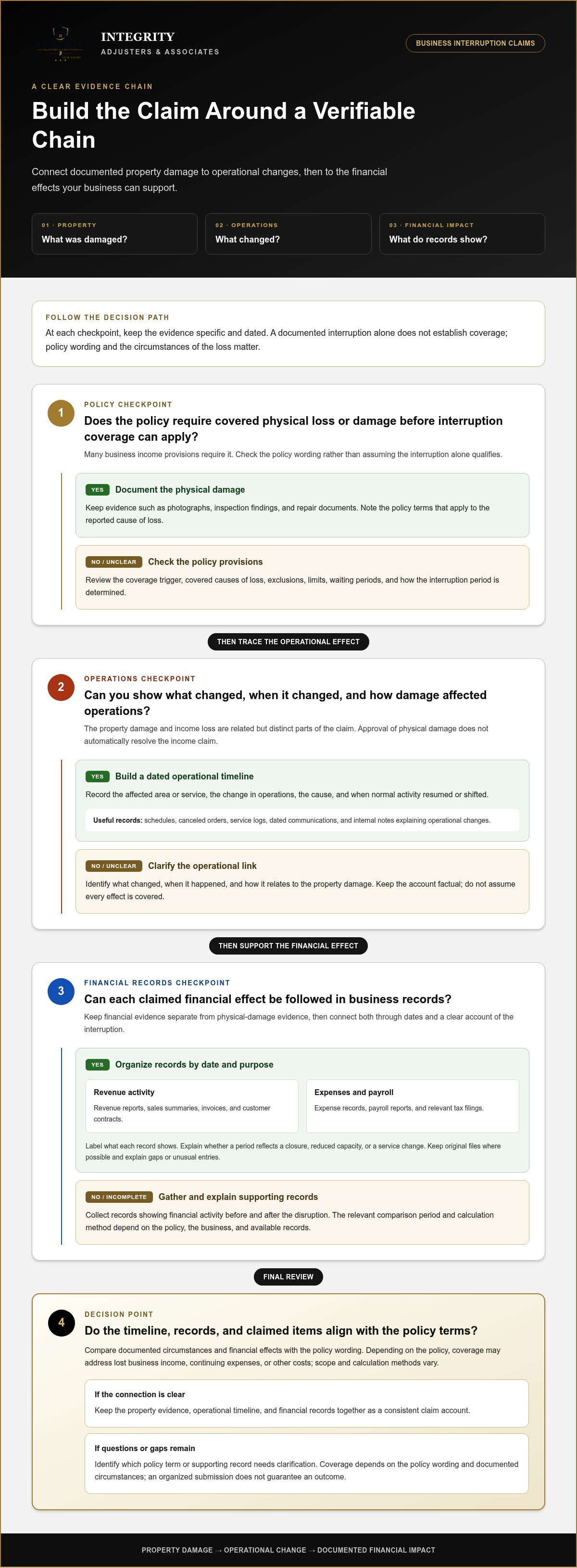
Build a business interruption claim file in clear, manageable steps
A structured claim file makes it easier to explain what happened, how operations changed, and how the loss was calculated. Build it in stages rather than sending a pile of unrelated records. Keep a digital or physical copy of everything you submit, and don’t assume one filing deadline applies to every policy. Review your policy and insurer communications for instructions specific to your claim.
What should the initial claim file contain?
Start with the policy, incident information, insurer correspondence, and records of property damage. Then create a dated timeline that connects the incident to the business effects. Include closures, restricted services, changes in operating capacity, and the dates activities resumed or changed again.
- Collect the core documents. Save the complete policy and endorsements, claim reference details, incident reports, insurer letters, photographs, inspection records, and available repair estimates.
- Build a dated operations timeline. Record when damage occurred, which areas or services were affected, what operating changes followed, and when each activity resumed. Note the source for each date, such as a closure notice or service log.
- Pair damage evidence with financial records. Organize revenue reports, expense records, payroll information, invoices, and contracts by date. Add a concise explanation showing how each record relates to the interruption and any amount claimed.
- Review the file for gaps. Check that dates and amounts are consistent across records. If a document is missing or an entry needs context, explain that clearly instead of leaving the insurer to guess.
For a broader overview of property documentation and the claim process, use this commercial property insurance claim guide alongside the policy-specific instructions for your loss.
How can a business respond to insurer questions?
Answer each request directly, with concise explanations tied to specific dates and records. If a question concerns a period of reduced operations, point to the relevant timeline entry and supporting documents. If the available records don’t fully answer it, identify what they show and what remains unclear. Avoid sending a large batch of unlabelled files; organize the response so each attachment has a clear purpose.
- 5. Maintain one claim log. Track each request, the date received, the response, documents submitted, and any follow-up. Keep copies of emails, letters, and attachments together.
- 6. Confirm what you sent. Save submission receipts or correspondence showing which documents were provided. This helps prevent duplicate work and makes it easier to answer follow-up questions accurately.
For general sequencing, the New Jersey claim filing steps article offers a related reference, though business interruption claims require records tailored to commercial operations. Organized business interruption insurance claim help can bring damage evidence, financial records, and insurer communications into a coherent file. If you need support documenting a commercial property loss and assembling claim materials, get help with your business interruption claim.
How claim advocacy can help New Jersey businesses navigate next steps
A business interruption claim can involve policy language, property documentation, financial records, and ongoing insurer communications. A public adjuster advocates for the policyholder, helping bring these pieces together for review. The role is to document the loss and present a supported claim, not to guarantee coverage or a particular result. Policy terms and the facts of the loss remain central.
What does a public adjuster do for a business interruption claim?
A public adjuster represents the policyholder’s interests in the property claim process, rather than the insurance company’s. For a commercial loss, that support can include documenting property damage, organizing records about interrupted operations, and assembling claim materials that explain how the loss affected the business. The applicable policy wording and documented circumstances guide how the claim is assessed and presented.
This advocacy can clarify the relationship between damage and claimed financial effects. For example, if a business’s operations changed in stages, a clear presentation can distinguish the dates and impacts instead of treating the entire disruption as one unexplained period. If a question arises about a record or claimed item, organized supporting material can make the basis for the claim easier to follow. Coverage decisions still depend on the policy and evidence.
When can business claim advocacy be useful?
Advocacy may be useful when records are extensive, operations have changed in several ways, or the business is working through questions about the insurer’s assessment. It can also help when property damage documentation and financial information need to be brought into one consistent account. Integrity Adjusters & Associates supports commercial property policyholders by documenting losses and assembling comprehensive claim materials for presentation to the insurer.
That support is especially relevant when the business needs a clear way to explain the claim across multiple documents and communications. A policyholder can explore commercial property claim advocacy to understand the role public-adjusting support may play in a commercial loss.
Before taking next steps, gather the policy and current claim correspondence, then identify the specific questions or documentation challenges that remain. A focused review can help establish what the file shows, where clarification may be needed, and how the loss can be presented in an organized manner. Business interruption insurance claim help should be grounded in evidence and policy language, not assumptions about what will be covered.
If a commercial property loss has disrupted your business, Integrity Adjusters & Associates can help document the loss and build a comprehensive claim for insurer review. Reach out to discuss policyholder advocacy for your claim.
Take the Next Step With a Clear Plan
A disruption can leave important decisions competing for your attention. Identify the next question that needs an answer, whether it concerns policy language, a disputed period, or how to present your claim. A focused next step can help move the process forward without assuming what the policy will cover.
Seeking business interruption insurance claim help can bring a policyholder advocate into a complicated commercial claim. Integrity Adjusters & Associates helps document losses and prepare comprehensive claims for insurer review. The aim is a clear, evidence-based presentation, not a promised result.
Request help with your business interruption claim and take the next step with a steady plan. Integrity Adjusters & Associates provides public-adjusting advocacy for New Jersey residential and commercial property insurance claims.
Frequently Asked Questions
Does business interruption insurance cover lost profits?
It may cover lost business income if the policy’s requirements are met, but the policy wording determines how the loss is calculated. Some policies distinguish income from expenses or apply specific limits and exclusions. For example, a business with a large one-time order may need to explain whether that order reflects typical activity. Use consistent accounting records and clarify unusual transactions so the claimed figures can be assessed in context.
Can I file a business interruption claim without property damage?
Possibly, but many policies require covered physical damage, while some endorsements may set out different conditions. The details matter. For example, a utility interruption or restricted access may be addressed only if applicable policy language provides for it. Preserve records showing the source and duration of the disruption, such as utility notices or customer communications. Then compare those facts with the policy before assuming the event qualifies.
What records should I keep for a business interruption insurance claim?
Keep both the original records and working copies, including point-of-sale exports, accounting ledgers, bank statements, customer cancellations, and insurer correspondence. If a sales report changes after an accounting adjustment, preserve the earlier version and note why it changed. A simple index with file names, dates, and descriptions can make large digital records easier to retrieve. The useful records depend on the business’s operations and policy terms.
How is the period of restoration determined?
The policy defines how the period of restoration applies, so don’t assume it ends on the repair completion date. A business may need time to test equipment, restock, or resume services in stages, but whether those events affect the covered period depends on the wording. Keep dated records of milestones, such as equipment returning to service or a department reopening. These details can help explain why operations resumed gradually rather than all at once.
What happens if my insurer disputes my business interruption loss?
Identify the specific point in dispute before sending more material. Is the question about the cause, calculation, records, or claimed time period? Compare the insurer’s explanation with the relevant policy language, then address each issue with concise, dated evidence. If the insurer’s position is unclear, request clarification of the reasons and documents considered. A public adjuster can help organize loss documentation and present the policyholder’s claim, but the outcome depends on the facts and policy.
Can a public adjuster help with a commercial business interruption claim?
Yes. A public adjuster advocates for the policyholder and can help document commercial property losses, organize claim materials, and present a comprehensive claim to the insurer. Integrity Adjusters & Associates provides commercial property claim advocacy in New Jersey. If records are complex or the business interruption portion raises questions, business interruption insurance claim help can bring structure to the presentation. Coverage and any claim decision remain subject to policy terms and documented circumstances.
Are New Jersey business interruption claim deadlines the same for every policy?
No. A claim may involve different dates and requirements, including policy provisions for notice or proof of loss and instructions in insurer communications. Don’t rely on a general deadline as a substitute for checking the documents tied to your claim. Record when the loss occurred, when notice was given, and when requests arrived. Verify any New Jersey-specific legal or regulatory deadline using current authoritative information, since this general guidance isn’t legal advice.


