

A low insurance estimate is not the last word, but frustration alone won’t change it. If the insurer’s valuation leaves out documented damage, a NJ insurance claim dispute adjuster can help you organize the facts and present a clearer account of the loss.
It’s understandable to feel unsure about what to do next. Policy language, claim correspondence, and damage estimates can be difficult to compare, especially when repairs or business operations are affected. A strong New Jersey claim dispute starts with a documented scope of loss and specific questions about the insurer’s decision.
This guide explains how to review an insurer’s estimate, organize evidence such as photographs and invoices, and prepare a focused response. It also explains how a public adjuster can help document residential or commercial property damage, build a comprehensive claim, and advocate during the insurer’s process. Whether you’re dealing with residential water, storm, or fire damage, or a commercial property loss, you’ll find practical ways to present the information clearly and understand where professional support can fit.
Key Takeaways
- Identify whether the disagreement concerns damage, repair scope, coverage, valuation, or claim handling before deciding how to respond.
- Build an organized evidence file with dated photos, videos, invoices, repair records, and specific questions about the insurer’s estimate.
- Compare the estimate with observed damage and available records. A difference alone doesn’t establish that the insurer made an error.
- Review your policy and claim correspondence, preserve the file, and pay attention to any stated deadlines.
- A NJ insurance claim dispute adjuster can help document residential or commercial losses, assemble a comprehensive claim, and advocate through insurer communications.
Why a New Jersey insurance claim may become a dispute
A property insurance claim dispute in New Jersey is a disagreement between a policyholder and an insurer about the damage, repair scope, coverage, valuation, or handling of a claim. The issue may be what was damaged, which work is included in an estimate, or how policy language applies to the documented loss.
When an insurer’s estimate differs from your records, compare the documents before drawing conclusions. Policy terms and claim-specific evidence matter. A residential water loss and a commercial storm loss may raise different questions, and whether an item is covered depends on the applicable policy and circumstances.
For context on the role of an adjuster in the claims process, watch this video:
What parts of a property claim can be disputed?
A disagreement may start with visible damage and extend to the scope or quantity of work included in the estimate. For example, a homeowner may have dated photographs showing water damage in a room that the estimate does not itemize. After a storm, a commercial property owner may compare documented roof damage with the areas and work listed in the insurer’s assessment. A fire loss may raise questions about whether damaged materials or spaces appear in the estimate.
Supporting records help establish what was observed and when. Coverage is a separate question: whether a particular cause or item is covered depends on the policy wording and circumstances of the loss. A difference in estimates alone doesn’t prove an error or establish coverage.
What should you review before responding to the insurer?
Start by bringing the claim materials into one file. Gather the insurer’s estimate, decision letters, policy documents, photographs, and claim correspondence. Compare documents line by line where possible, then note what appears different or missing. Keep observations separate from assumptions. For example, identify the location and date shown in a photograph rather than guessing why an item was left out.
Mark unclear policy wording and any deadlines stated in the policy or correspondence for qualified review. A NJ insurance claim dispute adjuster can help organize documented losses and present a comprehensive claim. For a general explanation of the role, see Public Adjuster. A careful review gives residential and commercial policyholders a factual starting point for responding.
How to build evidence for an NJ insurance claim dispute
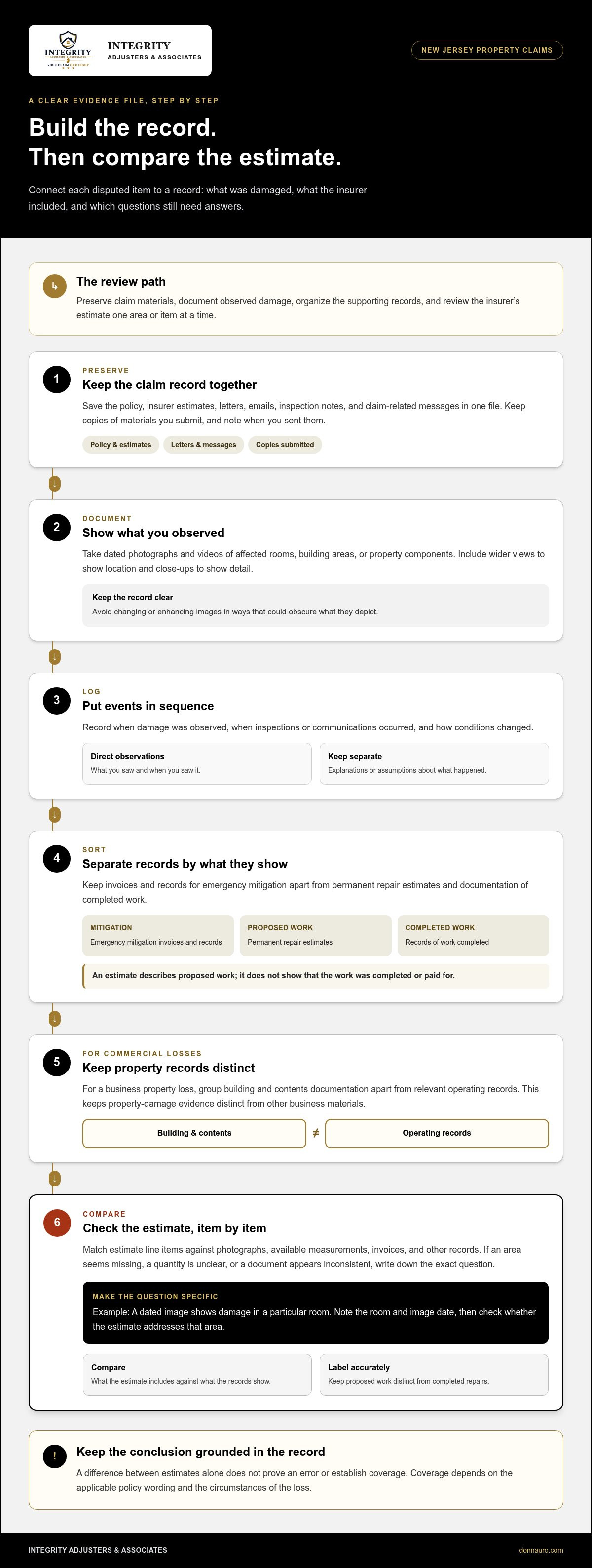
A clear claim file connects each disputed item to a record. Organize evidence to show what was damaged, what the insurer included, and which questions still need answers. Keep original files when possible, and label copies so you can find and compare them easily.
Create a clear record of property damage
Build the file in sequence, from the earliest available documentation through your estimate review:
- Preserve the claim record. Save the policy, insurer estimates, letters, emails, inspection notes, and claim-related messages together. Keep copies of materials you submit and note when you sent them.
- Document what you observe. Take dated photographs and videos of affected rooms, building areas, or property components. Include wider views that show location and close-ups that show detail. Avoid changing or enhancing images in ways that could obscure what they depict.
- Maintain a simple log. Record when damage was observed, when inspections or communications occurred, and how conditions changed. Separate direct observations from explanations or assumptions.
- Sort supporting records by type. Keep invoices and records for emergency mitigation separate from permanent repair estimates and documentation of completed work. An estimate describes proposed work; it doesn’t show that work was completed or paid for.
- Organize commercial records separately. For a business property loss, group building and contents documentation apart from relevant operating records. This keeps property-damage evidence distinct from other business materials.
Compare the insurer estimate with the documented loss
Review the estimate one area or item at a time. Match its line items against your photographs, available measurements, invoices, and other records. If an area appears to be missing, a quantity is unclear, or a document seems inconsistent with the estimate, write down the exact question. Don’t assume that a difference proves misconduct or establishes coverage.
For example, if a dated image shows damage in a particular room, note the room and image date, then check whether the estimate addresses that area. If a repair estimate describes proposed work, label it as an estimate. Keep it separate from invoices or records showing completed work. Clear labels make evidence easier to assess and reduce the risk of confusing proposed work with completed repairs.
A NJ insurance claim dispute adjuster can help policyholders organize documented losses and assemble a comprehensive claim for insurer review. Integrity Adjusters & Associates provides public-adjusting advocacy for residential and commercial property claims in New Jersey, including water, storm, and fire losses. A methodical evidence file gives the claim review a stronger factual foundation.
How to assess an insurer estimate and identify the real disagreement
A lower estimate can feel unfair, especially when damage remains visible or the proposed work seems incomplete. But a lower figure alone doesn’t prove the insurer made an error. Compare the estimate with the documented damage and policy terms, then identify exactly where the accounts differ. That gives you a focused basis for asking questions instead of relying on the total alone.
Separate damage scope, valuation, and coverage questions
Scope describes the damage and work represented in the estimate. Valuation concerns how the listed work is priced. Coverage is a policy-specific question about whether the loss or an item is covered under the applicable terms. An estimate may explain the insurer’s assessment, but it doesn’t settle every coverage question. Flag unclear policy interpretation or legal issues for qualified review.
Use a comparison like this to locate the disagreement:
| Insurer estimate | Observed damage | Available records | Unresolved question |
|---|---|---|---|
| Lists work for the area | Damage appears in the same area | Dated photos or inspection notes | Does the estimate address all documented damage? |
| Includes a quantity or measurement | Observed dimensions or affected extent differ | Measurements, diagrams, or invoices | How was the listed quantity determined? |
| Does not show a specific item | Item appears affected or damaged | Photos, receipts, or other claim records | Was the item assessed, excluded, or omitted? |
For a water loss, compare the estimate with records showing which areas were affected and what damage was documented. The residential water damage claim guide offers additional context for this type of claim.
Organize a concise response to the claim decision
Group your questions by estimate item or damaged area. For each one, identify the supporting record and ask for a specific clarification. For example: “The estimate doesn’t list the damaged area shown in these dated photographs. Was this area assessed?” Keep communications factual, dated, and consistent with the claim file. Avoid conclusions about intent. Focus on what the documents show and what remains unanswered.
If a disputed loss affects business property, keep building-damage questions distinct from operating records. The commercial property claim advocacy guide provides related context. A NJ insurance claim dispute adjuster can help organize documented differences into a clear claim presentation for insurer review.
What New Jersey policyholders can do next in a claim dispute
A clear next step keeps a claim dispute focused on the record. Work through the file in order and check the policy and correspondence for instructions or dates that may apply. Deadlines can depend on the policy and claim circumstances, so review the specific terms rather than relying on a general timeline.
- Preserve the claim file. Keep the policy, estimates, decision letters, photos, invoices, and communications together. Save copies of anything you send or receive.
- Review relevant policy wording. Mark provisions that appear connected to the loss, along with language you don’t understand. Don’t assume an item is covered or excluded based on the estimate alone.
- Compare the decision with the documented damage. Identify specific differences between the estimate and your records, such as an area not addressed or a line item that needs clarification.
- Prepare focused questions. Tie each question to an estimate item, a documented observation, or a policy passage. Separate what you know from what you’re asking the insurer to explain.
Communicate clearly and preserve the claim record
Keep written communications in the claim file. After a call or inspection, note the date, participants, and any follow-up items. If a decision or estimate item is unclear, ask for an explanation in writing and refer to the relevant document or area. Stay factual and avoid unsupported conclusions about the cause of damage, coverage, or necessary work. If wind or storm damage is central to the dispute, the residential storm damage claim guide provides related context.
Understand the roles involved in a claim dispute
A public adjuster advocates for the policyholder by helping document and present a property claim, organize damage information, and navigate insurer communications. This role is distinct from legal representation, selling insurance policies, or completing physical repairs. A public adjuster doesn’t guarantee a claim outcome, but can help bring structure to the claim presentation. This support may apply to residential water, storm, and fire losses, as well as commercial property claims.
For support organizing a documented property loss and preparing it for insurer review, explore claim advocacy support.
How a New Jersey public adjuster can support a property claim dispute
A property claim can involve many records, estimates, and conversations with the insurer. Integrity Adjusters & Associates provides public-adjusting advocacy for residential and commercial property claims in New Jersey. The firm helps policyholders document damage, assemble a comprehensive claim, and navigate the insurer process. A NJ insurance claim dispute adjuster can bring structure to the claim presentation by connecting documented damage with questions that remain unresolved.
What to expect from claim advocacy
Claim advocacy starts with the information available about the loss. A public adjuster can review claim materials, organize the policyholder’s damage record, and help present documented property losses to the insurance provider. The goal is a clear, supportable account of the claim, not a promised result. Advocacy does not guarantee that an insurer will agree with the claim, provide coverage, or reach a particular settlement.
This role is distinct from legal representation, insurance sales, and physical repairs. It focuses on documenting and presenting the property claim and helping the policyholder navigate claim communications and process steps. Support can apply to residential water, storm, and fire losses, as well as commercial fire, storm, and business property claims.
Prepare for a focused claim discussion
Before discussing a disputed claim, gather the core records in one place:
- The relevant policy documents and insurer estimate
- Decision letters and other claim correspondence
- Dated photographs, videos, and other damage records
- Relevant invoices, repair estimates, or completed-work records, clearly labeled by type
Then write a short summary of the disputed items. Identify the affected area or estimate line, point to the supporting record, and list the clarification you’re seeking. Keep unanswered questions separate from established facts. This makes it easier to explain what you believe is missing without overstating the evidence or assuming the reason for the difference.
For a fire loss, the Cherry Hill fire damage claim guide offers additional context on property claim advocacy. A well-organized file gives the discussion a practical starting point, whether the loss affects a home or a business. The insurer still evaluates the claim under the policy and specific facts, so advocacy can strengthen documentation and presentation but cannot promise coverage or a settlement outcome.
Discuss your New Jersey claim dispute with Integrity Adjusters & Associates.
Move Your Property Claim Forward With a Clear Plan
A property claim dispute is easier to address when you can show precisely where the insurer’s estimate, decision, or handling differs from the documented loss. Preserve the claim file, compare estimate details with available records, and keep questions grounded in the policy and facts. These steps give you a more organized basis for communicating with the insurer.
If you need support, an NJ insurance claim dispute adjuster can help document a residential or commercial property loss, prepare a comprehensive claim, and guide you through insurer communications. Advocacy can strengthen how the claim is organized and presented, though it can’t guarantee coverage or a particular settlement.
Integrity Adjusters & Associates provides residential and commercial property claim advocacy in New Jersey. Discuss your New Jersey property claim with Integrity Adjusters & Associates to explore support for documenting your loss and navigating the claim process. An evidence-led next step can help you move forward with greater clarity.
Frequently Asked Questions
Can I dispute an insurance claim decision in New Jersey?
Yes. If you disagree with an insurer’s property claim decision, you can respond with relevant documentation and ask for clarification. Identify whether the concern involves damage, repair scope, valuation, coverage, or claim handling. Compare the decision with the policy and your claim records, and keep communications in writing. Review any deadlines stated in your policy or correspondence, since timing can depend on your specific claim.
How do I challenge a low property insurance estimate?
Compare the estimate line by line with the damage you observed and your supporting records. Note areas that appear to be missing, quantities that need explanation, or documented damage not addressed. Ask the insurer specific questions in writing and include relevant dated photos, measurements, invoices, or repair records. A lower estimate alone doesn’t establish an error, so focus your response on documented differences and applicable policy terms.
What does a public adjuster do in an insurance claim dispute?
A public adjuster advocates for the policyholder by helping document property damage, organize claim information, and prepare a comprehensive claim for presentation to the insurer. An NJ insurance claim dispute adjuster can also help policyholders organize claim communications and focus the presentation on records and unresolved questions. Public adjusting is not legal representation, insurance sales, or physical repair work, and advocacy can’t guarantee coverage or a particular settlement.
When should I get help with a New Jersey property claim dispute?
Consider getting support when you’re unsure how to organize the evidence, interpret the estimate, or respond to claim correspondence. Help may also be useful when documented damage and the insurer’s assessment appear to differ, or when a residential or commercial loss involves many records. Address the issue promptly and review any dates in your policy or insurer correspondence. A public adjuster can help prepare and present the property claim.
What documents should I gather for an insurance claim dispute?
Gather your policy, insurer estimate, decision letters, claim correspondence, and inspection notes. Add dated photographs or videos, measurements, invoices, repair estimates, and records of completed work. Keep emergency mitigation documents separate from permanent repair estimates and completed-work records. For a commercial property claim, organize building and property-damage materials separately from relevant business operating records. Label each item clearly so you can connect it to the disputed area or estimate question.
Can a public adjuster guarantee a higher insurance settlement?
No. A public adjuster can help document the loss, assemble claim materials, and advocate for the policyholder during the insurer process, but can’t guarantee coverage, claim approval, or a higher settlement. The insurer evaluates the claim based on the policy and claim-specific facts. Strong, organized documentation can make the policyholder’s position clearer, but the outcome depends on the evidence, applicable policy terms, and the insurer’s decision.
Is a public adjuster the same as an insurance company adjuster?
No. A public adjuster advocates for the policyholder by helping document and present the property claim. An insurance company adjuster handles the claim on behalf of the insurer. Their roles differ, so keep track of who you’re communicating with and which organization they represent. A public adjuster doesn’t sell insurance policies, provide legal representation, or perform physical repairs. The focus is claim documentation and advocacy through the insurer process.


