

What if the damage you can see is only part of the loss your insurance claim needs to document? After a storm, fire, or water event, it’s understandable to feel unsure what to photograph, which records to gather, and whether an insurer’s estimate captures the full picture. A Woodbridge NJ property damage assessment for an insurance claim connects observed damage with organized evidence, helping you present a clearer account of the loss.
This is different from a property tax assessment. A tax assessment helps determine a property’s assessed value for taxation. An insurance-focused assessment documents damage related to a reported loss and supports the claim process. Keeping those purposes separate can prevent confusion as you review paperwork and communicate with your insurer.
In this article, you’ll learn what an insurance-focused assessment involves, which property and claim details to organize, and how to compare your documentation with the insurer’s estimate. Integrity Adjusters & Associates helps residential and commercial property owners document losses and prepare comprehensive claims. If an estimate appears to leave out damage, claim advocacy can help organize relevant evidence for the insurer’s review.
Key Takeaways
- A Woodbridge NJ property damage assessment helps organize observed losses into a clearer insurance claim record.
- Tax assessments, insurer inspections, and policyholder documentation serve different purposes. Knowing which record you’re reviewing can help you spot gaps.
- Keep photos, receipts, inventories, prior condition records, and insurer communications together to make claim information easier to review.
- Integrity Adjusters & Associates helps residential and commercial property owners document losses and prepare comprehensive insurance claims.
What a Woodbridge NJ Property Damage Assessment Means After a Loss
What should an assessment establish after property damage? It should create a clear, organized record of the loss observed at the property: which areas are affected, what condition they’re in, and what information may help explain the damage. A Woodbridge NJ property damage assessment for an insurance claim documents those facts so they can be reviewed as part of the claim.
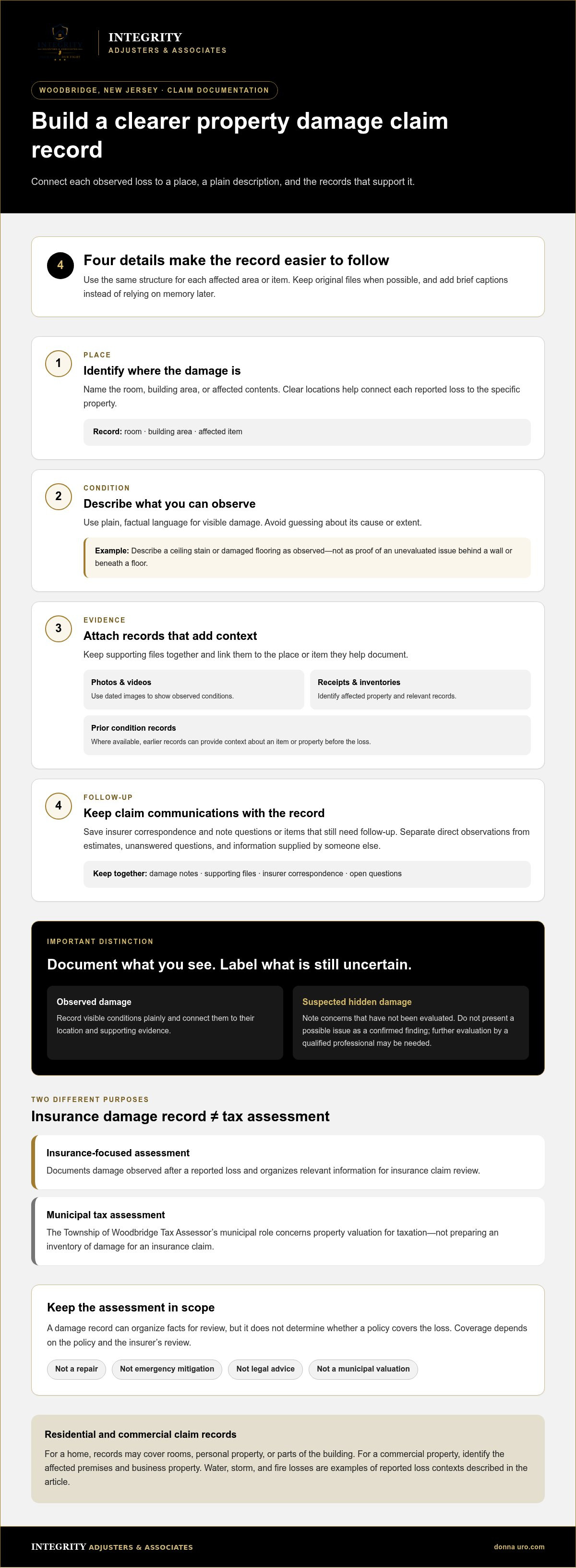
That record has limits. Documented damage does not, by itself, determine whether an insurance policy covers the loss. Coverage depends on the policy and the insurer’s review. An assessment also isn’t a repair, emergency mitigation, legal advice, or a municipal valuation. Those are separate functions.
For a visual overview of how building damage may be assessed, watch this video:
Insurance damage assessment versus Woodbridge tax assessment
Searches for a local assessment can lead to the Township of Woodbridge Tax Assessor. That office’s municipal role concerns property valuation for taxation, not preparing an inventory of damage for an insurance claim. The two meanings share the word “assessment,” but answer different questions: what value is assigned for tax purposes, versus what damage is observed and recorded after a loss?
For an insurance claim, the focus is on the affected property and the supporting information that helps explain the reported loss. The local context matters, too. Woodbridge, New Jersey is where the property and claim records are situated; the assessment should be grounded in evidence from that specific property, not assumptions about the area.
Which property owners may need claim documentation?
Homeowners may need a record of damage to rooms, personal property, or parts of the home after a reported water, storm, or fire loss. Commercial owners may need to document damage to a building or business property, organizing records around the affected premises and assets. These are distinct claim contexts, so the documentation should identify the property and losses clearly rather than treating residential and commercial impacts as interchangeable.
In either case, the purpose is to build a clearer record for claim review. A well-organized assessment can show what was observed and provide a factual basis for discussing the loss with the insurer. It does not promise a coverage decision or settlement. Integrity Adjusters & Associates supports residential and commercial policyholders by documenting property losses, preparing comprehensive claims, and helping them navigate the insurer’s process.
How a Woodbridge Property Damage Assessment Builds an Insurance Claim
A useful assessment gives a claim structure. Instead of a collection of unconnected photos and notes, it creates an organized record of observed damage, affected areas, and relevant property information. That makes it easier to follow what happened and see which evidence supports each part of the reported loss.
For example, a note that says “water damage in the house” leaves important details unclear. A more useful record identifies the room, describes the visible condition, and connects it to dated photos or related receipts. The Woodbridge NJ property damage assessment doesn’t decide coverage; it organizes facts for review under the policy.
Record visible conditions separately from suspected hidden damage. You can document what you see, such as a ceiling stain or damaged flooring, while noting concerns that haven’t been evaluated. Don’t present a possible issue behind a wall or beneath a floor as a confirmed finding. Further evaluation by a qualified professional may be needed to determine its extent.
What information belongs in an assessment record?
Use a consistent structure so each item can be traced to a place, date, and supporting record. Keep original files when possible, and add brief captions rather than relying on memory later. Separate direct observations from estimates, unanswered questions, or information supplied by someone else.
- Location: Identify the room, building area, or affected contents.
- Observed condition: Describe visible damage plainly, without guessing at its cause or extent.
- Supporting evidence: Keep dated photographs and videos with receipts, inventories, and records showing prior condition where available.
- Claim communications: Save insurer correspondence and note which questions or items still need follow-up.
These records help connect reported damage to relevant property details. An inventory may identify an affected item, while a receipt or prior photo may provide context about its condition before the loss. Label uncertain details clearly. Accuracy is more useful than making a record sound complete when information is still missing.
How claim advocacy uses the documented loss
A public adjuster can help a policyholder organize observed losses and supporting materials into a comprehensive claim for the insurer. The record gives the claim a clearer structure: what was affected, where the damage was observed, and what documentation accompanies each item. That organization can also help the policyholder navigate communications and the insurer’s review process.
Integrity Adjusters & Associates provides residential and commercial property claim advocacy, including support for water, storm, and fire losses. Advocacy focuses on documenting the loss and preparing the claim. It isn’t repair work, emergency mitigation, or legal representation, and a documented assessment doesn’t guarantee that a loss is covered or that a particular payment will be made.
If you’d like help organizing property-loss records into a claim, explore property claim advocacy as a next step.
Property Damage Assessment, Insurer Inspection, and Tax Assessment Compared
The word “assessment” can refer to different records, and confusing them can make claim paperwork harder to interpret. A municipal tax assessment concerns property valuation for taxation. An insurer’s inspection or estimate contributes to its review of a reported loss. Policyholder claim documentation organizes observed damage and supporting information from the owner’s perspective.
These records may relate to the same property, but they serve different purposes. None automatically determines whether a policy covers a loss or what the final claim outcome will be. Use this comparison to identify what each record can help establish.
| Record | Purpose | Who conducts or prepares it | How it’s used |
|---|---|---|---|
| Municipal tax assessment | Assigns a property value for taxation. | The municipal tax assessor. | Supports municipal property valuation, not an inventory of insurance loss. |
| Insurer inspection or estimate | Contributes to the insurer’s evaluation of a reported claim. | An insurer or its representative. | Helps inform claim review; it may describe inspected damage and estimated work or costs. |
| Policyholder claim documentation | Organizes reported losses and evidence about the property’s condition. | The policyholder, with help from a public adjuster when engaged. | Helps present the reported damage and supporting records for insurer review. |
Claim documentation records property loss; municipal valuation records property value for taxation. Keeping that distinction in mind can help Woodbridge owners understand which question a document answers and what information it does not establish.
What does an insurer’s property inspection establish?
An insurer’s inspection contributes information to the insurer’s claim review. An inspection or estimate can describe damage observed during that process, but it isn’t automatically a complete inventory of every loss a policyholder reports. Its scope depends on the inspection and the information considered. This doesn’t mean every inspection is incomplete or inaccurate. It means owners should understand what the document covers and compare it with their own records.
When does an independent claim assessment add context?
Organized documentation can help a policyholder present the reported loss clearly, especially when records identify relevant areas, contents, and supporting evidence. A public adjuster can help prepare a comprehensive claim and navigate the insurer’s process on the policyholder’s behalf. This is a separate perspective, not an automatic challenge to every insurer decision. Policy terms and the specific facts of the loss shape claim review.
A Woodbridge NJ property damage assessment should be read as a documented account, not a coverage ruling. If records differ, focus on the facts behind each item: what was observed, what evidence supports it, and what remains uncertain. That approach keeps the discussion specific and gives the insurer clearer information to consider without treating any one document as the final word.
What Woodbridge Property Owners Should Do Before a Damage Assessment
After a loss, safety comes first. Don’t delay urgent safety measures to gather paperwork or photograph damage. Once it’s safe, start a clear record of what you observe and keep claim-related materials together. A Woodbridge NJ property damage assessment is easier to support when the information is organized, dated, and separated from assumptions about cause or coverage.
Organize property and claim records
Set up one digital or paper claim file. Add dated observations, affected locations, available ownership or maintenance records, inventories, receipts, and repair-related documents. Save copies of anything sent to the insurer, along with responses and other claim communications. Keep original photos and receipts where possible, and label files so you can tell what each one shows.
- Address immediate safety concerns. Follow appropriate safety guidance and take urgent steps to protect people. Don’t enter an area that appears unsafe just to document it.
- Record what you can observe safely. Note the date, affected rooms or building areas, and visible conditions. Keep direct observations distinct from suspected damage or questions that need further evaluation.
- Preserve supporting evidence. Save photos and videos, receipts, inventories, and records that may show the property’s prior condition. Add brief labels or notes to identify where and when each item was recorded.
- Collect relevant property records. Gather available ownership, maintenance, inventory, and repair documents that relate to the affected property or items. Don’t treat an estimate or an unverified possibility as a confirmed loss.
- Keep claim communications together. Save insurer messages and copies of documents you submit. Review your policy and insurer communications for instructions and applicable timeframes; don’t rely on a general article to establish a claim deadline.
Keep Woodbridge location details factual
Woodbridge Township is in Middlesex County, but a property’s location alone doesn’t establish what caused damage or whether a policy covers it. References to the Raritan River, tidal flooding, or nor’easters should be included only when current, reliable information supports the specific statement. Don’t treat a general local risk description as proof of what happened at an individual property.
Flood coverage and other policy provisions depend on the policy terms and circumstances of the loss. Record the observed conditions and relevant dates, then let the claim review consider those facts. Avoid labeling a loss as flood damage or assuming coverage based on location alone. Precision protects the usefulness of your file.
If you want support organizing loss records and preparing a comprehensive claim, get help with property claim documentation.
Get Property Damage Claim Advocacy for a Woodbridge NJ Assessment
A documented loss is a starting point. The next step is presenting the relevant information in a clear, organized claim and responding to the insurer’s review. Integrity Adjusters & Associates provides public-adjusting advocacy for residential and commercial property claims, helping policyholders document losses, prepare comprehensive claims, and navigate the insurer’s process.
A Woodbridge NJ property damage assessment can involve different needs depending on the property and reported loss. A homeowner’s claim may concern damage to the residence or its contents. A business claim may involve commercial property or other affected business assets. Keeping those contexts distinct helps focus the documentation on the property and losses being presented.
What to expect from public adjusting advocacy
Public adjusting advocacy centers on the policyholder’s claim. Integrity Adjusters & Associates helps document property losses, organize relevant claim information, and prepare a comprehensive submission for the insurer. The work can also support communication through the insurer’s process, so the reported damage and its documentation are presented in a structured way.
This is policyholder advocacy, not legal representation. It also isn’t insurance policy sales, repair work, or emergency mitigation. No assessment or claim presentation can guarantee coverage, approval, or a particular settlement amount. The policy terms, evidence, and circumstances of the reported loss remain relevant to the insurer’s review.
Choose a relevant next step for your property
For homeowners dealing with water damage, the article Residential Water Damage Claim Support: A Homeowner’s Guide to Fair Settlements offers a focused next read. It addresses the residential water-loss claim context rather than treating every property claim as the same situation.
Business owners can turn to Commercial Property Insurance Claim Help: A Guide to Business Advocacy in 2026 for guidance focused on commercial property claims. Business documentation may differ from a homeowner’s records, so a resource centered on commercial advocacy can help clarify that separate process.
If you’re preparing to discuss a property loss, gather the records you have and identify the questions or concerns you want addressed. Integrity Adjusters & Associates can help you consider how claim advocacy may support the documentation and insurer process for your residential or commercial property. Discuss your Woodbridge property damage claim with Integrity Adjusters & Associates to take the next step with a clearer understanding of the process.
Move Forward With a Clearer Claim Plan
The next useful step after a loss is to turn uncertainty into a manageable plan. Set aside the records you’ve gathered, note what remains unclear, and consider what support would help you present the claim with confidence. A Woodbridge NJ property damage assessment is most useful when its documentation leads to informed, deliberate decisions, not assumptions about coverage or outcome.
Integrity Adjusters & Associates provides residential and commercial property claim advocacy, helping policyholders document losses and build comprehensive claims. That support brings structure to the insurer’s process while keeping the focus on the facts of your property and reported damage.
You don’t need to have every detail resolved before taking the next step. Start with the information you have and the questions you want answered. Discuss your Woodbridge property damage claim with Integrity Adjusters & Associates and move forward with a clearer path.
Frequently Asked Questions
What is a property damage assessment for an insurance claim?
It’s a structured review of damage reported after a loss, prepared to help explain what was affected and what evidence supports the claim. For example, after a kitchen leak, the record might distinguish damage to cabinetry from damage to flooring and note which items have photos or repair records. This gives the claim reviewer specific details to consider rather than one broad description of the incident.
Is a property damage assessment the same as a Woodbridge tax assessment?
No. A Woodbridge tax assessment is used for municipal property valuation and taxation; an insurance damage assessment concerns reported loss and related claim evidence. A tax valuation doesn’t itemize damaged rooms or contents, and an insurance claim record isn’t a tax valuation. When reviewing paperwork after a loss, check who prepared it and what decision or review it’s intended to support before relying on it for another purpose.
Who assesses property damage for an insurance claim?
An insurer may arrange an inspection as part of its claim review. The policyholder can also document damage and provide relevant records, while a public adjuster can help organize losses and prepare a claim for the insurer. These roles aren’t interchangeable: an insurer’s inspection informs its review, and policyholder documentation gives additional context. The person preparing a record doesn’t, by that fact alone, decide whether the policy covers the loss.
What should I document before a property damage assessment?
After addressing immediate safety needs, record the date, affected locations, and visible conditions. When safe, take broad photos that show where damage is and closer views of specific details. Keep receipts, relevant inventories, prior property records, and insurer messages in one organized file. If an item must be moved or discarded to protect people or prevent further damage, preserve any evidence you can safely capture first, without delaying necessary action.
Can a public adjuster help with a property damage claim in Woodbridge, NJ?
Yes. Integrity Adjusters & Associates provides public-adjusting advocacy for residential and commercial property claims in New Jersey. A public adjuster can help the policyholder document reported losses, build a comprehensive claim, and navigate the insurer’s process. For a Woodbridge homeowner, the claim may involve residential water, storm, or fire damage; a business owner’s claim may concern commercial property damage. Advocacy isn’t legal representation or a promise of a particular result.
Does a property damage assessment guarantee that insurance will cover the loss?
No. An assessment records information about damage, but it can’t guarantee coverage, claim approval, or a particular payment. The insurer reviews the policy terms alongside the facts of the loss. For instance, the cause of damage and the policy’s applicable provisions may matter to the decision. Keep the assessment as supporting documentation, and compare the insurer’s explanation with the policy and the evidence available for the reported event.
How do I find flood zone information for a Woodbridge property?
Search the property address through FEMA’s Flood Map Service Center and review relevant floodplain information from Woodbridge Township. Use the exact address, since map designations can vary between nearby properties. A map can provide location-based flood information, but it doesn’t establish the cause of damage at a specific building or determine insurance coverage. For a claim, keep map findings separate from observations and records about the actual loss.


