

A damage inspection may capture visible problems without showing the full scope of a home loss. If you’re unsure whether the insurer’s assessment reflects what you observed, a Cherry Hill homeowners insurance claim advocate can help document the damage and present a clearer, more complete claim.
It can be difficult to track photographs, repair estimates, policy documents, and insurer correspondence while managing damage at home. A public adjuster works on the policyholder’s side, helping organize claim evidence and communicate the documented loss to the insurance company. This role differs from an adjuster who represents the insurer, and it does not guarantee a particular settlement.
This article explains how claim evidence can support an insurer’s review and offers practical steps Cherry Hill homeowners can use to keep claim information organized. You’ll also learn how public adjusting advocacy fits into the process, from organizing available damage information to building a comprehensive claim presentation. The aim is to make the next step clearer while the insurer evaluates the loss.
Key Takeaways
- A Cherry Hill homeowners insurance claim advocate can help organize damage information and present a comprehensive claim for the insurer to review.
- Dated photos, videos, receipts, and relevant communications can create a factual record of observed damage and affected areas.
- Staff and independent adjusters evaluate claims for the insurer; a public adjuster advocates for the policyholder.
- If a claim is unclear, follow a practical sequence: prioritize safety, prevent further damage when safe, document what you observe, and organize your records.
- Integrity Adjusters & Associates helps document property damage, build a clear claim presentation, and navigate the insurer’s process without promising a particular outcome.
What a Cherry Hill Homeowners Insurance Claim Advocate Does
A homeowner facing property damage needs more than a list of visible problems. The loss and supporting information need to be presented clearly so the insurer can review what happened and what was affected. A Cherry Hill homeowners insurance claim advocate helps document the damage and organize relevant information into a comprehensive claim for the insurance company.
Integrity Adjusters & Associates provides public-adjusting advocacy for policyholders. A public adjuster works on the policyholder’s side to help prepare and present a property claim. This is different from legal representation: the firm focuses on documenting damage, preparing the claim, and navigating the insurer’s process, not providing legal advice or acting as an attorney. The general role is also described in this overview of the Public Adjuster.
Advocacy does not determine coverage by itself. The individual policy’s terms, the documented loss, and the insurer’s review all affect whether damage is covered and what payment may be considered. An organized presentation helps communicate the available facts, but cannot promise claim approval or a particular settlement.
How claim advocacy supports a Cherry Hill homeowner
Claim information often arrives in pieces: photos from different rooms, notes about when damage was noticed, property records, and messages exchanged with the insurer. An advocate helps bring relevant details together and build a comprehensive claim presentation. The aim is to make the reported damage and supporting information easier to follow, without overstating what the evidence shows.
For example, if a homeowner reports storm damage in several areas, the presentation should distinguish the observed conditions by location and connect each item to the supporting information available. An advocate can also help the policyholder keep communications and process steps organized, including questions, submitted materials, and insurer responses. Clear records support an accurate discussion and fair consideration, but do not guarantee a result.
When a homeowner may seek claim support
Not every property claim requires professional advocacy. Support may be useful when a homeowner is unsure whether the damage has been clearly documented, what information to gather, or how to respond to questions about the claim. A loss affecting several areas of the home can also create a substantial record to organize.
Support may also help when the insurer’s assessment appears different from the homeowner’s documented observations. Start by identifying the specific difference, such as an affected area or item of damage, and gathering information related to it. A claim advocate can help present those details systematically for review. The focus stays on evidence and accuracy, rather than assuming that every difference means the claim is disputed or that a particular outcome will follow.
How Damage Documentation Builds a Clearer New Jersey Home Claim
Documentation gives a claim a factual structure. It records what damage was observed, where it appeared, when it was documented, and what related property information may help explain the loss. A photo of a ceiling stain, for example, is more useful when the room and date are clear and notes describe when the stain was first noticed. Keep observations factual, and avoid guessing at the cause if it isn’t known.
A well-documented claim is an organized account of the loss, supported by records showing what was observed and what information was gathered. Photos and videos can show visible conditions, while receipts, relevant communications, and property records may provide context. Repair assessments or estimates can also be useful, but they should accompany the observed evidence rather than replace it. An estimate describes proposed work or costs; by itself, it does not show the full record of what was damaged.
Organize damage records before claim discussions
Make the record easy to follow. Group photos and videos by room or building area, and retain dates when available. Keep copies of receipts and other records related to temporary protection or damage-related expenses. A simple timeline can track when damage was discovered, when it was reported, inspection dates, and insurer communications. This makes it easier to connect each item to the sequence of events.
Label images by location, such as “upstairs bedroom” or “kitchen ceiling,” instead of leaving a folder of files without context. Save emails, letters, and notes from calls together, adding dates and the names of people involved when known. Keep original files where practical and store a separate copy so the record remains accessible.
Connect the evidence to the policy and claim
Review the relevant policy documents for coverage terms, exclusions, limits, and duties related to reporting and cooperation. Then describe each observed area clearly and connect it to supporting records. Don’t assume a photo, repair estimate, or receipt automatically establishes coverage. The insurer reviews the claim under the individual policy and considers the information submitted.
- Note which rooms or property areas are represented in the records.
- Flag unclear dates, missing photos, or descriptions that don’t match across documents.
- Keep estimates and receipts distinct from photos and notes about observed conditions.
Before claim discussions, a Cherry Hill homeowners insurance claim advocate can help organize available records into a clear presentation and identify information that may need follow-up. Integrity Adjusters & Associates helps policyholders document property damage and build comprehensive claims for insurers. If you’re bringing scattered records into order, claim documentation support can help make the loss information easier to present and review.
Public Adjuster, Insurance Adjuster, or Attorney: Who Does What?
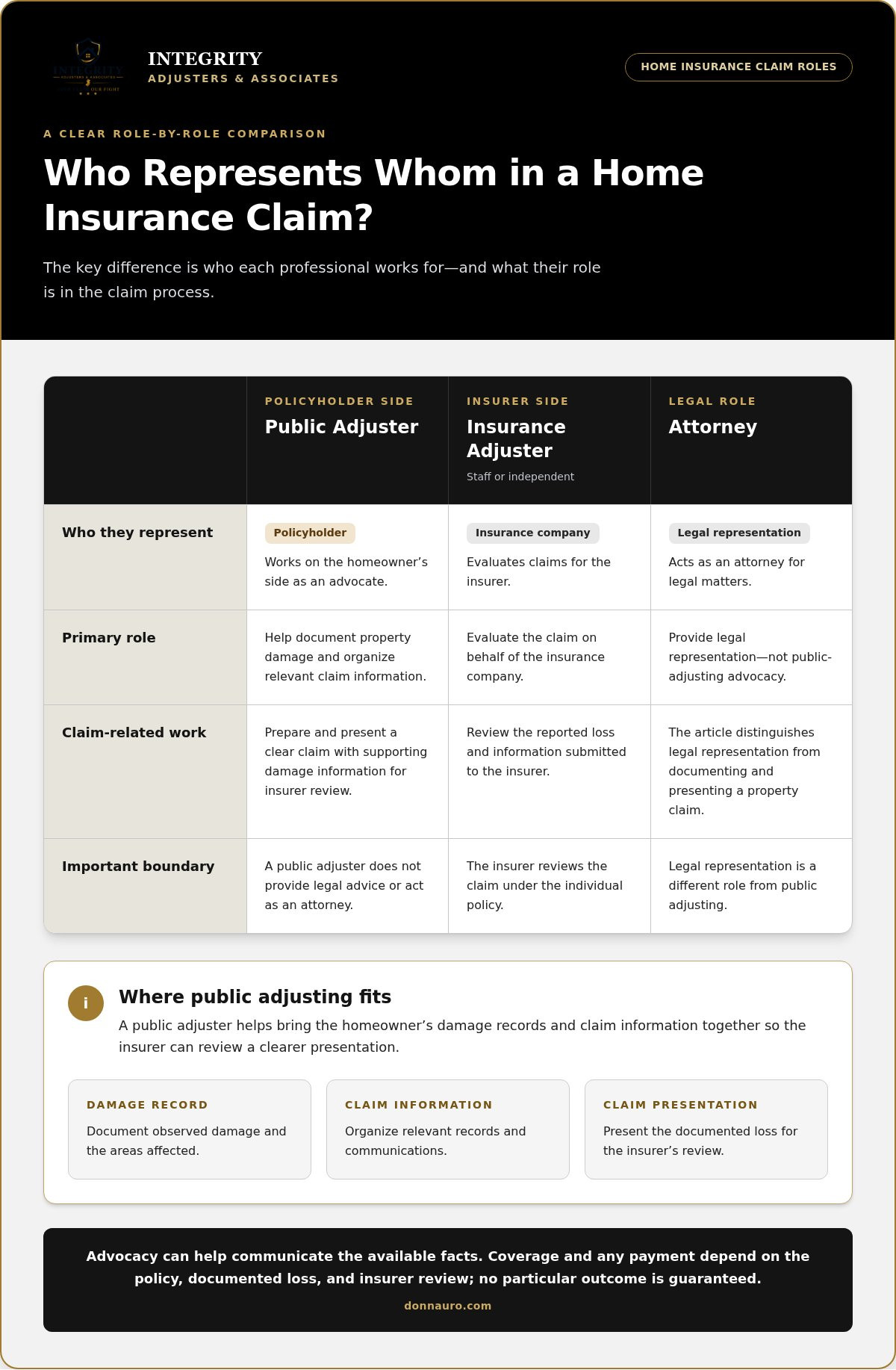
These professionals may all appear in a homeowners claim, but they serve different roles. Knowing whom each represents helps you direct questions appropriately and understand who is organizing the claim, evaluating it for the insurer, or providing legal advice.
| Professional | Whom they represent | General claim role |
|---|---|---|
| Staff adjuster | The insurance company | Evaluates the reported loss and claim information for the insurer. |
| Independent adjuster | The insurance company that hires them | Assesses claim information on the insurer’s behalf as a third-party contractor. |
| Public adjuster | The policyholder | Helps document and present the homeowner’s property claim. |
| Attorney | The client | Provides legal representation and advice on legal questions. |
An insurer’s adjuster evaluates a claim for the insurance company. A public adjuster’s client is the policyholder. Neither adjuster independently establishes coverage or guarantees payment. The insurer reviews the claim under the policy and considers the evidence and other relevant information.
What distinguishes a public adjuster from the insurer’s adjuster?
The difference is representation and perspective, not an assumption of misconduct. A staff adjuster works for the insurer, while an independent adjuster is hired by the insurer to assess claims. A public adjuster represents the homeowner in documenting and presenting the loss. A Cherry Hill homeowners insurance claim advocate in a public-adjusting role can help organize claim information and communicate documented damage from the policyholder’s perspective.
For instance, if the homeowner’s records describe damage in several areas, a public adjuster can help assemble those observations into a coherent claim presentation. The insurer still reviews the submitted information and applicable policy terms. The advocate’s work supports a clear, complete presentation; it does not replace the insurer’s review or decide the outcome.
When does an insurance claim raise a legal question?
Some questions concern documentation and claim preparation. Others involve legal rights or interpretation of policy language, such as a disagreement about what a provision means or what remedies may be available. These are legal questions. Homeowners should direct them to a qualified New Jersey attorney, who can provide legal advice and representation based on the circumstances.
Integrity Adjusters & Associates focuses on public-adjusting advocacy: documenting property damage, preparing a comprehensive claim, and helping navigate the insurer’s process. The firm does not provide legal representation. Keeping the roles clear helps homeowners choose the right kind of support for the question at hand, without treating every claim difference as a legal dispute.
What Cherry Hill Homeowners Can Do When a Claim Is Unclear
Uncertainty about an insurer’s assessment can make the next step hard to identify. Keep your response measured and evidence-based. Start with safety, then build a clear record and communicate with the insurer according to the reporting and cooperation requirements in your policy.
Prompt, organized documentation helps explain what was reported, what you observed, and what information supports the claim. It does not determine coverage, but it can make the facts easier to review. A practical sequence is:
- Protect people first. Avoid areas that may be unsafe and follow appropriate safety guidance.
- Prevent further damage when safe. Take reasonable steps to limit additional harm only when it’s safe to do so.
- Document observed conditions. Record affected areas with dated photos or video where possible, and distinguish what you saw from what you suspect caused it.
- Organize and communicate. Gather related records, keep copies of what you submit, and contact the insurer promptly in line with your policy.
Record when you reported the loss, what materials you sent, and whom you spoke with. For calls, note the date, contact details, and any next steps discussed. Save copies of emails, letters, photographs, receipts, and other submitted documents together. This gives you a reliable reference if questions arise later.
Prepare for an insurer inspection or follow-up
Before an inspection or follow-up discussion, make relevant photographs, timelines, receipts, and claim correspondence easy to access. Describe damage by location and condition, using direct observations rather than assumptions about cause or coverage. If you notice a new issue or have a question, write it down with the date. Clear notes help keep the discussion focused and reduce reliance on memory.
Respond carefully to an unclear estimate or claim decision
Read the insurer’s written position alongside your documentation and relevant policy language. Identify specific differences, such as an area shown in your records that isn’t addressed in the estimate, or a question about how a policy term applies. List each concern plainly and attach the records that relate to it. Precise questions are easier to review than broad conclusions.
Keep a copy of your response and note when it was sent. Deadlines and formal procedures can depend on the policy and circumstances, so don’t rely on a general online timeline for a specific claim. Verify applicable New Jersey requirements before acting on an appeal or dispute deadline. If the issue concerns legal rights or policy interpretation, consult a qualified New Jersey attorney.
If the claim record is difficult to assemble or the insurer’s questions are hard to track, a Cherry Hill homeowners insurance claim advocate can help organize the documented loss and prepare a comprehensive presentation. Get help organizing your property claim with policyholder-focused claim advocacy from Integrity Adjusters & Associates.
How Integrity Adjusters & Associates Advocates for Cherry Hill Homeowners
A property claim can involve scattered records, insurer questions, and damage across several parts of a home. Integrity Adjusters & Associates brings structure to that process through public-adjusting advocacy for policyholders. The firm helps document property damage, build a comprehensive claim for presentation to the insurer, and navigate claim communications and process steps.
The focus is accuracy. Damage descriptions and supporting records should present the loss clearly without overstating what the evidence shows. The goal is to advocate for fair consideration of the documented claim, not to promise a particular payment or approval. Coverage and settlement decisions depend on the individual policy, the facts of the loss, and the insurer’s review.
A methodical approach to residential claim advocacy
Claim preparation starts by bringing relevant information together. Photographs, videos, receipts, repair assessments, policy documents, and insurer correspondence can each add context, but they serve different purposes. Organized records help show what was observed, where it occurred, and what information supports the reported loss. Integrity assists policyholders in assembling that material into a clear claim presentation for the insurance provider.
As the insurer reviews the claim, questions or requests may require follow-up. A public-adjusting advocate can help the homeowner keep communications and claim information organized and present relevant documentation from the policyholder’s perspective. This does not replace the insurer’s review or determine coverage. It provides structured advocacy focused on explaining the loss and supporting the claim with available evidence.
For Cherry Hill homeowners, a Cherry Hill homeowners insurance claim advocate can help bring order to a complex property claim. Integrity’s work centers on documentation, claim preparation, and navigating the insurer’s process. Any coverage or settlement decision remains tied to the policy terms and the facts established during claim review.
Explore related New Jersey property claim guidance
The type of damage can shape which records are relevant and what details need careful attention. Homeowners dealing with a water loss can review residential water damage claim support. For fire-related property loss, see Cherry Hill fire damage claim support. Homeowners documenting storm damage can explore residential storm damage claim advocacy.
If you’re ready to discuss your property claim, contact Integrity Adjusters & Associates. You can focus the conversation on the damage you’ve documented, the information gathered so far, and how public-adjusting advocacy can help present your claim to the insurer.
Take the Next Step With a Clear Claim Plan
Before your next claim conversation, identify the question you most need answered. It might concern a room that hasn’t been addressed, a document the insurer requested, or a difference between your records and the assessment. A focused question gives the discussion direction and helps you decide what information to gather next.
If you want support preparing for that discussion, a Cherry Hill homeowners insurance claim advocate can help organize the claim details into a clear presentation. Integrity Adjusters & Associates works with policyholders to document property damage, build comprehensive claims, and navigate the insurer’s process. The goal is to present the reported loss clearly and advocate for fair consideration, while coverage and payment remain subject to the policy and claim review.
To discuss your homeowners insurance claim, contact Integrity Adjusters & Associates and take the next step toward a clearer plan for presenting your property loss.
Frequently Asked Questions
What does a homeowners insurance claim advocate do in Cherry Hill?
A claim advocate helps a homeowner present property-loss information in an organized way. A Cherry Hill homeowners insurance claim advocate may be useful when damage affects several rooms and records are spread across emails, photos, and estimates. Integrity Adjusters & Associates provides public-adjusting advocacy for residential property claims in New Jersey. The advocate supports the claim process, while the insurer determines coverage under the policy and reviews the claim facts.
Is a public adjuster the same as my insurance company’s adjuster?
No. The insurer’s adjuster assesses the claim for the insurance company, while a public adjuster represents the policyholder in preparing and presenting the claim. For example, a homeowner can use a public adjuster’s support to organize observations and records before responding to an insurer’s questions. The roles have different clients. A public adjuster isn’t an attorney, so direct questions about legal rights or policy disputes to a qualified New Jersey attorney.
When should I contact a claim advocate about homeowners insurance damage?
Consider seeking claim support if the damage spans multiple areas, you’re unsure what information to assemble, or the insurer’s assessment raises specific questions. You don’t need to wait for a formal dispute to organize your records. Keep communicating with the insurer in line with your policy’s reporting and cooperation requirements. The useful next step depends on the damage, the documentation you have, and where the claim stands.
Can a claim advocate help if my homeowners insurance offer seems too low?
A public adjuster can help organize damage information and present supporting records for the insurer to consider, but can’t guarantee a revised offer. Start by comparing the written estimate with your own records. Note concrete questions, such as a room or item shown in your photos that isn’t addressed in the estimate. Review relevant policy documents as well, since payment depends on the policy terms and facts of the loss.
What documents should I gather for a homeowners insurance claim?
Gather the policy, claim correspondence, dated photos or videos, relevant receipts, and any repair assessments or estimates you’ve received. A simple dated note about when you noticed each issue can help distinguish newly observed damage from conditions reported earlier. Keep a copy of each item you send the insurer. If a record is unavailable, note that rather than filling the gap with an assumption about the damage or its cause.
Can a public adjuster provide legal representation for a homeowners insurance claim?
No. Public adjusting and legal representation are separate roles. A public adjuster can assist the policyholder with claim documentation and presentation, while an attorney provides legal advice and representation. If you’re unsure whether a question concerns claim records or legal rights, describe the issue precisely and seek the appropriate support. For litigation, legal rights, or a legal dispute over policy interpretation, consult a qualified New Jersey attorney.
Does homeowners insurance cover every type of property damage in Cherry Hill?
No. Coverage depends on the specific policy and circumstances of the loss, so a general list of covered damage types can’t settle an individual claim. Read the insurer’s written explanation alongside the relevant policy language, including any cited exclusions or limits. If the explanation doesn’t address a documented condition, note the exact point and ask for clarification through the insurer’s claim process.


