

Your insurance adjuster isn't looking for ways to pay your claim. They're looking for reasons to categorize your loss as "deferred maintenance" or "ordinary wear and tear." When your New Jersey business is targeted, the damage is more than skin deep. In the first four months of 2026 alone, there were 5,779 reports of vandalism across the state. Despite this high frequency, securing commercial property vandalism claim help remains a complex struggle for most owners who are forced to navigate the process alone.
You likely feel the weight of this situation. You expect your policy to act as a safety net, yet you're met with demands for forensic evidence and rigid police report timelines. It's exhausting to fight for a settlement while managing business interruption. This guide outlines how to navigate these hurdles and secure a settlement that covers full restoration to your pre-loss condition. We'll examine the specific documentation you need, the reality of NJ vacancy clauses, and how professional advocacy minimizes your downtime by forcing the insurer to respect the facts.
Key Takeaways
- Distinguish between "malicious mischief" and maintenance issues to avoid common insurer denials and coverage exclusions.
- Secure commercial property vandalism claim help to document "willful intent" and prevent adjusters from underestimating the scope of your loss.
- Counter aggressive insurer tactics that categorize functional property damage as mere cosmetic flaws to reduce your settlement offer.
- Use the Appraisal Clause in your New Jersey policy as a faster, strategic alternative to litigation for resolving valuation disputes.
- Implement immediate reporting protocols with local NJ police to satisfy "Notice of Loss" requirements and preserve your claim's integrity.
Defining Commercial Vandalism and Malicious Mischief Under NJ Policies
In the framework of New Jersey insurance law, vandalism is the willful and malicious destruction or defacement of property. It isn't an accident or a result of negligence. It requires a specific intent to cause harm. Most commercial policies in the state include a "Vandalism and Malicious Mischief" (VMM) endorsement. This language expands coverage to include deliberate acts that might not fit the narrowest definition of vandalism but still result in property loss. Defining Vandalism accurately is vital because your insurer will scrutinize the motive behind the damage. If they can't find proof of malicious intent, they may deny the claim. Obtaining commercial property insurance claim help allows you to align your documentation with these specific policy definitions from day one.
Common Vandalism Scenarios for New Jersey Businesses
Vandalism takes many forms across New Jersey's commercial landscape. Retailers in high-traffic areas like Newark or Jersey City frequently deal with graffiti. While paint on an exterior wall seems superficial, the cost to restore specialized masonry can be significant. More extreme cases involve arson or attempted fire-setting. These acts are treated as severe vandalism and often result in total structural losses. We also see cases of internal sabotage. This occurs when disgruntled employees or intruders deliberately destroy machinery, sever data lines, or damage inventory. Each of these events requires a methodical approach to evidence collection to prove the damage was intentional and covered under the VMM endorsement.
The Critical Distinction Between Vandalism and Theft
Insurers often exploit the technical differences between vandalism and theft to reduce their payouts. If an intruder smashes a glass door to steal cash, the insurance company might categorize the broken door as part of a burglary. If your policy has a high theft deductible or a "theft exclusion," you might receive nothing for the physical damage. However, if the intruder destroyed the door but took nothing, it's a pure vandalism claim. Commercial property vandalism claim help is essential here to ensure your loss is coded correctly. A public adjuster will audit your policy language to identify these traps. They'll ensure the damage is presented as a malicious act of destruction rather than an incidental byproduct of a theft. This distinction often determines whether a settlement covers the full cost of restoration or leaves the business owner with a significant financial gap.
Essential Evidence: Documenting Intent and Damage for Your Insurer
Precision is your strongest defense against a low settlement. To trigger your policy's vandalism coverage, you must prove the damage resulted from willful intent rather than negligence or an accident. This requires a methodical approach to forensic documentation. Under New Jersey law, NJSA 2C:17-3 defines criminal mischief as a purposeful act of property destruction. If your documentation doesn't reflect this legal standard, your insurer has a path to deny the claim. You can secure Commercial Business Property Claim Support to ensure every piece of evidence aligns with these strict legal requirements.
Preserving the scene is critical. Don't rush to clean up or repair the damage before it's fully documented. An expert public adjuster for office building damage will use high-resolution photography and detailed site logs to capture the state of the property. This forensic level of detail prevents the company adjuster from claiming the damage was pre-existing or caused by maintenance failures. Professional commercial property vandalism claim help ensures that the site is treated with the same care as a crime scene, protecting the integrity of your evidence.
The Role of NJ Police Reports and Forensic Evidence
Your local police report is the most influential document in your file. It's not enough for the report to simply state that damage occurred. It must specifically mention malicious intent or criminal mischief. In New Jersey, a police report serves as the primary official record used by insurers to establish the occurrence of a crime, making its specific wording a cornerstone of the claim's validity. Supplement this with security camera footage and witness statements. These elements provide the context needed to prove the perpetrator's motive. If the footage shows a deliberate act of destruction, it becomes nearly impossible for the insurer to argue the loss was accidental.
Identifying Hidden Damage Beyond the Surface
Vandalism often extends into areas you can't see during a walk-through. Forced entry can compromise structural integrity or damage door frames and locking mechanisms beyond simple repair. Intruders may also target HVAC units or electrical panels for internal sabotage. This "invisible" damage can lead to system failures months after the claim is closed. If water was used during the vandalism, we use infrared and moisture testing to find trapped pockets of liquid behind walls. Identifying these issues early ensures your claim covers more than just paint and glass. A strategic ally will help you uncover these costs before you sign a final release with the insurance company.
Why Company Adjusters Often Underestimate Vandalism Losses
The insurance company's adjuster is not your advocate. Their primary responsibility is to the carrier's bottom line, which creates an immediate conflict of interest when they evaluate the scope of your loss. Insurers frequently use "cosmetic" versus "functional" arguments to slash payouts. They might claim that graffiti on an expensive granite facade is merely a surface issue that can be scrubbed away, purposefully ignoring the chemical damage to the stone's porous integrity. When you seek commercial property vandalism claim help, you shift the burden of proof from your shoulders to a professional who understands these aggressive tactics.
Integrity Adjusters acts as a methodical buffer between you and the insurer. We recognize that the burden of proof rests solely on the business owner. If you don't document a specific loss, the insurer won't include it in their estimate. We ensure that every detail, from specialized finishes to internal sabotage, is accounted for in a settlement that reflects the actual cost of restoration to pre-loss condition. Our role is to ensure the facts of the damage dictate the payout, not the insurer's internal cost-cutting goals.
The Conflict of Interest in Damage Assessment
Staff adjusters and independent adjusters are both paid by the insurance company. Their performance is often measured by how effectively they control claim costs. They rely heavily on standardized pricing software like Xactimate. While this software works for generic residential repairs, it frequently fails to account for the custom finishes and high-grade materials found in New Jersey commercial properties. A "standard" rate for paint won't cover the specialized anti-graffiti coatings or industrial-grade seals required for a retail or warehouse facility. We challenge these generic estimates with real-world local contractor data.
Advocacy: How Public Adjusters Shield Your Business
We build a competing, comprehensive estimate that includes every necessary repair and all "soft costs" associated with the restoration. Our team attends every inspection alongside the company's representative. This physical presence prevents them from glossing over damaged areas or dismissing structural concerns as pre-existing conditions. Beyond physical repairs, we help you quantify the financial impact of the event. Securing business interruption insurance claim help is vital because vandalism often forces a temporary closure. We ensure your claim accounts for lost revenue and ongoing expenses, not just the visible surface damage.
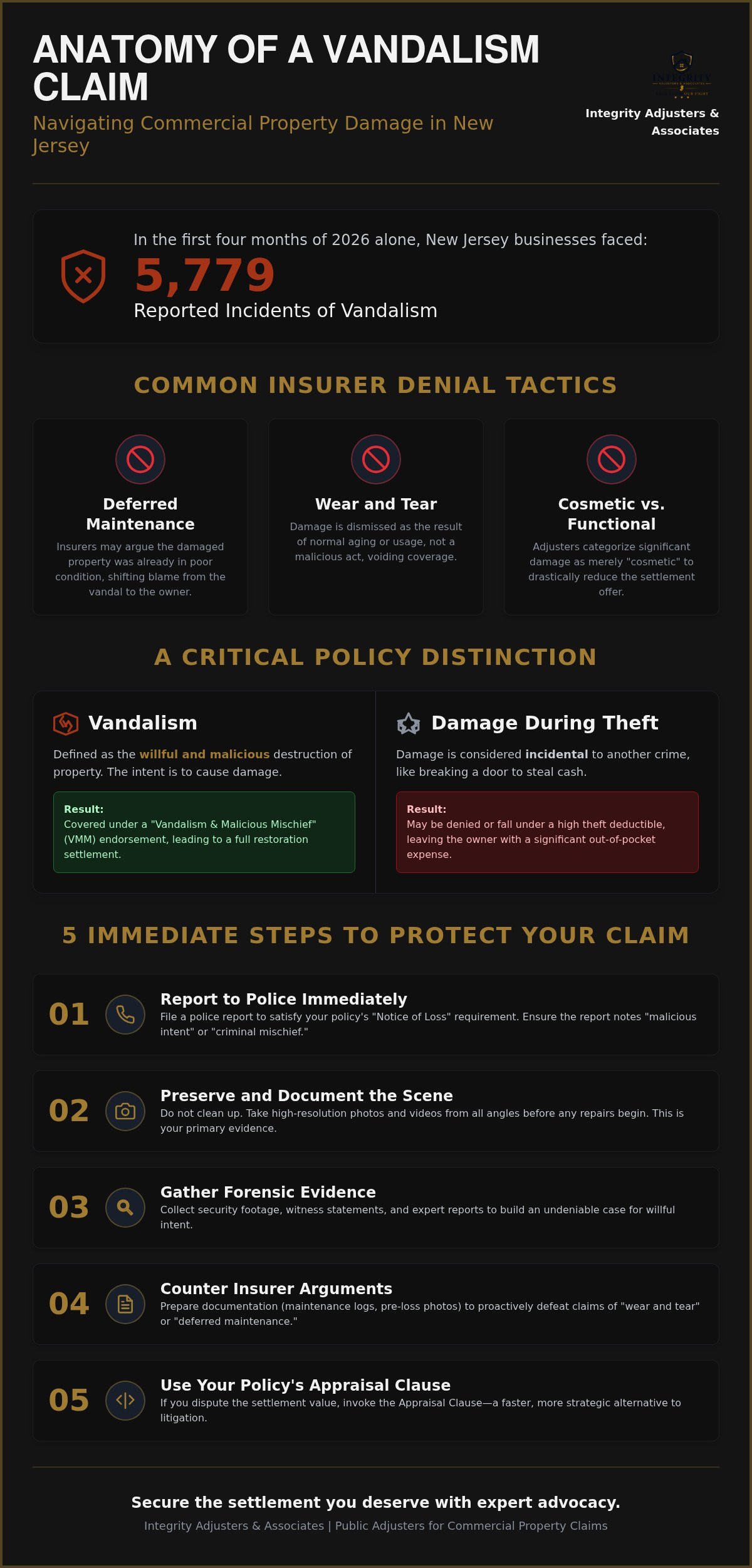
5 Immediate Steps to Protect Your Vandalism Insurance Claim
Immediate action is required to preserve your rights under a New Jersey commercial policy. Following a specific sequence ensures you meet all contractual obligations while building a robust foundation for your settlement. Seeking commercial property vandalism claim help early allows you to avoid procedural errors that insurers often use to justify denials. These first steps are not merely suggestions; they are often prerequisites for coverage.
- Report the crime: Contact your local NJ police department immediately to obtain a case number. This is the official record of the malicious act.
- Notify the insurer: Alert your agent to trigger the "Notice of Loss" requirement. Delaying this can be interpreted as a failure to cooperate with policy terms.
- Document everything: Capture high-resolution photos and videos of all damage before touching or cleaning any area.
- Perform mitigation: Execute "reasonable repairs" like boarding up windows to prevent secondary damage from weather or further intruders.
- Consult an expert: Speak with a public adjuster before the insurer's representative arrives for the first inspection to ensure your interests are protected.
If you are unsure how to proceed after a loss, request professional claim support to ensure your documentation is handled correctly from day one.
Securing the Perimeter and Mitigating Further Loss
Temporary mitigation is a mandatory policy requirement, not an optional convenience. If you leave your building open to the elements or further crime, the insurer may refuse to pay for subsequent damage. You must track and document the costs of emergency boarding, temporary fencing, or lock replacements for reimbursement. Keep every receipt. However, you must never perform permanent repairs until the carrier has inspected the damage. Premature restoration destroys evidence and can lead to a full claim denial.
Building a Comprehensive Proof of Loss Statement
The Proof of Loss is a formal legal document that itemizes every piece of damaged equipment, furniture, and inventory. It also details the total financial impact on your structure. Accuracy is paramount because this document serves as your official demand for payment. While the New Jersey statute of limitations for filing a lawsuit regarding property damage is six years, your specific policy likely mandates a much shorter window for submitting the formal Proof of Loss. Missing this internal deadline, which is often 30 to 60 days, can jeopardize your entire claim. Under New Jersey Department of Banking and Insurance standards, insurers must provide you with the necessary forms, but the responsibility to prove the extent of the loss remains yours.
Strategic Advocacy: Maximizing Your Vandalism Settlement in New Jersey
When an insurer refuses to agree on the value of your loss, you don't always have to resort to a lawsuit. Most New Jersey commercial policies include an "Appraisal Clause." This provision acts as a faster, more efficient path to settlement than traditional court proceedings. It allows both parties to hire independent appraisers who then select an umpire to resolve valuation disputes. Using this clause is a strategic move when you have professional commercial property vandalism claim help. It forces a resolution based on the actual cost of repairs rather than the insurer's internal pricing metrics.
We also address "Matching" laws for commercial exteriors. If a vandal defaces a specific section of your building and the original materials are no longer available, the insurer may be required to replace the entire surface to ensure a uniform appearance. This is especially relevant for brickwork, specialized siding, or stone facades. For shared properties, the complexity increases significantly. A condo association insurance claim adjuster is essential to navigate the overlapping responsibilities of individual unit owners and the association's master policy during a vandalism event.
Navigating Business Interruption and Soft Costs
Vandalism doesn't just damage property; it stops commerce. If your facility is unusable or requires extensive cleanup, your business interruption coverage should trigger. We help you document "extra expenses" that arise during this period. This includes the cost of temporary relocation, increased security details, or expedited shipping for replacement equipment. Calculating lost profits requires forensic accounting standards that many company adjusters ignore. We ensure your settlement covers the revenue you would've earned if the vandalism hadn't occurred, protecting your business's long-term financial health.
The Integrity Adjusters Method: From Filing to Resolution
Our method focuses on being the single point of contact for all insurance company inquiries. This prevents the carrier from catching you off guard with technical questions designed to elicit a statement they can use to lower your payout. We manage the entire timeline, from the initial filing to the final negotiation. It's critical to remember one rule: never sign a "full and final release" without a professional review. Damage discovered during the repair phase, known as a supplemental claim, can only be paid if you haven't signed away your rights. We act as your strategic ally to ensure every dollar of your loss is recovered.
Secure Your Business Restoration and Recovery
Recovering from a vandalism event requires more than just replacing broken glass. It demands a methodical approach to proving malicious intent and countering the aggressive underestimation tactics used by insurance carriers. By following strict reporting protocols and leveraging policy provisions like the Appraisal Clause, you position your business to receive a settlement that covers full restoration to pre-loss condition. Expert commercial property vandalism claim help acts as your strategic shield, ensuring the facts of your damage dictate the final payout.
You don't have to navigate this institutional complexity alone. Integrity Adjusters & Associates provides licensed New Jersey public adjusters who specialize in commercial property advocacy. We offer contingency-based representation; we only get paid if you recover your loss. Contact Integrity Adjusters & Associates for a Professional Vandalism Claim Review to bring order to the chaos of property damage. Let our team handle the carrier while you focus on returning to business as usual.
Frequently Asked Questions
Does commercial property insurance cover graffiti removal in New Jersey?
Yes, most commercial policies in New Jersey cover graffiti removal under the Vandalism and Malicious Mischief endorsement. It's important to document the defacement immediately before beginning any cleaning. Insurers often argue that graffiti is a cosmetic issue rather than a functional loss. However, professional commercial property vandalism claim help ensures that the cost of specialized chemicals or masonry restoration is included in your settlement to return the property to its pre-loss condition.
What happens if my vandalism claim is denied because the building was vacant?
If your building was vacant for more than 60 consecutive days, the insurer may invoke a vacancy clause to deny your claim. These clauses are standard in New Jersey commercial policies to manage higher risks associated with unoccupied spaces. If you're facing a denial, we review your policy to see if a vacancy permit or specific endorsements were in place. We also verify if the building met the legal definition of "vacant" under NJ standards.
How do I prove that the damage was malicious and not just accidental?
Proving malicious intent requires a detailed NJ police report that specifically cites "criminal mischief" or "malicious intent" as defined under NJSA 2C:17-3. You should also preserve security footage and witness statements that demonstrate the act was purposeful. We use this forensic evidence to counter insurer arguments that the damage resulted from wear and tear or accidental breakage. Methodical documentation is the only way to trigger the vandalism coverage within your commercial policy.
Can I file a vandalism claim if I don't know who committed the crime?
You can absolutely file a claim even if the perpetrator is never identified or caught. Your policy covers the specific peril of vandalism, not the prosecution of the criminal. In early 2026, New Jersey saw 5,779 reports of property damage, and many of these cases remain unsolved. As long as you have a police case number and forensic proof of the destruction, your insurer is contractually obligated to process the claim based on the policy terms.
Will my insurance premiums increase if I file a commercial vandalism claim?
Filing a single claim doesn't automatically trigger a premium increase, but insurance companies evaluate your business's overall risk profile during renewal. They look at the frequency of claims and the security measures you've implemented since the event. While a claim stays on your record, the cost of paying for major repairs out of pocket is usually much higher than a potential rate adjustment. We focus on securing a settlement that covers your full restoration costs.
What is the difference between a vandalism claim and a burglary claim?
Vandalism focuses on the willful destruction of property, while burglary involves unlawful entry with the intent to commit a crime, usually theft. The distinction is critical because different deductibles or exclusions may apply. If an intruder smashes a window but steals nothing, it's a vandalism claim. If they steal inventory, it's a burglary. Commercial property vandalism claim help is vital to ensure your loss is coded correctly to maximize your recovery under the proper coverage section.
How long does the insurance company have to pay my vandalism claim in NJ?
Under New Jersey Administrative Code, insurers must acknowledge your claim within 10 working days and typically provide a decision within 30 days after you submit a completed Proof of Loss. If the investigation is complex, they may request extensions. We manage all communications with the carrier to prevent unnecessary delays. Our team ensures that the insurer adheres to these state mandated timelines, pushing for a faster resolution so you can minimize business downtime.
Should I hire a public adjuster for a small vandalism claim?
Yes, because vandalism often involves hidden damage that isn't visible during a surface level walk-through. A forced entry might compromise structural integrity or damage expensive security systems. We provide specialized commercial property advocacy to identify these "invisible" costs early in the process. Since our representation is contingency based, you don't pay a fee unless we recover a settlement for you. It's a low risk way to ensure the insurance company doesn't underpay your business.


