
A restaurant fire isn't just a property claim. It's a high-stakes race against a ticking clock. The moment your refrigeration fails and your regular customers look for a new place to eat, your business is at risk. You've spent years building your reputation. You can't afford to let an insurance company's initial offer dictate your future. When disaster strikes, hiring a public adjuster for restaurant damage provides the professional advocacy you need to protect your investment. We know that a standard claim often overlooks the nuances of food service. This includes the high cost of specialized kitchen equipment and the strict requirements of New Jersey health codes.
We're here to ensure you secure a settlement that covers every ounce of spoiled inventory. We'll also account for the true impact of business interruption. This guide breaks down the methodical steps required to document your losses. It covers the 2024 Uniform Construction Code updates that affect your repair costs in 2026. You'll learn how to manage the claims process with precision. This ensures a rapid reopening that doesn't force you to cut corners on safety or quality. We provide the stability you need to move from chaos to a fully funded recovery.
Key Takeaways
- Use POS data and historical revenue trends to establish a factual baseline for your financial recovery.
- Navigate the complexities of 2026 NJ health codes and the Uniform Construction Code to ensure your repairs meet modern compliance standards.
- Partner with a public adjuster for restaurant damage to uncover hidden sub-limits for specialized kitchen equipment and perishable inventory.
- Calculate the true Period of Restoration to secure a business interruption payout that reflects your actual time to reach full operational capacity.
- Implement a methodical advocacy strategy that acts as a protective buffer between your restaurant and the insurance company's interests.
Why Restaurant Insurance Claims Require Specialized Advocacy
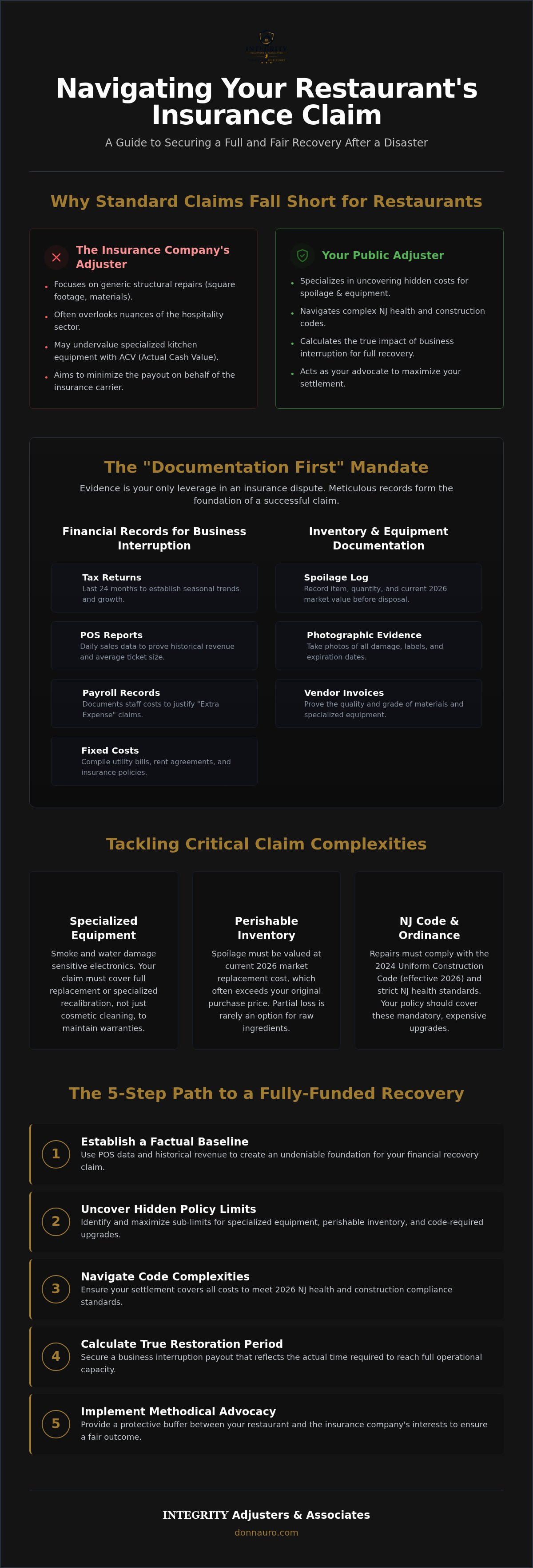
Restaurant property damage involves more than structural repairs. It's an operational crisis where every hour of closure compounds your financial loss. Standard commercial adjusters often view claims through a generic lens, focusing on square footage and building materials. This approach misses the nuances of the hospitality sector. A Public adjuster specializes in identifying these gaps, ensuring that sub-limits for things like spoilage or specialized ventilation don't leave you underfunded.
In New Jersey, the stakes are higher due to strict health department standards. If smoke or water penetrates your kitchen, you aren't just cleaning surfaces. You're facing a rigorous inspection process. Local officials may require total inventory disposal or expensive upgrades to meet the 2024 Uniform Construction Code, which New Jersey adopted in August 2026. Integrity Adjusters acts as a protective shield during these negotiations. We ensure your insurer pays for the full scope of work required by law, not just the minimum needed to make the building look functional.
The Perils of Perishable Inventory and Spoilage
Calculating the cost of lost stock is a detailed process. You must account for current 2026 market replacement costs, which often exceed your original wholesale purchase price. Health safety is an all or nothing requirement. If a power outage or fire affects your storage, partial loss is rarely an option for raw ingredients. Spoilage coverage typically provides reimbursement for the loss of perishable stock caused by power outages, mechanical breakdown, or contamination. Without precise documentation, carriers may attempt to minimize these payouts by questioning the inventory's shelf life or storage conditions.
Specialized Commercial Kitchen Equipment Valuation
Modern kitchens rely on high-end technology that requires more than a simple wipe-down after a loss. Smoke particles can corrode sensitive electronics in combi-ovens or digital POS systems. A public adjuster for restaurant damage understands that these items often require specialized recalibration or total replacement to maintain manufacturer warranties. If your policy uses Actual Cash Value (ACV), you might only receive a fraction of what a new unit costs. This gap can stall your reopening. For more details on navigating these financial hurdles, seek commercial property insurance claim help to ensure your equipment is valued accurately.
Essential Documentation Resource for Restaurant Claims
Evidence is your only leverage in an insurance dispute. Without meticulous records, your claim is merely an opinion. The insurance company relies on data to minimize payouts. You must fight back with facts. This "Documentation First" mandate requires you to act quickly. A public adjuster for restaurant damage helps organize this evidence into a professional proof of loss. This package includes everything from Point of Sale (POS) exports to detailed disposal logs for spoiled inventory.
Don't dispose of anything until it's recorded. Maintain a spoilage log that includes the item name, quantity, and current 2026 market value. Take photos of labels and expiration dates before items go into the dumpster. For custom fit-outs and specialized equipment, locate your original vendor invoices. These documents prove the quality and grade of your materials. This becomes vital when negotiating Ordinance or Law Coverage, as it helps establish the baseline for required code upgrades under the 2024 Uniform Construction Code. If you're feeling overwhelmed by the paperwork, securing professional claim support can provide the clarity you need to stay organized.
Financial Records for Business Interruption
Proving lost revenue requires a clear financial history. Gather the following documents immediately to establish your baseline:
- Tax Returns: Provide the last 24 months of filings to show seasonal trends and growth.
- POS Reports: Export daily sales data to demonstrate your historical revenue trajectory and average ticket size.
- Payroll Records: Document active staff costs to justify "Extra Expense" claims for keeping key employees during the closure.
- Fixed Costs: Compile utility bills, rent agreements, and insurance premiums that continue despite the shutdown.
Evidence of Physical Damage
Visual proof is undeniable. Use a high-resolution camera to capture every angle of the kitchen and dining area. Focus on the soot behind heavy appliances and water damage inside cabinetry. Don't forget the mechanical systems. Locate equipment serial numbers and maintenance logs. These records prove your gear was in good working order before the loss occurred. Independent property damage assessment reports add another layer of factual integrity. They provide a technical counter-argument to the insurer's internal findings. This methodical approach ensures no detail is overlooked during the restoration process.
Calculating Business Interruption and Extra Expense Claims
Business interruption isn't just a line item; it's the lifeline of your restaurant. The "Period of Restoration" is the critical timeframe between the loss and the moment your business returns to pre-disaster operational levels. In the food service industry, this period doesn't end when the contractor leaves. It ends when you pass your final health inspection and your staff is back in the kitchen. For a deeper look at these specific mechanics, consult our business interruption insurance claim guide.
In New Jersey, timing is everything. A loss during the summer tourism peak at the Shore or during the holiday season in North Jersey represents a massive revenue hit that standard calculations might overlook. We analyze your historical POS data to capture these seasonal surges accurately. We also leverage "Extra Expense" coverage. This pays for temporary solutions like mobile kitchen rentals or shifting to a catering-only model to maintain your revenue stream. These strategic pivots keep your brand active while repairs continue.
Hospitality Revenue Metrics That Matter
We don't just look at total sales. We analyze specific hospitality metrics to build a bulletproof claim. This includes "covers" per night and average check values. If you lost high-value catering contracts or pre-booked private holiday events, these must be documented as specific losses. We also advocate for "Extended Business Income" endorsements. This coverage bridges the gap between the day you reopen and the day your foot traffic actually returns to pre-loss levels. It's a vital buffer for the slow ramp-up period.
Mitigating the Loss of Customer Base
Time is your greatest enemy in the hospitality world. Industry patterns show a "forgetting curve" for diners; if you're closed for more than 30 days, your regulars start forming new habits at competing establishments. A public adjuster for restaurant damage acts as an accelerator for your recovery. We manage the insurance carrier's adjusters and documentation requirements to shorten your closure time. We also ensure your claim includes marketing expenses for your reopening campaign. This financial support helps you reclaim your market share and announce your return to the community. Our role is to act as your shield, ensuring the insurance company doesn't stall your recovery while your customer base drifts away.
Navigating NJ Health Codes and Ordinance Coverage
New Jersey restaurant owners face a complex regulatory hurdle after property damage. If your building dates back several decades, a standard repair won't suffice. "Law and Ordinance" coverage is essential for navigating these requirements. On August 17, 2026, New Jersey officially adopted the 2024 Uniform Construction Code. This means any significant renovation triggered by a claim must meet these new, stricter standards for electrical, plumbing, and energy efficiency. Without the right advocacy, you might be forced to pay for these mandatory upgrades out of pocket.
Carriers often argue for cleaning soot-damaged walls or equipment to save costs. However, in a dining environment, porous surfaces like drywall, ceiling tiles, and upholstery trap odors and microscopic contaminants. A public adjuster for restaurant damage understands that "clean" by insurance standards is not the same as "sanitary" by health department standards. We advocate for full replacement when cleaning cannot guarantee a bacteria-free environment. Integrity Adjusters ensures that your settlement reflects the true cost of returning to a code-compliant state.
Smoke, Soot, and Odor Remediation
Surface cleaning doesn't address the internal components of your HVAC system. If smoke has circulated through the vents, your food safety is compromised. Odors trapped in dining room fabrics can lead to permanent customer churn. It's vital to document how these "invisible" damages impact your ability to serve the public safely. For businesses facing secondary issues like broken windows or graffiti after an incident, our guide on commercial property vandalism claim help offers additional documentation strategies for multi-faceted losses.
Health Department Advocacy
The local health inspector is often your strongest ally in a claim. If an official report states that a kitchen area is non-compliant due to fire residue, the insurance company cannot legally force you to reopen in that state. We use these municipal reports as factual evidence for total loss claims on equipment and surfaces. NJ building codes and insurance settlements interact directly because your policy must fund the specific upgrades required by the state to issue a new Certificate of Occupancy. This prevents you from being caught between a low-ball insurance check and a mandatory health department requirement.
Don't let an adjuster's "cleaning" estimate delay your reopening or risk your license. Contact us for a professional claim review to ensure your repairs meet every New Jersey safety standard.
How Integrity Adjusters Secures Your Restaurant’s Future
Recovery is not a matter of luck. It is the result of a disciplined, methodical strategy. We utilize a proven 3-step process to move your claim from initial loss to a successful settlement. First, we Document every detail of the physical and financial damage. Second, we Build a technical claim package that speaks the language of insurance adjusters. Finally, we Advocate on your behalf during high-stakes negotiations. This structured approach brings order to the chaos of property loss.
Our local New Jersey expertise is your greatest asset. We understand the specific economic pressures of the 2026 hospitality market. We know the municipal requirements that vary from the Jersey Shore to the urban centers of North Jersey. A public adjuster for restaurant damage acts as your strategic navigator. We ensure the insurance company respects the complexity of your operation. We don't just ask for a settlement. We prove what you are owed based on factual integrity and industry standards.
The Buffer: Professional Representation
The insurance company's adjuster works for the carrier, not for you. Every statement you make during the claims process can impact your final payout. We act as a protective shield by handling all communication with the insurer. We attend every onsite inspection to ensure no damage is overlooked or minimized. This level of representation is vital for standalone eateries and complex commercial spaces alike. For those managing mixed-use properties, seeing how we assist as a public adjuster for office building damage provides perspective on our broad commercial property claim support.
The Settlement: Advocacy Based on Evidence
We negotiate from a position of technical authority. We present a comprehensive claim package that includes the inventory logs, POS data, and code-compliance requirements discussed in previous sections. This evidence-based approach makes it difficult for carriers to issue low-ball offers or arbitrary denials. We focus on the true cost of reopening, which includes everything from recalibrating specialized kitchen tech to funding the marketing needed to win back your diners. Our goal is to secure the resources you need to restore your brand's reputation and financial stability.
Your restaurant is more than a building. It's your livelihood and a pillar of your community. Don't leave your recovery to chance or the insurer's goodwill. Professional advocacy ensures that your interests are prioritized at every stage of the process. Contact Integrity Adjusters today to secure the methodical representation your business deserves.
Restore Your Restaurant with Factual Integrity
A restaurant claim is a race against time and regulatory complexity. Success depends on more than just repairing walls. It requires a deep understanding of spoilage logs, POS data, and the 2024 Uniform Construction Code requirements that New Jersey adopted in 2026. By hiring a public adjuster for restaurant damage, you ensure that every financial loss is documented and defended. We act as your buffer against the insurance company's interests, focusing on a settlement that reflects the true cost of reopening. This includes everything from specialized kitchen tech recalibration to the business income lost during your closure.
Our approach is built on meticulous documentation and evidence-based negotiation. We specialize in commercial business property claim support, providing the stability you need during an operational crisis. You don't have to navigate this institutional system alone. With licensed NJ public adjuster advocacy, you can focus on your staff and customers while we handle the technical recovery. Secure your restaurant’s recovery with Integrity Adjusters & Associates today. It's time to move from the chaos of property loss to a methodical, fully funded reopening that protects your livelihood and your brand's future.
Frequently Asked Questions
Does restaurant insurance cover food spoilage after a power outage?
Yes, food spoilage is typically covered if your policy includes a specific spoilage endorsement. This coverage applies to losses caused by power outages, mechanical breakdowns, or contamination. You must provide a detailed inventory log and photos of the spoiled stock. A public adjuster for restaurant damage ensures that the valuation reflects 2026 replacement costs rather than just original wholesale prices. Documentation is essential to prove the loss occurred during the covered period.
Can a public adjuster help with a denied business interruption claim?
Yes, a public adjuster can assist in disputing a denied business interruption claim. We review your policy language to identify coverage triggers the insurer may have overlooked. By analyzing your POS data and historical revenue trends, we build a fact-based argument for the payout you deserve. Our role is to act as a buffer and provide the technical evidence required to reverse a denial and secure your financial recovery.
How long does a restaurant insurance claim typically take in New Jersey?
The duration of a restaurant claim in New Jersey depends on the damage complexity and the insurer's responsiveness. Minor claims might resolve in a few weeks; however, major fires involving structural repairs and health code inspections can take several months. Using a methodical documentation process helps expedite the timeline. We manage the insurer's requests to prevent unnecessary delays, ensuring you move through the Period of Restoration as efficiently as possible.
What is the cost of hiring a public adjuster for a restaurant claim?
Public adjusters typically work on a contingency fee basis. This means we only receive payment if we successfully secure a settlement for your claim. The fee is a percentage of the final recovery amount paid by your insurance company. This structure aligns our interests with yours, as we strive to maximize your payout. You don't pay any upfront costs for our advocacy and documentation services during the claims process.
Will my insurance company cancel my policy if I hire a public adjuster?
No, your insurance company cannot legally cancel your policy simply because you hired a public adjuster. You have a right to professional representation during the claims process. Hiring a public adjuster for restaurant damage is a standard business practice that ensures your interests are protected. It signals to the carrier that you're serious about a fair settlement. We maintain a professional relationship with the insurer's representatives to keep the process moving forward.
Does insurance cover the cost of health code upgrades after a fire?
Coverage for health code upgrades depends on whether your policy includes Ordinance or Law provisions. This is critical in New Jersey following the 2026 adoption of the 2024 Uniform Construction Code. If local inspectors require upgrades to electrical or ventilation systems after a fire, this coverage helps pay those costs. We advocate for these expenses by using official health department reports to prove that the upgrades are mandatory for your reopening.
Can I reopen my restaurant while the insurance claim is still pending?
You can often reopen your restaurant while a claim is pending, provided you've fully documented the damage. It's vital to consult with your adjuster before starting repairs or discarding evidence. We help you coordinate with restoration teams to ensure that Extra Expense coverage is applied to any temporary measures you take. This allows you to serve customers and maintain your revenue stream without compromising the integrity of your insurance claim.
What is the difference between a company adjuster and a public adjuster?
The primary difference lies in whose interests the adjuster represents. A company adjuster is an employee of the insurance provider and works to protect the carrier's bottom line. A public adjuster is hired exclusively by you, the policyholder. We act as your strategic ally and shield. Our goal is to document every detail of your loss and negotiate the highest possible settlement based on the specific facts of your policy and loss.


